Last Updated on June 16, 2026
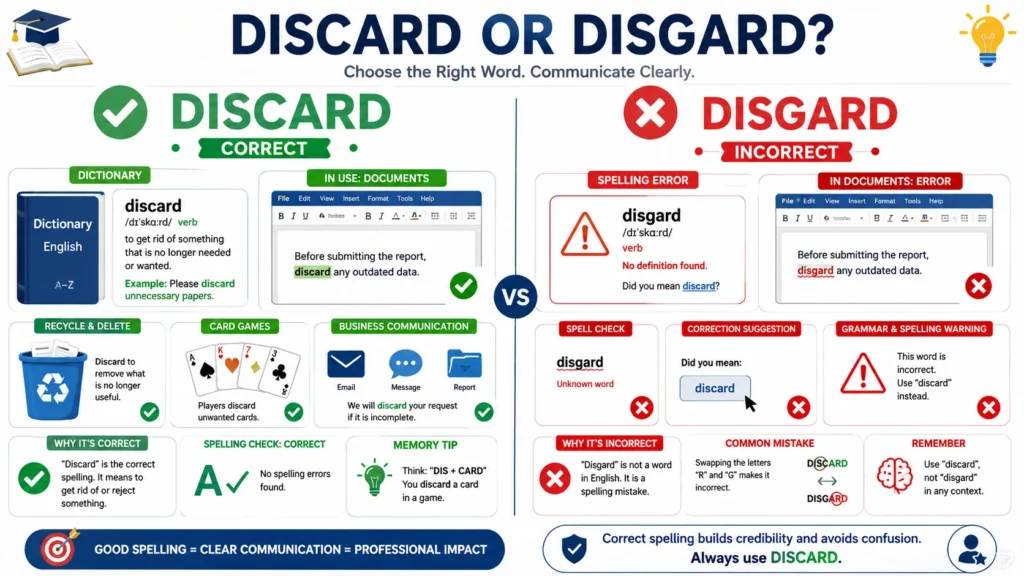
Discard is the correct English word that means to throw away, reject, or get rid of something. Disgard is a common misspelling and is not recognized as a standard English word. If you are unsure whether to use discard or disgard, always choose discard.
Many English words can be confusing. Some words sound similar, while others are often misspelled because of pronunciation habits. One common example is discard or disgard.
People frequently type disgard in emails, essays, text messages, and online searches. This happens because the pronunciation of discard can make some learners think the word contains a “g” sound. However, only one spelling is correct in standard English.
Understanding the difference between discard and disgard is important for students, professionals, writers, and anyone learning English. Using the wrong spelling can make writing look less professional and may even affect grades, job applications, or business communication.
This guide explains everything you need to know about discard or disgard. You will learn the correct spelling, meaning, usage, examples, common mistakes, grammar rules, exercises, and practical tips to remember the difference. By the end, you will be confident about using the word correctly in any situation.
Quick Answer
| Word | Correct? | Meaning |
|---|---|---|
| Discard | Yes | To throw away, reject, or remove something |
| Disgard | No | Incorrect spelling of discard |
Short Rule
❌ Disgard = Incorrect spelling
Whenever you are choosing between discard or disgard, use discard.
What Does Discard Mean?
The word discard is a verb and sometimes a noun.
As a verb, it means:
- To throw away something no longer needed
- To reject an idea
- To remove unwanted items
- To get rid of something
Simple Definition
Discard = To throw away or stop using something.
Examples
- Please discard the old documents.
- She discarded the broken toy.
- The company discarded outdated equipment.
- He discarded the idea after hearing feedback.
In each example, something is being removed, rejected, or thrown away.
What Does Disgard Mean?
The word disgard is not a standard English word.
Major dictionaries do not recognize it as a correct spelling.
Examples include:
- ❌ Please disgard this file.
- ❌ The teacher told us to disgard the worksheet.
Correct versions:
- ✅ Please discard this file.
- ✅ The teacher told us to discard the worksheet.
When people write disgard, they usually mean discard.
Why Do People Confuse Discard and Disgard?
Several reasons explain why this spelling mistake is common.
Pronunciation Confusion
Some English learners hear the word quickly and assume there is a “g” sound.
For example:
- discard
- disregard
- guard
- garden
Because many English words contain “g,” writers sometimes accidentally replace the “c” with a “g.”
Typing Errors
Fast typing often leads to spelling mistakes.
For example:
- discard → disgard
One wrong letter changes the word completely.
Similar Looking Words
English contains words like:
- disregard
- guard
- guardian
- guarded
These words may influence spelling memory and cause confusion.
Origin of the Word Discard
Learning the history of a word often helps people remember it.
The word discard comes from card games.
Historically, it meant:
“To throw away a card that is no longer useful.”
Over time, the meaning expanded to include:
- Throwing away objects
- Rejecting ideas
- Eliminating unwanted items
Today, the word is used in many contexts beyond games.
How to Use Discard Correctly
As a Verb
This is the most common use.
Examples
- Discard old batteries properly.
- The editor discarded unnecessary paragraphs.
- She discarded the packaging after opening the gift.
- We discarded outdated procedures.
As a Noun
Sometimes discard is used as a noun.
Examples
- The card became a discard.
- Place all discards in the bin.
This usage is less common than the verb form.
Discard in Everyday Life
The word appears in many situations.
At Home
- Discard expired food.
- Discard broken furniture.
- Discard old magazines.
At School
- Discard incorrect answers.
- Discard rough drafts.
- Discard unnecessary notes.
At Work
- Discard duplicate files.
- Discard outdated reports.
- Discard damaged inventory.
In Technology
- Discard temporary files.
- Discard deleted emails.
- Discard unsaved changes.
Discard vs Similar Words
Many words have meanings close to discard.
Discard vs Throw Away
| Discard | Throw Away |
|---|---|
| More formal | More casual |
| Common in professional writing | Common in everyday speech |
| Often used in business and technology | Often used in conversation |
Examples
- Please discard the document.
- Please throw away the document.
Both are correct.
Discard vs Delete
| Discard | Delete |
|---|---|
| Can apply to physical or digital items | Usually digital |
| Means reject or remove | Means erase data |
Example
- Discard the draft.
- Delete the file.
Discard vs Remove
| Discard | Remove |
|---|---|
| Means get rid of permanently | Means take away |
| Usually final action | Not always permanent |
Example
- Discard the damaged item.
- Remove the item from the shelf.
Discard vs Disregard
This is another common confusion.
| Discard | Disregard |
|---|---|
| Throw away or reject | Ignore |
| Physical or abstract object | Information, advice, warnings |
Examples
- Discard the broken phone.
- Disregard the previous email.
Advantages and Disadvantages of Using the Word Discard
Advantages
Clear Meaning
The word clearly communicates removal or rejection.
Professional Tone
It sounds appropriate in business and academic writing.
Widely Understood
Most English speakers understand it immediately.
Useful in Many Fields
Used in:
- Technology
- Education
- Healthcare
- Manufacturing
- Business
Disadvantages
Can Sound Formal
In casual conversation, “throw away” may feel more natural.
Sometimes Too Broad
Without context, readers may not know exactly what is being discarded.
Example:
- Discard it.
The word “it” may need clarification.
Real World Examples of Discard
Healthcare
Doctors and nurses often discard used medical supplies.
Example:
- Used gloves must be discarded safely.
Manufacturing
Factories discard defective products.
Example:
- The company discarded damaged items before shipping.
Technology
Software often asks users:
- Discard changes?
- Save changes?
- Cancel?
This means unsaved edits will be removed.
Environmental Management
Recycling programs focus on reducing discarded waste.
Example:
- Properly discard electronic devices.
Card Games
The original use remains common.
Example:
- Players discard cards they no longer need.
Regional and Global Usage
The word discard is recognized worldwide.
It is commonly used in:
- United States English
- British English
- Canadian English
- Australian English
- New Zealand English
The spelling remains the same everywhere.
Global Rule
✅ discard
❌ disgard
Unlike some English words that have regional spellings, this word does not change.
Common Mistakes When Using Discard
Writing Disgard
Incorrect
- Please disgard this message.
Correct
- Please discard this message.
Confusing Discard with Disregard
Incorrect
- Discard my previous instructions.
This may mean throw them away.
Better
- Disregard my previous instructions.
This means ignore them.
Wrong Verb Tense
Incorrect
- She discard the file yesterday.
Correct
- She discarded the file yesterday.
Missing Context
Weak
- Discard it.
Better
- Discard the damaged package.
Memory Tricks to Remember the Correct Spelling
Think of “Card”
Notice that discard contains the word card.
Dis + card = discard
Since the word originally came from card games, this trick helps many learners remember the spelling.
Remember There Is No G
A simple rule:
Discard contains C.
Disgard contains G.
The version with G is wrong.
Visual Reminder
Imagine throwing away a card.
Discard = dis + card
This visual connection makes the spelling easier to remember.
Grammar Rules for Discard
Present Tense
- I discard
- You discard
- We discard
- They discard
Example:
- We discard unnecessary paperwork.
Past Tense
- Discarded
Example:
- They discarded the old files.
Present Participle
- Discarding
Example:
- She is discarding outdated records.
Past Participle
- Discarded
Example:
- The damaged items have been discarded.
Common Sentences Using Discard
Business
- Discard duplicate entries before submitting the report.
School
- Discard incorrect answers and try again.
Home
- Discard spoiled food immediately.
Technology
- Click “Discard” to remove unsaved changes.
Healthcare
- Discard used medical supplies safely.
Exercises With Answers
Exercise 1: Choose the Correct Word
- Please _____ this damaged box.
- The software asked me to _____ changes.
- She _____ the old newspaper.
- Do not _____ important documents.
Answers
- discard
- discard
- discarded
- discard
Exercise 2: Correct the Mistake
Sentences
- Please disgard the broken item.
- We disgarded the old report.
- The file was disgarded.
Answers
- Please discard the broken item.
- We discarded the old report.
- The file was discarded.
Exercise 3: Fill in the Blank
- The teacher told students to _____ rough drafts.
- We _____ expired products yesterday.
- The nurse _____ used gloves safely.
- Should I save or _____ these changes?
Answers
- discard
- discarded
- discarded
- discard
Advanced Understanding of Discard
At an advanced level, discard does not always refer to physical objects.
It can also refer to ideas, theories, assumptions, and strategies.
Examples
- Scientists discarded an outdated theory.
- The company discarded its previous marketing plan.
- Researchers discarded unreliable data.
Here, nothing physical is thrown away. Instead, something is rejected or removed from consideration.
Related Concepts and Comparisons
Reject
Reject means refuse to accept.
Example:
- The manager rejected the proposal.
Eliminate
Eliminate means remove completely.
Example:
- The company eliminated unnecessary expenses.
Abandon
Abandon means leave behind.
Example:
- They abandoned the project.
Dispose
Dispose often refers to proper waste removal.
Example:
- Dispose of batteries responsibly.
Scrap
Scrap means discard something because it is no longer useful.
Example:
- The factory scrapped the defective parts.
FAQs
Is discard or disgard correct?
Discard is correct. Disgard is a misspelling and should not be used in formal or informal writing.
What does discard mean?
Discard means to throw away, reject, remove, or stop using something.
Is disgard a real word?
No. Disgard is not recognized as a standard English word.
Why do people write disgard instead of discard?
People often confuse the spelling because of pronunciation, typing mistakes, or similarity to words like “disregard.”
How do I remember discard or disgard?
Remember that discard contains the word “card.” Think of throwing away a card in a card game.
Can discard be used in business writing?
Yes. Discard is common in professional documents, reports, emails, and workplace communication.
What is the past tense of discard?
The past tense is discarded.
Example: The company discarded outdated records.
What is the difference between discard and disregard?
Discard means throw away or reject. Disregard means ignore.
Example:
- Discard the broken file.
- Disregard the previous message.
Can I use discard for ideas and opinions?
Yes. You can discard plans, theories, assumptions, opinions, or strategies.
Is discard used in software and technology?
Yes. Many applications use “Discard Changes” to remove unsaved edits.
Which spelling should English learners use: discard or disgard?
English learners should always use discard. The spelling disgard is incorrect.
Conclusion
The answer to the question discard or disgard is simple: discard is the only correct spelling. It means to throw away, reject, remove, or stop using something. The spelling disgard is a common mistake and should be avoided in all forms of writing.
Understanding this difference helps improve spelling accuracy, professional communication, and overall confidence in English. The word discard is widely used in everyday life, business, education, technology, healthcare, and many other fields. It can refer to physical objects, digital files, ideas, theories, or plans.
A useful memory trick is to remember that discard contains the word “card.” Since the word originally came from card games, this connection makes the spelling easier to remember. Whenever you see the choice between discard or disgard, choose discard.
For best results, practice using the word in sentences, complete spelling exercises, and watch for common mistakes such as confusing discard with disregard. Consistent use will make the correct spelling become second nature.

Justin Powell is a writer at GramBrix.com who focuses on grammar, clarity and effective communication, helping readers strengthen their language skills.