Last Updated on July 9, 2026
Double or nothing is a popular phrase that means risking everything you have already won for a chance to win twice as much. It is commonly used in gambling, sports, business, negotiations, and everyday conversations to describe a high risk, high reward situation. Understanding the meaning, origins, and practical uses of “double or nothing” helps you use the phrase correctly and avoid common misunderstandings.
The phrase double or nothing is one of the most recognizable expressions in the English language. You may hear it in casinos, sports competitions, friendly bets, business discussions, movies, and everyday conversations.
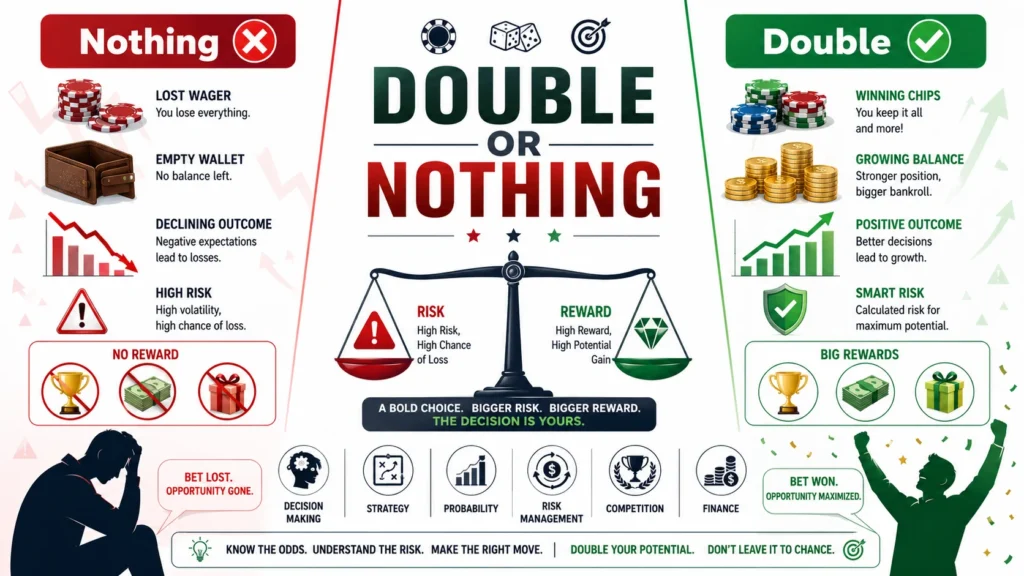
At its core, double or nothing means taking a risk. A person who has already won something agrees to gamble that win for a chance to double the reward. If they succeed, they receive twice as much. If they fail, they lose everything they had won.
The phrase has become much more than a gambling term. Today, people use it to describe any situation where someone risks a current advantage in hopes of achieving a bigger reward.
Many learners wonder whether double or nothing is always related to gambling, whether it can be used in professional settings, and how it differs from similar expressions such as “all or nothing” or “high risk, high reward.”
This guide explains everything you need to know about double or nothing, including its meaning, history, advantages, disadvantages, real world examples, common mistakes, and practical exercises.
Quick Answer
Double or nothing means risking an existing gain for the opportunity to receive twice as much.
Simple Formula
| Outcome | Result |
|---|---|
| Win | Reward doubles |
| Lose | Original reward is lost |
Example
Sarah wins $50 in a bet.
Her friend says, “Double or nothing?”
If Sarah accepts:
- Winning gives her $100.
- Losing leaves her with $0.
This simple concept forms the basis of the phrase.
What Does Double or Nothing Mean?
Double or nothing is an expression that describes a wager in which the winner of a previous bet risks their winnings in an attempt to gain twice the amount.
The phrase contains two possible outcomes:
- Double the reward
- Lose everything
There is no middle ground.
Because of this, double or nothing often symbolizes bold decision making and risk taking.
Basic Definition
Double or nothing means risking current winnings for the chance to win twice as much, while accepting the possibility of losing everything.
The Origin of Double or Nothing
The phrase originated in gambling circles.
Players who won a bet would often be offered another wager. Instead of collecting their winnings, they could place those winnings at risk again.
The new bet offered two outcomes:
- Double the money
- Lose the money already won
Over time, the phrase spread beyond gambling.
Today, people use it in:
- Sports
- Business
- Sales
- Investments
- Negotiations
- Everyday conversation
How Double or Nothing Works
The concept is simple.
Step One
You win something.
Example:
- Money
- Points
- Rewards
- Recognition
Step Two
You are offered another challenge.
Step Three
You risk what you already have.
Step Four
One of two outcomes occurs.
| Result | Outcome |
|---|---|
| Success | Reward doubles |
| Failure | Everything is lost |
Example
John wins $20.
He agrees to a double or nothing challenge.
| Scenario | Final Amount |
|---|---|
| Wins Again | $40 |
| Loses | $0 |
Double or Nothing in Gambling
The phrase is most closely associated with gambling.
Casino Games
Players often use double or nothing after winning:
- Poker
- Blackjack
- Sports betting
- Dice games
Example
A blackjack player wins $100.
Instead of cashing out, they place a double or nothing bet.
Possible outcomes:
- $200 total
- $0 total
This makes the phrase a classic gambling expression.
Double or Nothing in Everyday Conversation
People frequently use double or nothing casually.
Examples
“I beat you in the first game. Double or nothing?”
“You owe me lunch. Double or nothing on tomorrow’s match.”
“We finished the project early. Double or nothing that we finish the next one ahead of schedule too.”
In these cases, the phrase is often playful rather than literal.
Double or Nothing in Sports
Athletes and fans regularly use the phrase.
Friendly Competition
A tennis player wins the first match.
Their opponent says:
“Double or nothing on the rematch.”
Team Sports
Friends may use the phrase when making predictions about:
- Football
- Cricket
- Basketball
- Baseball
- Soccer
The idea remains the same.
Risk a previous result for a chance to increase the reward.
Double or Nothing in Business
Business professionals sometimes use double or nothing figuratively.
Sales Targets
A manager may say:
“If we hit this target, let’s go double or nothing next quarter.”
Investments
Investors occasionally describe aggressive strategies as double or nothing approaches.
Startups
Entrepreneurs often face situations where they must:
- Protect current profits
- Risk profits for greater growth
This can resemble a double or nothing decision.
Double or Nothing in Personal Life
The phrase appears in many everyday situations.
Education
“I got an A on the last test. Double or nothing on the final exam.”
Fitness
“I completed ten pushups yesterday. Double or nothing, I’ll do twenty today.”
Family Challenges
Parents and children sometimes use it during games and competitions.
Advantages of a Double or Nothing Approach
Although risky, this approach has benefits.
Potential for Larger Rewards
The biggest advantage is obvious.
You can double your gain.
Motivation
The challenge often increases focus and effort.
Excitement
People enjoy the thrill of competition.
Confidence Building
Winning a double or nothing challenge can boost confidence.
Advantages Table
| Advantage | Explanation |
|---|---|
| Higher Reward | Opportunity to double gains |
| Motivation | Encourages effort |
| Excitement | Creates engagement |
| Confidence | Success can build self belief |
| Challenge | Makes activities more interesting |
Disadvantages of a Double or Nothing Approach
The risks can be significant.
Total Loss
The biggest disadvantage is losing everything.
Emotional Decisions
People sometimes accept double or nothing bets without thinking carefully.
Increased Pressure
The stakes become higher.
Poor Risk Management
Repeated double or nothing decisions can lead to major losses.
Disadvantages Table
| Disadvantage | Explanation |
|---|---|
| Total Loss | Previous winnings disappear |
| Stress | Greater pressure |
| Emotional Choices | Decisions may be impulsive |
| Financial Risk | Can create serious losses |
| Unpredictability | Results are uncertain |
Real World Examples of Double or Nothing
Example One: Friendly Bet
Alex wins $10 from Ben.
Ben says:
“Double or nothing.”
If Alex accepts:
- Win = $20
- Lose = $0
Example Two: Sales Competition
A salesperson exceeds their target by 10%.
Management offers a larger incentive for reaching an even higher target.
The salesperson essentially chooses a double or nothing challenge.
Example Three: Sports Prediction
A friend wins a cricket prediction contest.
The other friend proposes:
“Double or nothing for next week’s match.”
Example Four: Video Games
Players often challenge each other:
“Double or nothing on the next round.”
Double or Nothing vs All or Nothing
Many people confuse these expressions.
Comparison Table
| Feature | Double or Nothing | All or Nothing |
|---|---|---|
| Existing Gain Required | Yes | No |
| Reward Can Double | Yes | Not Always |
| Risk Level | High | Very High |
| Common Use | Bets and challenges | Major decisions |
| Outcome Options | Double or lose | Complete success or failure |
Example
Double or Nothing:
You risk $100 winnings to win $200.
All or Nothing:
You invest everything in one project.
The meanings are related but not identical.
Double or Nothing vs High Risk, High Reward
These phrases overlap but are not the same.
| Double or Nothing | High Risk, High Reward |
|---|---|
| Specific wager structure | General concept |
| Two outcomes | Many possible outcomes |
| Existing gain involved | May not involve previous gain |
| Often used casually | Common in business and finance |
Regional and Global Usage
The phrase is widely understood in English speaking countries.
United States
Frequently used in:
- Gambling
- Sports
- Business
United Kingdom
Common in casual conversation and betting culture.
Canada
Used in both sports and everyday speech.
Australia
Popular in competitive and social settings.
Other Countries
English learners around the world encounter the phrase through:
- Movies
- Television
- Online gaming
- Sports broadcasts
Common Situations Where Double or Nothing Is Used
Competitions
- Chess
- Video games
- Sports
Gambling
- Poker
- Blackjack
- Betting
Workplace Challenges
- Sales contests
- Performance goals
Personal Goals
- Fitness targets
- Study plans
Entertainment
- Movies
- TV shows
- Game shows
Psychology Behind Double or Nothing
Why do people accept double or nothing offers?
Several psychological factors play a role.
Desire for Bigger Rewards
Humans naturally seek larger gains.
Competitive Spirit
People enjoy proving themselves.
Confidence Bias
Many believe they are more likely to win than statistics suggest.
Fear of Missing Out
People dislike watching opportunities pass by.
Thrill Seeking
The excitement itself can be rewarding.
Common Mistakes When Using Double or Nothing
Thinking It Means “Twice the Effort”
Incorrect:
Double or nothing means working twice as hard.
Correct:
It refers to risking an existing gain.
Assuming It Always Involves Money
Incorrect:
“It only applies to gambling.”
Correct:
It can be used metaphorically.
Confusing It With All or Nothing
These expressions have different meanings.
Using It Without Previous Winnings
Traditional double or nothing requires a previous gain or win.
Correct and Incorrect Usage Examples
| Incorrect | Correct |
|---|---|
| Let’s start double or nothing. | We already won once. Double or nothing? |
| Double or nothing means guaranteed profit. | Double or nothing involves risk. |
| It only applies to casinos. | It can be used figuratively. |
| Double or nothing always involves cash. | It can involve any reward. |
Double or Nothing in Popular Culture
Movies, television shows, and books often use the phrase.
It appears when:
- Characters make bets
- Rivals seek rematches
- Gamblers chase larger winnings
- Competitors raise the stakes
The phrase instantly communicates risk and excitement to audiences.
Strategic Thinking and Double or Nothing
Before accepting a double or nothing challenge, consider:
Risk
What could you lose?
Reward
What could you gain?
Probability
How likely are you to succeed?
Alternatives
Are there safer options?
Decision Checklist
Ask yourself:
- Is the reward worth the risk?
- Can I afford to lose?
- Am I acting emotionally?
- What are the odds?
When Double or Nothing Makes Sense
Sometimes the strategy is reasonable.
Situations
- Low stakes games
- Friendly competitions
- Educational challenges
- Personal motivation exercises
Example
You win a board game and agree to a rematch.
The consequences are small, making the risk manageable.
When Double or Nothing Does Not Make Sense
Avoid it when:
- The stakes are too high
- The loss would be harmful
- The decision is emotional
- The odds are poor
Example
Risking essential savings in a speculative investment would be dangerous.
Examples in Sentences
Casual Usage
“Double or nothing on the next round.”
Workplace Usage
“Our team met the goal. Let’s go double or nothing next quarter.”
Sports Usage
“We won today’s match. Double or nothing tomorrow.”
Academic Usage
“I scored well on the quiz. Double or nothing on the final test.”
Practice Exercises
Exercise One
Choose whether the sentence correctly uses double or nothing.
- I lost the first bet and offered double or nothing.
- We won the first game and agreed to go double or nothing.
- Double or nothing guarantees a profit.
Answers
- Incorrect
- Correct
- Incorrect
Exercise Two
Fill in the blanks.
- After winning the first round, Sarah agreed to _________.
- The phrase usually involves risking previous _________.
- Winning again would _________ the reward.
Answers
- double or nothing
- winnings
- double
Exercise Three
True or False
- Double or nothing always involves money.
- Double or nothing can be used metaphorically.
- Losing means keeping the original reward.
Answers
- False
- True
- False
Advanced Understanding of Double or Nothing
From a mathematical perspective, double or nothing is closely related to risk management and probability.
Imagine you have:
- $100 in winnings
You take a double or nothing challenge.
Possible outcomes:
- $200
- $0
This creates a highly volatile situation.
Professionals in finance often avoid repeatedly using a double or nothing strategy because a single loss can erase previous gains.
This demonstrates why risk assessment is important in both gambling and business.
Related Concepts
Risk and Reward
Higher rewards usually involve greater risks.
Betting
Double or nothing is a type of wager.
Probability
Success depends on the likelihood of winning.
Negotiation
People sometimes use the phrase during bargaining.
Competition
The phrase is common in contests and challenges.
FAQs
What does double or nothing mean?
It means risking existing winnings for the chance to win twice as much while accepting the possibility of losing everything.
Is double or nothing always about gambling?
No. Double or nothing is often used metaphorically in sports, business, education, and everyday conversation.
Can double or nothing involve something other than money?
Yes. The reward could be points, favors, prizes, meals, recognition, or other benefits.
What happens if you lose a double or nothing bet?
You lose the original winnings that were placed at risk.
What happens if you win a double or nothing challenge?
You receive twice the value of your original winnings.
Is double or nothing the same as all or nothing?
No. Double or nothing specifically involves risking previous winnings, while all or nothing refers to complete success or failure.
Why do people say double or nothing?
People use the phrase to increase the stakes and make a challenge more exciting.
Can businesses use a double or nothing strategy?
Yes. The phrase is often used figuratively when discussing aggressive growth opportunities or ambitious targets.
Is double or nothing a good strategy?
It depends on the risk, reward, and probability of success. Careful evaluation is important before accepting any double or nothing opportunity.
How do you use double or nothing in a sentence?
Example: “I won the first game, but we decided to go double or nothing in the rematch.”
Conclusion
The phrase double or nothing has remained popular because it captures a simple but powerful idea: risking a current gain for the chance to achieve something greater. Originally rooted in gambling, the expression has expanded into sports, business, education, entertainment, and everyday conversation.
Understanding double or nothing helps you recognize both its literal and figurative meanings. In its traditional sense, a person risks previous winnings to potentially double them. In modern usage, it often describes any situation involving higher stakes and a greater reward.
While the concept can be exciting, it also highlights the importance of risk management. Every double or nothing decision involves uncertainty. Success may bring larger rewards, but failure can eliminate previous gains.
When using the phrase, remember its connection to risk, reward, and decision making. Whether discussing a friendly competition, a business challenge, or a personal goal, double or nothing remains a vivid expression that clearly communicates the balance between opportunity and risk.

Victoria Lane is a grammar-focused writer at GramBrix.com, passionate about helping readers master the rules of language. She provides clear explanations and practical examples that make writing more accurate, polished and confident.