
Last Updated on August 16, 2026
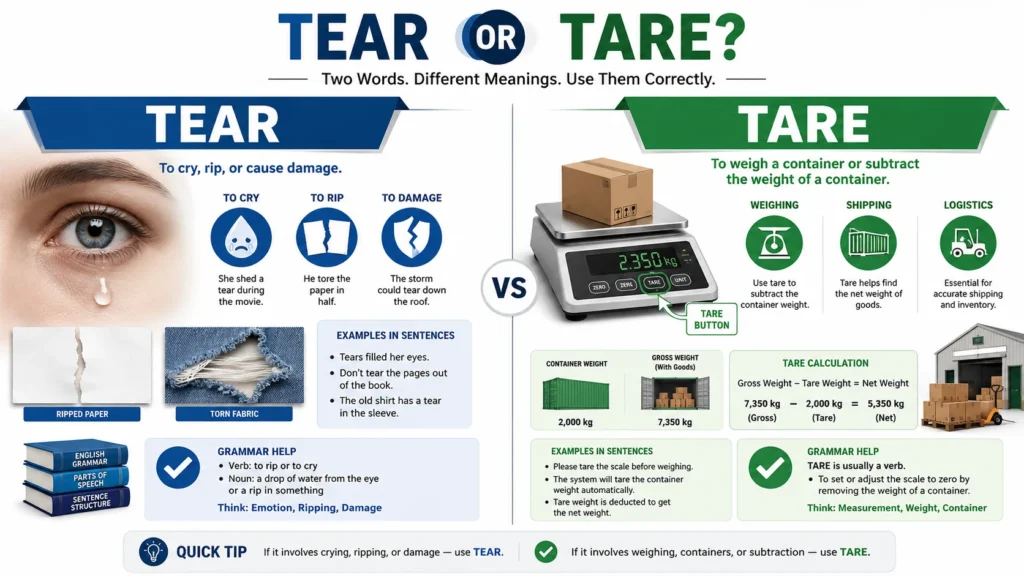
Tear and tare are two different English words with different meanings and pronunciations. Tear usually refers to ripping something or a drop from the eye, while tare refers to the weight of a container or an unwanted impurity. Understanding the difference between tear or tare helps improve writing accuracy and communication.
Have you ever written “tear” or “tare” and wondered which one is correct? You are not alone. These two words sound similar in some contexts. But their meanings are completely different. Tear can refer to a drop from your eye or the act of ripping something. Tare, on the other hand, is mainly used when discussing weight, especially the weight of packaging or a container. So, tear vs. tare is more than a spelling question. It depends on the context and meaning you want to express. In this guide, we will explain tear or tare, their definitions, pronunciation, examples, and common mistakes. Whether you are checking tare or tear, learning English vocabulary, or trying to improve your writing, this simple guide will help you choose the right word with confidence.
Quick Answer About Tear or Tare
The difference between tear or tare is simple:
| Word | Meaning | Example |
|---|---|---|
| Tear | To rip something or a drop from the eye | She shed a tear. |
| Tare | The weight of an empty container | The scale subtracts the tare weight. |
Simple Rule
Use tear when talking about:
- Crying
- Ripping
- Damage
Use tare when talking about:
- Weighing containers
- Packaging weight
- Measurement systems
Understanding Tear
What Does Tear Mean?
The word tear has multiple meanings in English.
It can mean:
- A drop of liquid from the eye.
- To rip or split something.
- Damage caused by use or force.
Tear as a Noun
When used as a noun, a tear is a drop of fluid that comes from the eye.
Examples:
- A tear rolled down her face.
- The movie brought tears to his eyes.
- She wiped away a tear.
Tear as a Verb
As a verb, tear means to rip or pull apart.
Examples:
- Do not tear the document.
- He accidentally tore the page.
- Children can easily tear thin paper.
Tear and Pronunciation
Interestingly, tear has two common pronunciations.
| Meaning | Pronunciation |
|---|---|
| Drop from the eye | Teer |
| Rip apart | Tair |
Examples:
- A tear in her eye (teer)
- Tear the paper (tair)
This pronunciation difference often confuses English learners.
Understanding Tare
What Does Tare Mean?
The word tare is mainly used in weighing and measurement.
It refers to the weight of a container, package, or wrapping that holds a product.
The tare weight is subtracted from the total weight to find the net weight of the contents.
Tare in Measurement
Imagine a jar filled with honey.
- Total weight = 1.5 kg
- Empty jar weight = 0.3 kg
The jar’s weight is the tare.
Net honey weight:
1.5 kg − 0.3 kg = 1.2 kg
Examples of Tare
- Press the tare button before weighing ingredients.
- The scale automatically removes the tare weight.
- Tare values are important in shipping.
Tare in Agriculture
Historically, tare also referred to certain unwanted weeds found among crops.
Examples:
- Farmers removed the tare from the wheat field.
- The field contained both wheat and tare plants.
Today, this meaning is less common than the measurement-related meaning.
Tear or Tare Comparison Table
| Feature | Tear | Tare |
|---|---|---|
| Part of Speech | Noun, Verb | Noun, Verb |
| Main Meaning | Rip or eye droplet | Container weight |
| Common Usage | Daily conversation | Weighing and logistics |
| Emotional Context | Often yes | No |
| Scientific Use | Rarely | Frequently |
| Found in Shipping | No | Yes |
| Found in Manufacturing | Rarely | Often |
| Related to Crying | Yes | No |
Origins of Tear and Tare
Origin of Tear
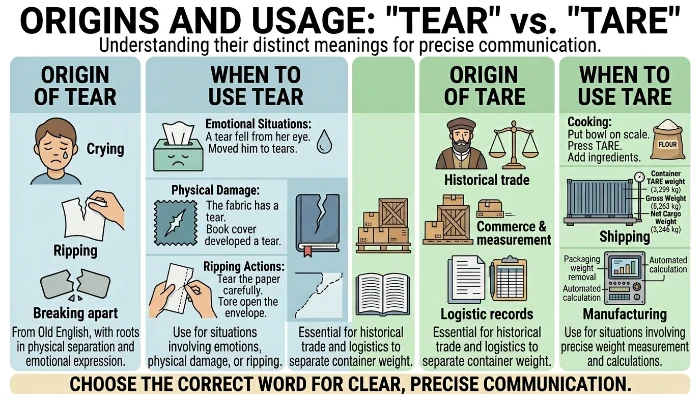
The word tear comes from Old English and has been used for centuries to describe:
- Crying
- Ripping
- Breaking apart
Its roots are connected to physical separation and emotional expression.
Origin of Tare
The word tare comes from historical trade and measurement systems.
Merchants needed a way to separate:
- Container weight
- Product weight
The term became essential in shipping, commerce, logistics, and manufacturing.
When to Use Tear
Use tear in situations involving emotions, physical damage, or ripping.
Emotional Situations
Examples:
- A tear fell from her eye.
- The speech moved him to tears.
- Tears filled her eyes.
Physical Damage
Examples:
- The fabric has a tear.
- The book cover developed a tear.
- There is a tear in the tent.
Ripping Actions
Examples:
- Tear the paper carefully.
- He tore open the envelope.
- Do not tear the label.
When to Use Tare
Use tare in situations involving weight measurement.
Cooking
Modern kitchen scales often include a tare function.
Examples:
- Put the bowl on the scale.
- Press tare.
- Add ingredients.
The scale ignores the bowl weight.
Shipping
Shipping companies use tare calculations daily.
Examples:
- Container tare weight: 2,500 kg
- Gross weight: 20,000 kg
- Net cargo weight: 17,500 kg
Manufacturing
Factories use tare measurements to ensure accurate production data.
Examples:
- Packaging weight must be removed.
- The system automatically calculates the tare.
Advantages and Disadvantages of Knowing the Difference
Advantages
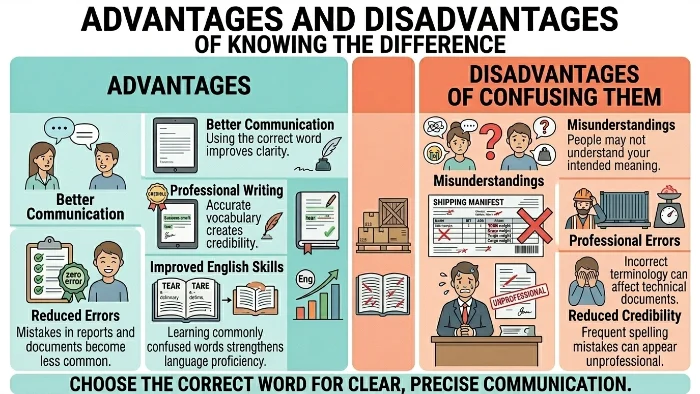
Better Communication
Using the correct word improves clarity.
Professional Writing
Accurate vocabulary creates credibility.
Reduced Errors
Mistakes in reports and documents become less common.
Improved English Skills
Learning commonly confused words strengthens language proficiency.
Disadvantages of Confusing Them
Misunderstandings
People may not understand your intended meaning.
Professional Errors
Incorrect terminology can affect technical documents.
Reduced Credibility
Frequent spelling mistakes can appear unprofessional.
Real World Examples of Tear or Tare
Example in Everyday Life
Sentence:
- A tear rolled down her cheek.
Meaning:
A drop from the eye.
Example in Office Work
Sentence:
- Do not tear the contract.
Meaning:
Do not rip the document.
Example in a Warehouse
Sentence:
- Enter the tare weight before shipping.
Meaning:
Record the container’s weight.
Example in a Grocery Store
Sentence:
- Press tare before weighing vegetables.
Meaning:
Remove container weight from the calculation.
Tear or Tare in Different Industries
Logistics Industry
The word tare is extremely common.
Examples:
- Tare weight
- Container tare
- Vehicle tare
Medical Industry
The word tear often appears.
Examples:
- Muscle tear
- Ligament tear
- Retinal tear
Education
Students commonly encounter tear in reading and writing exercises.
Manufacturing
Factories frequently use tare in production measurements.
Regional and Global Usage
United States
Both words are widely understood.
Tear is common in everyday language.
Tare is common in shipping and commerce.
United Kingdom
Usage is similar to American English.
Canada
The meanings remain the same.
Australia
Both words follow standard English definitions.
International English
Across English-speaking countries:
- Tear = crying or ripping
- Tare = measurement weight
The meanings rarely change by region.
Common Mistakes With Tear or Tare
Mistake 1
Incorrect:
- Press the tear button on the scale.
Correct:
- Press the tare button on the scale.
Mistake 2
Incorrect:
- A tare ran down her face.
Correct:
- A tear ran down her face.
Mistake 3
Incorrect:
- There is a tare in the paper.
Correct:
- There is a tear in the paper.
Mistake 4
Incorrect:
- He cried a tare.
Correct:
- He cried a tear.
Mistake 5
Incorrect:
- Remove the tear weight.
Correct:
- Remove the tare weight.
Memory Tricks for Tear or Tare
Remembering Tear
Think:
Tear = Tears from your eyes
Both words relate directly to crying.
Remembering Tare
Think:
Tare = Scale
A tare function is found on weighing scales.
Easy Formula
- Eye = Tear
- Weight = Tare
This simple rule solves most confusion.
Related Concepts and Comparisons
Tear vs Rip
| Word | Meaning |
|---|---|
| Tear | Rip apart |
| Rip | Forcefully split |
Examples:
- Tear the page.
- Rip the cardboard.
Tear vs Cry
| Word | Meaning |
|---|---|
| Tear | Liquid from eye |
| Cry | Emotional action |
Examples:
- A tear fell.
- She cried loudly.
Tare vs Gross Weight
| Term | Meaning |
|---|---|
| Tare | Empty container weight |
| Gross Weight | Total weight |
Formula:
Gross Weight = Net Weight + Tare Weight
Tare vs Net Weight
| Term | Meaning |
|---|---|
| Tare | Container weight |
| Net Weight | Product weight only |
Example:
- Jar = Tare
- Honey = Net Weight
Advanced Understanding of Tare Weight
Gross Weight
Total weight of everything.
Tare Weight
Weight of the container only.
Net Weight
Weight of the contents only.
Formula
Net Weight = Gross Weight − Tare Weight
Example:
| Measurement | Weight |
|---|---|
| Gross | 15 kg |
| Tare | 2 kg |
| Net | 13 kg |
This formula is widely used in:
- Shipping
- Logistics
- Warehousing
- Manufacturing
- Food production
Exercises on Tear or Tare
Choose the correct word.
Exercise 1
A _____ rolled down her cheek.
Answer: tear
Exercise 2
Press the _____ button before adding flour.
Answer: tare
Exercise 3
Do not _____ the document.
Answer: tear
Exercise 4
The shipping company recorded the container’s _____ weight.
Answer: tare
Exercise 5
The fabric has a small _____.
Answer: tear
Exercise 6
The digital scale can automatically _____ the container weight.
Answer: tare
Exercise 7
His emotional speech brought a _____ to her eye.
Answer: tear
Exercise 8
Warehouse workers must verify the _____ value.
Answer: tare
Exercise Answers Explained
Tear Answers
Questions 1, 3, 5, and 7 use tear because they involve:
- Crying
- Ripping
- Physical damage
Tare Answers
Questions 2, 4, 6, and 8 use tare because they involve:
- Measurement
- Shipping
- Scales
- Weight calculations
FAQs
What is the difference between tear or tare?
A tear is either a drop from the eye or a rip. A tare is the weight of a container that is subtracted during weighing.
Is tare used in everyday conversation?
Not often. The word tare is mainly used in weighing, shipping, logistics, and manufacturing.
Can tear be a noun and a verb?
Yes. A tear can be a drop from the eye or an act of ripping something.
What does the tare button do on a scale?
The tare button removes the weight of the container so only the contents are measured.
How do I remember tear or tare?
Think of tear for eyes and ripping. Think of tare for scales and weight measurements.
Is a tear always related to crying?
No. A tear can also mean a rip, split, or damaged area in a material.
What is tare weight in shipping?
Tare weight is the weight of the empty container before goods are loaded.
Can I use tear instead of tare?
No. Although the words look similar, they have completely different meanings and should not be used interchangeably.
Why is tare important in logistics?
Tare helps determine the exact net weight of cargo, products, or materials.
Which word is more common, tear or tare?
Tear is far more common in everyday English. Tare is mostly used in technical and commercial contexts.
Conclusion
Understanding the difference between tear or tare is easier once you know their core meanings. Tear relates to crying, ripping, or physical damage, while tare relates to weighing systems and the weight of containers. Although the words look similar, they belong to very different contexts.
For everyday communication, you will encounter tear much more frequently. You may see it in books, conversations, news articles, and personal writing. On the other hand, tare is common in industries such as logistics, shipping, manufacturing, food production, and laboratory work.
A simple memory trick can help: tear is for eyes and ripping, tare is for scales and weighing. By remembering this distinction, you can avoid common mistakes and improve both your spoken and written English.
Whenever you encounter the question tear or tare, focus on the context. If it involves emotion or damage, choose tear. If it involves weight calculations or containers, choose tare. Using the correct word will make your writing clearer, more professional, and more accurate.
Discover More Article
- Buses or Busses: Which Spelling Is Correct? Complete Guide (2026)
- Stint or Stent: Meaning, Differences and Correct Usage Guide (2026)

Victoria Lane is a grammar-focused writer at GramBrix.com, passionate about helping readers master the rules of language. She provides clear explanations and practical examples that make writing more accurate, polished and confident.