Last Updated on July 31, 2026
Hat and cap are both types of headwear, but they are not exactly the same. A hat typically has a full brim that extends around the head, while a cap usually features a visor or bill at the front and a more fitted design. Understanding the difference between hat or cap can help you choose the right style for fashion, sports, outdoor activities, or everyday wear.
Many people use the words hat and cap interchangeably. While both are worn on the head and serve similar purposes, they have distinct designs, histories, and uses.
For example:
- A cowboy hat is clearly a hat.
- A baseball cap is clearly a cap.
However, when shopping online or discussing fashion, people often wonder which term is correct and whether there is a real difference between the two.
The answer is yes. Hats and caps differ in structure, appearance, function, and style.
Whether you’re choosing headwear for sun protection, sports, fashion, work, or travel, understanding the difference between a hat and a cap can help you make a better decision.
This guide covers:
- Definitions
- Key differences
- Popular styles
- Advantages and disadvantages
- Real-world uses
- Common mistakes
- FAQs
Quick Answer
| Feature | Hat | Cap |
|---|---|---|
| Brim Around Entire Head | Usually Yes | No |
| Front Visor | Usually No | Yes |
| Formal Styles Available | Yes | Rarely |
| Sports Usage | Sometimes | Very Common |
| Casual Wear | Yes | Yes |
Simple Summary
A hat usually has a full brim around the head, while a cap typically has a front visor and a more fitted shape.
What Is a Hat?
Definition
A hat is a head covering that often includes a brim extending around the entire crown.
Main Purpose
Hats are worn for:
- Fashion
- Sun protection
- Weather protection
- Cultural traditions
- Professional uniforms
Common Hat Styles
Popular examples include:
- Cowboy hats
- Fedora hats
- Sun hats
- Bucket hats
- Panama hats
What Is a Cap?
Definition
A cap is a type of headwear with a soft crown and a visor or bill at the front.
Main Purpose
Caps are commonly used for:
- Sports
- Casual fashion
- Outdoor activities
- Team uniforms
Common Cap Styles
Examples include:
- Baseball caps
- Snapback caps
- Trucker caps
- Golf caps
- Dad caps
Main Difference Between Hat or Cap
Brim Design
Hat
Usually has a brim that surrounds the head.
Cap
Typically has a visor only at the front.
Structure
Hat
Often maintains a more structured shape.
Cap
Usually fits closely to the head.
Formality
Hat
Can be formal or fashionable.
Cap
Mostly casual and sporty.
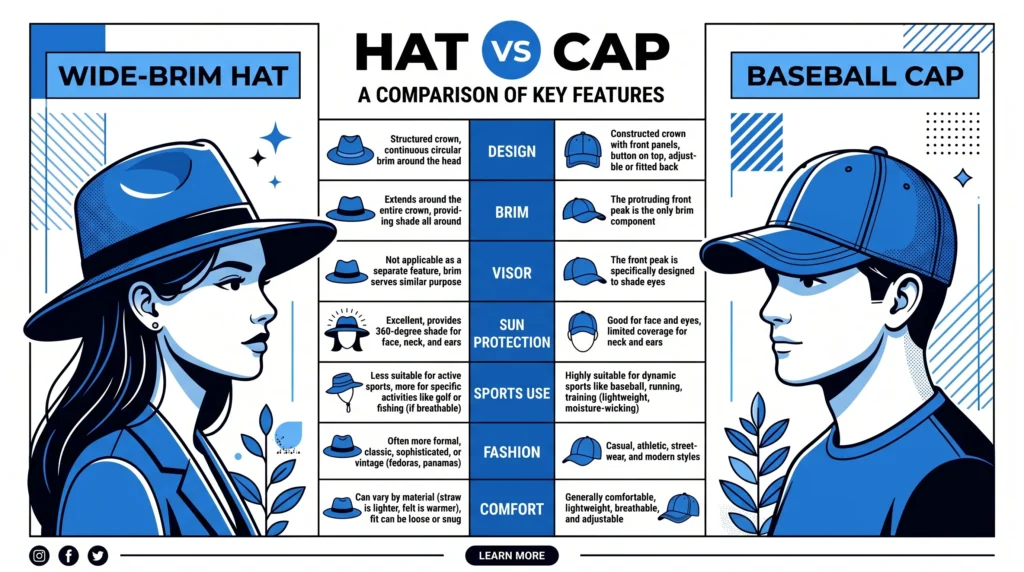
Comparison Table
| Feature | Hat | Cap |
|---|---|---|
| Full Brim | Yes | No |
| Front Bill | Rare | Yes |
| Formal Events | Common | Rare |
| Sports Activities | Limited | Very Common |
| Fashion Variety | High | Moderate |
| Sun Coverage | Greater | Moderate |
Popular Types of Hats
Fedora
Known for its stylish appearance.
Cowboy Hat
Popular in western fashion.
Sun Hat
Designed for maximum sun protection.
Bucket Hat
A casual favorite that has become trendy again.
Panama Hat
Lightweight and often worn in warm climates.
Popular Types of Caps
Baseball Cap
The most common cap style worldwide.
Snapback Cap
Features an adjustable closure.
Trucker Cap
Includes a mesh back panel.
Golf Cap
Designed for comfort during sports.
Dad Cap
Known for a relaxed, unstructured fit.
Advantages of Wearing a Hat
Better Sun Protection
The wider brim provides more shade.
Fashion Variety
Hats come in many formal and casual styles.
Weather Protection
Can shield the face, neck, and ears.
Cultural Significance
Many hats have historical and cultural importance.
Advantages of Wearing a Cap
Lightweight Design
Caps are often more comfortable for daily use.
Sports Friendly
Ideal for running, golfing, and outdoor activities.
Easy to Carry
Caps are compact and travel-friendly.
Casual Style
Pairs well with everyday outfits.
Disadvantages of Hats
Larger Size
Some hats are harder to store or pack.
Higher Cost
Premium hats can be expensive.
Less Suitable for Sports
Certain hat styles may not stay secure during activity.
Disadvantages of Caps
Limited Sun Coverage
Caps mainly protect the face.
Less Formal
Caps rarely work in formal settings.
Reduced Weather Protection
The sides and back of the head remain exposed.
Real World Examples
Outdoor Hiking
A wide-brim hat offers excellent sun protection.
Baseball Game
A baseball cap is the standard choice.
Beach Vacation
A sun hat helps protect against UV exposure.
Casual City Walk
A cap provides comfort and convenience.
Fashion Event
A fedora or Panama hat may complement a stylish outfit.
Hat or Cap for Different Activities
Sports
Best Choice
Cap
The visor helps reduce glare while remaining lightweight.
Travel
Best Choice
Depends on the destination.
Caps are easier to pack, while hats provide better sun protection.
Formal Occasions
Best Choice
Hat
Formal hats can enhance dressy outfits.
Outdoor Work
Best Choice
Wide-brim hat
Offers greater protection from sunlight.
Common Mistakes People Make
Calling Every Headwear Item a Hat
Some styles are specifically caps.
Assuming Caps and Hats Are Identical
Caps are actually a category of headwear with unique features.
Ignoring Sun Protection Needs
A cap may not provide enough coverage for extended outdoor exposure.
Choosing Style Over Function
Different situations may require different headwear.
Hat vs Cap in Fashion
Modern Trends
Both hats and caps remain popular in contemporary fashion.
Streetwear
Caps dominate casual streetwear culture.
Luxury Fashion
Designer hats often appear in high-end collections.
Seasonal Trends
Fashion trends influence the popularity of specific styles each year.
Related Headwear Comparisons
Hat or Helmet
A helmet provides safety protection, while a hat is primarily for style or weather.
Cap or Beanie
A beanie has no visor and is designed for warmth.
Fedora or Baseball Cap
One is dressy, while the other is casual and sporty.
Exercises With Answers
Exercise 1
Which headwear usually has a full brim?
Answer: Hat
Exercise 2
Which headwear commonly has a visor?
Answer: Cap
Exercise 3
Which is better for sports?
Answer: Cap
Exercise 4
Which provides greater overall sun coverage?
Answer: Hat
Exercise 5
Is a baseball cap considered a hat?
Answer: Technically it is a type of headwear, but it is specifically classified as a cap.
FAQs
What is the difference between a hat or cap?
A hat usually has a full brim around the head, while a cap typically has a visor at the front.
Is a baseball cap a hat?
A baseball cap belongs to the broader category of headwear, but it is specifically called a cap.
Which offers better sun protection?
Most wide-brim hats provide better sun coverage than caps.
Are caps more casual than hats?
Generally, yes. Caps are usually associated with casual and athletic wear.
Which is better for sports activities?
Caps are typically preferred because they are lightweight and secure.
Can hats be formal?
Yes. Styles such as fedoras and dress hats can be appropriate for formal occasions.
What is the most popular type of cap?
The baseball cap is one of the most popular cap styles worldwide.
Which is easier to travel with?
Caps are usually easier to pack and carry.
Do hats cost more than caps?
Some hats can be more expensive due to materials and craftsmanship.
Should I choose a hat or cap for everyday wear?
Choose based on your needs. Caps are convenient for casual use, while hats offer greater style variety and sun protection.
Conclusion
The debate over hat or cap comes down to design, purpose, and personal preference.
A hat typically features a full brim, offers better sun protection, and includes both casual and formal styles. A cap usually has a front visor, a snug fit, and is ideal for sports and everyday wear.
Key takeaways:
- Hats generally have a full brim.
- Caps usually feature a visor.
- Hats provide more sun coverage.
- Caps are better suited for sports.
- Both remain popular fashion accessories.
When choosing between a hat and a cap, consider your activity, comfort needs, weather conditions, and personal style. Both options serve valuable purposes and can be excellent additions to your wardrobe.

Victoria Lane is a grammar-focused writer at GramBrix.com, passionate about helping readers master the rules of language. She provides clear explanations and practical examples that make writing more accurate, polished and confident.