Last Updated on June 16, 2026
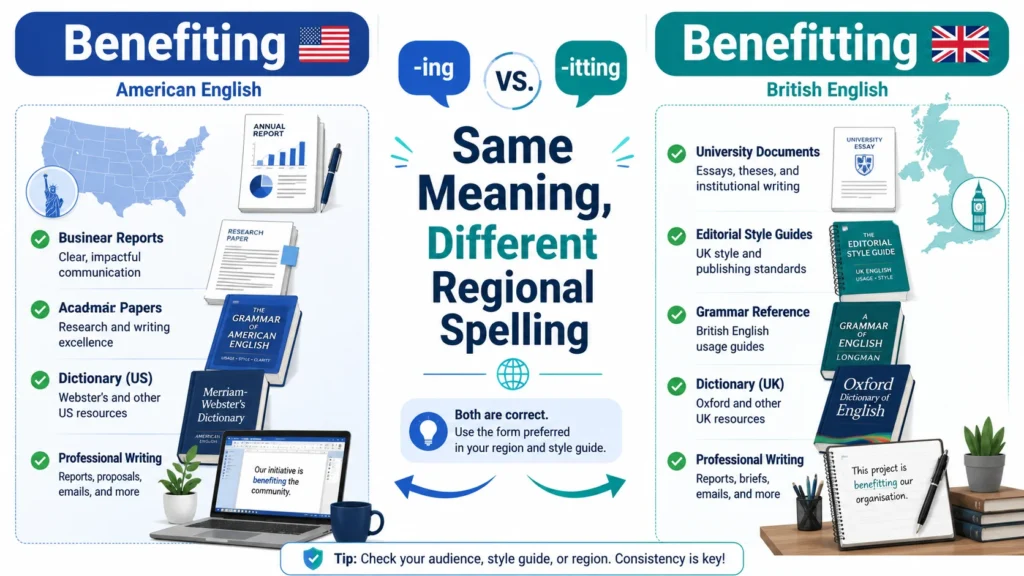
Benefiting and benefitting are both correct spellings of the verb meaning “to receive an advantage or gain a benefit.” The difference is mainly regional: benefiting is the preferred spelling in American English, while benefitting is more common in British English and some other English-speaking regions.
Have you ever written the word benefiting and wondered if it should be spelled benefitting instead? You are not alone. Many English writers pause when they reach this word because both spellings appear in books, websites, business documents, and everyday communication.
The confusion comes from a common spelling pattern in English. Some verbs double the final consonant before adding endings such as -ing or -ed, while others do not. As a result, many people are unsure whether the word should be written as benefiting or benefitting.
The good news is that both spellings are accepted. The choice usually depends on the version of English you use. American English generally prefers benefiting, while British English often uses benefitting.
Understanding the difference can help you write more professionally and consistently. Whether you are creating business reports, academic papers, blog posts, emails, or social media content, knowing when to use each spelling can improve clarity and credibility.
This guide explains everything you need to know about benefiting or benefitting, including definitions, usage rules, examples, regional differences, common mistakes, and practice exercises.
Quick Answer
| Spelling | Preferred Region | Correct? |
|---|---|---|
| Benefiting | American English | Yes |
| Benefitting | British English | Yes |
Simple Rule
- Use benefiting if you follow American English.
- Use benefitting if you follow British English.
- Be consistent throughout your document.
Example
American English:
- The company is benefiting from increased sales.
British English:
- The company is benefitting from increased sales.
Both sentences are correct.
Understanding the Word Benefit
Before comparing benefiting and benefitting, it helps to understand the base word.
Benefit is a noun and a verb.
Benefit as a Noun
A benefit is an advantage or positive result.
Examples:
- Health insurance is an employee benefit.
- Exercise provides many health benefits.
- Education offers lifelong benefits.
Benefit as a Verb
To benefit means to receive an advantage or to help someone.
Examples:
- Students benefit from regular practice.
- The new system benefits customers.
- The organization benefits local communities.
When we add -ing to the verb, we create the present participle form:
- benefiting
- benefitting
Why Is There Confusion Between Benefiting and Benefitting?
English spelling rules are not always straightforward.
Many writers learn that when a verb ends in a consonant, the final consonant is sometimes doubled before adding -ing.
For example:
| Base Verb | Adding -ing |
|---|---|
| Run | Running |
| Sit | Sitting |
| Stop | Stopping |
Because of these examples, some people assume that benefit should become benefitting.
However, spelling conventions vary between American and British English. This creates two accepted versions.
Benefiting Meaning
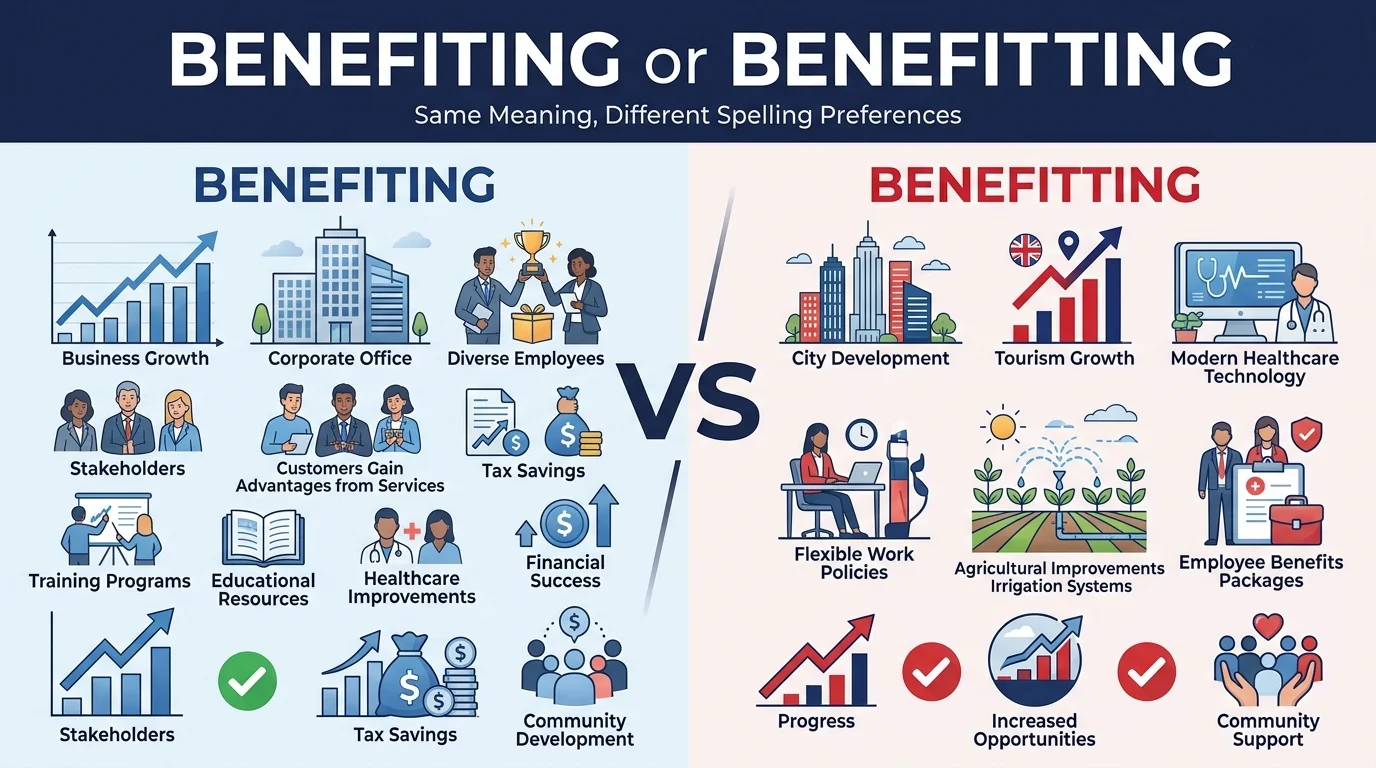
Benefiting is the present participle and gerund form preferred in American English.Benefiting Meaning
Examples
- She is benefiting from the training program.
- Businesses are benefiting from lower taxes.
- The community is benefiting from the new hospital.
- Children are benefiting from improved educational resources.
In Business Writing
American companies often use:
- benefiting customers
- benefiting stakeholders
- benefiting employees
Example:
- Our investment strategy is benefiting shareholders.
Benefitting Meaning
Benefitting has exactly the same meaning as benefiting.
The difference is spelling preference rather than meaning.
Examples
- The city is benefitting from increased tourism.
- Patients are benefitting from new medical technology.
- Employees are benefitting from flexible work policies.
- Farmers are benefitting from improved irrigation systems.
These examples are common in British publications.
Benefiting vs Benefitting Comparison Table
| Feature | Benefiting | Benefitting |
|---|---|---|
| Meaning | Receiving an advantage | Receiving an advantage |
| Grammar | Present participle | Present participle |
| American English | Preferred | Less common |
| British English | Accepted | More common |
| Formal Writing | Common in US | Common in UK |
| Pronunciation | Same | Same |
| Correctness | Correct | Correct |
The key takeaway is that both spellings are valid.
How English Spelling Rules Affect Benefiting and Benefitting
To understand the difference better, let’s look at spelling patterns.
The Double Consonant Rule
A final consonant is often doubled when:
- The word ends with a single vowel followed by a single consonant.
- The final syllable is stressed.
Examples:
| Word | Result |
|---|---|
| Begin | Beginning |
| Admit | Admitting |
| Refer | Referring |
What About Benefit?
The word benefit is pronounced:
BEN uh fit
The stress falls on the first syllable.
Because the final syllable is not stressed, American English usually does not double the final t.
This leads to:
- benefiting
- benefited
British English is often more flexible and may double the consonant, producing:
- benefitting
- benefitted
Benefited or Benefitted
The same regional difference appears in the past tense.
| American English | British English |
|---|---|
| Benefited | Benefitted |
| Benefiting | Benefitting |
Examples:
American English:
- The company benefited from strong demand.
British English:
- The company benefitted from strong demand.
Both are correct.
Real World Examples of Benefiting
Education
- Students are benefiting from online learning tools.
- Teachers are benefiting from better classroom technology.
Healthcare
- Patients are benefiting from early diagnosis programs.
- Hospitals are benefiting from improved equipment.
Business
- Small businesses are benefiting from tax incentives.
- Companies are benefiting from digital transformation.
Environment
- Wildlife is benefiting from conservation efforts.
- Communities are benefiting from cleaner energy sources.
Personal Development
- Individuals are benefiting from improved financial literacy.
- Workers are benefiting from professional training courses.
Real World Examples of Benefitting
Public Services
- Residents are benefitting from improved transportation networks.
- Citizens are benefitting from government reforms.
Technology
- Businesses are benefitting from cloud computing solutions.
- Consumers are benefitting from faster internet access.
Education
- Schools are benefitting from increased funding.
- Learners are benefitting from digital resources.
Healthcare
- Patients are benefitting from advanced treatment methods.
- Medical professionals are benefitting from better research tools.
Advantages and Disadvantages of Each Spelling
Advantages of Benefiting
Preferred in American English
Most American dictionaries favor this spelling.
Widely Recognized
It appears frequently in US business and academic writing.
Simpler Form
Many writers find it easier because it follows a straightforward pattern.
Consistency
Useful when writing for American audiences.
Disadvantages of Benefiting
May Look Unfamiliar in British Contexts
Some UK readers may expect benefitting.
Regional Preference Issues
International audiences may encounter both forms.
Advantages of Benefitting
Common in British English
Widely accepted in UK publications.
Fits British Spelling Patterns
Many British writers naturally use the doubled consonant.
Familiar to International Readers
Often seen in Commonwealth countries.
Disadvantages of Benefitting
Less Common in American Publications
US readers may consider it unusual.
Can Create Inconsistency
Mixing regional styles in one document can appear unprofessional.
Regional Usage Around the World
United States
The preferred spelling is:
benefiting
Examples:
- benefiting employees
- benefiting customers
- benefiting investors
United Kingdom
Both spellings may appear, but:
benefitting is often preferred.
Examples:
- benefitting communities
- benefitting businesses
- benefitting residents
Canada
Canadian English often combines American and British influences.
Both spellings appear, although benefiting is becoming increasingly common.
Australia
Australian English traditionally follows British conventions.
Therefore, benefitting is frequently used.
New Zealand
Both forms occur, but British-style spelling remains common.
Benefiting or Benefitting in Academic Writing
Academic writing values consistency.
If Following American Style Guides
Use:
- benefiting
- benefited
If Following British Style Guides
Use:
- benefitting
- benefitted
Example
American style:
- Researchers are benefiting from improved data collection methods.
British style:
- Researchers are benefitting from improved data collection methods.
Choose one style and maintain it throughout your paper.
Benefiting or Benefitting in Business Communication
Professional communication should match the audience.
Writing for US Clients
Use:
- benefiting
- benefited
Example:
- Customers are benefiting from our expanded services.
Writing for UK Clients
Use:
- benefitting
- benefitted
Example:
- Customers are benefitting from our expanded services.
Common Mistakes
Many writers make mistakes when using these spellings.
Mixing Styles
Incorrect:
- Employees are benefiting from the program.
- The company benefitted last year.
The spellings belong to different regional systems.
Correct American:
- Employees are benefiting from the program.
- The company benefited last year.
Correct British:
- Employees are benefitting from the programme.
- The company benefitted last year.
Assuming One Version Is Wrong
Incorrect belief:
- Benefitting is incorrect.
Reality:
- Both forms are accepted.
Using Different Spellings in the Same Document
Consistency matters.
Choose one version and stick with it.
Forgetting Your Audience
American readers generally expect:
- benefiting
British readers often expect:
- benefitting
Related Comparisons
Many English words show similar differences.
Traveling vs Travelling
| American | British |
|---|---|
| Traveling | Travelling |
Canceled vs Cancelled
| American | British |
|---|---|
| Canceled | Cancelled |
Modeled vs Modelled
| American | British |
|---|---|
| Modeled | Modelled |
Benefiting vs Benefitting
| American | British |
|---|---|
| Benefiting | Benefitting |
These examples show how regional spelling differences work.
Grammar Tips for Using Benefiting and Benefitting
Present Continuous
- The company is benefiting from growth.
- The company is benefitting from growth.
Gerund Form
- Benefiting from education improves opportunities.
- Benefitting from education improves opportunities.
Participle Phrase
- Benefiting from experience, she completed the task quickly.
- Benefitting from experience, she completed the task quickly.
Common Contexts Where the Word Appears
Business
- benefiting shareholders
- benefiting customers
- benefiting investors
Healthcare
- benefiting patients
- benefiting families
- benefiting healthcare providers
Education
- benefiting students
- benefiting teachers
- benefiting institutions
Government
- benefiting taxpayers
- benefiting communities
- benefiting citizens
Technology
- benefiting users
- benefiting developers
- benefiting organizations
Exercises With Answers
Exercise 1
Choose the preferred American English spelling.
- The company is ______ from higher demand.
- Students are ______ from better resources.
- Communities are ______ from infrastructure investments.
Answers
- benefiting
- benefiting
- benefiting
Exercise 2
Choose the preferred British English spelling.
- Employees are ______ from flexible schedules.
- Residents are ______ from public improvements.
- Businesses are ______ from economic growth.
Answers
- benefitting
- benefitting
- benefitting
Exercise 3
Identify the regional style.
- The project is benefiting local schools.
- The project is benefitting local schools.
Answers
- American English
- British English
Exercise 4
Correct the inconsistent sentence.
Sentence:
- Employees are benefiting from the programme, and the company benefitted financially.
Answer
American style:
- Employees are benefiting from the program, and the company benefited financially.
British style:
- Employees are benefitting from the programme, and the company benefitted financially.
When Should You Use Benefiting?
Use benefiting when:
- Writing in American English.
- Following US style guides.
- Creating content for American audiences.
- Writing business reports in the United States.
- Publishing academic work using American standards.
Example
- Consumers are benefiting from lower prices.
When Should You Use Benefitting?
Use benefitting when:
- Writing in British English.
- Following UK editorial standards.
- Creating content for British readers.
- Publishing in Commonwealth countries that favor British spelling.
Example
- Consumers are benefitting from lower prices.
Professional Writing Recommendations
For professional communication:
Know Your Audience
Audience determines spelling preference.
Use a Style Guide
Follow the chosen style consistently.
Check Your Spell Checker
Many word processors are configured for either US or UK English.
Maintain Consistency
Avoid switching between versions.
Consider International Readers
If your audience is global, select one standard and apply it throughout the document.
FAQs
Is benefiting or benefitting correct?
Both are correct. Benefiting is preferred in American English, while benefitting is more common in British English.
Which spelling is used in the United States?
American English generally prefers benefiting and benefited.
Which spelling is used in the United Kingdom?
British English often prefers benefitting and benefitted.
Do benefiting and benefitting have different meanings?
No. They have exactly the same meaning and pronunciation.
Is benefitting a spelling mistake?
No. It is a valid spelling, especially in British English.
Should I use benefiting in academic writing?
Use benefiting if your institution follows American English style guidelines.
Should I use benefitting in academic writing?
Use benefitting if your institution follows British English conventions.
How do I know which version to choose?
Consider your audience, location, publication standards, and style guide requirements.
What is the past tense of benefit?
American English commonly uses benefited, while British English often uses benefitted.
Can I use both spellings in the same article?
It is not recommended. Choose one style and remain consistent throughout your writing.
Conclusion
The debate over benefiting or benefitting is not about right versus wrong. Both spellings are correct and accepted by major dictionaries and style guides. The real difference lies in regional preference.
In American English, benefiting and benefited are the standard forms. In British English, benefitting and benefitted are commonly used. The meaning remains exactly the same regardless of which spelling you choose.
The most important rule is consistency. If you are writing for a US audience, use benefiting throughout your document. If you are writing for a UK audience, use benefitting consistently. Matching your spelling style to your readers helps create professional, polished, and trustworthy content.
Whether you are preparing academic papers, business reports, marketing materials, or everyday emails, understanding the difference between benefiting and benefitting ensures clearer communication and stronger writing. By choosing the appropriate regional form and maintaining consistency, you can write with confidence and avoid one of the most common spelling questions in English.

Victoria Lane is a grammar-focused writer at GramBrix.com, passionate about helping readers master the rules of language. She provides clear explanations and practical examples that make writing more accurate, polished and confident.