Last Updated on May 19, 2026
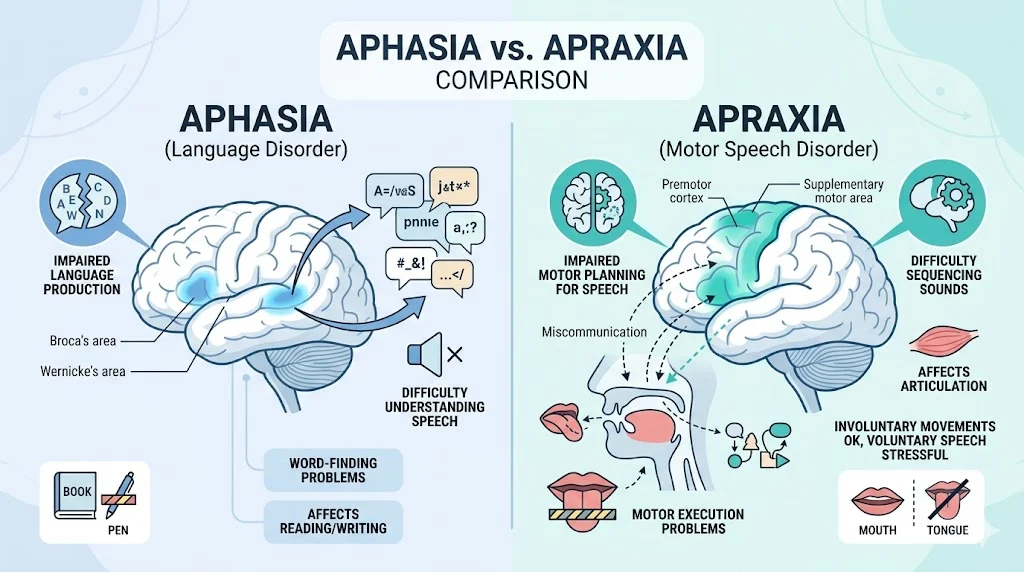
Aphasia vs apraxia are both communication and speech-related disorders, but they affect different brain functions. Aphasia impacts language ability, making it hard to understand or produce words. Apraxia affects motor planning, making it difficult to physically produce speech even when the person knows what they want to say.
Understanding aphasia vs apraxia helps in accurate diagnosis, better therapy planning, and improved communication outcomes for patients recovering from brain injury or neurological conditions.
Aphasia vs apraxia is a common comparison in speech and brain health. Many people confuse these two conditions because both can affect speaking. However, they are not the same.
Aphasia is a language problem. It affects how a person understands words and how they use language to speak, read, or write. Apraxia is a movement problem. It affects how the brain plans the movements needed for speech.
This confusion often happens after stroke or brain injury. A person may struggle to talk and assume it is one condition. But treatment depends on knowing the exact cause.
Learning the difference between aphasia vs apraxia is important for patients, caregivers, students, and healthcare workers. It helps improve therapy results and communication support.
In this article, we will explain aphasia vs apraxia in simple words. We will cover definitions, symptoms, comparisons, examples, exercises, and FAQs. By the end, you will clearly understand how these two conditions differ and how they affect daily life.
Quick Answer Overview
The difference between aphasia vs apraxia can be explained simply:
- Aphasia affects language processing in the brain.
- Apraxia affects motor planning for speech movements.
In aphasia vs apraxia:
- Aphasia = “I cannot find or understand words.”
- Apraxia = “I know the word, but my mouth cannot say it correctly.”
Both can occur after stroke, brain injury, or neurological disease, but they involve different brain areas and need different therapies.
What is Aphasia?
Aphasia is a communication disorder caused by damage to the brain’s language centers, usually in the left hemisphere.
In aphasia vs apraxia comparison, aphasia is related to language understanding and production.
A person with aphasia may:
- Struggle to find words
- Speak in short or broken sentences
- Have difficulty understanding others
- Experience trouble reading or writing
Types of Aphasia
- Broca’s aphasia: Speech is slow and broken
- Wernicke’s aphasia: Speech is fluent but meaningless
- Global aphasia: Severe impairment in all language skills
What is Apraxia?
Apraxia of speech is a motor speech disorder. It happens when the brain cannot properly plan the movements needed for speech.
In aphasia vs apraxia comparison, apraxia is about movement, not language.
A person with apraxia may:
- Know what they want to say
- Struggle to move lips, tongue, or jaw correctly
- Make inconsistent speech errors
- Sound like they are “groping” for words
Types of Apraxia
- Apraxia of speech (AOS)
- Oral apraxia (difficulty with non-speech mouth movements)
Aphasia vs Apraxia Comparison Table
| Feature | Aphasia | Apraxia |
| Main Problem | Language processing | Motor planning for speech |
| Brain Area | Language centers (left hemisphere) | Motor planning areas |
| Speech Ability | Words and grammar affected | Speech movement affected |
| Understanding | Often impaired | Usually normal |
| Awareness | May not realize errors | Fully aware of errors |
| Writing/Reading | Often affected | Usually normal |
| Type of Error | Wrong words or sentences | Distorted sounds, incorrect movements |
This table clearly shows aphasia vs apraxia differences in function and symptoms.
Advantages and Disadvantages (Clinical Perspective)
Although aphasia vs apraxia are not “beneficial conditions,” understanding them clinically helps in diagnosis and therapy.
Importance of Identifying Aphasia
Advantages:
- Helps design language-based therapy
- Improves communication strategies
- Allows family education and support
Disadvantages:
- Long recovery time in severe cases
- Emotional frustration due to communication loss
Importance of Identifying Apraxia
Advantages:
- Helps focus on speech motor training
- Improves articulation therapy outcomes
- Enables targeted rehabilitation
Disadvantages:
- Speech recovery may be slow
- Requires intensive practice and repetition
Real-World Examples of Aphasia vs Apraxia
Example of Aphasia
A 60-year-old stroke patient wants to say “I need water,” but says:
- “Water want give”
He understands others but cannot form correct sentences. This is aphasia.
Example of Apraxia
A patient tries to say “banana” but says:
- “ba na na ba”
They know the word but cannot coordinate speech muscles properly. This is apraxia.
Combined Case
Some patients may have both aphasia vs apraxia together. For example:
- They struggle to find words (aphasia)
- And also struggle to pronounce them (apraxia)
This makes diagnosis more complex.
Regional and Global Usage of Aphasia vs Apraxia Concepts
Medical understanding of aphasia vs apraxia is universal, but awareness levels vary:
- Developed countries: Early diagnosis and therapy are common
- Developing countries: Limited access to speech therapy services
- Rehabilitation centers: Focus on stroke recovery programs
- Academic research: Ongoing studies on brain plasticity and speech recovery
Globally, stroke is the most common cause of both conditions.
Common Mistakes in Understanding Aphasia vs Apraxia
Mistake 1: Thinking they are the same
Many people assume both are speech disorders with the same cause. In reality, aphasia vs apraxia are different neurological problems.
Mistake 2: Confusing speech difficulty types
Not all speech problems are aphasia or apraxia. Some may be:
- Dysarthria (muscle weakness)
- Hearing impairment
- Cognitive decline
Mistake 3: Misdiagnosis without therapy evaluation
Only a speech-language pathologist can correctly differentiate aphasia vs apraxia through assessment.
Mistake 4: Assuming recovery is identical
Aphasia recovery focuses on language therapy, while apraxia requires motor speech training.
Exercises with Answers (Aphasia vs Apraxia Practice)
Exercise 1: Identify the Condition
Read the cases and choose aphasia or apraxia.
- A patient cannot understand simple instructions.
- A patient knows words but cannot pronounce them properly.
- A patient speaks fluent but meaningless sentences.
- A patient struggles to move lips correctly to form sounds.
Answers:
- Aphasia
- Apraxia
- Aphasia (Wernicke’s aphasia)
- Apraxia
Exercise 2: Match the Feature
Match the correct condition:
A. Language loss
B. Motor planning issue
C. Word confusion
D. Speech movement difficulty
Answers:
- Aphasia: A, C
- Apraxia: B, D
Exercise 3: True or False
- Aphasia affects brain language centers. (True)
- Apraxia affects understanding of language. (False)
- Aphasia vs apraxia both affect speech but differently. (True)
- Apraxia is always caused by muscle weakness. (False)
Related Concepts and Comparisons
Understanding aphasia vs apraxia is easier when compared with related conditions:
Dysarthria
- Caused by muscle weakness
- Speech is slurred
- Different from aphasia vs apraxia
Stroke-related speech disorders
- Aphasia, apraxia, and dysarthria often occur after stroke
Cognitive communication disorder
- Affects thinking and communication planning
Detailed Breakdown: Aphasia vs Apraxia in Daily Life
Communication Challenges in Aphasia
- Difficulty ordering food
- Trouble answering phone calls
- Problems reading signs
- Writing errors in messages
Communication Challenges in Apraxia
- Slurred or broken speech
- Difficulty saying names
- Inconsistent pronunciation
- Frustration during conversation
Diagnosis Process for Aphasia vs Apraxia
Doctors and speech therapists use several methods:
- Brain imaging (MRI, CT scan)
- Speech-language assessments
- Listening to spontaneous speech
- Repetition and naming tests
Proper diagnosis ensures correct aphasia vs apraxia treatment planning.
Treatment Approaches
Aphasia Treatment
- Language therapy exercises
- Word retrieval practice
- Communication boards
- Family communication training
Apraxia Treatment
- Repetitive speech drills
- Motor planning exercises
- Slowed speech practice
- Sound sequencing therapy
Prevention and Risk Reduction
While aphasia vs apraxia cannot always be prevented, risk can be reduced by:
- Managing blood pressure
- Preventing stroke
- Healthy diet and exercise
- Avoiding head injuries
- Early neurological care
FAQs
What is the main difference between aphasia vs apraxia?
Aphasia affects language understanding and expression, while apraxia affects the ability to plan and produce speech movements.
Can a person have both aphasia vs apraxia?
Yes, some patients after stroke may have both conditions at the same time.
Is aphasia vs apraxia caused by stroke only?
No, both can also be caused by brain injury, tumors, or neurological diseases.
Which is more serious, aphasia vs apraxia?
Both can be serious depending on severity, but aphasia often affects broader communication abilities.
Can aphasia vs apraxia improve over time?
Yes, with therapy and rehabilitation, both conditions can improve significantly.
How is aphasia vs apraxia diagnosed?
Speech-language pathologists use tests, observation, and brain imaging to diagnose both conditions.
Is writing affected in aphasia vs apraxia?
Writing is often affected in aphasia, but usually not in apraxia.
What therapy works best for aphasia vs apraxia?
Aphasia responds to language therapy, while apraxia improves with motor speech training.
Can children have aphasia vs apraxia?
Yes, although it is more common in adults after brain injury, children can also be affected.
Are aphasia vs apraxia permanent?
They can be long-term, but many patients recover partially or fully with therapy.
Conclusion
Understanding aphasia vs apraxia is essential for recognizing different types of speech and communication disorders. Aphasia affects language processing, while apraxia affects the motor planning needed for speech. Although both conditions may appear similar, they have different causes, symptoms, and treatments.
Early diagnosis plays a key role in recovery. Speech therapy, rehabilitation, and consistent practice can significantly improve communication ability in both conditions. Caregivers and patients should focus on patience, structured therapy, and professional guidance.
The key takeaway is simple: aphasia vs apraxia are not the same. One is a language disorder, and the other is a motor speech disorder. Understanding this difference leads to better care, better communication, and better recovery outcomes.

Victoria Lane is a grammar-focused writer at GramBrix.com, passionate about helping readers master the rules of language. She provides clear explanations and practical examples that make writing more accurate, polished and confident.