
Last Updated on July 9, 2026
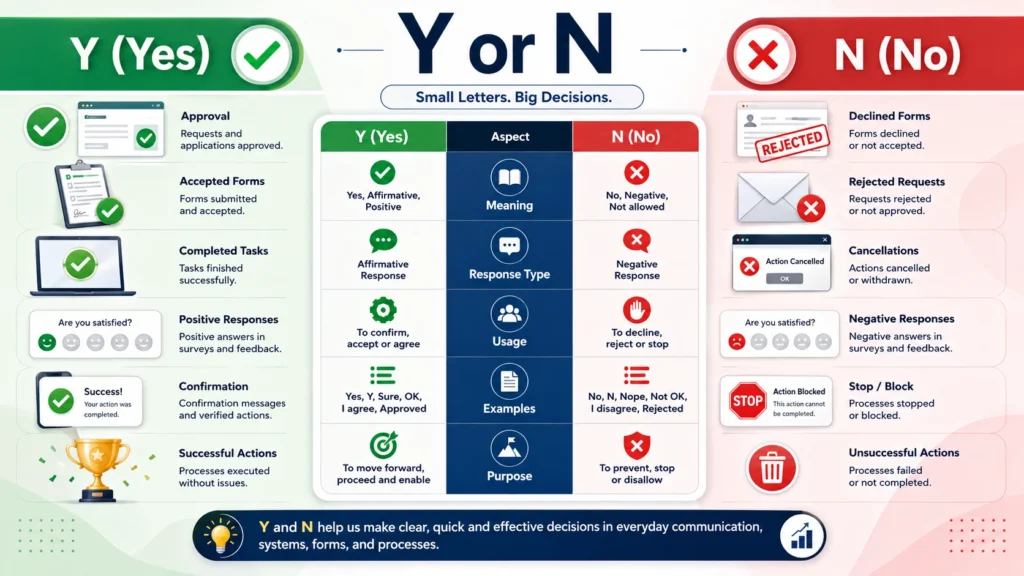
The keyword “y or n” is unusual because it can mean different things depending on context. Most commonly, Y stands for Yes and N stands for No in forms, surveys, computer systems, databases, programming, and online communication. Understanding when to use Y or N helps people answer questions quickly, store data efficiently, and avoid confusion.
The phrase “y or n” appears everywhere. You may see it on online forms, computer screens, surveys, mobile apps, questionnaires, databases, and even text messages. At first glance, it looks simple. The letter Y usually means Yes, while the letter N usually means No.
Even though the concept seems straightforward, many people still have questions about it. Should you type Y or N? Why do some systems use Y/N instead of Yes/No? Is it acceptable in professional settings? Does it mean the same thing around the world?
These questions matter because Y and N are used in many important situations. Businesses use them to collect information. Software developers use them in programs. Researchers use them in surveys. Customers use them when answering forms.
This guide explains everything about y or n, from basic definitions to advanced applications. By the end, you will understand where it came from, how it is used, common mistakes to avoid, and how to use it correctly in real life.
Quick Answer
Y means Yes.
N means No.
The expression “y or n” is a shorthand way of asking someone to choose between a positive response and a negative response.
| Letter | Meaning | Purpose |
|---|---|---|
| Y | Yes | Positive response |
| N | No | Negative response |
| Y/N | Yes or No | Binary choice |
Simple Example
Question:
“Would you like to continue? (Y/N)”
Answers:
- Y = Continue
- N = Stop
This simple format is used in countless digital and paper systems.
What Does Y or N Mean?
The expression y or n is an abbreviation.
Instead of writing:
- Yes
- No
A system asks users to enter:
- Y
- N
This saves space and speeds up data entry.
Why It Became Popular
There are several reasons:
- Faster typing
- Less storage in older computer systems
- Easier database management
- Quick survey responses
- Simpler user interfaces
In the early days of computing, memory and storage were limited. Using one character instead of a full word helped reduce resource usage.
Today, the tradition continues because it remains efficient.
Definition of Y
What Is Y?
Y is the abbreviation for Yes.
It indicates:
- Agreement
- Acceptance
- Confirmation
- Approval
- Positive response
Examples
Question:
“Do you accept the terms?”
Answer:
Y
Question:
“Would you like email notifications?”
Answer:
Y
In both cases, Y means the user agrees.
Definition of N
What Is N?
N is the abbreviation for No.
It indicates:
- Rejection
- Disagreement
- Refusal
- Negative response
Examples
Question:
“Do you want to save changes?”
Answer:
N
Question:
“Would you like to subscribe?”
Answer:
N
In these situations, N means the user declines.
The Difference Between Y and N
The main difference is the response type.
| Feature | Y | N |
|---|---|---|
| Meaning | Yes | No |
| Response Type | Positive | Negative |
| Indicates | Acceptance | Rejection |
| Action | Continue | Stop |
| Survey Value | Agree | Disagree |
Easy Analogy
Think of a traffic signal.
- Y is like a green light.
- N is like a red light.
One allows movement. The other stops it.
Why Systems Use Y or N
Many systems prefer Y/N because it is simple.
Faster Input
Users type one character instead of a full word.
Reduced Errors
A limited choice means fewer variations.
For example:
Instead of receiving:
- Yes
- YES
- yes
- Yep
- Sure
A system only stores:
- Y
Better Data Organization
Databases can store information more consistently.
Easier Analysis
Researchers can quickly count positive and negative responses.
Y or N in Computer Programming
Programming frequently uses Y/N values.
User Confirmation
Example:
“Delete file? (Y/N)”
The program waits for a response.
Configuration Settings
Software often stores:
| Setting | Value |
|---|---|
| Notifications Enabled | Y |
| Notifications Disabled | N |
| Auto Save Enabled | Y |
| Auto Save Disabled | N |
Database Fields
Many databases store boolean information using Y and N.
Examples:
- Employee Active: Y
- Employee Active: N
Y or N in Surveys
Surveys commonly use yes/no questions.
Example
Do you own a car?
- Y
- N
Do you exercise weekly?
- Y
- N
This method allows researchers to gather large amounts of information quickly.
Benefits
- Easy to answer
- Easy to analyze
- Consistent data
- Faster completion
Y or N in Online Forms
Online forms frequently include Y/N selections.
Examples
Do you agree to receive emails?
- Y
- N
Have you read the privacy policy?
- Y
- N
Have you previously registered?
- Y
- N
These questions help organizations collect structured information.
Y or N in Text Messaging
Many people use Y and N informally.
Examples
“Coming tonight? Y/N”
“Need help? Y/N”
This style is common among younger users and in fast-paced conversations.
Advantages
- Quick
- Easy
- Convenient
Disadvantages
- Can seem informal
- Not suitable for all professional communication
Advantages of Using Y or N
Simplicity
Only two choices exist.
Speed
Users respond quickly.
Consistency
Everyone uses the same format.
Easy Storage
Databases require less space.
Efficient Processing
Software can process responses rapidly.
Disadvantages of Using Y or N
Limited Detail
A user may want to answer:
- Maybe
- Sometimes
- Not sure
Y/N does not allow these options.
Potential Confusion
Some people may not understand the abbreviation.
Accessibility Concerns
Certain users prefer full words.
Oversimplification
Complex questions may require more nuanced answers.
Real World Examples of Y or N
Banking
“Would you like a receipt? (Y/N)”
Healthcare
“Do you have allergies? (Y/N)”
Employment Forms
“Currently employed? (Y/N)”
Education
“Have you completed the course? (Y/N)”
Shopping
“Add gift wrapping? (Y/N)”
These examples show how widely the format is used.
Regional and Global Usage
North America
Y/N is very common in software and surveys.
Europe
Frequently used in forms and databases.
Asia
Often appears in technology systems and registration forms.
Global Digital Platforms
Most international websites understand Y as Yes and N as No.
Because English dominates many software systems, Y/N has become globally recognized.
Common Mistakes When Using Y or N
Using Full Words When Only Y/N Is Accepted
Incorrect:
Question: Enter Y or N
Answer: Yes
Correct:
Answer: Y
Using Lowercase When Uppercase Is Required
Incorrect:
y
Correct:
Y
Some systems are case-sensitive.
Entering Other Responses
Incorrect:
- Maybe
- OK
- Sure
Correct:
- Y
- N
Misunderstanding the Prompt
Always read carefully before answering.
Y or N Versus Yes or No
| Feature | Y/N | Yes/No |
|---|---|---|
| Length | Short | Longer |
| Speed | Faster | Slower |
| Formality | Lower | Higher |
| Database Use | Common | Less Common |
| Human Readability | Moderate | Excellent |
When to Use Y/N
- Forms
- Software
- Surveys
- Databases
When to Use Yes/No
- Professional writing
- Legal documents
- Customer communication
- Reports
Related Concepts and Comparisons
Binary Choices
Y/N is a binary decision.
Only two options exist.
Examples:
- True/False
- On/Off
- Accept/Reject
- Enable/Disable
Boolean Values
Programming often converts Y/N into:
| Y/N | Boolean |
|---|---|
| Y | True |
| N | False |
Checkboxes
Checkboxes are visual versions of Y/N decisions.
Checked = Yes
Unchecked = No
How Businesses Use Y or N
Businesses rely on Y/N fields daily.
Customer Records
Email Subscription:
- Y
- N
Human Resources
Employee Active:
- Y
- N
Inventory Systems
In Stock:
- Y
- N
Marketing
Customer Consent:
- Y
- N
These values simplify reporting and automation.
How Developers Use Y or N
Developers often work with binary decisions.
Configuration Files
Example:
Notifications = Y
User Input
Example:
Continue installation? Y/N
Data Validation
Systems verify that only Y or N is entered.
Automation
Many automated processes depend on these values.
Best Practices for Using Y or N
Make Instructions Clear
State:
“Enter Y for Yes or N for No.”
Accept Both Cases
Allow:
- Y
- y
- N
- n
Validate User Input
Reject invalid answers.
Provide Help Text
Users should understand what each option means.
Consider Accessibility
In some situations, Yes/No may be more user-friendly.
Exercises With Answers
Exercise 1
Question:
Would you like to save the file?
Answer:
Y
Exercise 2
Question:
Do you want to cancel the order?
Answer:
N
Exercise 3
Question:
Have you read the instructions?
Answer:
Y
Exercise 4
Question:
Would you like to unsubscribe?
Answer:
N
Exercise 5
Question:
Do you accept the agreement?
Answer:
Y
Practice Quiz
Choose the correct response.
Question 1
Do you want notifications?
Answer: Y
Question 2
Do you refuse the offer?
Answer: N
Question 3
Do you agree to continue?
Answer: Y
Question 4
Do you wish to stop?
Answer: N
Question 5
Do you accept the invitation?
Answer: Y
Advanced Understanding of Y or N
As systems grow more complex, Y/N values remain important.
Data Analytics
Researchers can quickly count:
- Total Y responses
- Total N responses
Machine Processing
Computers process single-character responses efficiently.
Reporting
Managers can summarize data easily.
Example:
| Response | Count |
|---|---|
| Y | 850 |
| N | 150 |
This immediately reveals trends.
When Not to Use Y or N
Avoid Y/N when more detailed responses are needed.
Poor Example
How satisfied are you?
- Y
- N
Better Example
- Very satisfied
- Satisfied
- Neutral
- Dissatisfied
- Very dissatisfied
Complex questions often require more options.
FAQs
What does y or n mean?
Y means Yes and N means No. It is a shorthand method used in forms, software, surveys, and databases.
Is y or n the same as yes or no?
Yes. Y represents Yes, while N represents No.
Why do computer programs use y or n?
Programs use y or n because it is faster to enter, easier to validate, and simpler to store.
Can I type yes instead of y?
Some systems allow it, but others require only Y or N. Always follow the instructions shown.
Is y or n used worldwide?
Yes. Many international software systems recognize Y as Yes and N as No.
What is the difference between y or n and true or false?
Y/N is designed for user responses, while True/False is often used in programming and logic.
Should forms use y or n or yes or no?
For user friendliness, Yes/No is often better. For databases and internal systems, Y/N is common.
What does y or n mean in texting?
In texting, y or n usually means “yes or no?” and asks for a quick answer.
Can y or n be stored in a database?
Yes. Many databases use Y/N fields to represent binary choices efficiently.
When should I avoid using y or n?
Avoid it when users need more detailed answers than a simple yes or no response.
Conclusion
The phrase “y or n” may look small, but it plays a major role in modern communication, software, databases, surveys, and business systems. In its simplest form, Y means Yes and N means No. This straightforward approach allows users to provide quick responses while helping organizations collect and process information efficiently.
The popularity of Y/N comes from its speed, simplicity, and consistency. It reduces typing, improves data quality, and supports automation. At the same time, it is important to recognize its limitations. Not every question can be answered with a simple yes or no. More complex situations may require additional choices or detailed responses.
When using Y or N, make instructions clear, validate responses properly, and consider whether a binary choice is truly appropriate. Following these best practices ensures better user experiences and more accurate data collection. Whether you are filling out a form, developing software, managing a database, or answering a survey, understanding y or n helps you communicate clearly and effectively.

Victoria Lane is a grammar-focused writer at GramBrix.com, passionate about helping readers master the rules of language. She provides clear explanations and practical examples that make writing more accurate, polished and confident.