Last Updated on July 30, 2026
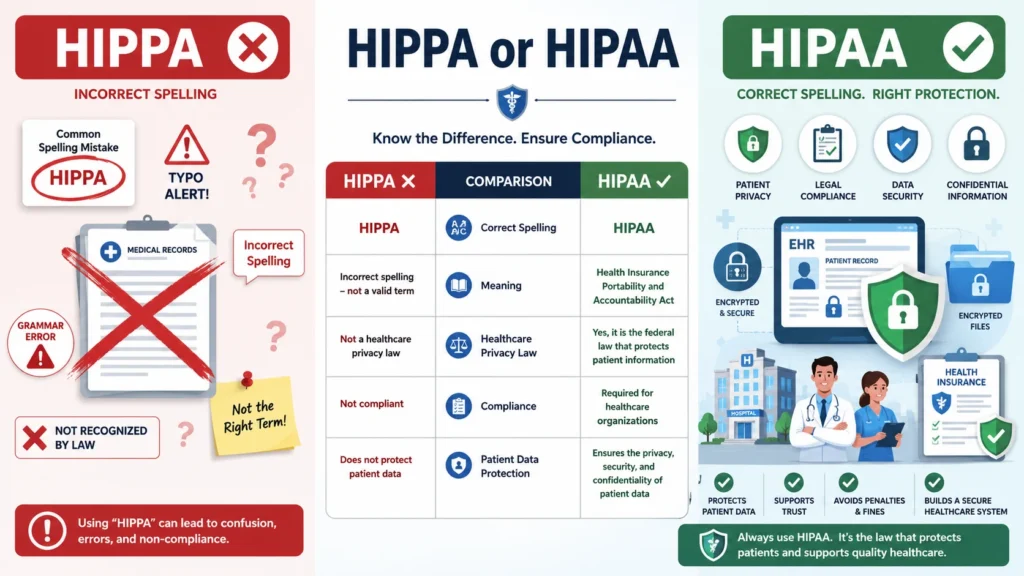
HIPAA is the correct term, while HIPPA is a common misspelling. HIPAA stands for the Health Insurance Portability and Accountability Act, a U.S. law that protects patient health information and establishes privacy and security standards for healthcare organizations.
Many people search for HIPPA or HIPAA because the two terms look very similar. The confusion is understandable. Both words appear in healthcare discussions, medical offices, insurance documents, and privacy compliance training. However, only one of them is correct.
The correct term is HIPAA, which stands for the Health Insurance Portability and Accountability Act of 1996. The term HIPPA is simply a spelling mistake that has become very common online and in everyday conversations.
Understanding the difference matters. If you work in healthcare, insurance, information technology, legal services, or business operations, using the correct acronym helps maintain professionalism and accuracy. Even patients often encounter HIPAA when signing privacy forms at hospitals, clinics, pharmacies, and doctor’s offices.
This guide explains everything you need to know about HIPPA or HIPAA, including definitions, examples, legal requirements, common mistakes, advantages and disadvantages, practical exercises, and frequently asked questions. By the end, you will know exactly why HIPAA is correct and how it affects healthcare privacy in the real world.
Quick Answer
| Term | Correct? | Meaning |
|---|---|---|
| HIPAA | Yes | Health Insurance Portability and Accountability Act |
| HIPPA | No | Common misspelling of HIPAA |
Short answer: Always use HIPAA. Never use HIPPA in professional, legal, medical, or academic writing.
What Is HIPAA?
HIPAA stands for:
Health Insurance Portability and Accountability Act
This U.S. federal law was enacted in 1996 to help protect sensitive patient health information.
HIPAA establishes rules regarding:
- Patient privacy
- Medical record security
- Electronic health information
- Healthcare data sharing
- Patient rights
- Healthcare insurance portability
The law applies to many organizations, including:
- Hospitals
- Clinics
- Doctors
- Dentists
- Pharmacies
- Health insurance companies
- Healthcare clearinghouses
- Business associates handling healthcare data
The goal of HIPAA is to ensure that personal health information remains private and secure.
Why Do People Write HIPPA Instead of HIPAA?
The confusion comes from the order of the letters.
Many people assume the acronym should be:
Health Insurance Privacy and Protection Act
Since privacy is one of HIPAA’s most well-known functions, people naturally place the letter “P” before the second “A.”
However, the actual law is:
Health Insurance Portability and Accountability Act
Therefore, the correct acronym is:
H I P A A
Not:
H I P P A
Easy Memory Trick
Remember:
Portability comes before Accountability.
Portability = P
Accountability = A
Act = A
Therefore:
HIPAA
Definition of HIPAA
HIPAA is a federal law that establishes standards for protecting patient health information while allowing healthcare organizations to operate efficiently.
The law focuses on:
- Privacy of patient information
- Security of electronic records
- Standardization of healthcare transactions
- Protection against unauthorized access
Healthcare providers must follow HIPAA rules whenever they collect, store, transmit, or share patient information.
Understanding Protected Health Information
One of the most important concepts in HIPAA is Protected Health Information (PHI).
PHI includes any information that can identify a patient and relates to health conditions, treatment, or payment.
Examples include:
| Protected Health Information | Example |
|---|---|
| Name | John Smith |
| Address | Home address |
| Phone number | Personal phone |
| Medical record number | Patient ID |
| Insurance details | Policy information |
| Test results | Blood test report |
| Diagnosis | Diabetes diagnosis |
| Treatment records | Surgery documentation |
Healthcare organizations must protect this information from unauthorized access.
The Main Rules Under HIPAA
Several major rules make up HIPAA compliance requirements.
Privacy Rule
The Privacy Rule controls how patient information may be used and disclosed.
It gives patients rights such as:
- Accessing medical records
- Requesting corrections
- Receiving privacy notices
- Limiting certain disclosures
Example
A hospital cannot share a patient’s diagnosis with an unrelated person without proper authorization.
Security Rule
The Security Rule protects electronic health information.
Organizations must implement:
- Administrative safeguards
- Physical safeguards
- Technical safeguards
Examples include:
- Password protection
- Encryption
- Access controls
- Employee training
Breach Notification Rule
Organizations must notify affected individuals when a data breach occurs.
Notifications may also need to be sent to government authorities and, in some cases, the media.
Example
If hackers steal patient records from a healthcare database, the organization may be required to notify impacted patients.
Enforcement Rule
This rule establishes penalties and investigations for HIPAA violations.
Organizations that fail to comply may face:
- Financial penalties
- Corrective action plans
- Government investigations
- Reputational damage
HIPPA or HIPAA in Everyday Use
People encounter HIPAA in many situations.
At a Doctor’s Office
Patients often sign HIPAA privacy acknowledgment forms.
At a Hospital
Medical staff follow HIPAA procedures when discussing patient information.
At a Pharmacy
Prescription information is protected under HIPAA.
In Telehealth
Video consultations must comply with HIPAA privacy standards.
In Healthcare Technology
Electronic health record systems are designed with HIPAA requirements in mind.
HIPAA Compliance Requirements
Healthcare organizations must follow specific compliance requirements.
These typically include:
Administrative Safeguards
- Employee training
- Risk assessments
- Security policies
- Incident response plans
Physical Safeguards
- Locked facilities
- Secure storage
- Visitor controls
- Device protection
Technical Safeguards
- Encryption
- Authentication systems
- Audit logs
- Access restrictions
Compliance is an ongoing process rather than a one-time task.
Advantages of HIPAA
HIPAA provides significant benefits for patients and healthcare organizations.
| Advantage | Description |
|---|---|
| Privacy Protection | Safeguards personal health information |
| Patient Trust | Builds confidence in healthcare providers |
| Data Security | Reduces unauthorized access |
| Standardization | Creates consistent national rules |
| Patient Rights | Gives patients more control over records |
| Accountability | Encourages responsible handling of data |
Improved Privacy
Patients can feel more secure sharing sensitive medical information.
Better Security
Organizations implement stronger cybersecurity measures.
Increased Trust
Healthcare relationships often depend on confidentiality.
Greater Transparency
Patients have more visibility into how their information is used.
Disadvantages and Challenges of HIPAA
Although HIPAA provides important protections, it can also create challenges.
| Challenge | Explanation |
|---|---|
| Compliance Costs | Security measures can be expensive |
| Administrative Burden | Documentation requirements take time |
| Employee Training | Ongoing education is necessary |
| Complex Regulations | Rules can be difficult to interpret |
| Technology Expenses | Secure systems require investment |
Cost Considerations
Small healthcare providers may struggle with compliance expenses.
Operational Complexity
Organizations must continually update policies and procedures.
Risk of Human Error
Many HIPAA violations occur because employees make mistakes.
Real World Examples of HIPAA Compliance
Understanding real scenarios makes HIPAA easier to grasp.
Example One
A nurse discusses a patient’s condition only with authorized medical staff.
Result:
HIPAA compliant.
Example Two
A doctor leaves patient records visible in a public waiting area.
Result:
Potential HIPAA violation.
Example Three
A healthcare organization encrypts all electronic patient records.
Result:
Supports HIPAA compliance.
Example Four
An employee shares patient information on social media.
Result:
Serious HIPAA violation.
Example Five
A patient requests a copy of medical records.
Result:
HIPAA generally grants patients access rights.
HIPAA in the Digital Age
Healthcare increasingly relies on technology.
Modern HIPAA concerns include:
- Cloud storage
- Telemedicine
- Mobile devices
- Electronic health records
- Artificial intelligence
- Cybersecurity threats
Organizations must balance innovation with privacy protection.
Electronic Health Records
Electronic records improve efficiency but require strong security controls.
Remote Work
Healthcare employees working remotely must still follow HIPAA requirements.
Cybersecurity
Ransomware attacks have increased the importance of HIPAA security compliance.
Regional and Global Usage
United States
HIPAA applies specifically to the United States healthcare system.
Healthcare providers throughout the country follow HIPAA standards.
Europe
Europe generally follows different privacy regulations, including:
- General Data Protection Regulation (GDPR)
While GDPR and HIPAA share privacy goals, they are different laws.
Canada
Canada has healthcare privacy laws at federal and provincial levels.
These laws are separate from HIPAA.
Australia
Australia uses its own privacy regulations for healthcare information.
Global Organizations
International companies serving U.S. healthcare clients often need to comply with HIPAA when handling protected health information.
HIPAA Compared With Similar Terms
HIPAA vs GDPR
| Feature | HIPAA | GDPR |
|---|---|---|
| Region | United States | European Union |
| Focus | Health information | Personal data |
| Industry Specific | Yes | No |
| Patient Rights | Yes | Yes |
| Healthcare Focus | Strong | Limited |
HIPAA vs HITECH
| HIPAA | HITECH |
|---|---|
| Original law | Expansion law |
| 1996 | 2009 |
| Privacy framework | Strengthened enforcement |
| Foundation of compliance | Enhanced electronic security |
HIPAA vs PHI
| Term | Meaning |
|---|---|
| HIPAA | Federal law |
| PHI | Protected Health Information |
HIPAA creates the rules. PHI is the information being protected.
Common HIPAA Mistakes
Many organizations make avoidable mistakes.
Using HIPPA Instead of HIPAA
The most obvious mistake is spelling the acronym incorrectly.
Correct:
HIPAA
Incorrect:
HIPPA
Weak Passwords
Poor password practices increase security risks.
Sharing Information Without Authorization
Employees sometimes disclose information improperly.
Lack of Employee Training
Untrained staff members are more likely to violate privacy rules.
Ignoring Security Updates
Outdated software creates vulnerabilities.
Commonly Confused Sentences
| Incorrect | Correct |
|---|---|
| Our company follows HIPPA regulations. | Our company follows HIPAA regulations. |
| HIPPA training is mandatory. | HIPAA training is mandatory. |
| HIPPA compliance protects patient data. | HIPAA compliance protects patient data. |
| The HIPPA Privacy Rule applies here. | The HIPAA Privacy Rule applies here. |
| We completed HIPPA certification. | We completed HIPAA compliance training. |
How to Remember HIPAA Correctly
Try these memory techniques.
Method One
Break down the acronym:
Health
Insurance
Portability
Accountability
Act
HIPAA
Method Two
Think:
Two A’s at the end.
Accountability + Act
HIPAA
Method Three
Repeat:
“Portability and Accountability”
Not:
“Privacy and Protection”
Exercises With Answers
Exercise 1
Which spelling is correct?
A. HIPPA
B. HIPAA
Answer
B. HIPAA
Exercise 2
What does the first “A” in HIPAA represent?
A. Authorization
B. Accountability
C. Administration
Answer
B. Accountability
Exercise 3
What does HIPAA protect?
A. Patient health information
B. Restaurant menus
C. Vehicle registrations
Answer
A. Patient health information
Exercise 4
Is HIPPA an official healthcare law?
Answer
No. HIPPA is a misspelling of HIPAA.
Exercise 5
Which is protected by HIPAA?
A. Medical records
B. Weather reports
C. Movie reviews
Answer
A. Medical records
Advanced Understanding of HIPAA
For professionals, HIPAA extends beyond basic privacy.
Key areas include:
Risk Management
Organizations regularly evaluate security risks.
Access Control
Only authorized personnel may access protected information.
Audit Trails
Systems track who accesses records and when.
Data Encryption
Sensitive information is protected during storage and transmission.
Vendor Management
Third party vendors handling healthcare data must also meet HIPAA requirements.
Best Practices for HIPAA Compliance
Organizations should follow these recommendations.
- Conduct annual risk assessments
- Train employees regularly
- Encrypt sensitive information
- Limit data access
- Monitor systems continuously
- Create breach response plans
- Update software frequently
- Maintain compliance documentation
These practices help reduce privacy and security risks.
FAQs
Is HIPPA or HIPAA correct?
HIPAA is correct. HIPPA is a common misspelling of the healthcare privacy law.
What does HIPAA stand for?
HIPAA stands for Health Insurance Portability and Accountability Act.
Why do people spell HIPAA as HIPPA?
Many people mistakenly assume the acronym relates directly to privacy, causing them to place the second “P” before the “A.”
Is HIPPA an official law?
No. HIPPA is not an official law or regulation.
What information does HIPAA protect?
HIPAA protects Protected Health Information, including medical records, diagnoses, treatment information, and insurance details.
Who must comply with HIPAA?
Healthcare providers, health plans, healthcare clearinghouses, and many business associates must comply with HIPAA requirements.
Can individuals violate HIPAA?
HIPAA generally applies to covered entities and business associates, though individuals working for those organizations can cause violations.
Does HIPAA apply outside the United States?
HIPAA is a U.S. law, but international organizations handling U.S. healthcare data may need to comply.
What happens if a company violates HIPAA?
Consequences can include fines, investigations, corrective actions, and reputational damage.
How can I remember the difference between HIPPA and HIPAA?
Remember that HIPAA stands for Health Insurance Portability and Accountability Act. The acronym ends with two A’s because of Accountability and Act.
Conclusion
The debate over HIPPA or HIPAA has a simple answer: HIPAA is the correct term, and HIPPA is a misspelling. HIPAA stands for the Health Insurance Portability and Accountability Act, a landmark U.S. law designed to protect patient health information and establish standards for privacy, security, and data management in healthcare.
Understanding the correct spelling is more than a grammar issue. It reflects professionalism, legal accuracy, and awareness of healthcare compliance requirements. Whether you are a patient, healthcare worker, administrator, IT professional, or business owner, using the correct acronym helps prevent confusion and improves communication.
Remember the simple rule: Portability and Accountability create HIPAA. If you see HIPPA, it is incorrect.
For organizations, maintaining HIPAA compliance requires ongoing training, security controls, risk assessments, and careful handling of Protected Health Information. For individuals, understanding HIPAA helps protect privacy rights and encourages informed healthcare decisions.
Using the correct term and understanding its purpose are the first steps toward better healthcare privacy awareness.

Victoria Lane is a grammar-focused writer at GramBrix.com, passionate about helping readers master the rules of language. She provides clear explanations and practical examples that make writing more accurate, polished and confident.