Last Updated on July 5, 2026
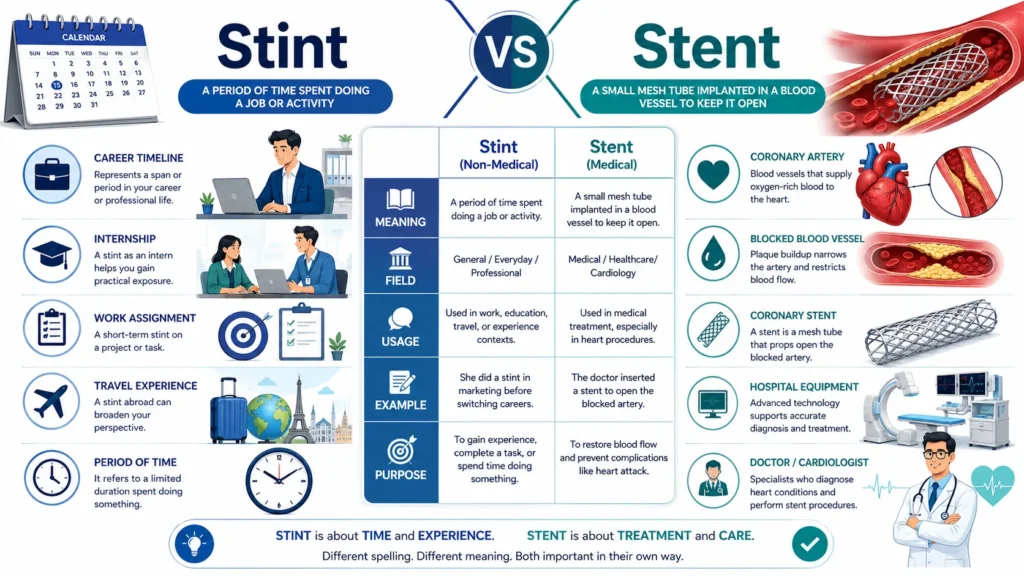
“Stint” and “stent” are two different words with completely different meanings. A stint refers to a period of time spent doing a job, activity, or task, while a stent is a small medical device inserted into a blood vessel or other passageway to keep it open. Confusing these words can lead to serious misunderstandings, especially in healthcare and professional writing.
The confusion between stint or stent is common because the two words look and sound similar. Many people accidentally use one when they mean the other. While this mistake may seem small, it can completely change the meaning of a sentence.
Imagine reading that someone “received a stint in a coronary artery.” That sentence sounds strange because a stint is a period of work or activity. The correct word would be stent, which is a medical device used in arteries. Likewise, saying someone “completed a stent at a company” would be incorrect because a person completes a stint at a job, not a stent.
Understanding the difference between these words is important for students, writers, healthcare professionals, job seekers, and anyone who wants to communicate clearly. This guide explains the meanings of both terms, provides examples, highlights common mistakes, and offers practical exercises to help you remember the correct usage.
By the end of this article, you will never confuse stint or stent again.
Quick Answer
| Word | Meaning | Example |
|---|---|---|
| Stint | A period of time spent doing a task, job, or activity | She completed a six month stint abroad. |
| Stent | A medical tube or device used to keep a passage open in the body | The patient received a coronary stent. |
Simple Rule
- Stint = Time
- Stent = Medical Device
If you are talking about work, service, duty, or time, use stint.
If you are talking about healthcare, arteries, blood flow, or surgery, use stent.
What Does Stint Mean?
A stint is a fixed period during which a person performs a task, job, duty, or activity.
It often refers to employment, military service, volunteering, sports participation, or any temporary assignment.
Definition
Stint (noun): A limited period spent doing a particular job, activity, or task.
Examples
- He completed a two year stint in the military.
- She had a brief stint as a teacher.
- The actor’s stint on the television show was successful.
- During his stint overseas, he learned a new language.
- Her internship stint helped build valuable skills.
Common Contexts for Stint
Employment
Many professionals have multiple stints throughout their careers.
Example:
- She enjoyed her stint at the marketing agency.
Sports
Athletes often spend stints with different teams.
Example:
- The player returned after a successful stint in Europe.
Volunteer Work
Example:
- His volunteer stint lasted six months.
Education
Example:
- She completed a research stint at a university.
What Does Stent Mean?
A stent is a medical device used to keep a body passage open.
Doctors commonly place stents in arteries that have become narrowed or blocked. This helps restore normal blood flow.
Definition
Stent (noun): A small tube inserted into a blood vessel or other body passage to keep it open.
Examples
- The patient received a heart stent after a blockage was discovered.
- Doctors inserted a stent into the artery.
- A coronary stent improved blood flow to the heart.
- The surgeon recommended a stent procedure.
- Modern stents have improved patient outcomes.
Types of Stents
| Type | Purpose |
|---|---|
| Coronary Stent | Keeps heart arteries open |
| Vascular Stent | Supports blood vessels |
| Ureteral Stent | Helps urine flow from kidneys |
| Biliary Stent | Keeps bile ducts open |
| Airway Stent | Supports breathing passages |
Stint or Stent: Side by Side Comparison
| Feature | Stint | Stent |
|---|---|---|
| Part of Speech | Noun | Noun |
| Main Meaning | Period of work or activity | Medical tube or support device |
| Related Field | Employment, sports, service | Medicine, surgery |
| Refers to Time? | Yes | No |
| Refers to Healthcare Device? | No | Yes |
| Example | A stint in London | A coronary stent |
The Origins of Stint and Stent
Understanding the history of these words helps explain why they have different meanings.
Origin of Stint
The word stint comes from Old English and originally meant to limit, stop, or assign a specific amount of work.
Over time, the meaning evolved into a fixed period devoted to a task or responsibility.
Example:
- A worker’s stint at a factory.
- A soldier’s stint in service.
Origin of Stent
The word stent has a fascinating history.
It comes from the surname of Scottish dentist Charles Stent, who developed a dental material in the nineteenth century. Later, the name became associated with medical devices used to support body structures.
Today, stent is a standard medical term worldwide.
Why People Confuse Stint and Stent
Several factors contribute to confusion.
Similar Spelling
Only one letter differs between the words.
- Stint
- Stent
This makes typing errors common.
Similar Pronunciation
In some accents, the words sound very similar.
Autocorrect Mistakes
Spell check tools may not catch the error because both words are legitimate English words.
Lack of Familiarity
Many people know one word but not the other.
Someone familiar with employment terminology may not know medical terminology, and vice versa.
Real World Examples of Stint
Below are practical examples showing how stint appears in everyday language.
Business
- After a three year stint at the company, she became a manager.
Journalism
- The reporter’s stint in Asia produced award winning stories.
Sports
- His stint with the national team improved his reputation.
Education
- She completed a summer research stint at a leading university.
Government Service
- His stint in public office lasted four years.
Real World Examples of Stent
Medical professionals use the word stent frequently.
Heart Disease Treatment
A patient with blocked coronary arteries may receive a stent to improve blood circulation.
Kidney Treatment
Doctors sometimes place a ureteral stent to help urine flow properly.
Bile Duct Procedures
A biliary stent can relieve blockages affecting digestion.
Airway Support
Some patients receive airway stents to improve breathing.
Advantages and Disadvantages of a Stint
Although a stint is not an object, it can have benefits and drawbacks.
Advantages
Skill Development
Short assignments often build experience.
Career Growth
Different stints expose people to new opportunities.
Networking
Temporary roles help create professional connections.
Flexibility
People can explore different industries.
Disadvantages
Limited Stability
Short stints may not provide long term security.
Adjustment Periods
Frequent changes require adaptation.
Reduced Benefits
Some temporary positions offer fewer benefits.
Advantages and Disadvantages of a Stent
Medical stents also have benefits and risks.
Advantages
Improved Blood Flow
Stents help restore circulation.
Reduced Symptoms
Patients often experience less pain.
Less Invasive
Many stent procedures avoid major surgery.
Faster Recovery
Recovery times are often shorter than traditional operations.
Disadvantages
Risk of Blood Clots
Some patients require long term medication.
Potential Complications
Infections or device problems may occur.
Repeat Procedures
Some patients need additional treatment later.
Regional and Global Usage
The words stint and stent are used throughout the English speaking world.
United States
Both terms are common.
- Stint is frequently used in business and sports.
- Stent is widely used in healthcare.
United Kingdom
The same distinction exists.
British newspapers regularly refer to:
- A politician’s stint in office.
- A patient receiving a coronary stent.
Canada
Canadian English follows the same usage patterns.
Australia and New Zealand
The words retain identical meanings.
No major regional variation exists regarding the definitions.
Common Mistakes and Corrections
Understanding mistakes helps prevent future errors.
| Incorrect | Correct |
|---|---|
| He received a stint in his artery. | He received a stent in his artery. |
| She had a stent working abroad. | She had a stint working abroad. |
| Doctors inserted a stint into the vessel. | Doctors inserted a stent into the vessel. |
| His stent at the company lasted a year. | His stint at the company lasted a year. |
| The patient needed another stint procedure. | The patient needed another stent procedure. |
Memory Tricks for Remembering the Difference
Simple memory techniques can make the distinction easy.
Stint Has an “I” for Interval
An interval is a period of time.
- Stint = Time period
Stent Has an “E” for Emergency Medicine
Many stents are used in emergency medical situations.
- Stent = Medical device
Work Versus Health
Ask yourself:
Are you discussing a job or activity?
Use stint.
Are you discussing a medical procedure?
Use stent.
Related Concepts and Comparisons
Several words are related to stint and stent.
Stint vs Assignment
| Stint | Assignment |
|---|---|
| Focuses on time period | Focuses on task |
| Temporary duration | Specific responsibility |
Example:
- Her six month stint included a major assignment.
Stent vs Bypass Surgery
| Stent | Bypass Surgery |
|---|---|
| Less invasive | More invasive |
| Faster recovery | Longer recovery |
| Tube inserted into artery | New blood flow route created |
Stint vs Tenure
| Stint | Tenure |
|---|---|
| Usually temporary | Often long term |
| Fixed period | Longer service period |
Stint in Professional Writing
Writers frequently use stint when describing careers.
Examples:
- His stint as CEO transformed the company.
- During her stint in Paris, she expanded the business.
- The journalist’s stint abroad inspired a bestselling book.
Professional resumes and biographies often contain this word.
Stent in Medical Writing
Healthcare publications frequently mention stents.
Examples:
- Drug eluting stents reduce artery narrowing.
- The patient underwent coronary stent placement.
- Modern stent technology continues to improve.
Medical records require precise usage because confusing stint and stent could create serious misunderstandings.
Exercises with Answers
Exercise 1
Choose the correct word.
- She completed a six month _____ in Germany.
- Doctors inserted a _____ into the blocked artery.
- His _____ at the company ended last year.
- The patient required another _____ procedure.
- Her teaching _____ improved her skills.
Answers
- Stint
- Stent
- Stint
- Stent
- Stint
Exercise 2
- He received a stint after his heart attack.
- Her stent at the law firm lasted two years.
- The surgeon inserted a stint into the artery.
- My summer stent taught me valuable skills.
Answers
- He received a stent after his heart attack.
- Her stint at the law firm lasted two years.
- The surgeon inserted a stent into the artery.
- My summer stint taught me valuable skills.
Exercise 3
Fill in the blanks.
- A temporary period of work is called a ______.
- A device used to keep an artery open is called a ______.
- His overseas ______ lasted one year.
- The doctor recommended a coronary ______.
Answers
- Stint
- Stent
- Stint
- Stent
FAQs
What is the difference between stint and stent?
A stint is a period spent doing work or an activity. A stent is a medical device used to keep a passage in the body open.
Is stint a medical term?
No. A stint generally refers to time spent performing a job, role, or activity.
Is stent related to heart surgery?
Yes. A coronary stent is commonly used to treat blocked heart arteries.
Can I say a stint in a company?
Yes. “A stint in a company” is correct and commonly used in professional writing.
Can I say a stent at a company?
No. A stent is a medical device, not a period of employment.
What does a coronary stent do?
A coronary stent helps keep an artery open and improves blood flow to the heart.
Why are stint and stent often confused?
They look and sound similar, differing by only one letter.
How can I remember stint or stent correctly?
Think of stint = interval of time and stent = emergency medical device.
Are stint and stent interchangeable?
No. They have completely different meanings and should never be used interchangeably.
Which word should I use in a resume: stint or stent?
Use stint when describing a period of employment or work experience.
Conclusion
The distinction between stint or stent is simple once you understand their meanings. A stint refers to a period of time spent doing a particular job, task, role, or activity. It is commonly used in professional, educational, military, and sports contexts. A stent, on the other hand, is a medical device designed to keep arteries, blood vessels, or other body passages open. It belongs entirely to the field of medicine.
Because the words differ by only one letter, mistakes are common. However, using the wrong word can create confusion and, in medical situations, may even affect clarity in important communications. A helpful memory trick is to associate stint with an interval of time and stent with a medical treatment device.
When writing, always consider the context. If you are discussing employment, service, experience, or duration, choose stint. If you are discussing healthcare, surgery, arteries, or medical procedures, choose stent. Following this simple rule will help ensure accurate and professional communication every time.

Kevin Brooks is a grammar specialist at GramBrix.com, dedicated to helping readers understand language rules with clarity and confidence. He simplifies complex grammar concepts through practical examples and easy explanations.