
Last Updated on July 9, 2026
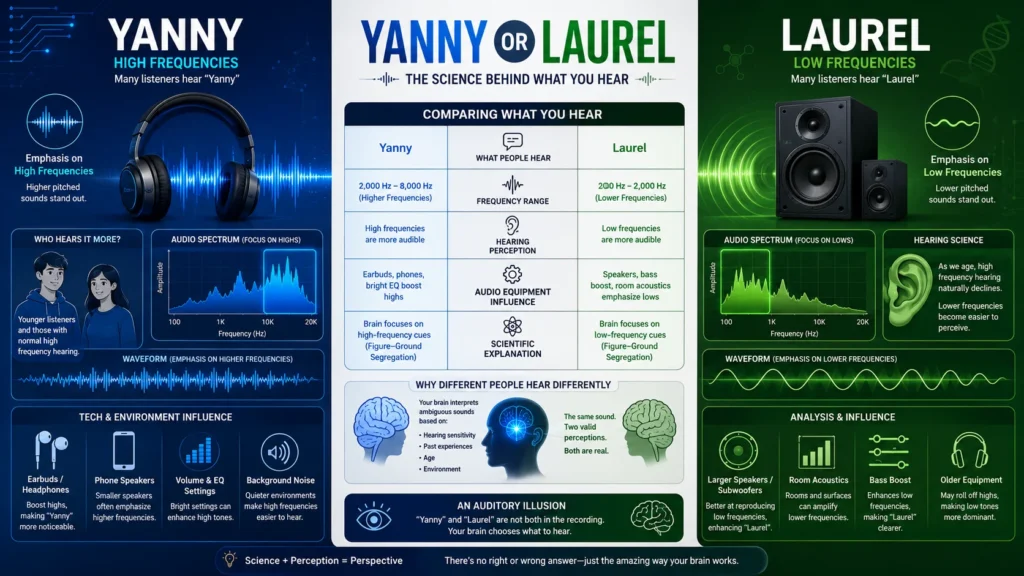
Yanny or Laurel refers to a viral audio illusion that caused people to hear two different words from the same sound clip. Some listeners hear “Yanny,” while others hear “Laurel,” depending on factors such as audio frequency, hearing ability, speaker quality, and brain processing.
The phrase yanny or laurel became one of the most famous internet debates of modern times. Millions of people listened to a short audio clip and argued about what they heard. Some clearly heard the word “Yanny.” Others were certain the recording said “Laurel.”
What made the debate so interesting was that both groups were confident they were right.
Unlike a simple spelling mistake or misunderstanding, this audio clip showed how human hearing works. It revealed that our ears and brains do not always process sounds in the same way.
The yanny or laurel phenomenon quickly spread across social media, television, schools, and science websites. It became a fascinating example of auditory perception and cognitive processing.
Understanding why people hear different words can teach us about sound frequencies, hearing ranges, age related hearing changes, and how the brain interprets information.
This guide explains everything about yanny or laurel, from its origin to the science behind the illusion, along with examples, exercises, common mistakes, and expert insights.
Quick Answer
The audio recording technically contains the word Laurel.
However, some people hear Yanny because different frequencies within the audio clip become more noticeable depending on hearing ability, speaker settings, headphone quality, and brain interpretation.
In short:
| Question | Answer |
|---|---|
| What was actually recorded? | Laurel |
| Why do some people hear Yanny? | Higher frequencies become more prominent |
| Why do others hear Laurel? | Lower frequencies dominate |
| Is either listener wrong? | No |
| What does it demonstrate? | Auditory illusion and perception differences |
What Is Yanny or Laurel?
Yanny or Laurel is an auditory illusion in which listeners perceive different words from the same audio recording.
An auditory illusion occurs when the brain interprets sound differently than expected.
Just as optical illusions can trick the eyes, auditory illusions can trick the ears.
The yanny or laurel recording became famous in 2018 when a student shared it online. The clip spread rapidly, and people around the world began debating what they heard.
The recording sounded like:
- Laurel to some listeners
- Yanny to others
- A mixture of both for some people
This unusual difference sparked interest among scientists, audiologists, psychologists, and the general public.
The Origin of the Yanny or Laurel Debate
The audio originated from an online vocabulary recording.
The original spoken word was “Laurel.”
When the recording was played through different devices and frequency ranges, listeners began hearing different sounds.
Social media platforms amplified the discussion. Celebrities, scientists, journalists, and politicians joined the conversation.
The debate became one of the most widely discussed auditory phenomena in internet history.
How Does the Yanny or Laurel Illusion Work?
The explanation lies in sound frequencies.
Human hearing depends on frequency ranges measured in Hertz (Hz).
Different sounds contain:
- Low frequencies
- Mid frequencies
- High frequencies
The yanny or laurel recording contains multiple frequency layers.
Lower Frequencies
Lower frequencies emphasize sounds closer to:
Laurel
These frequencies are easier for many adults to hear.
Higher Frequencies
Higher frequencies emphasize sounds closer to:
Yanny
People who hear higher frequencies more clearly often perceive Yanny.
Brain Interpretation
The brain does not simply receive sound.
It actively interprets information.
When hearing ambiguous audio, the brain chooses the interpretation that best matches the frequencies it detects.
The Science Behind Yanny or Laurel
Scientists studied the clip and found that both words can emerge from different frequency emphasis.
The phenomenon involves:
- Auditory perception
- Cognitive processing
- Frequency filtering
- Hearing sensitivity
- Neural interpretation
Imagine looking at a blurry image.
One person sees a duck.
Another sees a rabbit.
The image is the same.
The interpretation differs.
The same principle applies to yanny or laurel.
Auditory Illusions Explained
An auditory illusion occurs when a sound can be interpreted in multiple ways.
Examples include:
| Auditory Illusion | Description |
|---|---|
| Yanny or Laurel | Different words heard from one clip |
| Shepard Tone | Sound appears to rise forever |
| McGurk Effect | Visual information changes perceived speech |
| Tritone Paradox | Different listeners hear different pitch directions |
| Phantom Words | Repeated sounds create imaginary words |
These examples demonstrate that hearing is not purely mechanical.
The brain plays an active role.
Why Age Matters in the Yanny or Laurel Debate
Age can influence what listeners hear.
As people age, sensitivity to high frequencies often decreases.
This condition is known as age related hearing loss.
Younger Listeners
More likely to hear:
- Yanny
- Higher frequency components
Older Listeners
More likely to hear:
- Laurel
- Lower frequency components
However, age is not the only factor.
Many younger people hear Laurel, and many older people hear Yanny.
The Role of Speakers and Headphones
Audio equipment can significantly affect perception.
Smartphone Speakers
May emphasize certain frequencies.
Laptop Speakers
Can alter balance between high and low frequencies.
Headphones
Often provide a more detailed frequency response.
Professional Audio Equipment
Can reveal both interpretations more clearly.
Because of these differences, two people listening to the same file on different devices may hear different words.
Why the Brain Hears Different Things
The brain constantly predicts incoming information.
This process is called predictive perception.
When sound is unclear, the brain fills gaps using:
- Previous experiences
- Language patterns
- Frequency clues
- Expectations
As a result, two people can hear different words even when listening to identical audio.
Advantages and Disadvantages of the Yanny or Laurel Phenomenon
Advantages
| Advantage | Explanation |
|---|---|
| Educational | Teaches auditory science |
| Entertaining | Encourages discussion |
| Scientific Value | Helps study perception |
| Awareness | Highlights hearing differences |
| Research Tool | Useful in cognitive studies |
Disadvantages
| Disadvantage | Explanation |
|---|---|
| Confusion | People may believe others are wrong |
| Misinterpretation | Can lead to incorrect assumptions about hearing |
| Oversimplification | Hearing differences involve many factors |
| Online Arguments | Viral debates often become polarized |
Real World Examples of Audio Perception Differences
The yanny or laurel example is not unique.
Similar situations occur daily.
Phone Calls
Background noise changes what people hear.
Song Lyrics
Listeners often mishear lyrics.
These are called mondegreens.
Voice Assistants
Devices sometimes misunderstand spoken commands.
Public Announcements
Different listeners may interpret unclear announcements differently.
The same principle of perception applies.
Regional and Global Popularity
The yanny or laurel debate became a worldwide phenomenon.
Countries across North America, Europe, Asia, Australia, Africa, and South America discussed the recording.
Social media helped spread the illusion globally.
People from different languages and cultures experienced similar effects.
This showed that auditory perception is a universal human experience.
Yanny or Laurel Compared With Optical Illusions
Auditory and visual illusions share many similarities.
| Optical Illusion | Auditory Illusion |
|---|---|
| Tricks the eyes | Tricks the ears |
| Visual interpretation varies | Sound interpretation varies |
| Brain fills missing details | Brain fills missing sounds |
| Same image, different views | Same audio, different words |
Examples of visual illusions include:
- Dress color debates
- Ambiguous drawings
- Perspective illusions
Yanny or laurel is the audio equivalent.
Common Mistakes When Discussing Yanny or Laurel
Assuming One Group Is Wrong
Many people believe only one interpretation can be correct.
In reality, the recording contains information that supports both perceptions.
Correction
Recognize that auditory perception varies.
Ignoring Audio Equipment
Different devices affect sound reproduction.
Correction
Test the clip on multiple devices.
Assuming Age Is the Only Factor
Age matters but is not the sole reason.
Correction
Consider hearing ability, environment, and equipment.
Confusing Hearing With Intelligence
Hearing one word does not indicate intelligence or knowledge.
Correction
The difference is mainly perceptual.
Related Concepts
Understanding yanny or laurel becomes easier when studying related topics.
Auditory Perception
How the brain interprets sounds.
Hearing Range
The frequencies a person can detect.
Cognitive Psychology
The study of mental processes.
Speech Recognition
How humans and machines identify spoken language.
Frequency Analysis
Examining sound components by frequency.
Comparison Between Yanny and Laurel
| Feature | Yanny | Laurel |
|---|---|---|
| Frequency Emphasis | Higher | Lower |
| Common Among | Younger listeners | Older listeners |
| Audio Interpretation | Bright sound profile | Deeper sound profile |
| Original Recording | No | Yes |
| Scientific Validity | Perceived interpretation | Actual recorded word |
What Researchers Learned From Yanny or Laurel
Researchers discovered several important lessons.
Hearing Is Subjective
People do not always hear identical sounds.
Perception Depends on Context
Equipment and environment matter.
The Brain Is Predictive
The brain actively constructs meaning.
Auditory Illusions Are Powerful
Simple recordings can reveal complex neurological processes.
Exercises With Answers
Exercise 1
What was the original recorded word?
A. Yanny
B. Laurel
Answer
B. Laurel
Exercise 2
Why do some people hear Yanny?
A. Higher frequencies are emphasized
B. The recording changes words
C. The audio is fake
Answer
A. Higher frequencies are emphasized
Exercise 3
True or False:
Everyone should hear the exact same word.
Answer
False
Auditory perception varies.
Exercise 4
Which factor can influence perception?
A. Headphones
B. Speaker quality
C. Hearing sensitivity
D. All of the above
Answer
D. All of the above
Exercise 5
What type of phenomenon is yanny or laurel?
Answer
An auditory illusion.
Practical Lessons From Yanny or Laurel
The debate teaches several useful lessons.
Listen Carefully
Perception can be influenced by context.
Respect Different Experiences
Others may genuinely perceive something differently.
Verify Information
Not all disagreements result from misinformation.
Understand Human Cognition
The brain actively interprets reality rather than simply recording it.
Yanny or Laurel in Education
Teachers often use the audio clip to explain:
- Hearing science
- Psychology
- Neuroscience
- Communication
- Human perception
Students quickly understand the concepts because the example is engaging and memorable.
Yanny or Laurel and Modern Technology
Modern technologies use principles related to sound perception.
Examples include:
- Speech recognition systems
- Voice assistants
- Hearing aids
- Audio compression
- Artificial intelligence voice processing
Studying auditory illusions helps improve these technologies.
FAQs
What is yanny or laurel?
Yanny or laurel is a famous auditory illusion where listeners hear different words from the same audio clip.
Which word is actually correct?
The original recording contains the word Laurel, although many people genuinely hear Yanny.
Why do I hear Yanny instead of Laurel?
You may be more sensitive to higher frequency components in the recording.
Can the same person hear both Yanny and Laurel?
Yes. Adjusting frequencies or using different devices can change perception.
Is yanny or laurel a hearing test?
No. It is an auditory illusion and should not be used to diagnose hearing ability.
Does age affect the yanny or laurel illusion?
Age can influence perception because hearing sensitivity often changes over time.
Why did the yanny or laurel debate become viral?
The clip demonstrated a surprising difference in human perception and sparked widespread curiosity.
Can headphones change what I hear?
Yes. Different headphones emphasize different frequency ranges.
What scientific field studies yanny or laurel?
Psychology, neuroscience, audiology, linguistics, and cognitive science all study similar phenomena.
What does yanny or laurel teach us about perception?
It shows that perception is not always identical between people and that the brain actively interprets sensory information.
Conclusion
The yanny or laurel phenomenon remains one of the most fascinating examples of auditory perception ever shared online. A single audio clip led millions of people to hear different words, demonstrating that hearing is more complex than many assume.
The original recording says Laurel, yet many listeners genuinely hear Yanny because of frequency emphasis, hearing sensitivity, speaker characteristics, and brain interpretation. This does not mean one group is right and the other is wrong. Instead, it highlights how perception works differently across individuals.
The debate also offers valuable lessons about neuroscience, psychology, communication, and sound engineering. It reminds us that our brains constantly interpret information rather than simply recording it.
If you want to better understand the yanny or laurel illusion, experiment with different headphones, speakers, and audio settings. Doing so can reveal how subtle changes in frequency can dramatically alter what you hear. Most importantly, the phenomenon encourages curiosity about the remarkable way humans experience sound and perceive the world around them.

Justin Powell is a writer at GramBrix.com who focuses on grammar, clarity and effective communication, helping readers strengthen their language skills.