
Last Updated on June 16, 2026
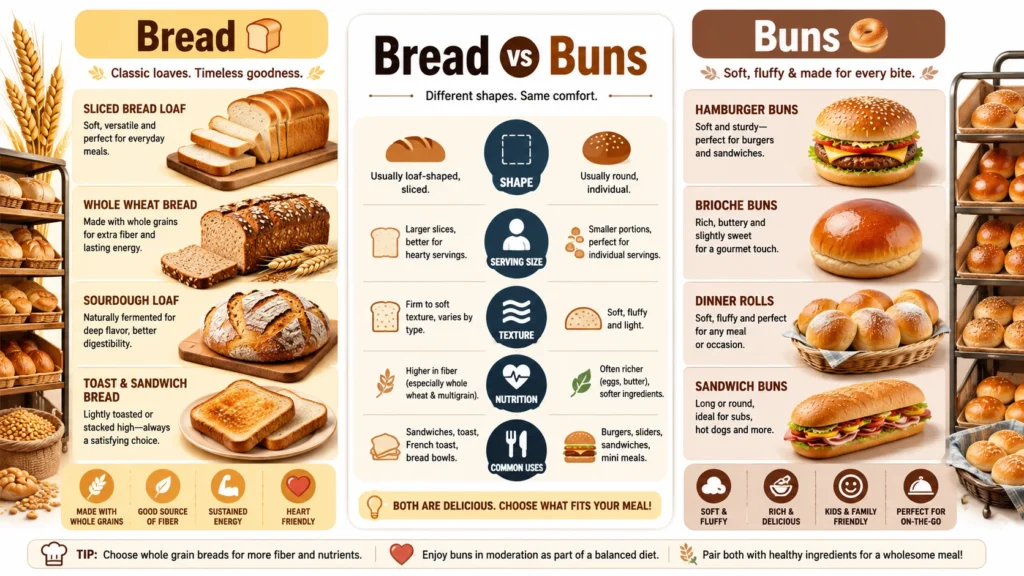
When comparing bread or buns, the main difference is shape, size, and intended use. Bread is usually baked as a loaf and sliced for many purposes, while buns are smaller, individual portions often used for burgers, sandwiches, or served alongside meals. Both are made from similar ingredients, but their texture, appearance, and uses can vary greatly.
Many people use bread and buns every day. They are common foods found in homes, restaurants, bakeries, and grocery stores around the world. Yet many people still wonder about the difference between bread or buns.
At first glance, they seem very similar. Both are usually made from flour, water, yeast, and salt. Both can be soft, fluffy, chewy, or crusty. Both can be used for sandwiches and meals.
The confusion often comes from the fact that buns are a type of bread. However, not all bread is a bun. Understanding the difference can help you choose the right option for meals, baking projects, nutrition goals, and special recipes.
This guide explains everything you need to know about bread or buns, including definitions, advantages, disadvantages, regional differences, examples, common mistakes, and practical exercises. By the end, you will clearly understand when to use bread and when buns are the better choice.
Quick Answer About Bread or Buns
| Feature | Bread | Buns |
|---|---|---|
| Shape | Usually loaf-shaped | Individual round or shaped portions |
| Size | Larger | Smaller |
| Serving | Sliced into pieces | Served individually |
| Uses | Toast, sandwiches, meals | Burgers, sandwiches, side dishes |
| Texture | Can be soft or crusty | Usually softer |
| Baking Style | Baked as one large loaf | Baked as separate pieces |
Short Answer
If you are choosing between bread or buns, bread refers to a larger baked loaf that is sliced before serving, while buns are smaller individual bread portions often designed for specific foods such as burgers or sandwiches.
What Is Bread?
Bread is one of the oldest prepared foods in human history. It is made by combining ingredients such as:
- Flour
- Water
- Yeast
- Salt
Additional ingredients may include:
- Sugar
- Milk
- Butter
- Eggs
- Seeds
- Herbs
The dough rises before baking, creating the familiar texture many people enjoy.
Common Types of Bread
Some popular bread varieties include:
- White bread
- Whole wheat bread
- Sourdough bread
- Rye bread
- Multigrain bread
- French bread
- Italian bread
- Artisan bread
Bread is generally baked as a loaf and sliced after baking.
Characteristics of Bread
Bread often has:
- A larger size
- A loaf shape
- Multiple servings
- A firm outer crust in some varieties
- A soft interior crumb
What Are Buns?
Buns are small, individual bread portions. They are usually baked separately rather than as one large loaf.
Buns often have a soft texture and are designed for easy serving.
Common Types of Buns
Examples include:
- Hamburger buns
- Hot dog buns
- Dinner rolls
- Brioche buns
- Potato buns
- Milk buns
- Sweet buns
Many buns contain slightly more sugar, butter, or eggs than standard bread recipes, creating a softer texture.
Characteristics of Buns
Buns typically feature:
- Individual serving sizes
- Round or oval shapes
- Soft texture
- Easy portability
- Convenient meal portions
Bread or Buns: Detailed Comparison
Shape
Bread is usually baked as a loaf.
Buns are baked as separate portions.
Think of bread as a large pizza and buns as individual slices already separated.
Serving Size
Bread serves multiple people because it is sliced.
Buns are generally intended for one serving each.
Texture
Bread can range from very crusty to very soft.
Buns are usually softer and lighter.
Purpose
Bread is more versatile.
Buns are often designed for specific uses such as:
- Burgers
- Hot dogs
- Sandwiches
- Dinner sides
Storage
Bread may stay fresh longer due to its larger size.
Buns can dry out more quickly because of their greater exposed surface area.
Bread or Buns in Everyday Life
Breakfast
Bread is commonly used for:
- Toast
- French toast
- Avocado toast
- Peanut butter sandwiches
Buns are often used for:
- Breakfast sandwiches
- Sweet breakfast rolls
Lunch
Bread works well for:
- Club sandwiches
- Grilled cheese
- Paninis
Buns work well for:
- Hamburgers
- Chicken sandwiches
- Pulled pork sandwiches
Dinner
Bread may accompany:
- Soups
- Salads
- Pasta dishes
Buns may accompany:
- Barbecue meals
- Holiday dinners
- Family gatherings
The History of Bread
Bread dates back thousands of years.
Ancient civilizations including those in:
- Egypt
- Mesopotamia
- Greece
- Rome
all developed methods of baking bread.
The invention of yeast-leavened bread transformed baking and created softer products similar to many modern breads.
Over time, regional cultures developed unique bread traditions that remain popular today.
The History of Buns
Buns developed later as baking techniques improved.
Their smaller size made them:
- Easier to transport
- Easier to serve
- More convenient for individual meals
The rise of hamburgers and fast food in the twentieth century greatly increased the popularity of buns worldwide.
Advantages of Bread
Greater Versatility
Bread can be used in countless ways.
Examples include:
- Sandwiches
- Toast
- Stuffing
- Bread pudding
- Croutons
Cost Effective
A loaf often provides many servings.
Longer Shelf Life
Large loaves sometimes retain moisture better than individual buns.
Wide Variety
Consumers can choose from many bread styles and flavors.
Disadvantages of Bread
Requires Slicing
Many loaves must be cut before serving.
Less Portable
A whole loaf is harder to carry than individual buns.
Can Become Stale
Once sliced, bread may dry out quickly.
Advantages of Buns
Convenient Portions
Each bun is ready to serve.
Perfect for Specific Foods
Buns fit burgers and sandwiches perfectly.
Easy to Pack
Individual servings make transportation simple.
Soft Texture
Many people enjoy the tenderness of buns.
Disadvantages of Buns
Less Flexible
Buns are often designed for specific uses.
Shorter Freshness
They may become stale faster than large loaves.
Higher Cost Per Serving
Buying individual buns can cost more than purchasing one loaf of bread.
Nutritional Comparison of Bread or Buns
Nutrition depends on ingredients and serving size.
| Nutrient | Bread | Buns |
|---|---|---|
| Calories | Moderate | Moderate to high |
| Fiber | Higher in whole grain versions | Varies by recipe |
| Sugar | Usually lower | Often higher |
| Fat | Usually lower | Sometimes higher |
| Protein | Similar | Similar |
Which Is Healthier?
The healthier choice depends on ingredients.
Whole grain bread often provides:
- More fiber
- More nutrients
- Better satiety
Whole grain buns can offer similar benefits.
The ingredient list matters more than whether the product is bread or a bun.
Bread or Buns for Weight Management
People managing weight often ask whether bread or buns are better.
The answer depends on:
- Portion size
- Calories
- Ingredients
- Overall diet
For example:
- One thick bun may contain more calories than two slices of bread.
- Whole grain bread may provide more fiber and fullness.
Always check nutrition labels.
Bread or Buns for Sandwiches
Bread for Sandwiches
Ideal for:
- Club sandwiches
- Vegetable sandwiches
- Grilled sandwiches
- Deli sandwiches
Buns for Sandwiches
Ideal for:
- Burgers
- Chicken sandwiches
- Barbecue sandwiches
- Sloppy joes
Comparison Table
| Sandwich Type | Best Choice |
|---|---|
| Grilled Cheese | Bread |
| Hamburger | Bun |
| Club Sandwich | Bread |
| Pulled Pork | Bun |
| Tuna Sandwich | Bread |
| Cheeseburger | Bun |
Regional and Global Usage of Bread or Buns
North America
Popular breads include:
- White bread
- Whole wheat bread
- Sourdough
Popular buns include:
- Hamburger buns
- Hot dog buns
- Potato buns
Europe
Bread plays a major cultural role.
Examples include:
- Baguettes
- Rye bread
- Ciabatta
- Rustic loaves
Buns are also common but often served as rolls.
Asia
Many countries enjoy:
- Milk bread
- Steamed buns
- Sweet buns
Asian buns can differ greatly from Western versions.
Middle East
Flatbreads are especially common.
Examples include:
- Pita
- Lavash
- Khubz
South Asia
Popular bread products include:
- Naan
- Roti
- Paratha
Modern burger buns are also widely consumed.
Common Mistakes When Discussing Bread or Buns
Thinking They Are Completely Different Foods
Buns are actually a type of bread.
Assuming All Buns Are Sweet
Many buns are savory.
Believing Bread Is Always Healthier
Nutrition depends on ingredients.
Ignoring Portion Size
Serving size significantly affects calories and nutrition.
Using the Wrong Product
A burger on sliced bread may work, but a bun usually performs better.
Real World Examples
Example 1: Fast Food Restaurant
A burger restaurant typically uses buns because they:
- Hold fillings securely
- Fit burger patties
- Improve presentation
Example 2: Family Breakfast
A family making toast usually chooses bread because:
- It slices evenly
- Fits toasters
- Works with many toppings
Example 3: School Lunch
Bread may be chosen for sandwiches because one loaf creates many servings.
Example 4: Barbecue Party
Buns are preferred for:
- Burgers
- Pulled pork
- Chicken sandwiches
Bread or Buns in Baking
Home bakers often wonder which is easier.
Baking Bread
Requires:
- Mixing dough
- Kneading
- Proofing
- Shaping
- Baking
Baking Buns
Requires:
- Dividing dough
- Portioning evenly
- Individual shaping
Both require similar skills.
Popular Types of Bread
White Bread
Soft and mild.
Whole Wheat Bread
Higher in fiber.
Rye Bread
Distinct flavor.
Sourdough Bread
Tangy taste and chewy texture.
Multigrain Bread
Contains multiple grains and seeds.
Popular Types of Buns
Hamburger Buns
Designed for burgers.
Brioche Buns
Rich and buttery.
Potato Buns
Soft and slightly sweet.
Dinner Rolls
Served with meals.
Milk Buns
Extra soft and fluffy.
Related Concepts and Comparisons
Bread vs Rolls
Rolls are individual portions similar to buns.
Bread vs Bagels
Bagels are boiled before baking.
Bread vs Biscuits
Biscuits have a different preparation method and texture.
Bread vs Flatbread
Flatbread is typically thinner and may not use yeast.
Bread vs Brioche
Brioche is a rich bread made with eggs and butter.
How to Choose Between Bread or Buns
Ask yourself:
What Are You Serving?
- Burgers → Buns
- Toast → Bread
- Club sandwiches → Bread
- Barbecue sandwiches → Buns
How Many People Are Eating?
- Large groups → Bread may be economical
- Individual servings → Buns are convenient
What Texture Do You Want?
- Chewy or crusty → Bread
- Soft and fluffy → Buns
Exercises With Answers
Exercise 1
Choose bread or bun.
A cheeseburger is usually served on a _____.
Answer: Bun
Exercise 2
Choose bread or bun.
French toast is usually made from _____.
Answer: Bread
Exercise 3
Choose bread or bun.
A hot dog is typically served in a _____.
Answer: Bun
Exercise 4
Choose bread or bun.
A loaf is a type of _____.
Answer: Bread
Exercise 5
True or False
All buns are bread.
Answer: True
Exercise 6
True or False
All bread is a bun.
Answer: False
Exercise 7
Which is usually softer?
A. Bread loaf
B. Bun
Answer: B. Bun
Exercise 8
Which is generally more versatile?
A. Bread
B. Bun
Answer: A. Bread
Frequently Asked Questions
Is a bun considered bread?
Yes. A bun is a type of bread baked as an individual serving rather than a large loaf.
Which is healthier, bread or buns?
The ingredients matter more than the form. Whole grain bread or whole grain buns are usually healthier choices.
Can I use bread instead of buns for burgers?
Yes. However, buns usually provide better structure and presentation for burgers.
Why are burger buns softer than bread?
Many burger buns contain extra sugar, butter, milk, or eggs, which create a softer texture.
Are buns sweeter than bread?
Some buns are sweeter, but not all. Many savory buns contain very little sugar.
What is the main difference between bread or buns?
Bread is usually baked as a loaf and sliced, while buns are baked as individual portions.
Are dinner rolls and buns the same thing?
They are very similar. Many people use the terms interchangeably depending on region and style.
Can buns be made from whole wheat flour?
Yes. Whole wheat buns are common and provide more fiber than refined white buns.
Which is better for sandwiches, bread or buns?
It depends on the sandwich. Traditional sandwiches often use bread, while burgers and barbecue sandwiches usually use buns.
Do buns contain more calories than bread?
Sometimes. A large bun may contain more calories than two slices of bread. Always check nutrition information.
Conclusion
The debate between bread or buns is not really about which one is better. Instead, it is about choosing the right option for the situation. Bread is a broad category that includes many styles, textures, and flavors. It is versatile, economical, and suitable for everything from toast to deli sandwiches. Buns, on the other hand, are individual portions of bread designed for convenience, portability, and specific foods such as burgers and sandwiches.
Understanding the difference helps you make better choices in cooking, baking, meal planning, and nutrition. Bread generally offers greater flexibility, while buns provide convenience and structure for certain meals. Neither is automatically healthier than the other. The ingredients, serving size, and preparation method matter most.
For everyday use, keep both available when possible. Choose bread for toast, traditional sandwiches, and general meal preparation. Choose buns when serving burgers, hot dogs, barbecue sandwiches, or individual portions. By matching the product to the purpose, you can enjoy better texture, presentation, and overall eating experience.

Justin Powell is a writer at GramBrix.com who focuses on grammar, clarity and effective communication, helping readers strengthen their language skills.