
Last Updated on June 19, 2026
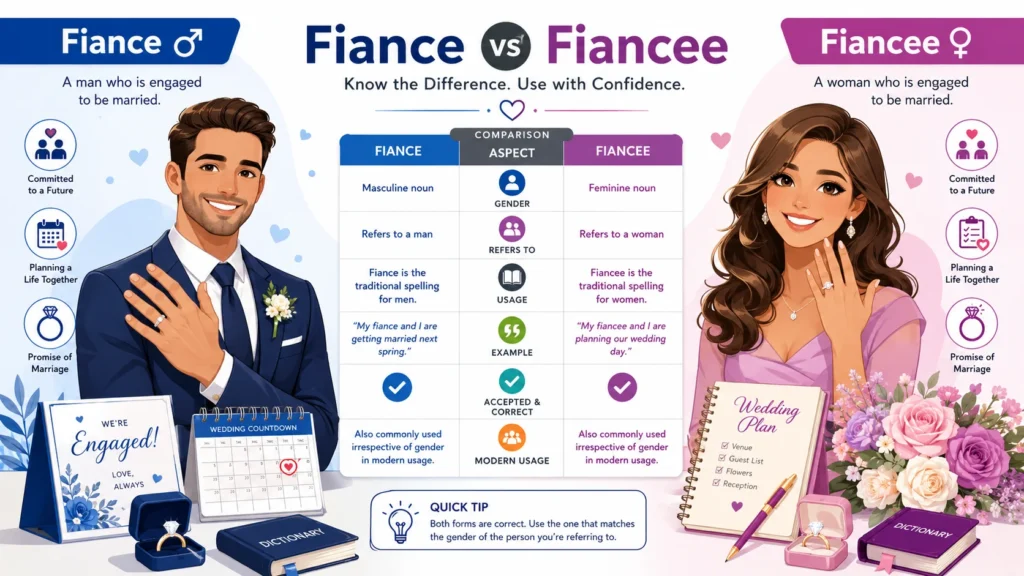
Fiance or fiancee? The difference is simple: fiance traditionally refers to a man who is engaged to be married, while fiancee traditionally refers to a woman who is engaged to be married. In modern English, many people use these terms interchangeably, but knowing the traditional distinction can improve your writing and communication.
Many people get confused when choosing between fiance or fiancee. The words look almost identical. The pronunciation is also very similar. Because of this, many writers, students, and professionals are unsure which spelling to use.
The confusion becomes even greater when writing wedding invitations, social media announcements, legal documents, biographies, or personal profiles. A single extra letter can change the meaning of the word.
Both terms come from French and refer to someone who is engaged to be married. However, traditional grammar rules assign each spelling to a different gender. Understanding this distinction helps you communicate more accurately and professionally.
In today’s world, language continues to evolve. Some people follow traditional rules closely, while others use the words more flexibly. This makes it important to understand both the historical meaning and modern usage.
This guide explains everything you need to know about fiance or fiancee, including definitions, examples, regional usage, common mistakes, exercises, and practical tips.
Quick Answer
| Term | Traditional Meaning | Gender |
|---|---|---|
| Fiance | A person engaged to be married | Male |
| Fiancee | A person engaged to be married | Female |
Simple Rule
- Use fiance for a man.
- Use fiancee for a woman.
Examples
- Sarah introduced her fiance, Michael.
- John introduced his fiancee, Emma.
Understanding the Origin of Fiance and Fiancee
The words fiance and fiancee come from French.
French often changes word endings based on gender. Traditionally:
- Fiancé refers to a man.
- Fiancée refers to a woman.
English borrowed these words from French and adopted the same distinction.
The accent marks are often removed in English writing, resulting in:
- fiance
- fiancee
However, you may still see:
- fiancé
- fiancée
Both versions are generally accepted.
Examples
French Style:
- My fiancé proposed last year.
- Her fiancée loves traveling.
English Style:
- My fiance proposed last year.
- Her fiancee loves traveling.
Definition of Fiance
A fiance is traditionally a man who is engaged to be married.
Examples
- Jennifer and her fiance are planning a summer wedding.
- Her fiance works as an engineer.
- My fiance proposed during our vacation.
Easy Memory Trick
Think of fiance as the shorter word.
Traditionally, it refers to the male partner.
Definition of Fiancee
A fiancee is traditionally a woman who is engaged to be married.
Examples
- Mark and his fiancee recently bought a house.
- His fiancee chose the wedding venue.
- My fiancee loves outdoor weddings.
Easy Memory Trick
The extra “e” in fiancee helps identify the feminine form.
Fiance or Fiancee Comparison Table
| Feature | Fiance | Fiancee |
|---|---|---|
| Meaning | Engaged man | Engaged woman |
| Traditional Gender | Male | Female |
| Origin | French | French |
| Used Before Marriage | Yes | Yes |
| Common in Formal Writing | Yes | Yes |
| Common in Wedding Documents | Yes | Yes |
| Modern Gender Neutral Use | Sometimes | Sometimes |
Why People Confuse Fiance and Fiancee
Several factors contribute to the confusion.
Similar Spelling
Only one letter separates the two words.
- fiance
- fiancee
Similar Pronunciation
Most English speakers pronounce them nearly the same way.
Influence of Modern Language
Many people today focus less on grammatical gender distinctions.
Autocorrect and Spell Check
Some software treats both forms as acceptable, which can reinforce mistakes.
Lack of Formal Grammar Education
Many learners are never taught the French origins of these words.
Real World Examples of Fiance and Fiancee
Understanding actual usage helps clarify the difference.
Wedding Announcement
Correct:
- Jessica and her fiance, Daniel, are excited to announce their engagement.
Correct:
- Daniel and his fiancee, Jessica, are excited to announce their engagement.
Social Media Post
Correct:
- My fiance surprised me with concert tickets.
Correct:
- My fiancee planned the perfect birthday celebration.
Professional Biography
Correct:
- He lives in Chicago with his fiancee.
Correct:
- She lives in Seattle with her fiance.
Legal Documents
Many legal documents specify:
- fiance (male)
- fiancee (female)
Accuracy matters in formal paperwork.
Modern Usage of Fiance and Fiancee
Language changes over time.
Today, many English speakers use fiance as a gender neutral term.
Some style guides accept this modern trend.
Examples
- Alex introduced their fiance.
- My fiance and I are getting married next year.
In these examples, the gender may not be specified.
However, traditional distinctions remain common in:
- Journalism
- Wedding publications
- Formal writing
- Academic writing
- Legal documents
For professional communication, following traditional usage is usually safest.
Regional Usage Around the World
United States
Americans commonly use both terms.
Traditional distinctions remain widespread.
However, gender neutral language is becoming more common.
United Kingdom
British English generally preserves the traditional difference between fiance and fiancee.
Formal publications often follow this rule.
Canada
Canadian English typically follows traditional usage but increasingly accepts gender neutral applications.
Australia and New Zealand
Both countries generally maintain traditional distinctions while recognizing modern flexibility.
International English
Writers learning English as a second language are often taught:
- fiance = man
- fiancee = woman
This remains the clearest and most widely accepted approach.
Advantages and Disadvantages of Using Traditional Distinctions
Advantages
Greater Precision
Readers immediately know the person’s gender.
Professional Appearance
Correct usage demonstrates attention to detail.
Better Formal Communication
Useful in official documents and publications.
Follows Established Grammar
Matches traditional English conventions.
Disadvantages
Slightly More Complex
Writers must remember two spellings.
May Feel Outdated to Some Readers
Some people prefer gender neutral language.
Easy to Mistype
The extra “e” is often forgotten.
Advantages and Disadvantages of Gender Neutral Usage
Advantages
Simpler Writing
Only one form needs to be remembered.
Inclusive Language
May suit modern communication preferences.
Common in Casual Writing
Frequently seen on social media.
Disadvantages
Less Precise
Gender information may be unclear.
Potential Confusion
Some readers may expect traditional distinctions.
Not Always Preferred in Formal Contexts
Editors may correct the usage.
Common Mistakes With Fiance or Fiancee
Mistake One: Using Fiance for a Woman
Incorrect:
- My fiance is named Sarah.
Correct:
- My fiancee is named Sarah.
Mistake Two: Using Fiancee for a Man
Incorrect:
- Her fiancee is named David.
Correct:
- Her fiance is named David.
Mistake Three: Inconsistent Usage
Incorrect:
- My fiance and I are getting married. My fiancee chose the venue.
If referring to the same person, choose one form consistently.
Mistake Four: Confusing Spouse With Fiance
A fiance or fiancee is not yet married.
Incorrect:
- My fiance and I celebrated our 20th wedding anniversary.
Correct:
- My spouse and I celebrated our 20th wedding anniversary.
Related Terms You Should Know
Engaged
A person who has agreed to marry someone.
Example:
- They are engaged.
Bride
A woman on her wedding day.
Example:
- The bride walked down the aisle.
Groom
A man on his wedding day.
Example:
- The groom waited at the altar.
Spouse
A married partner.
Example:
- My spouse works in healthcare.
Partner
A general term for a romantic companion.
Example:
- My partner enjoys hiking.
Fiance, Fiancee, Partner, and Spouse Comparison
| Word | Married? | Gender Specific? |
|---|---|---|
| Fiance | No | Traditionally male |
| Fiancee | No | Traditionally female |
| Partner | No or Yes | Usually gender neutral |
| Spouse | Yes | Gender neutral |
| Husband | Yes | Male |
| Wife | Yes | Female |
When to Use Fiance
Use fiance when:
- Referring to an engaged man.
- Writing formally.
- Following traditional grammar.
- Preparing professional documents.
Examples
- Her fiance proposed during a trip to Paris.
- The fiance attended the wedding planning meeting.
When to Use Fiancee
Use fiancee when:
- Referring to an engaged woman.
- Writing wedding announcements.
- Following traditional style guides.
- Preparing official documents.
Examples
- His fiancee selected the wedding photographer.
- The fiancee designed the invitations.
Tips for Remembering the Difference
Tip One
The female version has an extra “e.”
Tip Two
Think of the extra letter as representing the feminine form.
Tip Three
Remember:
- fiance = man
- fiancee = woman
Tip Four
Practice with sentences until it becomes automatic.
Real Life Scenarios
Scenario One
Michael is engaged to Emma.
Correct sentence:
- Emma introduced her fiance, Michael.
Scenario Two
Emma is engaged to Michael.
Correct sentence:
- Michael introduced his fiancee, Emma.
Scenario Three
A wedding invitation.
Correct:
- John and his fiancee, Rachel, invite you to celebrate their engagement.
Scenario Four
A company biography.
Correct:
- She lives with her fiance and their dog.
Fiance or Fiancee in Professional Writing
Professional writing often requires accuracy.
Examples include:
- News articles
- Academic papers
- Legal records
- Wedding magazines
- Corporate biographies
Editors generally expect traditional usage.
For this reason, understanding fiance or fiancee remains valuable.
Exercises With Answers
Exercise 1
Choose the correct word.
- Sarah introduced her (fiance / fiancee).
- David introduced his (fiance / fiancee).
- My (fiance / fiancee) proposed yesterday.
- Her (fiance / fiancee) works in finance.
Answers
- fiance
- fiancee
- Depends on gender
- fiance
Exercise 2
Correct the sentence.
- My fiance is named Emily.
- Her fiancee is named Mark.
- The fiancee proposed to his partner.
Answers
- My fiancee is named Emily.
- Her fiance is named Mark.
- The fiance proposed to his partner.
Exercise 3
Fill in the blank.
- My _______ and I are planning our wedding. (female partner)
- Her _______ bought an engagement ring. (male partner)
- His _______ selected the venue. (female partner)
Answers
- fiancee
- fiance
- fiancee
FAQs
What is the difference between fiance or fiancee?
A fiance is traditionally a man who is engaged, while a fiancee is traditionally a woman who is engaged.
Can fiance be used for a woman?
In modern casual English, some people use fiance as gender neutral. Traditional grammar reserves fiance for men.
Can fiancee refer to a man?
Traditionally, no. Fiancee refers to an engaged woman.
Which spelling is more common today?
Both are common. Usage depends on context and writing style.
Do I need the accent marks in fiance and fiancee?
No. Most English publications omit the accents, though fiancé and fiancée remain correct.
Is fiance or fiancee used after marriage?
No. After marriage, terms such as spouse, husband, or wife are used.
What should I use in formal writing?
Use fiance for an engaged man and fiancee for an engaged woman.
Are fiance and fiancee pronounced differently?
In English, they are usually pronounced very similarly, which contributes to confusion.
Is fiance gender neutral now?
Some modern writers use fiance as a gender neutral term, but traditional usage remains widespread.
Which term should I use on wedding invitations?
Follow traditional usage for maximum clarity: fiance for a man and fiancee for a woman.
Related Comparisons
People who search for fiance or fiancee often also compare:
- Affect or effect
- Then or than
- Complement or compliment
- Husband or spouse
- Partner or spouse
- Mrs or Ms
- Woman or women
- Who or whom
These pairs highlight how small spelling differences can create different meanings.
Conclusion
Understanding the difference between fiance or fiancee is easier than many people think. Traditionally, a fiance is a man who is engaged to be married, while a fiancee is a woman who is engaged to be married. The distinction comes from French and has been part of English usage for many years.
Although modern language trends sometimes use fiance as a gender neutral term, traditional forms remain the preferred choice in formal writing, professional communication, wedding announcements, journalism, and legal documents. Using the correct term improves clarity and helps readers understand exactly whom you are describing.
If you are unsure which word to choose, remember a simple rule: the extra “e” in fiancee traditionally indicates the feminine form. This small detail can prevent mistakes and make your writing look polished and professional.
For the best results, use traditional distinctions in formal contexts and be consistent throughout your writing. Accuracy, clarity, and consistency will always strengthen your communication.

Kevin Brooks is a grammar specialist at GramBrix.com, dedicated to helping readers understand language rules with clarity and confidence. He simplifies complex grammar concepts through practical examples and easy explanations.