Last Updated on August 17, 2026
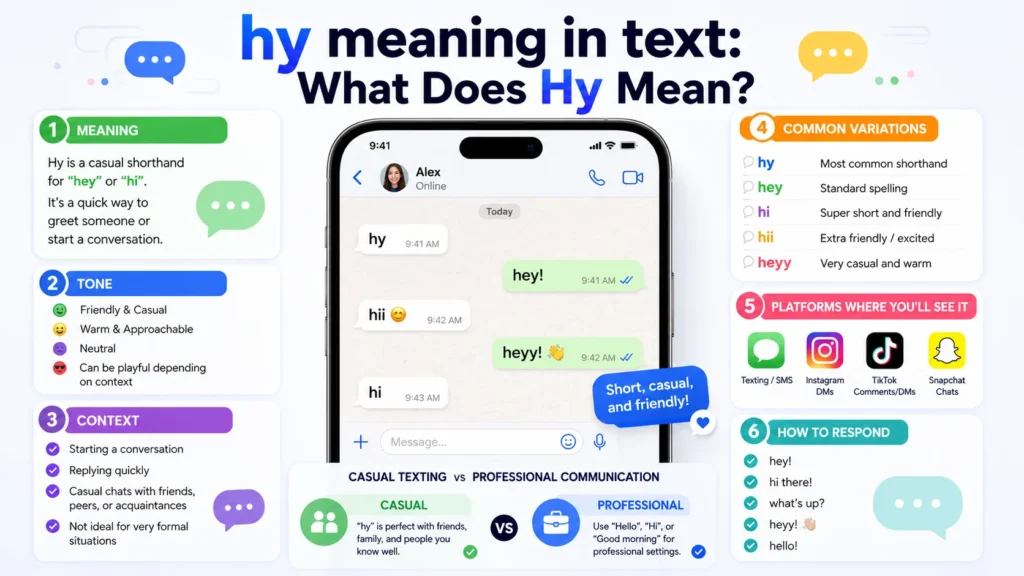
Hy meaning in text is usually “hey,” a casual greeting used in texts, chats, and social media. It can start a conversation, get someone’s attention, or create a friendly tone. Meaning depends on context, spelling, and the relationship between the people chatting.
Hy meaning in text is usually a casual way to write “hey” when someone wants to greet another person online. You may see it in texting, Snapchat messages, Instagram DMs, TikTok comments, gaming chats, or other informal conversations. However, the exact tone can change with context.
For example, “hy” may simply mean hello. It can also sound playful, relaxed, rushed, or informal. Furthermore, some people use it because they type quickly or prefer shortened internet language.
The term does not usually carry a complicated hidden meaning. In most everyday conversations, the sender simply wants to say “hey” or get your attention.
Still, context matters. A message such as “hy” feels different from “HYYYY!” or “hy, are you free?” The words around it can reveal the sender’s intention.
This guide explains the common meaning, social tone, platform differences, conversational examples, possible misunderstandings, and natural responses. It also compares “hy” with related greetings such as “hi,” “hey,” “hii,” and “yo.”
Quick Answer Box
| Meaning | Context | Primary Platforms | Example | Tone |
|---|---|---|---|---|
| Hey or hello | Casual greeting | Snapchat, TikTok, Instagram, texting | “hy, what’s up?” | Friendly |
| Getting attention | Starting a conversation | DMs and messaging apps | “hy, can I ask you something?” | Casual |
| Informal spelling | Fast or relaxed typing | Texting and social media | “hy u free?” | Relaxed |
| Playful greeting | Friendly conversations | DMs and chats | “hy 😂” | Playful |
| Simple acknowledgment | Short exchanges | Messaging platforms | “hy” | Neutral |
What Does hy meaning in text Mean?
The most common interpretation is simple: “hy” means “hey.”
People use it as an informal greeting. It often appears at the beginning of a message when someone wants to open a conversation.
Consider these examples:
“hy, how are you?”
“hy, are you home?”
“hy! Long time no talk.”
In each case, the sender is probably using “hy” as a shortened or informal version of “hey.”
The spelling may come from casual internet communication. Online conversations often encourage speed and informality. People may remove letters, repeat letters, skip punctuation, or use unconventional spellings.
Therefore, “hy” belongs to the broad family of informal digital greetings.
Why Do People Type “Hy” Instead of “Hey”?
There are several possible reasons.
First, the sender may simply type it out of habit. Digital communication develops its own spelling patterns.
Second, the person may want a shorter greeting. “Hy” requires fewer keystrokes than “hey.”
Third, the spelling may reflect a casual communication style. Someone who frequently uses abbreviations might naturally write “hy” without thinking about it.
Finally, some people may use it because they see others using the same spelling online.
Importantly, “hy” does not automatically indicate a particular emotion. You should avoid assuming that it means flirting, annoyance, excitement, or sadness without additional context.
Is It the Same as “Hey”?
Usually, yes.
“Hey” is the standard English spelling. “Hy” is an informal variation that often communicates the same basic idea.
The difference mainly involves style and tone rather than dictionary meaning.
| Expression | Common interpretation | Formality |
|---|---|---|
| Hey | Casual greeting | Informal |
| Hy | Informal version of hey | Very informal |
| Hi | Standard greeting | Neutral |
| Hii | Friendly or playful hi | Informal |
| Heyy | Warm or playful hey | Informal |
| Yo | Casual greeting | Very informal |
| Hello | Standard greeting | More neutral |
However, individual preferences differ. One person may see “hy” as completely normal, while another may consider it an unusual spelling.
Contextual Dynamics and Nuances of the Term
The surrounding message often determines how a short greeting feels.
A single word gives you limited information. Therefore, you should examine what comes next.
For example, compare these messages:
“hy”
“hy 😊”
“hy, can we talk?”
“hy!!!”
“hy bro”
They all begin with the same expression. Yet, their conversational purposes can differ.
Neutral Usage
A simple “hy” can function as a basic greeting.
Person A: hy
Person B: hey, what’s up?
There may be no deeper meaning. The sender could simply be starting a conversation.
Friendly Usage
An emoji or additional phrase can make the greeting warmer.
Message: “hy 😊 how have you been?”
Here, the sender appears friendly and interested in continuing the conversation.
Attention Seeking
Sometimes the greeting works more like a conversational tap on the shoulder.
Message: “hy, are you there?”
In this case, the sender wants a response or wants to confirm that the other person is available.
Playful Usage
Repeated letters, emojis, or exaggerated punctuation can create a playful tone.
Message: “hyyyy 😂”
The longer spelling may suggest enthusiasm or friendliness. However, you should interpret it based on the relationship between the speakers.
Potentially Awkward Usage
A one word message can sometimes feel abrupt.
Message: “hy”
If the recipient does not know the sender well, they may wonder what the person wants.
Consequently, adding a question or topic can make the conversation clearer.
“hy, how was your weekend?”
sounds more purposeful than simply:
“hy”
Real Life Conversation Examples Using hy meaning in text
Real conversations show how the same greeting can work in different situations.
Example 1: Starting a Casual Chat
Alex: hy
Sam: hey! What’s up?
Alex: nothing much. You?
Sam: Just finishing some work.
Here, the greeting simply opens a relaxed conversation.
Example 2: Asking a Question
Mia: hy, are you free tonight?
Jordan: I think so. Why?
Mia: Want to grab something to eat?
In this situation, the greeting introduces a practical question.
Example 3: Reconnecting With Someone
Chris: hy! It’s been forever.
Taylor: Seriously 😂 How have you been?
Chris: Pretty good. I started a new job.
The exclamation mark and follow up make the greeting feel warmer.
Example 4: Getting Someone’s Attention
Jamie: hy
Morgan: hey
Jamie: Can you send me that photo from yesterday?
Here, the sender uses the greeting before making a request.
Example 5: Friendly and Playful
Sam: hyyyy
Alex: lol hey 😂
Sam: What are you doing?
Alex: Watching a movie.
The extended spelling creates a more playful atmosphere.
These examples demonstrate an important point: the greeting itself rarely provides enough information to determine the sender’s complete intention.
Platform Specific Breakdown
Digital platforms develop different communication habits. Therefore, the same informal greeting may feel slightly different depending on where you see it.
How It Is Used on Snapchat
Snapchat conversations often use extremely casual language.
A person might send:
“hy”
“hy u up?”
“hy 😂”
“hy what you doing?”
Snapchat encourages quick exchanges. Therefore, short greetings fit naturally into the platform’s messaging style.
A greeting may also appear before a photo, video, or question.
For example:
Sender: hy
Friend: hey
Sender: check this out 😂
In this situation, the greeting simply creates a conversational opening.
However, do not automatically interpret a Snapchat greeting as romantic. Friends, classmates, coworkers, and acquaintances can all use casual greetings.
The Role of hy meaning in text on TikTok
TikTok comments and direct messages often contain compressed language.
Users may write:
“hy 😂”
“hy what is this”
“hy I need this”
“hy bro”
The meaning remains highly dependent on the surrounding content.
In a comment section, the greeting might be attention grabbing. In a DM, it may be the beginning of a longer conversation.
TikTok also has a strong culture of playful spelling. Consequently, unusual spellings do not necessarily signal an error.
Instagram and Texting Dynamics
Instagram DMs often combine casual greetings with emojis, reactions, and short questions.
For example:
“hy, where did you get that?”
“hy! Love your new post.”
“hy are you coming?”
Text messages work similarly. The greeting can introduce anything from a casual conversation to a practical request.
However, context matters even more when the message comes from someone you rarely speak with.
If a stranger sends only “hy,” you may reasonably wonder why they contacted you. If a close friend sends it, you probably need less context.
Alternative Meanings and NLP Variations of the Phrase
Although the most common interpretation is “hey,” short internet expressions can have multiple uses.
The broader semantic field includes greetings, attention markers, conversational openers, and informal acknowledgments.
“Hi”
“Hi” is a conventional greeting.
It generally feels neutral and friendly.
Example:
“Hi, how are you?”
“Hey”
“Hey” is slightly more conversational.
It can work with friends, acquaintances, coworkers, and even strangers in informal settings.
Example:
“Hey, are you free later?”
“Hii”
The additional “i” often adds warmth or playfulness.
Example:
“Hii! How are you?”
However, extra letters do not have one universal meaning.
“Heyy”
Similarly, “heyy” can sound warmer or more expressive than “hey.”
Example:
“Heyy, what have you been up to?”
Again, context determines whether it sounds friendly, playful, flirtatious, or simply habitual.
“Yo”
“Yo” is more casual.
It can sound confident, relaxed, humorous, or familiar.
Example:
“Yo, you coming?”
“Sup”
“Sup” is a shortened form of “what’s up?”
It functions differently from a basic greeting because it also asks about the person’s current situation.
Example:
“Sup? You online?”
These variations demonstrate why internet slang should be interpreted semantically rather than through spelling alone.
Misinterpretations: When NOT to Use hy meaning in text
Although the expression works well in casual communication, it is not appropriate for every situation.
Formal Emails
Avoid informal spellings in professional emails.
Instead of:
“hy, can you send the report?”
Use:
“Hi, could you please send the report?”
A professional message benefits from clarity and conventional language.
Academic Communication
Teachers, professors, researchers, and university administrators generally expect standard written English.
Therefore, use “Hi” or “Hello” rather than unconventional texting spellings.
Job Applications
A hiring manager may view excessive slang as overly casual.
For example, avoid:
“hy, I’m interested in the position.”
A stronger opening would be:
“Hello, I’m writing to express my interest in the position.”
Customer Service
Customer service communication should prioritize clarity.
A casual greeting may work in some brands’ social media accounts. However, a professional support message usually benefits from standard spelling.
When the Recipient May Not Understand Internet Slang
Not everyone follows online language trends.
Older relatives, international contacts, professional contacts, or unfamiliar audiences may not recognize unconventional spellings immediately.
Consequently, standard language is safer when you are unsure.
How to Respond in Chat Comfortably
The easiest response is usually equally simple.
If someone sends:
“hy”
you can reply:
“Hey!”
or:
“Hi! What’s up?”
If you want to continue the conversation, add a question.
“Hey! How are you?”
“Hi! What’s going on?”
“Hey, what’s up?”
When You Do Not Know the Person
You can remain friendly without becoming overly familiar.
“Hi! Can I help you?”
This response acknowledges the greeting while asking for the person’s purpose.
When You Think They Want Something
A practical response works well.
“Hey, what’s up?”
That gives the sender an opportunity to explain why they reached out.
When You Want to Match Their Tone
Tone matching can make online conversations feel natural.
If someone writes:
“hyyyy 😂”
you might respond:
“heyyy 😂 what’s up?”
However, you do not need to copy their spelling exactly. Natural communication matters more than imitation.
When You Want to Keep Things Professional
Use standard English.
“Hi, how can I help?”
This approach keeps the conversation friendly while maintaining appropriate boundaries.
FAQs
What does hy meaning in text usually mean?
It usually means “hey.” People commonly use it as an informal greeting in texts, DMs, social media, and casual online conversations.
Is “hy” a real English word?
It is not the standard spelling of the English greeting “hey.” Instead, it is an informal digital spelling commonly used in casual communication.
Does “hy” mean hello?
Yes, in most everyday chats it functions like “hello” or “hey.” The exact tone depends on the surrounding conversation.
Is “hy” considered slang?
It can be considered informal internet language. It is more appropriate for casual conversations than formal writing.
Does it mean someone is flirting?
Not necessarily. A person can use the greeting with friends, family, classmates, coworkers, or romantic interests. Context determines the tone.
Why do people write “hy” instead of “hey”?
People may use it because they type quickly, prefer short spellings, or have adopted the form from online conversations. It can also be a personal texting habit.
Should I respond with “hey” or “hi”?
Either response works. “Hey” usually feels more conversational, while “hi” can feel slightly more neutral.
Can I use “hy” in a professional message?
It is better to use “Hi” or “Hello” in professional communication. Standard spelling creates a clearer and more polished impression.
What does “hyyy” mean?
Repeated letters usually add emphasis or emotion. Depending on context, “hyyy” may sound enthusiastic, playful, excited, or affectionate.
What is the safest response to a one word greeting?
A simple response such as “Hey, what’s up?” works in most casual situations. If you do not know the sender, “Hi, can I help you?” is safer.
Conclusion
Understanding hy meaning in text is ultimately about understanding context.
In most casual conversations, “hy” means “hey.” It works as a quick greeting, conversation starter, or attention getter. However, its emotional tone can vary depending on punctuation, emojis, repeated letters, and the relationship between the people involved.
Digital communication constantly changes language. People shorten words, create new spellings, repeat letters, and combine text with emojis. These habits allow users to communicate tone quickly without writing long explanations.
Furthermore, internet language is highly flexible. A spelling that looks unusual in formal English can feel completely natural in a private chat.
That distinction matters.
“Hy” can fit naturally into a casual Snapchat conversation. It may also appear in an Instagram DM or TikTok message. However, the same spelling may look unprofessional in a job application, academic email, or business communication.
The best approach is therefore simple: read the context before interpreting the message.
If a friend sends “hy,” a relaxed “hey!” is usually enough. If an unfamiliar person sends it, you can respond politely while asking what they need.
Most importantly, do not assign hidden meaning to a short greeting without evidence. A single word rarely tells the entire story.
Modern internet slang is shaped by speed, culture, community, and personal communication habits. Understanding those factors makes online conversations easier to interpret and helps you choose responses that feel natural, clear, and appropriate.

Victoria Lane is a grammar-focused writer at GramBrix.com, passionate about helping readers master the rules of language. She provides clear explanations and practical examples that make writing more accurate, polished and confident.