Last Updated on August 17, 2026
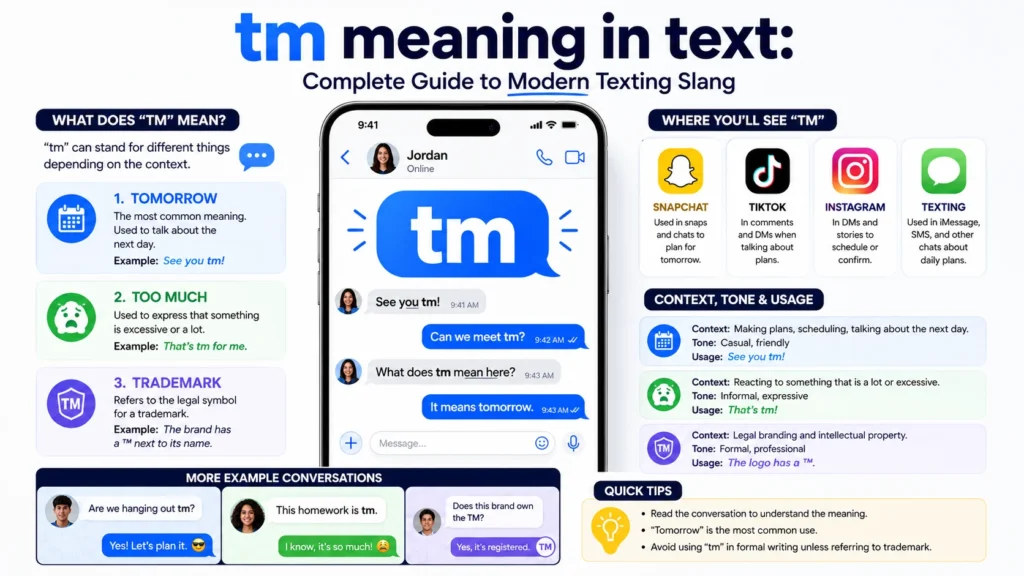
In texting, tm usually means “tomorrow.” It can also mean “too much” in some conversations, so context matters. On Snapchat, TikTok, Instagram, and messaging apps, the intended meaning usually becomes clear from the surrounding words and timing of the message.
tm meaning in text usually refers to “tomorrow,” especially in casual messages about plans, deadlines, appointments, or future events. However, the abbreviation can have other meanings. Therefore, you should always check the surrounding conversation before assuming what someone means.
Internet slang changes quickly. People shorten words to type faster, sound casual, or match the communication style of their friends. As a result, short abbreviations often carry different meanings across communities.
For example, someone might text, “See you tm,” and clearly mean “See you tomorrow.” Meanwhile, another person might use “tm” as shorthand for “too much.” The difference comes from context.
This guide explains the most common interpretation, alternative uses, platform specific patterns, realistic conversations, and practical ways to respond.
Quick Answer Box
| Meaning | Context | Primary Platforms | Example | Tone |
|---|---|---|---|---|
| Tomorrow | Plans and future events | Texting, Snapchat, Instagram | “See you tm” | Casual |
| Too much | Reactions or opinions | Texting, TikTok, social media | “That is tm for me” | Casual |
| Trademark | Business or formal contexts | Websites, documents | “BrandName™” | Formal |
| Context dependent | Specialized conversations | Any platform | “What does tm mean here?” | Neutral |
What Does tm meaning in text Mean?
The most common tm meaning in text is “tomorrow.” People use it as a quick abbreviation when discussing something that will happen the following day.
For example:
“Are we still meeting tm?”
This normally means:
“Are we still meeting tomorrow?”
The abbreviation saves typing time. It also fits the relaxed style of digital communication.
However, tm does not have one universal definition. Depending on the conversation, it can represent “too much,” “trademark,” or another phrase used within a specific community.
Why People Use tm meaning in text
People shorten words for several reasons.
First, abbreviations make messages faster to type. Second, they create a more relaxed tone. Furthermore, short forms can make conversations feel more natural between friends.
Texting culture also rewards efficiency. People frequently use abbreviations such as:
| Abbreviation | Common Meaning |
|---|---|
| tm | Tomorrow |
| tmr | Tomorrow |
| tmrw | Tomorrow |
| rn | Right now |
| idk | I do not know |
| btw | By the way |
| lol | Laughing out loud |
| ngl | Not gonna lie |
| imo | In my opinion |
| asap | As soon as possible |
Not every abbreviation has the same level of popularity. Some forms depend on age, platform, region, and personal preference.
Is tm a Standard English Word?
No. In casual texting, tm functions as an abbreviation rather than standard formal English.
Therefore, you would usually avoid it in academic writing, professional reports, formal applications, or official documents.
For example, this works in a casual chat:
“Can you send it tm?”
A more professional version would be:
“Could you send it tomorrow?”
The second version removes ambiguity and sounds more appropriate for formal communication.
Contextual Dynamics and Nuances
Context determines how readers interpret short internet abbreviations.
When someone writes “tm” alongside words such as “see,” “meet,” “call,” “send,” or “come,” the intended meaning is usually tomorrow.
For example:
“I’ll call you tm.”
Here, “tomorrow” fits naturally.
However, a different sentence can produce a different interpretation.
“That movie was tm.”
In this case, someone might interpret tm as “too much,” although the abbreviation is less universally understood in that sense.
The Words Around the Abbreviation Matter
Look at the entire sentence rather than focusing on two letters.
| Message | Likely Interpretation |
|---|---|
| “See you tm” | Tomorrow |
| “Can you finish tm?” | Tomorrow |
| “Call me tm morning” | Tomorrow |
| “That was tm” | Possibly too much |
| “TM registered brand” | Trademark |
| “What does tm mean?” | Depends on context |
Furthermore, time related words provide strong clues.
Words such as “morning,” “night,” “later,” “meeting,” and “school” often indicate that the abbreviation refers to tomorrow.
Capitalization Can Change the Impression
Lowercase “tm” usually looks like casual texting.
Capitalized “TM” may look more formal or technical. In branding, “TM” commonly refers to “trademark.”
However, capitalization alone does not guarantee a specific meaning. Many people type everything in lowercase.
Therefore, consider capitalization together with the surrounding words.
Real Life Conversation Examples Using tm meaning in text
Real conversations provide the clearest way to understand digital slang.
Example 1: Making Plans
Alex: Are you free tonight?
Jordan: Nope, but I can hang out tm.
Alex: Perfect. Around 5?
Jordan: Yeah, works for me.
Here, tm clearly means tomorrow because the conversation discusses scheduling.
Example 2: School Assignment
Maya: Did you finish the history project?
Chris: Almost. I’ll finish it tm.
Maya: Okay, the teacher wants it in the morning.
Chris: I know. I’ll send it tonight if I can.
The context strongly suggests tomorrow.
Example 3: Casual Follow Up
Sam: You still coming to the game?
Ryan: Yeah, tm right?
Sam: Yep. Starts at 7.
Ryan: Cool. See you there.
The surrounding reference to a future event makes the meaning straightforward.
Example 4: Possible Alternative Meaning
Nina: What did you think of the concert?
Ella: Honestly, tm for me.
Nina: Too much?
Ella: Exactly. Way too loud.
Here, tm means “too much” because the conversation concerns intensity rather than a future date.
This example shows why context matters.
Example 5: Asking for Clarification
Taylor: I can send the details tm.
Morgan: You mean tomorrow?
Taylor: Yep, tomorrow morning.
Morgan: Got it.
Asking for clarification is perfectly acceptable when an abbreviation could have multiple interpretations.
Platform Specific Breakdown
Internet slang does not behave identically everywhere. Platform culture affects how people shorten words and interpret abbreviations.
How It Is Used on Snapchat
Snapchat encourages quick, informal communication. Users often send short messages because conversations happen rapidly.
In this environment, tm meaning in text most commonly points to “tomorrow” when the conversation involves plans.
For example:
“We still meeting tm?”
A friend would likely understand the message immediately.
Snapchat also relies heavily on context. A single abbreviation may appear alongside emojis, photos, videos, or previous messages.
Therefore, the surrounding conversation often provides more information than the abbreviation itself.
The Role of tm meaning in text on TikTok
TikTok has its own rapidly changing vocabulary. Comments and direct messages often use compressed language.
Someone might write:
“Posting the full video tm.”
Here, the meaning is almost certainly tomorrow.
However, TikTok comments can be more ambiguous. Users sometimes invent abbreviations, repurpose existing slang, or use community specific meanings.
Consequently, you should not assume every two letter combination has one fixed definition.
Instagram and Texting Dynamics
Instagram DMs usually follow the same casual communication patterns as ordinary texting.
Friends may write:
“I’ll explain tm lol.”
The meaning depends on the conversation. If the person is talking about a future explanation, tomorrow makes sense.
Instagram comments can be different. Public comments often include slang designed to be short, expressive, or humorous.
Therefore, the same abbreviation may feel natural in a private message but confusing in a public comment.
Other Messaging Apps
The same basic principle applies to iMessage, WhatsApp, Messenger, Discord, and similar services.
The platform rarely determines the definition by itself. Instead, the conversation establishes the meaning.
| Platform | Likely Use | Context Importance |
|---|---|---|
| Snapchat | Tomorrow | Very high |
| TikTok | Tomorrow or community slang | Very high |
| Tomorrow | High | |
| iMessage | Tomorrow | High |
| Tomorrow | High | |
| Discord | Context dependent | Very high |
| Facebook Messenger | Tomorrow | High |
Alternative Meanings and NLP Variations
Understanding tm meaning in text requires more than memorizing one definition.
Language models, search engines, and human readers use contextual signals to determine meaning. The same abbreviation can represent different concepts depending on nearby words.
Tomorrow
This remains the dominant casual interpretation in many texting situations.
Common examples include:
“See you tm.”
“Can we talk tm?”
“I’ll do it tm.”
The abbreviation functions as a shortened form of “tomorrow.”
Too Much
In some conversations, tm can represent “too much.”
For example:
“That price is tm.”
However, this usage is less universal than “tomorrow.” Many readers may not understand it immediately.
Therefore, using “too much” in full can prevent confusion.
Trademark
TM can also mean “trademark.”
You may see it in business, branding, advertising, or legal discussions.
For example:
“The company added TM to its brand name.”
This meaning is very different from the casual texting abbreviation.
The trademark symbol is also commonly represented as ™.
Time Related Interpretation
In certain contexts, people may use “tm” as shorthand connected to time. However, such uses depend heavily on the community.
This is another reason not to interpret abbreviations without context.
NLP Interpretation
From a natural language processing perspective, tm is an ambiguous token.
A language system considers nearby words to identify the likely meaning.
For example:
| Nearby Words | Likely Meaning |
|---|---|
| “see,” “meet,” “call” | Tomorrow |
| “wild,” “expensive,” “intense” | Possibly too much |
| “brand,” “logo,” “registered” | Trademark |
| Specialized terminology | Community specific meaning |
This contextual approach mirrors how humans understand ambiguous language.
Misinterpretations: When NOT to Use tm meaning in text
Although short abbreviations are convenient, they are not appropriate for every situation.
Avoid them when clarity matters more than speed.
Professional Emails
Instead of:
“I’ll send it tm.”
Write:
“I’ll send it tomorrow.”
Professional communication benefits from direct language.
Academic Writing
Avoid casual abbreviations in essays, research papers, and formal assignments.
The full word provides a clearer and more polished presentation.
Important Instructions
If someone needs precise information, avoid ambiguity.
For example:
“Submit it tm.”
could technically create confusion if the recipient does not recognize the abbreviation.
Instead:
“Submit it tomorrow by 10 AM.”
The second version communicates the deadline more clearly.
International Communication
Not every English speaker uses the same internet slang.
Therefore, abbreviations can become especially confusing when people have different linguistic backgrounds.
In those situations, spelling out “tomorrow” is often safer.
How to Respond in Chat Comfortably
You do not need to overthink a short abbreviation.
If the meaning is obvious, respond normally.
Someone says:
“See you tm.”
You can answer:
“Sounds good!”
Or:
“See you tomorrow!”
Both responses work.
When You Understand the Meaning
Keep your response natural.
| Incoming Message | Natural Response |
|---|---|
| “See you tm” | “See you!” |
| “Call me tm” | “Sure, I will.” |
| “Can we meet tm?” | “Yeah, what time?” |
| “I’ll send it tm” | “Okay, thanks.” |
You do not need to repeat the abbreviation.
When You Are Unsure
Ask a simple clarification question.
For example:
“Do you mean tomorrow?”
This sounds natural and avoids an unnecessary misunderstanding.
You can also say:
“What do you mean by tm here?”
That works particularly well when the context does not reveal the intended meaning.
When You Want to Sound Professional
Use the full word.
Instead of:
“I can meet tm.”
Try:
“I can meet tomorrow.”
The second version sounds clearer without being overly formal.
FAQs
What does tm mean in text?
In most casual messages, tm means “tomorrow.” Context can change the interpretation, however, especially when the message discusses opinions or branding.
Is tm the same as tmr?
Usually, yes. Both can represent “tomorrow” in casual digital communication. However, tmr and tmrw may be more immediately recognizable to some readers.
Does tm always mean tomorrow?
No. It can have other meanings. For example, TM can refer to “trademark,” while some people use tm for “too much.”
Is tm commonly used on Snapchat?
Yes. Snapchat users often favor short, informal expressions. Therefore, tm can naturally appear in messages about plans for the next day.
What does TM mean in business?
In business and branding, TM commonly refers to “trademark.” The meaning differs from casual texting.
How should I respond when someone says tm?
First, look at the surrounding message. If the conversation clearly concerns tomorrow, respond normally. If the meaning remains unclear, ask for clarification.
Can I use tm in a professional email?
You can, but it is usually better to write “tomorrow.” Full words reduce ambiguity and create a more professional impression.
Why do people use abbreviations in texting?
People use them to type faster, maintain a casual tone, save space, and match the communication habits of their social group.
Could tm mean something different on TikTok?
Yes. TikTok communities sometimes develop specialized slang. Therefore, comments can have meanings that differ from ordinary texting.
Is tm grammatically correct?
It is acceptable as informal digital shorthand, but it is not a standard replacement for “tomorrow” in formal English writing.
Conclusion
Understanding tm meaning in text starts with one simple rule: context comes first.
In most casual conversations, the abbreviation means “tomorrow.” However, other interpretations exist. “Too much” can appear in informal reactions, while “trademark” belongs to branding and business contexts.
The platform can influence how people communicate. Snapchat, TikTok, Instagram, messaging apps, and online communities all encourage concise language. Nevertheless, the surrounding conversation remains the strongest clue.
Modern internet language constantly evolves. New abbreviations appear, old expressions change meaning, and different communities develop their own vocabulary.
Therefore, effective digital communication is not just about knowing slang. It is about understanding intent.
When a message is obvious, respond naturally. When it is ambiguous, ask. And when clarity matters, use the complete word.
That simple approach helps you understand modern texting without overthinking every abbreviation.

Justin Powell is a writer at GramBrix.com who focuses on grammar, clarity and effective communication, helping readers strengthen their language skills.