
Last Updated on July 15, 2026
| Term | Meaning |
|---|---|
| Sodomized | Traditionally refers to being subjected to sodomy; in modern usage, it may appear in legal, historical, literary, or figurative contexts |
| Category | Definition / Historical Term |
| Common Contexts | History, law, literature, news, conversation |
| Tone | Serious, formal, or figurative depending on context |
| Example | “The historical document used the term sodomized in a legal context.” |
If you have encountered the word sodomized in a book, news article, legal document, historical text, or online discussion, you may wonder exactly what it means.
The term carries historical, legal, religious, and cultural significance. Moreover, its meaning has evolved over time. In modern English, people often encounter the word in discussions about history, law, criminal cases, literature, or figurative speech rather than everyday conversation.
Understanding the sodomized meaning requires looking at its definition, origin, context, and modern usage. Furthermore, it helps to understand when the term is appropriate, when it may be offensive, and how people interpret it today.
This guide explains the term clearly, accurately, and respectfully while covering its various meanings and contexts.
Quick Answer Box
| Category | Explanation |
|---|---|
| Meaning | Subjected to sodomy or described in relation to sodomy |
| Word Type | Verb (past tense and past participle form) |
| Usage | Historical, legal, literary, and figurative |
| Tone | Serious and formal |
| Common Contexts | Law, history, news reports, literature |
| Example | “The court records used the term sodomized.” |
| Modern Use | Less common in everyday speech |
What Does It Mean?
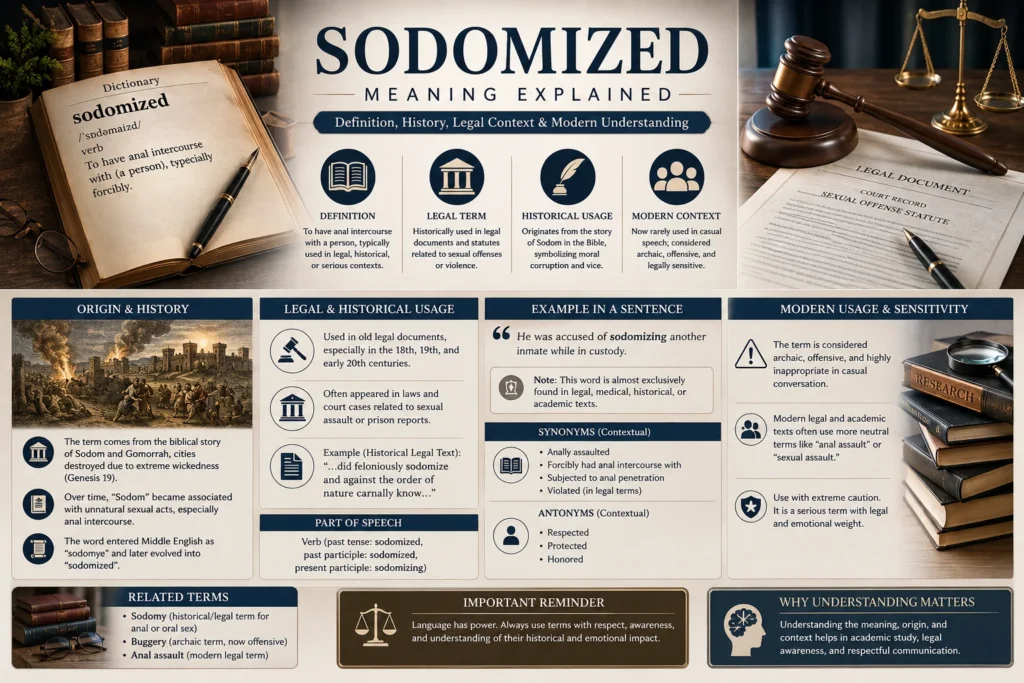
The word sodomized is the past tense and past participle form of the verb sodomize.
Traditionally, the term refers to a person who has been subjected to an act historically categorized as sodomy. The exact legal and cultural definition of sodomy has varied significantly across countries, religions, and time periods.
Therefore, the meaning often depends on context.
In many modern discussions, the term appears in:
- Historical records
- Legal documents
- Academic writing
- News reporting
- Literary works
Because of its serious nature, people rarely use it casually.
Full Definition
The dictionary definition of sodomized generally refers to having been subjected to an act classified as sodomy.
Historically, laws defined sodomy differently depending on the jurisdiction. Some legal systems used the term broadly, while others applied it to specific acts.
Today, many legal systems have changed or eliminated older sodomy laws. Consequently, the word often appears in historical or legal discussions rather than contemporary legal practice.
Grammatical Breakdown
- Base Verb: Sodomize
- Present Form: Sodomize
- Past Form: Sodomized
- Past Participle: Sodomized
Example:
“The historical report stated that the victim had been sodomized.”
In this sentence, the word functions as a past participle.
Origin and Historical Background
The term derives from the biblical city of Sodom, a place mentioned in religious texts.
Historically, religious scholars, lawmakers, and societies connected the name with certain prohibited sexual behaviors. Over time, the word evolved into legal and cultural terminology.
Religious Influence
For centuries, religious teachings influenced how societies interpreted the term.
As a result, many historical laws adopted related language.
Legal Development
Different countries developed different definitions.
For example:
- Medieval legal systems used broad definitions.
- Colonial laws often borrowed European interpretations.
- Modern legal systems generally use more specific terminology.
Therefore, the meaning changed over time.
Context and Usage
Understanding context is essential.
Legal Context
In legal documents, the word may appear when discussing:
- Historical criminal cases
- Court decisions
- Legal reforms
- Historical statutes
Historical Context
Historians often use the term when analyzing:
- Old legal records
- Religious texts
- Government archives
- Social history
News Reporting
Journalists may use the term when summarizing court records or criminal allegations.
However, professional reporting usually relies on precise legal language.
Literary Context
Authors sometimes use the word in novels, biographies, or historical fiction.
In these cases, the term helps establish period accuracy.
Real-Life Examples
Example 1: Historical Research
A historian examines court records from the eighteenth century and encounters the term repeatedly.
Example 2: Legal Analysis
A law professor discusses how historical statutes defined certain offenses.
Example 3: Academic Writing
A researcher analyzes social attitudes reflected in older legal language.
Example 4: News Coverage
A reporter summarizes allegations described in official court documents.
Example 5: Literature
A novelist uses the term to reflect the language of a particular historical era.
Conversation Examples
Conversation Example 1
Person A: I saw the word sodomized in a history book.
Person B: It is a historical and legal term. Its meaning depends on the context.
Conversation Example 2
Person A: Why does that court document use the word?
Person B: Older legal systems often used different terminology than modern laws.
Conversation Example 3
Person A: Is the term still common today?
Person B: It appears mostly in legal, historical, or academic discussions.
Conversation Example 4
Person A: Does the word always mean the same thing?
Person B: Not necessarily. Definitions varied across jurisdictions and time periods.
Conversation Example 5
Person A: Why do authors still use it?
Person B: Sometimes they want historical accuracy in their writing.
Platform-Specific Meaning
Social Media
People may encounter the term when discussing:
- Historical events
- Criminal cases
- Legal reforms
The meaning generally remains consistent.
Online Forums
Users often ask for clarification about the word’s historical or legal significance.
Educational Websites
Educational platforms usually explain the term from a historical and linguistic perspective.
News Platforms
News organizations may use the term when quoting legal records or court documents.
Academic Databases
Researchers frequently encounter the term in historical analysis.
Alternative Meanings
Besides its literal meaning, some people use the word figuratively.
Figurative Usage
Occasionally, someone may say:
“Our team got sodomized in that game.”
In this context, the speaker does not mean the literal definition. Instead, they mean the team suffered a severe defeat.
However, many people consider this figurative use insensitive because of the word’s serious associations.
Exaggerated Slang Usage
Some online communities use the term hyperbolically to describe:
- Major losses
- Extreme disadvantages
- Harsh criticism
Nevertheless, such usage can offend readers.
Related Terms and NLP Variations
Search engines often associate this keyword with related terms.
Related Terms
- Sodomy
- Sodomize
- Historical legal terminology
- Criminal law terminology
- Legal definitions
Semantic Variations
- Historical offense terminology
- Legal language
- Court terminology
- Judicial records
- Criminal statutes
Common Search Queries
- What does sodomized mean?
- Is sodomized a legal term?
- Where does the word come from?
- Is sodomized still used today?
How to Respond or Reply
If someone uses the term in conversation, the best response depends on context.
Educational Context
Response:
“The term has historical and legal significance. Its meaning depends on context.”
Academic Context
Response:
“Many historical legal systems used that terminology differently than modern laws.”
Clarification Context
Response:
“Are you referring to the historical definition or a figurative use?”
News Context
Response:
“The report appears to be using legal terminology from court records.”
Common Misinterpretations
Misinterpretation 1: The Meaning Never Changed
In reality, definitions varied across cultures and legal systems.
Misinterpretation 2: It Is Common Everyday Language
Most people rarely use the term in ordinary conversation.
Misinterpretation 3: It Always Appears in Legal Contexts
Although legal usage is common, literature and history also use the term.
Misinterpretation 4: Every Country Defines It Identically
Definitions historically differed from one jurisdiction to another.
When NOT to Use It
Professional Business Communication
Avoid using the term unless directly relevant to legal or historical discussions.
Casual Jokes
Because the word has serious implications, joking usage can appear insensitive.
Social Media Arguments
Using emotionally charged language often creates confusion rather than clarity.
Workplace Conversations
Unless discussing legal, historical, or academic subjects, the term is usually inappropriate.
Usage Tips
Use Precise Language
When discussing legal matters, choose accurate terminology.
Consider Your Audience
Some readers may find the term disturbing because of its historical associations.
Understand Context
Always determine whether the usage is:
- Legal
- Historical
- Academic
- Literary
- Figurative
Avoid Ambiguity
If clarity matters, explain the context rather than relying solely on the term.
Prefer Modern Terminology When Appropriate
Modern legal and professional writing often uses more precise language.
Why Understanding the Term Matters
Language evolves over time.
Therefore, understanding historical terms helps readers:
- Interpret old documents
- Understand legal history
- Analyze literature
- Follow academic discussions
- Read historical records accurately
Moreover, context prevents misunderstandings.
A reader who understands the historical and legal background can interpret the term more accurately than someone relying solely on assumptions.
Legal and Cultural Significance
The term occupies a unique place in legal history.
Historical Law
Many jurisdictions once maintained laws using terminology related to sodomy.
Legal Reform
Over time, many countries revised or repealed those laws.
Cultural Impact
The term appears in discussions involving:
- Human rights
- Legal reform
- Religious history
- Social history
Consequently, the word carries broader cultural significance beyond its dictionary definition.
FAQs
What does sodomized mean?
It is the past tense and past participle form of sodomize and historically refers to being subjected to an act categorized as sodomy.
Is sodomized a legal term?
It has often appeared in legal and historical documents, although modern legal systems frequently use more specific language.
Is the word still used today?
Yes, but it appears mostly in legal, historical, academic, or news contexts.
Where does the term come from?
The word derives from the biblical city of Sodom.
Is it common in everyday conversation?
No. Most people rarely use it in ordinary conversation.
Does the meaning vary by country?
Yes. Historical legal definitions differed across jurisdictions.
Can the word be used figuratively?
Some people use it figuratively to describe a severe loss or defeat, although many consider that usage insensitive.
Why does it appear in historical documents?
Older legal systems commonly used the term in statutes and court records.
Is it appropriate in professional writing?
Only when discussing relevant legal, historical, academic, or literary topics.
Why is context important?
Because historical, legal, literary, and figurative uses can carry different implications.
Conclusion
The sodomized meaning centers on the past tense form of sodomize, a term with deep historical, legal, religious, and cultural roots. Although modern audiences still encounter the word, it most often appears in historical records, academic discussions, legal documents, news reporting, and literature.
Furthermore, the meaning and interpretation of the term have evolved over time. Different societies, legal systems, and historical periods applied the concept in different ways. Therefore, understanding context remains essential.
When you encounter the word today, consider where it appears, why it is being used, and whether the discussion is historical, legal, academic, literary, or figurative. Doing so provides a more accurate understanding of both the term itself and the broader conversation surrounding it

Kevin Brooks is a grammar specialist at GramBrix.com, dedicated to helping readers understand language rules with clarity and confidence. He simplifies complex grammar concepts through practical examples and easy explanations.