Last Updated on July 17, 2026
| Term | Meaning |
|---|---|
| Clingy | Excessively dependent on another person for attention, reassurance, time, or emotional support. |
| Common Context | Relationships, friendships, family dynamics, texting, and social media. |
| Tone | Usually negative but sometimes playful or affectionate. |
| Example | “He’s been texting me every five minutes. He’s getting clingy.” |
| Related Terms | Needy, attached, dependent, possessive, affectionate |
The word clingy appears frequently in conversations about relationships, friendships, texting habits, and social media behavior. You may hear someone describe a partner as clingy, joke about being clingy themselves, or wonder whether constant communication crosses the line into unhealthy dependence.
Understanding the clingy meaning requires more than knowing a simple dictionary definition. The term carries emotional, social, and psychological implications. Moreover, its meaning can change depending on context, tone, and the relationship between the people involved.
In most situations, clingy describes someone who seeks excessive attention, reassurance, contact, or emotional closeness from another person. However, being affectionate and being clingy are not always the same thing. Therefore, understanding the difference helps avoid misunderstandings.
This guide explains the complete meaning of clingy, how people use the term in everyday conversations, examples from real-life situations, social media interpretations, common misconceptions, and healthy ways to respond.
Quick Answer Box
| Element | Explanation |
|---|---|
| Meaning | Excessively dependent or attached to someone |
| Common Use | Relationships and friendships |
| Emotional Tone | Usually negative, sometimes playful |
| Context | Dating, texting, social media, family relationships |
| Example | “She’s becoming clingy and wants constant reassurance.” |
| Opposite | Independent, self-sufficient |
| Formality | Informal everyday term |
| Common Audience | Teens, adults, social media users |
What Does It Mean?
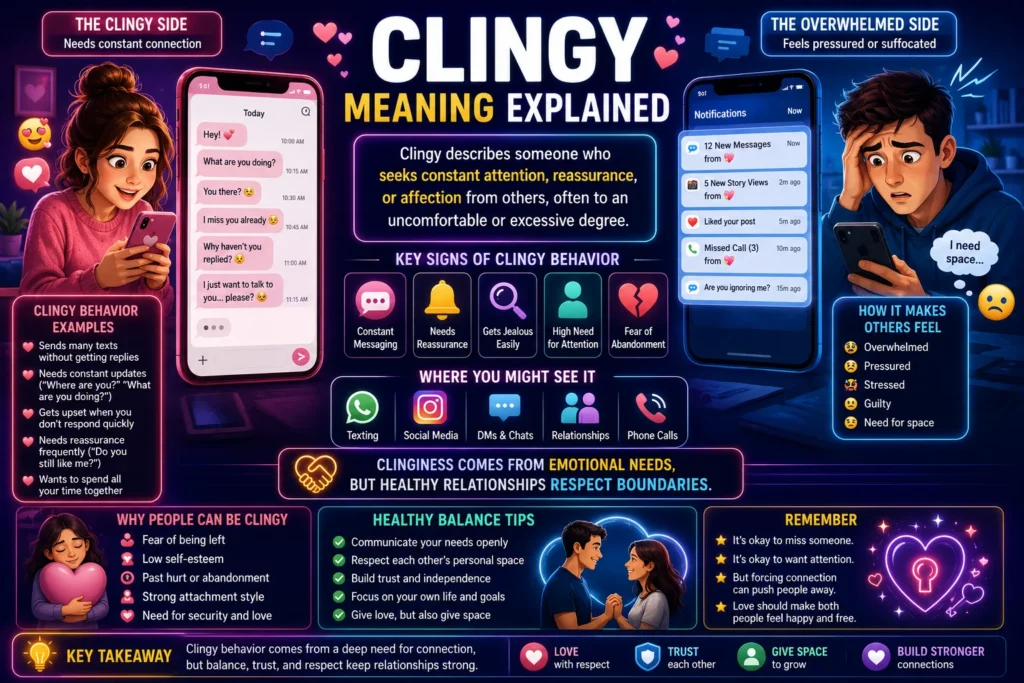
The most common clingy meaning refers to a person who relies too heavily on another individual for attention, validation, emotional support, or companionship.
Someone may appear clingy if they:
- Constantly seek reassurance
- Need frequent communication
- Become upset when responses are delayed
- Want excessive time together
- Struggle with personal boundaries
- Depend heavily on another person’s approval
For example:
“My friend gets upset whenever I don’t reply immediately. She’s becoming clingy.”
In this situation, the person expects a level of attention that may feel overwhelming.
However, clingy behavior exists on a spectrum. Therefore, not every request for attention qualifies as clinginess.
Full Definition
Clingy is an adjective used to describe behavior that reflects excessive attachment, dependence, or neediness toward another person.
The word comes from the verb cling, which means to hold tightly onto something or someone.
In emotional and social contexts, clingy behavior often includes:
- Frequent messaging
- Constant check-ins
- Fear of abandonment
- Seeking repeated reassurance
- Difficulty spending time alone
- Overreliance on another person’s presence
Importantly, clinginess often stems from emotional needs rather than bad intentions.
For example, someone may act clingy because they:
- Feel insecure
- Fear rejection
- Have experienced past relationship difficulties
- Need validation
- Feel anxious about losing a connection
Therefore, understanding the reason behind the behavior matters.
Context & Usage
People use the word clingy in many different situations.
Romantic Relationships
This is the most common context.
Example:
“My boyfriend gets upset if I don’t text back within ten minutes. He’s a little clingy.”
The speaker feels overwhelmed by constant attention demands.
Friendships
Friends can also display clingy behavior.
Example:
“She expects me to spend every weekend with her.”
This may indicate emotional dependence.
Family Relationships
Parents, siblings, or relatives can sometimes be described as clingy.
Example:
“My younger brother is clingy whenever guests visit.”
Here, the term refers to excessive attachment.
Workplace Situations
Although less common, people sometimes use clingy in professional settings.
Example:
“That coworker constantly asks for approval before every task.”
However, workplace use often requires sensitivity.
Online Communication
Social media and texting have expanded the use of the term significantly.
People often describe excessive messaging as clingy behavior.
Real-Life Examples
The best way to understand clingy meaning is through practical examples.
Conversation Example 1: Dating
Alex: Why are you stressed?
Taylor: My partner texts me every five minutes.
Alex: Sounds a little clingy.
Conversation Example 2: Friendship
Sarah: Emma gets upset when I hang out with other friends.
Mia: That’s pretty clingy behavior.
Conversation Example 3: Family
Dad: Why is your little cousin following you everywhere?
Son: He’s just clingy around new people.
Conversation Example 4: Texting
Person A: Did he send another message?
Person B: Yep. That’s message number twelve today.
Person A: Wow. That’s clingy.
Conversation Example 5: Social Media
User 1: She comments on every single post.
User 2: She seems really clingy online.
Platform-Specific Meaning
Social media has created new ways for people to interpret clingy behavior.
Snapchat
On Snapchat, users often describe someone as clingy when they:
- Demand constant snaps
- Get upset over lost streaks
- Expect immediate replies
- Monitor activity closely
Example:
“He keeps asking why I opened his snap but didn’t reply.”
TikTok
TikTok frequently discusses clingy behavior through relationship content.
Creators often debate:
- Healthy attachment
- Emotional dependence
- Relationship boundaries
Many videos explore the difference between affection and clinginess.
Instagram users may label behavior as clingy when someone:
- Constantly messages
- Reacts to every story
- Monitors online activity
- Seeks continual attention
On WhatsApp, clinginess often appears through excessive messaging.
Examples include:
- Multiple unanswered texts
- Repeated follow-ups
- Constant status checking
Facebook users may describe someone as clingy if they:
- Comment excessively
- Constantly tag others
- Demand attention publicly
Dating Apps
Clinginess becomes a major topic on dating platforms.
Common signs include:
- Excessive messages immediately after matching
- Pressure for constant communication
- Unrealistic expectations early on
Discord
Gaming and community groups sometimes use clingy to describe members who depend heavily on specific friendships.
Alternative Meanings
While clingy usually has a negative meaning, context can soften or change the interpretation.
Affectionate Clingy
Sometimes people use clingy positively.
Example:
“My dog is clingy, and I love it.”
The term becomes affectionate rather than critical.
Playful Self-Description
Many people jokingly describe themselves as clingy.
Example:
“I’m a little clingy when I really like someone.”
This often signals self-awareness.
Cute Attachment
Some couples view mild clinginess as romantic.
Example:
“She’s clingy in the sweetest way.”
The behavior feels endearing rather than problematic.
Emotional Dependence
In more serious discussions, clingy refers to unhealthy emotional reliance.
This meaning carries stronger negative implications.
Related Terms / NLP Variations
Several words share similarities with clingy.
Needy
Needy often emphasizes emotional demands.
Example:
“He constantly needs reassurance.”
Dependent
Dependent focuses on reliance.
Example:
“She’s emotionally dependent on her partner.”
Possessive
Possessive behavior involves control.
Example:
“He doesn’t like when she spends time with friends.”
Attached
Attached is generally more neutral.
Example:
“They’re very attached to each other.”
Affectionate
Affectionate describes warmth and care.
Unlike clingy, it usually lacks negative implications.
Insecure
Insecurity sometimes contributes to clingy behavior.
However, the words are not identical.
Overattached
Overattached closely resembles clingy.
Both suggest excessive emotional dependence.
How to Respond / Reply
People often wonder how to respond when someone acts clingy or calls them clingy.
If Someone Calls You Clingy
Stay calm and ask for clarification.
Example:
“Can you explain what makes you feel that way?”
This encourages productive conversation.
If Someone Is Being Clingy
Set respectful boundaries.
Example:
“I enjoy talking with you, but I need some personal time too.”
Clear communication helps prevent misunderstandings.
If It Was a Joke
Respond lightly.
Example:
“Maybe a little, but only because you’re awesome.”
Humor can diffuse tension.
If You Feel Hurt
Express your feelings honestly.
Example:
“I wasn’t trying to be clingy. I just enjoy spending time together.”
Honest communication often resolves issues.
If the Behavior Is Serious
Discuss expectations openly.
Healthy relationships require balance.
Misinterpretations
Many people misuse the word clingy.
Affection Is Not Always Clingy
Someone who enjoys spending time together isn’t automatically clingy.
Healthy affection differs from emotional dependence.
Frequent Communication Isn’t Always Clinginess
Some couples naturally communicate often.
Context matters.
Different People Have Different Needs
One person may see behavior as caring.
Another may view the same behavior as clingy.
Therefore, perception plays a major role.
Clingy Doesn’t Always Mean Toxic
People often associate clinginess with unhealthy relationships.
However, mild clinginess can simply reflect emotional attachment.
Introverts and Extroverts Differ
Communication expectations vary.
As a result, clinginess can be subjective.
When NOT to Use It
Although common, the term clingy isn’t always appropriate.
During Serious Mental Health Discussions
Avoid casually labeling emotional struggles as clinginess.
The situation may involve anxiety or deeper concerns.
Professional Environments
Using clingy at work may sound judgmental.
Choose more neutral language when possible.
Without Understanding Context
Avoid quick conclusions.
Understanding the full situation matters.
During Emotional Conflicts
Calling someone clingy during an argument may escalate tensions.
Instead, discuss specific behaviors.
As a Personal Attack
The term should describe behavior, not attack character.
Respectful communication remains important.
Usage Tips
Understanding how to use clingy correctly improves communication.
Focus on Behavior
Describe actions rather than labeling people.
Example:
“The constant texting feels overwhelming.”
This sounds more constructive.
Consider Context
Relationship dynamics vary significantly.
Therefore, avoid assuming one standard fits everyone.
Use Empathy
Many clingy behaviors stem from insecurity or fear.
Compassion improves communication.
Balance Independence and Connection
Healthy relationships need both closeness and personal space.
Communicate Expectations
Clear boundaries prevent many misunderstandings.
Avoid Overusing the Label
Not every display of affection qualifies as clinginess.
Use the term thoughtfully.
FAQs
What does clingy mean in a relationship?
Clingy usually describes someone who seeks excessive attention, reassurance, or time from their partner.
Is being clingy a bad thing?
Not always. Mild attachment can be normal. However, excessive dependence may create relationship challenges.
What causes clingy behavior?
Common causes include insecurity, fear of abandonment, anxiety, past relationship experiences, and low self-confidence.
Is clingy the same as affectionate?
No. Affection shows care and warmth. Clinginess involves excessive dependence or attention-seeking.
Can friends be clingy?
Yes. Clingy behavior can occur in friendships, family relationships, and romantic partnerships.
How do I stop being clingy?
Focus on personal interests, build confidence, maintain independence, and communicate openly about your needs.
What does clingy mean in texting?
It often refers to excessive messaging, repeated follow-ups, or expecting immediate responses.
Is clingy behavior toxic?
Not necessarily. However, extreme clinginess can create unhealthy relationship dynamics.
Can social media make people seem clingy?
Yes. Constant messaging, excessive reactions, and monitoring activity can appear clingy online.
What is the opposite of clingy?
Common opposites include independent, self-sufficient, confident, and emotionally secure.
Conclusion
The clingy meaning generally refers to excessive emotional attachment, dependence, or a strong need for attention and reassurance from another person. The term appears frequently in relationships, friendships, texting conversations, and social media interactions.
Although clingy behavior often carries a negative reputation, context matters. Sometimes the term describes genuine emotional dependence. Other times, people use it playfully or affectionately. Therefore, understanding the specific situation is essential before making assumptions.
Healthy relationships balance connection with independence. Moreover, clear communication helps people express needs without feeling overwhelmed. By understanding what clingy means, recognizing common signs, and responding thoughtfully, you can navigate personal and online relationships more effectively.

Victoria Lane is a grammar-focused writer at GramBrix.com, passionate about helping readers master the rules of language. She provides clear explanations and practical examples that make writing more accurate, polished and confident.