
Last Updated on July 15, 2026
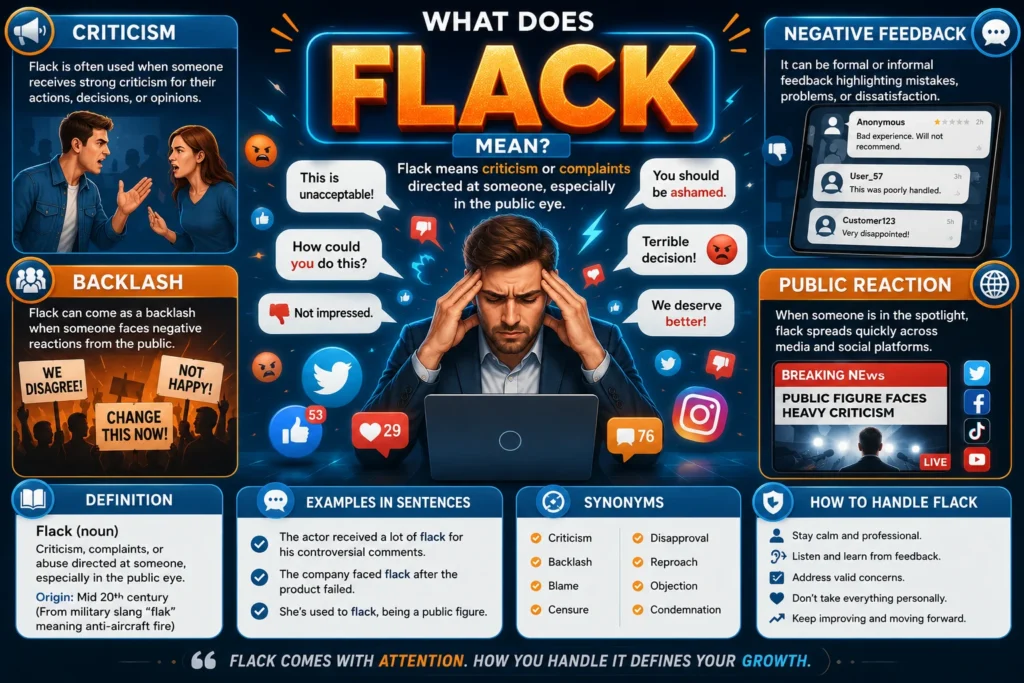
Flack usually means strong criticism, negative publicity, or complaints directed at a person, company, organization, or idea. It can also refer to a public relations representative who handles media communication and publicity.
Have you ever heard someone say, “The company received a lot of flack after the announcement,” and wondered what they meant?
The word flack appears frequently in news reports, business discussions, social media conversations, and everyday speech. Although many people recognize the term, they often misunderstand its exact meaning. Some assume it only refers to criticism. Others think it exclusively describes a public relations professional.
In reality, flack has multiple meanings depending on context. Most commonly, it refers to criticism, backlash, complaints, or negative reactions. However, it can also describe a publicity agent or public relations representative.
This guide explains the complete flack meaning, how people use it, where it came from, examples in real conversations, platform-specific usage, common misconceptions, related terms, and practical tips for using it correctly.
Quick Answer Box
| Element | Explanation |
|---|---|
| Meaning | Criticism, complaints, backlash, or negative publicity |
| Secondary Meaning | Public relations representative or press agent |
| Context | Business, politics, media, social media, everyday conversation |
| Common Usage | “She got a lot of flack for that decision.” |
| Platforms | X, Facebook, Instagram, LinkedIn, Reddit, news articles |
| Tone | Usually negative but not offensive |
| Synonyms | Criticism, backlash, complaints, opposition, negative feedback |
| Example | “The actor received flack for his controversial comments.” |
What Does Flack Mean?
The most common meaning of flack is:
Strong criticism, negative feedback, complaints, or public disapproval.
When someone “gets flack,” people criticize them for something they said or did.
For example:
- The company got flack for raising prices.
- The politician received flack for the new policy.
- The celebrity faced flack after the interview.
In these examples, flack refers to criticism or backlash from the public.
People often use the phrase:
“Get flack.”
This expression means:
“To receive criticism or negative reactions.”
For example:
- “I knew I would get flack for my opinion.”
- “The coach got flack after the team lost.”
Full Definition
The word flack has two recognized meanings.
Meaning 1: Criticism or Backlash
This is the most common modern usage.
It refers to:
- Public criticism
- Complaints
- Negative reactions
- Opposition
- Disapproval
- Backlash
Examples:
- The company received flack online.
- The decision attracted flack from customers.
- She got flack from coworkers.
Meaning 2: Public Relations Representative
In another context, a flack can mean:
- Press agent
- Publicist
- Media representative
- PR professional
Examples:
- The actor’s flack arranged the interview.
- Reporters contacted the company flack.
- A flack answered media questions.
Although this meaning still exists, modern speakers use the criticism-related meaning much more often.
Context & Usage
Understanding context helps determine which meaning applies.
Business Context
Companies often receive flack when customers dislike decisions.
Examples:
- Price increases
- Service outages
- Product recalls
- Policy changes
Sentence:
“The airline got flack after canceling hundreds of flights.”
Political Context
Politicians frequently receive flack for decisions and public statements.
Examples:
- Voting decisions
- Policy proposals
- Campaign comments
Sentence:
“The senator received flack from voters.”
Workplace Context
Employees and managers may receive flack from colleagues.
Examples:
- Missed deadlines
- Management decisions
- Project changes
Sentence:
“The manager got flack for changing the schedule.”
Entertainment Context
Celebrities often face flack online.
Examples:
- Interviews
- Social media posts
- Public appearances
Sentence:
“The singer received flack after posting the video.”
Personal Relationships
Friends and family members can also give flack.
Sentence:
“I got flack from my family for quitting my job.”
Real-Life Examples
Conversation Example 1
Person A: Why is everyone talking about the company?
Person B: They’re getting a lot of flack for their new pricing policy.
Conversation Example 2
Person A: Did people like the movie?
Person B: Mostly, yes. However, it got some flack for the ending.
Conversation Example 3
Person A: Why did he delete his post?
Person B: Because he received a lot of flack in the comments.
Conversation Example 4
Person A: Was the announcement successful?
Person B: Not really. The organization got flack from customers.
Conversation Example 5
Person A: Did your boss approve your idea?
Person B: Yes, although I got some flack from coworkers first.
Platform-Specific Meaning
X (Twitter)
On X, people commonly use flack when discussing public criticism.
Examples:
- Brand backlash
- Political debates
- Celebrity controversies
Sentence:
“The company is getting major flack online.”
Facebook users often use flack in discussions about local issues, businesses, and public events.
Example:
“The city council received flack for the proposal.”
Influencers and creators frequently mention flack when discussing criticism.
Example:
“She got flack for promoting that product.”
Reddit users regularly use the term when discussing controversial opinions.
Example:
“I’ll probably get flack for saying this, but I disagree.”
On LinkedIn, flack usually refers to professional criticism or public business backlash.
Example:
“The brand received flack after the campaign launch.”
News Websites
Journalists commonly use flack to describe public reaction.
Example:
“The administration faced flack over the decision.”
Alternative Meanings
Although criticism remains the dominant definition, flack may appear in other contexts.
Publicist
A flack can be a publicity professional.
Example:
“The musician’s flack organized press interviews.”
Media Contact
Companies sometimes assign a flack to answer journalist inquiries.
Example:
“Reporters contacted the corporate flack.”
Press Representative
A flack may serve as the public voice of an organization.
Example:
“The company flack released a statement.”
These meanings appear less frequently than the criticism-related definition.
Related Terms and NLP Variations
Search engines and AI systems associate flack with several related concepts.
Synonyms
- Criticism
- Backlash
- Complaints
- Opposition
- Disapproval
- Negative feedback
- Pushback
- Objections
- Condemnation
- Reproach
Similar Expressions
- Catch heat
- Face backlash
- Receive criticism
- Get criticized
- Come under fire
- Face opposition
- Get negative feedback
Related Phrases
- Get flack
- Take flack
- Face flack
- Receive flack
- Draw flack
- Attract flack
Opposites
- Praise
- Approval
- Support
- Compliments
- Recognition
- Endorsement
How to Respond When Someone Uses “Flack”
The best response depends on context.
If Someone Says They Got Flack
You might respond:
- “Why were people upset?”
- “Was the criticism justified?”
- “How did you handle it?”
- “Did things improve afterward?”
If a Company Receives Flack
Possible responses include:
- Acknowledging concerns
- Providing clarification
- Offering solutions
- Correcting mistakes
If a Friend Gets Flack
Supportive responses may include:
- “That sounds frustrating.”
- “People can be harsh sometimes.”
- “Do you think the criticism was fair?”
Misinterpretations
Many people misunderstand the word flack.
Mistake 1: Assuming It Always Means Anger
Flack usually refers to criticism, not necessarily anger.
Someone can give flack without being furious.
Mistake 2: Confusing It With Hate
Flack does not always indicate hatred.
People often give constructive criticism.
Mistake 3: Thinking It Only Means Public Relations
Although flack can describe a publicist, that meaning appears less often today.
Mistake 4: Assuming It’s Slang
Flack is not modern internet slang.
It is a recognized English word used in journalism, business, and everyday conversation.
Mistake 5: Believing It Is Offensive
The term is generally neutral.
Most people use it in professional and casual settings.
When NOT to Use It
There are situations where another word may work better.
Formal Academic Writing
Words like these may sound more precise:
- Criticism
- Opposition
- Negative feedback
- Public disapproval
Legal Documents
Legal writing typically requires more exact language.
Use:
- Objections
- Complaints
- Allegations
Instead of:
- Flack
Scientific Reports
Researchers generally prefer formal terminology.
Highly Technical Communication
Professional audiences may appreciate more specific wording.
Usage Tips
Use It for Public Criticism
Correct:
“The company got flack for the policy.”
Use It for Negative Reactions
Correct:
“The post attracted flack online.”
Use It Naturally
People often pair flack with verbs such as:
- Get
- Receive
- Face
- Attract
- Draw
- Take
Examples:
- Take flack
- Get flack
- Draw flack
Consider Your Audience
Business professionals recognize the term. However, international audiences may understand “criticism” more easily.
Don’t Overuse It
Repeating the word too often can weaken writing. Therefore, alternate with:
- Backlash
- Criticism
- Complaints
- Opposition
Flack vs Similar Terms
| Term | Meaning | Difference |
|---|---|---|
| Flack | Criticism or backlash | Often informal |
| Criticism | Negative evaluation | More formal |
| Backlash | Strong public reaction | Usually widespread |
| Complaint | Specific grievance | More targeted |
| Opposition | Resistance to something | Broader meaning |
| Pushback | Resistance or objections | Often workplace-related |
Origin of the Word Flack
The history of flack is interesting because the word developed multiple meanings over time.
One theory links it to anti-aircraft fire during World War II. Another explanation traces the publicist meaning to early publicity professionals.
Over time, English speakers increasingly used flack to describe criticism and negative public reactions.
Today, that meaning dominates everyday usage.
Emotional Meaning of Flack
Beyond dictionary definitions, flack often carries emotional weight.
When someone says:
“I got a lot of flack.”
They may imply:
- Feeling judged
- Facing pressure
- Experiencing public scrutiny
- Managing criticism
Therefore, the word often communicates more than simple disagreement.
It suggests noticeable criticism from multiple people.
Edge Cases and Special Situations
Can Flack Be Positive?
Not usually.
The word almost always refers to criticism or negative reactions.
Can One Person Give Flack?
Yes.
Example:
“My brother gave me flack for buying that car.”
Does Flack Mean Online Backlash Only?
No.
People can receive flack:
- Online
- At work
- At school
- In politics
- Within families
Is Flack Serious?
Sometimes.
Minor teasing can count as flack. However, large-scale public criticism can also qualify.
The seriousness depends on context.
Can Businesses Recover From Flack?
Yes.
Many organizations receive criticism and later rebuild trust through transparency and corrective action.
FAQs
What does flack mean in simple terms?
Flack usually means criticism, complaints, backlash, or negative reactions directed at someone or something.
What does “getting flack” mean?
Getting flack means receiving criticism or negative feedback from others.
Is flack a negative word?
Generally, yes. However, it describes criticism rather than an insult.
What is an example of flack?
“The company got flack after raising subscription prices.”
Does flack mean hate?
No. Criticism and hate are different. Someone can receive flack without being hated.
Is flack formal or informal?
It sits between informal and professional English. Journalists, businesses, and everyday speakers use it regularly.
What does flack mean in politics?
In politics, flack usually refers to criticism from voters, opponents, journalists, or the public.
What does flack mean on social media?
On social media, flack often means backlash, negative comments, or criticism from users.
Can flack refer to a publicist?
Yes. A flack can also mean a press agent or public relations representative.
Is flack the same as backlash?
Not exactly. Backlash usually suggests a stronger and broader public reaction, while flack can refer to criticism of any size.
Conclusion
The flack meaning most commonly refers to criticism, complaints, backlash, or public disapproval. When people say someone is “getting flack,” they mean that person is receiving negative reactions from others. Meanwhile, the word can also refer to a public relations representative, although that usage appears less frequently today.
Whether you encounter the term in news reports, business discussions, workplace conversations, social media posts, or everyday speech, understanding its context makes interpretation easy. In most situations, flack simply means criticism directed toward a person, company, organization, decision, or public statement.

Justin Powell is a writer at GramBrix.com who focuses on grammar, clarity and effective communication, helping readers strengthen their language skills.