
Last Updated on July 16, 2026
| Quick Definition | Meaning |
|---|---|
| Word | Mortise |
| Part of Speech | Noun and Verb |
| Primary Meaning | A hole, slot, or recess cut into a piece of material to receive a matching tenon |
| Common Context | Woodworking, carpentry, furniture making, construction |
| Example | “The carpenter cut a mortise into the door frame for a secure joint.” |
| Tone | Technical, professional, practical |
If you’ve encountered the term mortise while reading about woodworking, carpentry, furniture construction, or home improvement, you may wonder what it actually means. Although the word sounds highly specialized, it refers to one of the oldest and most reliable joining methods in construction and craftsmanship.
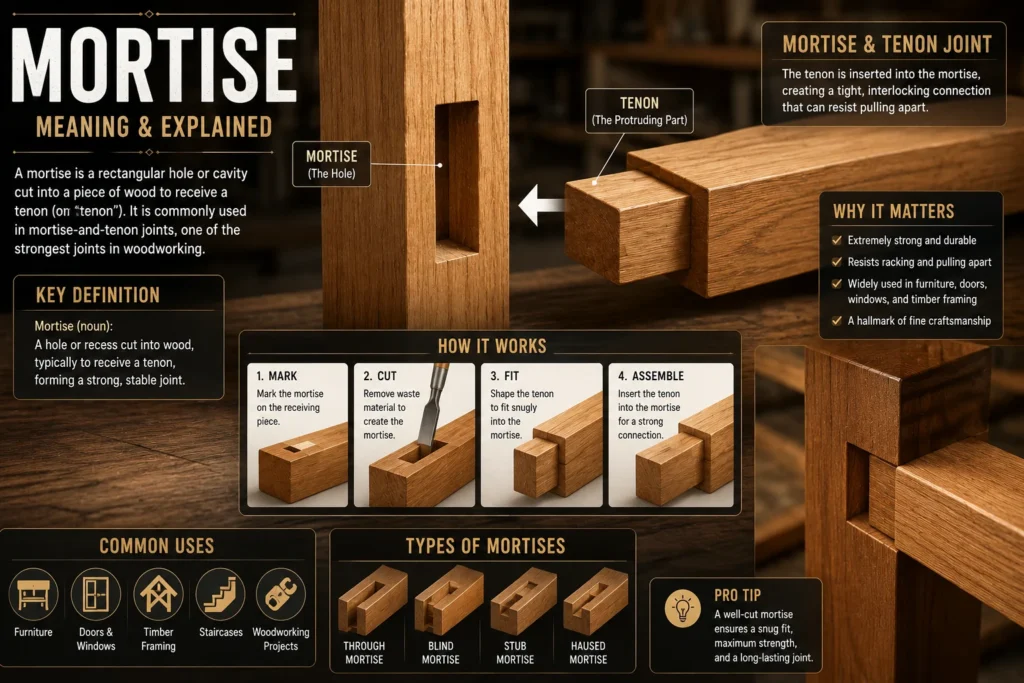
A mortise is a cavity or slot cut into one piece of material. It works together with a matching projection called a tenon. When combined, they create a mortise-and-tenon joint, a connection that builders and craftsmen have used for thousands of years.
Today, mortises appear in furniture, doors, cabinets, timber framing, and modern construction projects. Understanding the mortise meaning helps you better understand woodworking terminology, construction plans, and DIY instructions.
In this guide, you’ll learn the exact definition of mortise, its history, practical applications, examples, variations, common misunderstandings, and much more.
Quick Answer Box
Meaning: A mortise is a hole, cavity, groove, or recess cut into a material to receive a matching tenon.
Context: Woodworking, carpentry, joinery, furniture making, and construction.
Usage: Used to create strong and durable joints.
Industries: Furniture manufacturing, architecture, cabinet making, timber framing, restoration work.
Example: “The craftsman carved a mortise into the wooden frame before inserting the tenon.”
Tone: Technical and professional.
What Does Mortise Mean?
A mortise is a specially cut opening in wood, metal, or another material designed to receive a projecting piece called a tenon.
The mortise serves as the female component of a joint, while the tenon serves as the male component. Together, they form one of the strongest mechanical joints available in woodworking.
In simple terms:
- Mortise = hole or slot
- Tenon = tongue or projection
- Mortise-and-tenon = complete joint
Because the tenon fits tightly into the mortise, the connection becomes strong and stable.
For example, many wooden chairs contain mortise-and-tenon joints connecting the legs to the seat frame.
Full Definition
According to traditional woodworking terminology, a mortise is:
A cavity, recess, or slot cut into a piece of material to receive and secure a tenon or corresponding projection.
The word can function as both a noun and a verb.
Mortise as a Noun
As a noun, mortise refers to the actual cavity.
Example:
- The mortise was carefully cut into the oak beam.
Mortise as a Verb
As a verb, mortise means creating that cavity.
Example:
- The carpenter mortised the door frame before installation.
Therefore, the word can describe both the structure and the action.
Context and Usage
The term appears primarily in construction-related industries. However, its meaning varies slightly depending on the context.
Woodworking
In woodworking, a mortise is a rectangular hole cut into a piece of wood.
Woodworkers create mortises using:
- Chisels
- Routers
- Drill presses
- Mortising machines
The mortise accepts a matching tenon to create a strong joint.
Carpentry
Carpenters frequently use mortises when building:
- Doors
- Window frames
- Structural framing
- Staircases
These joints improve durability and strength.
Furniture Making
Furniture makers rely heavily on mortise-and-tenon construction because it withstands years of stress.
Examples include:
- Dining tables
- Chairs
- Benches
- Cabinets
- Bed frames
Architecture
Architects often specify mortise-and-tenon joinery for traditional or historic structures.
These joints contribute to both functionality and aesthetics.
Metalworking
Although less common, mortises can also appear in metal fabrication.
In this context, the mortise serves the same purpose: receiving a matching component.
Real-Life Examples
Understanding the mortise meaning becomes easier when you see it in real situations.
Example 1: Door Construction
A carpenter cuts a mortise into a wooden door frame.
Next, the tenon on the door rail slides into that opening.
As a result, the frame becomes stronger.
Example 2: Dining Chair
A chair leg contains a tenon.
The seat frame contains a mortise.
When joined together, the chair remains stable despite years of use.
Example 3: Timber Framing
Large wooden beams often use mortise-and-tenon joints.
These joints support significant structural loads.
Example 4: Antique Furniture Restoration
A furniture restorer repairs damaged mortises in a century-old cabinet.
Instead of replacing the entire piece, they restore the original joint.
Example 5: Cabinet Making
Custom cabinets frequently use mortise joints for doors and frames.
This method improves durability compared to simpler fastening techniques.
Platform-Specific Meaning
Unlike many modern internet terms, mortise does not significantly change meaning across platforms. However, different communities discuss it differently.
YouTube
Woodworking creators often demonstrate:
- Cutting mortises
- Mortise-and-tenon construction
- Tool reviews
- Joinery tutorials
Videos frequently showcase step-by-step processes.
DIY and woodworking communities discuss:
- Best mortising tools
- Joinery techniques
- Furniture repairs
- Project troubleshooting
Users often compare traditional and modern methods.
Pinterest users share:
- Furniture projects
- Joinery diagrams
- Workshop ideas
- Design inspiration
Mortise examples often appear in visual guides.
Facebook Groups
Woodworking groups regularly post:
- Project photos
- Joinery advice
- Tool recommendations
- Construction techniques
Professional Construction Forums
Industry professionals discuss:
- Structural requirements
- Engineering considerations
- Code compliance
- Commercial applications
Alternative Meanings
Although woodworking provides the primary definition, the word occasionally appears in other contexts.
Mortise Lock
A mortise lock is a lock installed within a pocket cut into a door.
In this case, the door contains a mortise specifically designed for the lock body.
Mechanical Engineering
Some mechanical systems use mortise-like recesses to receive corresponding parts.
The underlying concept remains the same: one component fits securely into another.
Historical Construction
Historic builders used mortise-and-tenon joints extensively before modern screws and metal fasteners became common.
Therefore, the term often appears in discussions of ancient architecture.
Types of Mortises
Not all mortises look identical.
Different projects require different designs.
Through Mortise
A through mortise passes completely through the material.
The tenon remains visible from the opposite side.
Blind Mortise
A blind mortise does not pass through the entire piece.
Instead, it stops before reaching the opposite surface.
Stub Mortise
A stub mortise is relatively shallow.
Furniture makers frequently use this design.
Wedged Mortise
A wedged mortise includes wedges that expand the tenon.
Consequently, the joint becomes exceptionally strong.
Open Mortise
An open mortise extends to the edge of the material.
This variation simplifies assembly in some applications.
Related Terms and NLP Variations
People searching for mortise meaning often look for related terms as well.
Closely Related Terms
- Tenon
- Mortise-and-tenon joint
- Joinery
- Woodworking joint
- Timber framing
- Wood connection
- Recess
- Slot
- Cavity
- Groove
Similar Construction Terms
- Dovetail joint
- Lap joint
- Finger joint
- Dado
- Rabbet
- Biscuit joint
- Pocket hole joint
Synonyms in Certain Contexts
Although no perfect synonym exists, people may use:
- Slot
- Recess
- Opening
- Cavity
However, these words lack the technical precision of “mortise.”
Mortise vs Tenon
Many beginners confuse mortises and tenons.
Here’s a simple comparison.
| Feature | Mortise | Tenon |
|---|---|---|
| Function | Receives connection | Fits into mortise |
| Shape | Hole or cavity | Projection or tongue |
| Role | Female component | Male component |
| Location | Cut into material | Extends from material |
| Purpose | Accepts tenon | Inserts into mortise |
Together, they create a mortise-and-tenon joint.
Neither component works effectively without the other.
Mortise vs Dovetail Joint
These two woodworking terms often appear together.
Mortise-and-Tenon Joint
Best for:
- Frames
- Doors
- Tables
- Chairs
Provides excellent structural strength.
Dovetail Joint
Best for:
- Drawers
- Boxes
- Cabinets
Offers exceptional resistance to pulling forces.
Although both joints are strong, they serve different purposes.
Historical Significance of Mortises
The mortise-and-tenon joint has existed for thousands of years.
Ancient civilizations used it long before metal fasteners became common.
Ancient Egypt
Egyptian craftsmen employed mortise-and-tenon construction in furniture and buildings.
Archaeologists have discovered examples dating back several millennia.
Ancient China
Chinese architecture relied heavily on sophisticated joinery systems.
Many structures incorporated mortise-and-tenon techniques.
Medieval Europe
European builders used mortises extensively in timber-framed houses and churches.
Many of those structures still stand today.
Modern Construction
Although modern hardware exists, craftsmen continue using mortise-and-tenon joints because of their proven reliability.
Real-World Usage Scenarios
Understanding when people use the word helps clarify its meaning.
Scenario 1: Furniture Workshop
Customer:
“How is this chair assembled?”
Craftsman:
“It uses traditional mortise-and-tenon joinery.”
Scenario 2: Construction Site
Worker:
“Did you finish cutting the mortises?”
Carpenter:
“Yes. The tenons should fit perfectly now.”
Scenario 3: Home Renovation
Homeowner:
“Why is this door so sturdy?”
Contractor:
“It has mortise-and-tenon construction.”
Scenario 4: Restoration Project
Restorer:
“The original mortises remain intact after 100 years.”
Scenario 5: DIY Class
Instructor:
“Today we’ll learn how to cut a mortise using a router.”
How to Respond When Someone Mentions a Mortise
Your response depends on the conversation.
If You’re Learning
You might ask:
- What type of mortise is it?
- How deep should the mortise be?
- Which tool created it?
If You’re Building Something
You might say:
- The mortise looks accurate.
- The tenon fits well.
- Let’s test the joint strength.
If You’re Discussing Design
You might ask:
- Why choose mortise-and-tenon over screws?
- Is traditional joinery necessary here?
Common Misinterpretations
Several misunderstandings surround the term.
Mistake 1: Thinking Mortise Means the Entire Joint
A mortise represents only one part.
The complete connection consists of:
- Mortise
- Tenon
Together they form the joint.
Mistake 2: Confusing It with a Lock
A mortise lock contains a mortise.
However, the lock itself is not the mortise.
Mistake 3: Assuming It Applies Only to Wood
Although woodworking dominates usage, other materials can contain mortises.
Mistake 4: Using Mortise and Tenon Interchangeably
These terms describe different components.
Precision matters in technical discussions.
When NOT to Use the Term
Avoid using mortise when discussing:
- Simple screw connections
- Nail-based joints
- Adhesive-only bonds
- Generic holes unrelated to joinery
The term has a specific technical meaning.
Therefore, using it incorrectly may confuse professionals.
Usage Tips
To use the word correctly, follow these guidelines.
Use Technical Precision
Say:
- Mortise-and-tenon joint
Instead of:
- Fancy wooden connection
Identify the Component
Remember:
- Mortise = cavity
- Tenon = projection
Consider the Context
Construction professionals expect precise terminology.
Therefore, accuracy improves communication.
Learn Related Vocabulary
Understanding terms like:
- Dado
- Rabbet
- Dovetail
- Joinery
will strengthen your woodworking knowledge.
Why Mortise-and-Tenon Joints Remain Popular
Despite modern fasteners, mortise-and-tenon construction remains highly respected.
Strength
The joint distributes force efficiently.
As a result, it handles heavy loads.
Longevity
Many mortise-and-tenon structures survive for centuries.
Appearance
The joint creates clean, professional craftsmanship.
Versatility
Builders use it in furniture, architecture, and restoration work.
Tradition
Many craftsmen value traditional joinery techniques.
Consequently, the mortise remains relevant in modern woodworking.
FAQs
What is the simple meaning of mortise?
A mortise is a hole, slot, or recess cut into a material to receive a matching tenon.
What is a mortise-and-tenon joint?
It is a woodworking joint where a tenon fits into a mortise to create a strong connection.
Is mortise a noun or a verb?
It can be both. As a noun, it refers to the cavity. As a verb, it means cutting that cavity.
What does a mortise look like?
It usually appears as a rectangular hole or slot in wood.
Why do carpenters use mortises?
Carpenters use them because they create strong, durable joints.
What tools cut mortises?
Common tools include chisels, routers, drill presses, and mortising machines.
What is the difference between a mortise and a tenon?
A mortise is the receiving cavity, while a tenon is the projecting piece that fits into it.
Are mortise joints stronger than screws?
In many woodworking applications, properly made mortise-and-tenon joints provide exceptional strength and durability.
What is a mortise lock?
A mortise lock fits inside a specially cut pocket in a door.
Is mortise an old-fashioned term?
No. Although the technique is ancient, professionals still use the term extensively today.
Conclusion
The mortise meaning centers on a cavity, slot, or recess cut into a material to receive a matching tenon. Together, these two components form the famous mortise-and-tenon joint, one of the strongest and most enduring connections in woodworking and construction.
Moreover, mortises appear in furniture, doors, timber framing, cabinetry, and architectural projects worldwide. Although the concept dates back thousands of years, modern craftsmen continue to rely on it because of its strength, durability, and precision.
Whether you’re studying woodworking, renovating a home, restoring antique furniture, or simply expanding your vocabulary, understanding the term mortise provides valuable insight into one of history’s most important construction techniques.

Kevin Brooks is a grammar specialist at GramBrix.com, dedicated to helping readers understand language rules with clarity and confidence. He simplifies complex grammar concepts through practical examples and easy explanations.