
Last Updated on July 15, 2026
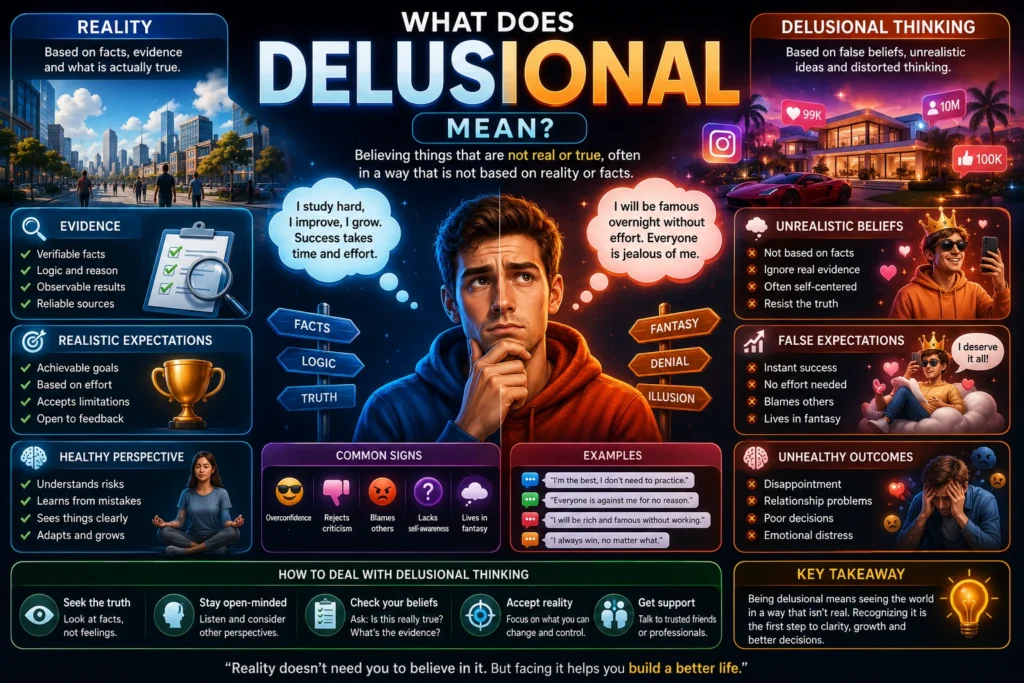
Delusional means holding beliefs or ideas that are clearly false, unrealistic, or unsupported by evidence. In psychology, it can describe a symptom involving fixed false beliefs. In everyday conversation, people often use it to describe unrealistic thinking, exaggerated expectations, or beliefs that ignore reality.
The word delusional appears everywhere today. People use it in conversations, social media posts, relationship discussions, political debates, and mental health conversations. You may hear someone say, “He’s completely delusional,” or see comments online claiming that a person is “being delusional.”
However, the meaning of delusional changes depending on the context. In psychology, it has a specific clinical definition. Meanwhile, in everyday speech, people often use it casually to describe unrealistic beliefs, wishful thinking, or expectations that seem disconnected from reality.
Because the term carries both medical and conversational meanings, many people misunderstand it. Some use it too loosely. Others assume it always refers to a mental illness.
This comprehensive guide explains the complete delusional meaning, including its definition, psychological context, everyday usage, examples, social media trends, related terms, common mistakes, and practical tips for using the word accurately.
Quick Answer Box
| Element | Explanation |
|---|---|
| Meaning | Holding beliefs that are false, unrealistic, or unsupported by evidence |
| Clinical Meaning | Fixed false beliefs despite evidence to the contrary |
| Everyday Meaning | Unrealistic thinking or expectations |
| Common Contexts | Psychology, relationships, social media, politics, sports, business |
| Tone | Usually negative or critical |
| Example | “He believes he’ll become a billionaire next week without any plan. That’s delusional.” |
| Platforms | TikTok, X, Instagram, Reddit, Facebook |
| Related Words | Unrealistic, irrational, misguided, detached from reality |
What Does It Mean?
At its core, delusional means believing something that does not align with reality.
The word describes a person, thought, belief, expectation, or perception that remains disconnected from facts or evidence.
For example:
- Someone believes they will win an election despite having no support.
- A person insists an impossible event will happen.
- An individual refuses to accept overwhelming evidence.
In each case, others may describe that belief as delusional.
The severity depends on context. Sometimes the term describes mild unrealistic thinking. In other situations, it refers to a serious psychological symptom.
Full Definition
The dictionary definition of delusional is:
Characterized by or relating to delusions, especially beliefs that remain fixed despite clear evidence proving them false.
The term comes from the noun delusion, which refers to a false belief.
There are two major ways people use the word today:
Clinical Definition
In psychology and psychiatry, delusional refers to persistent false beliefs that remain unchanged despite contradictory evidence.
Examples include:
- Believing someone is secretly communicating through television broadcasts.
- Believing strangers are monitoring every action without evidence.
- Believing one possesses extraordinary powers despite proof otherwise.
Everyday Definition
In everyday speech, people use delusional more casually.
Examples include:
- Unrealistic goals
- Extreme overconfidence
- Wishful thinking
- Ignoring obvious facts
For example:
“He thinks he’ll become a professional athlete without training. That’s delusional.”
This usage does not necessarily indicate a mental health condition.
Context & Usage
The meaning often depends on the situation.
Personal Relationships
People frequently use delusional when discussing dating and relationships.
Examples:
- Ignoring clear signs of rejection
- Believing a relationship exists when it does not
- Holding unrealistic expectations
Sentence:
“She thinks her ex will return tomorrow even though he moved overseas. Her friends call that delusional.”
Career and Success
People sometimes use the term when discussing unrealistic ambitions.
Example:
“He expects to become CEO next month despite having no experience.”
Politics
Political discussions often include accusations of delusional thinking.
Example:
“Critics called the proposal delusional.”
Sports
Fans sometimes use the word humorously.
Example:
“As a fan, I’m delusional enough to think we’ll win every game.”
Social Media
Online communities use delusional frequently as slang.
This usage often carries humor or exaggeration rather than clinical meaning.
Real-Life Examples
Conversation Example 1
Person A: He thinks he’ll become rich overnight.
Person B: That’s pretty delusional.
Conversation Example 2
Person A: She still believes her celebrity crush will marry her.
Person B: That sounds delusional.
Conversation Example 3
Person A: The company expects profits to triple without investing more money.
Person B: That seems delusional.
Conversation Example 4
Person A: Our team hasn’t won in years, but I think we’ll win the championship.
Person B: That’s delusional optimism.
Conversation Example 5
Person A: He ignored all the evidence.
Person B: Then he’s being delusional.
Platform-Specific Meaning
TikTok
TikTok helped popularize the phrase “delulu,” which comes from delusional.
Users often joke about unrealistic romantic fantasies.
Examples:
- “I’m delulu and proud.”
- “Delulu is the solulu.”
These expressions are usually humorous.
Instagram users often apply delusional to:
- Dating advice
- Influencer culture
- Lifestyle expectations
Example:
“Thinking you’ll become famous overnight is delusional.”
X (Twitter)
Political and cultural debates frequently use the term.
Example:
“That prediction is completely delusional.”
Reddit discussions often distinguish between realistic goals and delusional expectations.
Example:
“The plan sounds ambitious, but not delusional.”
Users commonly employ the term during debates about news, politics, and relationships.
Alternative Meanings
Although the core meaning remains consistent, nuances vary.
Medical Usage
In healthcare settings, delusional describes a recognized psychological symptom.
Casual Criticism
People often use the term to criticize unrealistic thinking.
Humorous Self-Description
Some individuals jokingly call themselves delusional.
Example:
“I’m delusional enough to think my lottery ticket will win.”
Motivational Culture
Some online communities use delusional humor to encourage confidence.
Example:
“Act delusional until success becomes reality.”
This usage is usually playful rather than clinical.
Related Terms and NLP Variations
Understanding related words helps clarify meaning.
Synonyms
- Unrealistic
- Irrational
- Misguided
- Unreasonable
- Detached from reality
- Fantastical
- Impractical
- Illogical
Related Words
- Delusion
- Deluded
- Delusionary
- Fantasy
- Hallucination
- Misconception
Similar Expressions
- Living in a fantasy world
- Out of touch with reality
- Wishful thinking
- Unrealistic expectations
- False belief
Opposites
- Realistic
- Rational
- Practical
- Grounded
- Logical
- Objective
Emotional Meaning
The word delusional often carries emotional implications.
When people call someone delusional, they may mean:
- The person ignores reality.
- The person refuses evidence.
- The person believes unlikely outcomes.
- The person exaggerates possibilities.
Therefore, the word often functions as criticism.
However, context matters.
Sometimes friends use it jokingly.
Other times, it reflects serious concern.
Psychological Meaning
In mental health discussions, the word has a much more specific meaning.
A clinical delusion is:
A fixed false belief that persists despite clear contradictory evidence.
Mental health professionals use careful evaluation before describing someone as delusional.
Several categories of delusions exist.
Grandiose Delusions
A person believes they possess extraordinary importance, abilities, or powers.
Example:
Believing one controls world events.
Persecutory Delusions
A person believes others are targeting, following, or harming them.
Referential Delusions
A person believes ordinary events contain secret messages meant specifically for them.
Somatic Delusions
A person believes something unusual is happening within their body despite medical evidence.
Importantly, casual internet use of delusional differs significantly from these clinical definitions.
How to Respond or Reply
When someone uses the word delusional, your response depends on context.
If Someone Uses It Casually
Possible responses:
- “Why do you think that’s unrealistic?”
- “Maybe it’s ambitious rather than delusional.”
- “Let’s look at the facts.”
If Someone Uses It as Criticism
You might ask:
- “What evidence supports that?”
- “What makes you say that?”
- “Can you explain your reasoning?”
In Mental Health Discussions
Respond carefully and respectfully.
Avoid diagnosing others casually.
Instead, focus on behaviors and evidence.
Misinterpretations
Many people misunderstand the word.
Mistake 1: Assuming Delusional Always Means Crazy
This misconception is common.
A person can hold unrealistic beliefs without having a psychological disorder.
Mistake 2: Using It as a Medical Diagnosis
Most people lack the expertise to diagnose mental health conditions.
Therefore, avoid using the word clinically unless appropriate.
Mistake 3: Confusing Confidence With Delusion
Ambitious goals are not automatically delusional.
Many successful people pursued goals others considered unrealistic.
Mistake 4: Assuming All Delusions Involve Mental Illness
Context matters greatly.
Casual speech often uses the term metaphorically.
Mistake 5: Using It as an Insult
The word can sound dismissive or offensive when directed at individuals.
When NOT to Use It
Certain situations require caution.
Professional Settings
Calling coworkers delusional can appear disrespectful.
Instead, discuss evidence and expectations.
Mental Health Discussions
Avoid casual diagnoses.
Respect professional terminology.
Sensitive Personal Conversations
The term may feel insulting.
Therefore, choose more constructive language when possible.
Conflict Situations
Using the word can escalate disagreements.
Focus on facts rather than labels.
Usage Tips
Consider Context
First, determine whether the conversation involves psychology or everyday speech.
Avoid Overusing the Word
Many situations call for more precise language.
Examples include:
- Optimistic
- Unrealistic
- Overconfident
- Misguided
Use Evidence-Based Language
Instead of labeling someone, explain why a belief seems unrealistic.
Understand Tone
The term usually sounds negative.
Therefore, use it thoughtfully.
Know Your Audience
Professional audiences often prefer more nuanced language.
Delusional vs Similar Terms
| Term | Meaning | Key Difference |
|---|---|---|
| Delusional | False or unrealistic beliefs | Strongest term |
| Unrealistic | Not practical or likely | Less severe |
| Optimistic | Positive expectations | Often positive |
| Naive | Lacking experience | Not necessarily false |
| Irrational | Illogical thinking | Focuses on reasoning |
| Overconfident | Excessive confidence | Focuses on self-belief |
Edge Cases and Special Situations
Can Delusional Be Positive?
Sometimes online communities use it humorously.
Example:
“I’m delusional enough to believe I can finish ten projects this week.”
However, the core meaning remains negative.
Is Delusional a Slang Term?
Not originally.
It is a standard English word.
However, internet culture created slang variations such as:
- Delulu
- Delulu era
- Delulu mindset
Can Someone Be Delusional About Success?
People often use the term that way.
However, history shows that ambitious goals sometimes become reality.
Therefore, context and evidence matter.
Is Every Unrealistic Goal Delusional?
No.
Many challenging goals seem unrealistic initially.
The difference lies in evidence, planning, and probability.
Can the Word Be Offensive?
Yes.
Because it questions someone’s perception of reality, some people find it insulting.
FAQs
What does delusional mean in simple terms?
Delusional means believing something that is false, unrealistic, or unsupported by evidence.
Is delusional a mental illness?
No. Delusional is a description. However, it can refer to symptoms associated with certain mental health conditions.
What does delusional mean in slang?
In slang, it often means overly optimistic, unrealistic, or living in a fantasy.
What is a delusion?
A delusion is a fixed false belief that remains despite evidence showing it is incorrect.
What does “delulu” mean?
Delulu is internet slang derived from delusional. People often use it humorously to describe unrealistic hopes or fantasies.
Is calling someone delusional rude?
It can be. The term often sounds critical and may offend people.
What is the difference between delusional and unrealistic?
Delusional suggests a stronger disconnect from reality, while unrealistic simply means unlikely or impractical.
Can successful people seem delusional?
Sometimes. Ambitious visions may appear unrealistic initially. However, success depends on evidence, effort, and execution.
How do psychologists define delusional?
Psychologists use the term to describe persistent false beliefs that continue despite contradictory evidence.
Is delusional always negative?
Usually yes. However, online communities sometimes use it jokingly or playfully.
Conclusion
The delusional meaning centers on beliefs, expectations, or perceptions that conflict with reality or available evidence. In psychology, the term refers to fixed false beliefs that persist despite contradictory facts. Meanwhile, in everyday conversation, people often use it to describe unrealistic thinking, excessive optimism, wishful fantasies, or expectations that seem detached from reality.
Understanding the distinction between the clinical and casual meanings is essential. Although social media frequently uses the term humorously, it still carries significant weight in mental health contexts. Therefore, using the word thoughtfully helps ensure clear, respectful, and accurate communication.

Justin Powell is a writer at GramBrix.com who focuses on grammar, clarity and effective communication, helping readers strengthen their language skills.