Last Updated on July 24, 2026
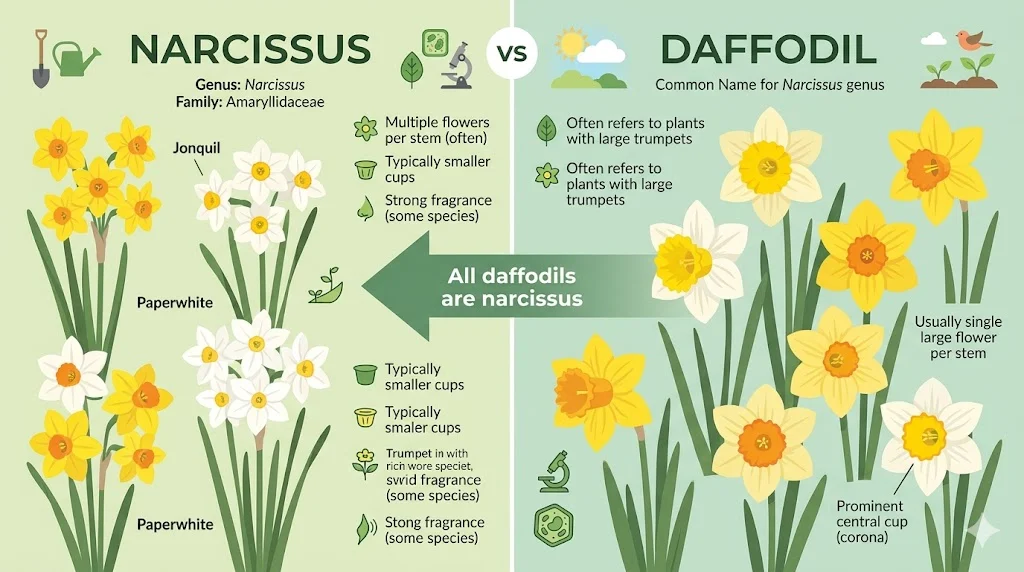
The difference between narcissus and daffodil is mainly botanical and cultural. “Daffodil” is the common name for certain species within the Narcissus genus, while “narcissus” is the scientific genus name that includes daffodils and related flowers. In simple terms, all daffodils are narcissus, but not all narcissus are daffodils. These plants are closely related, often confused, and widely used in gardens and floral design.
The topic of narcissus vs daffodil is one of the most common points of confusion in gardening and plant identification. Many people think these are two completely different flowers. In reality, they are closely connected and often refer to the same plant group.
This confusion happens because different regions and traditions use different names. Gardeners, florists, and scientists may describe the same flower in different ways. This leads to misunderstanding when buying bulbs, reading plant labels, or planning a garden.
Understanding narcissus vs daffodil is important for anyone interested in gardening, botany, or landscaping. It helps you choose the right plants, care for them properly, and avoid mistakes when identifying species. It also improves your knowledge of plant classification.
In this guide, you will learn the full difference between narcissus and daffodil in simple language. We will explore definitions, examples, uses, advantages, mistakes, and real-world gardening tips. By the end, you will clearly understand how these plants relate and how to identify them correctly.
Quick Answer Overview: Narcissus vs Daffodil
The simplest explanation of narcissus vs daffodil is:
- Narcissus is the scientific genus name.
- Daffodil is the common name for many yellow trumpet-shaped narcissus flowers.
- All daffodils belong to the narcissus family.
- Not all narcissus are daffodils (some are paperwhites, jonquils, etc.).
Simple Analogy
Think of it like this:
- Narcissus = “fruit”
- Daffodil = “apple”
All apples are fruit, but not all fruit are apples. The same idea applies to narcissus vs daffodil.
Definition of Narcissus
The term narcissus refers to a genus of flowering plants in the Amaryllidaceae family. These plants are native mainly to Europe, North Africa, and parts of Asia.
Key Characteristics of Narcissus
- Scientific genus: Narcissus
- Flowering plant with bulb structure
- Produces trumpet or cup-shaped flowers
- Includes many species and hybrids
- Grows best in temperate climates
Types of Narcissus
Some common types include:
- Daffodils
- Jonquils
- Paperwhites
- Tazetta narcissus
- Poeticus narcissus
Each type has different shapes, scents, and blooming seasons.
Definition of Daffodil
A daffodil is a common name used for certain species of narcissus, especially those with yellow or white flowers and a trumpet-shaped center.
Key Characteristics of Daffodils
- Belong to the narcissus genus
- Usually bright yellow or white
- Have a central trumpet (corona)
- Bloom in early spring
- Popular in gardens and parks
Why They Are Called Daffodils
The name “daffodil” comes from traditional English usage. It is mainly used for ornamental garden flowers that are part of the narcissus group.
Narcissus vs Daffodil: Core Differences Explained
Scientific vs Common Name
- Narcissus: Botanical classification
- Daffodil: Common gardening name
Scope of Classification
- Narcissus: Entire genus
- Daffodil: Subset of narcissus species
Appearance
- Narcissus: Includes many shapes and colors
- Daffodil: Usually yellow or white trumpet flowers
Usage
- Narcissus: Used in scientific study and plant taxonomy
- Daffodil: Used in gardening and floral trade
Comparison Table: Narcissus vs Daffodil
| Feature | Narcissus | Daffodil |
| Type | Genus (scientific) | Common name |
| Classification | Broad group | Subset of narcissus |
| Species coverage | All species | Selected species |
| Color range | White, yellow, orange, pink | Mostly yellow/white |
| Usage | Botany, taxonomy | Gardening, decoration |
| Examples | Paperwhite, Jonquil | Trumpet daffodil |
| Meaning | Scientific term | Cultural/common term |
Advantages and Disadvantages of Narcissus Plants
Advantages
Understanding narcissus vs daffodil also helps highlight plant benefits:
- Easy to grow in many climates
- Require low maintenance
- Bloom early in spring
- Resistant to deer and rodents
- Long-lasting flowers
- Can naturalize in gardens
Disadvantages
- Toxic if ingested
- Short blooming period
- Can become overcrowded over time
- Requires proper drainage
- Not suitable for indoor eating environments
Real-World Examples of Narcissus vs Daffodil
Example 1: Garden Planting
A gardener buys “daffodil bulbs” for spring planting. These bulbs are actually narcissus species selected for their bright yellow flowers.
Example 2: Florist Labels
A florist may label a bouquet as “narcissus flowers” when including paperwhite narcissus instead of traditional daffodils.
Example 3: Botanical Gardens
Botanical gardens use “narcissus collection” to include all species, while visitors often call them all daffodils.
Regional and Global Usage of Narcissus vs Daffodil
United Kingdom
- “Daffodil” is the most common term
- Associated with spring and national symbolism
United States
- Both terms are used
- “Daffodil” is more common in everyday language
Europe
- “Narcissus” is more common in scientific and botanical contexts
Asia
- Scientific naming “narcissus” is often used in horticulture markets
Common Mistakes in Understanding Narcissus vs Daffodil
Mistake 1: Thinking They Are Different Plants
Many beginners believe narcissus and daffodil are separate species. In reality, daffodils are part of the narcissus genus.
Mistake 2: Assuming All Narcissus Are Yellow
Not all narcissus are yellow. Some are white, orange, or even pink-toned.
Mistake 3: Mislabeling in Gardening
Garden centers sometimes label all narcissus as daffodils, which causes confusion.
Mistake 4: Ignoring Botanical Classification
Skipping scientific classification leads to misunderstanding plant care needs.
Exercises with Answers: Narcissus vs Daffodil
Exercise 1
Question: Are all daffodils narcissus?
Answer: Yes, all daffodils are part of the narcissus genus.
Exercise 2
Question: Is every narcissus a daffodil?
Answer: No, only certain narcissus species are called daffodils.
Exercise 3
Question: Which term is scientific: narcissus or daffodil?
Answer: Narcissus is the scientific term.
Exercise 4
Question: Name two types of narcissus besides daffodils.
Answer: Paperwhite and jonquil.
Exercise 5
Question: What season do daffodils usually bloom?
Answer: Early spring.
Related Concepts and Comparisons
Narcissus vs Tulip
- Narcissus: bulb plant, often scented
- Tulip: cup-shaped, wider color variety
Narcissus vs Lily
- Narcissus: trumpet-shaped flowers
- Lily: larger petals and taller stems
Narcissus vs Hyacinth
- Narcissus: single or clustered blooms
- Hyacinth: dense flower spikes
Botanical Classification Overview
- Family: Amaryllidaceae
- Genus: Narcissus
- Species: multiple (daffodil is one group)
FAQs
What is the main difference between narcissus vs daffodil?
Narcissus is the scientific genus, while daffodil is a common name for certain narcissus species.
Are daffodils and narcissus the same plant?
Yes, daffodils are a type of narcissus, but not all narcissus are daffodils.
Why are narcissus called daffodils?
The name daffodil is a traditional English term used for ornamental narcissus flowers.
Can narcissus grow in all climates?
They grow best in temperate climates but can adapt to many regions with proper care.
Are narcissus flowers poisonous?
Yes, all narcissus plants contain toxic compounds if ingested.
Do daffodils bloom every year?
Yes, they are perennial bulbs and bloom annually in spring.
What colors do narcissus flowers come in?
They come in yellow, white, orange, and sometimes pink shades.
How long do daffodil flowers last?
Typically, blooms last 2–4 weeks depending on weather conditions.
Is narcissus used in medicine or perfume?
Some species are studied for fragrance, but they are not commonly used in modern medicine.
Which is more correct, narcissus or daffodil?
Both are correct; narcissus is scientific, and daffodil is common usage.
Conclusion
Understanding narcissus vs daffodil helps clear one of the most common botanical confusions. While these terms are often used interchangeably, they are not identical. Narcissus refers to the full plant genus, while daffodils represent a specific group within that genus.
For gardeners, this knowledge is practical. It helps in choosing bulbs, identifying plants, and caring for them properly. For students and plant enthusiasts, it improves understanding of botanical classification and plant diversity.
The key takeaway is simple: all daffodils are narcissus, but not all narcissus are daffodils. By remembering this, you can confidently identify and use both terms correctly in gardening, learning, and everyday conversation.

Kevin Brooks is a grammar specialist at GramBrix.com, dedicated to helping readers understand language rules with clarity and confidence. He simplifies complex grammar concepts through practical examples and easy explanations.