Last Updated on August 12, 2026
A wart vs callus comparison helps people understand two common skin conditions that often look similar but have different causes and treatments. A wart is caused by a viral infection, while a callus develops from repeated pressure or friction. Knowing the difference helps you choose the right care and avoid worsening the condition.
Have you ever noticed a rough, hard spot on your skin and wondered whether it is a wart or callus? You are not alone. These two common skin conditions can look surprisingly similar, especially when they appear on the hands, fingers, or feet. However, their causes are very different. A wart is caused by a viral infection, while a callus develops when repeated pressure or friction makes the skin thicker.
Knowing the difference between wart vs callus matters because the right treatment depends on the cause. A wart may require wart-specific treatment, while a callus often improves by reducing friction and gently caring for the thickened skin. In this guide, we explain the key differences, symptoms, causes, diagnosis, treatment options, common mistakes, and prevention tips. The information is presented in a clear, practical way to help you better understand these skin changes and know when professional advice may be appropriate.
Quick Answer / Overview of Wart vs Callus
A wart vs callus comparison can be summarized quickly:
- A wart is a viral skin infection caused by the human papillomavirus (HPV).
- A callus is thickened skin caused by repeated friction or pressure.
- Warts can spread from person to person or from one body part to another.
- Calluses are not contagious.
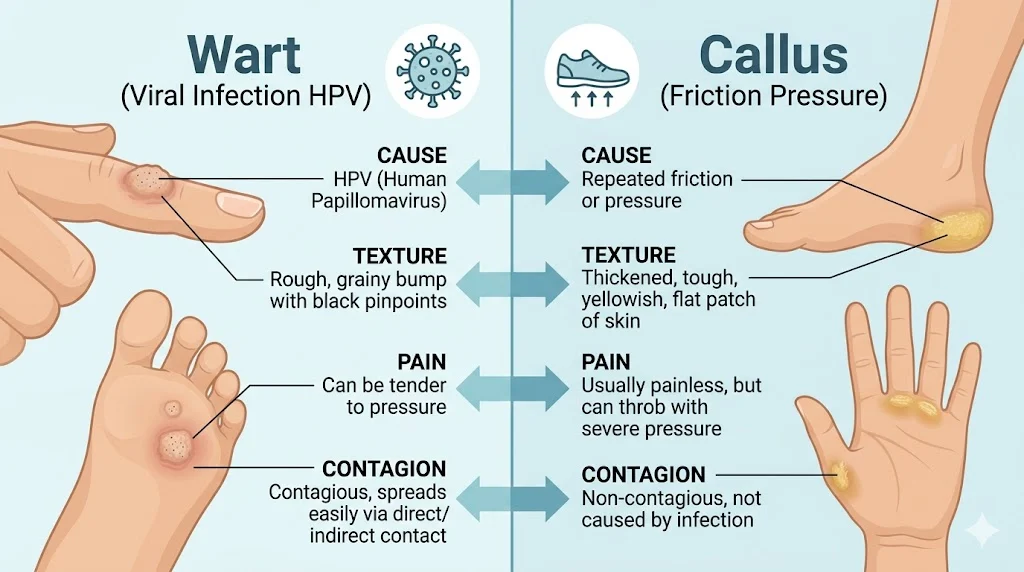
- Warts often have a rough, grainy surface with black dots.
- Calluses are usually smooth, thick, and yellowish or gray.
Simple analogy
Think of a wart as a “guest virus” living in your skin, while a callus is your skin’s “armor” protecting itself from pressure.
Definition and Explanation of Wart vs Callus
What is a Wart?
A wart is a small, rough skin growth caused by infection with the human papillomavirus (HPV). The virus enters through tiny cuts or weak areas in the skin.
Key features of warts:
- Caused by viral infection
- Contagious
- Rough and grainy texture
- May contain black dots (clotted blood vessels)
- Can appear anywhere on the body
Common types:
- Common warts (hands, fingers)
- Plantar warts (feet)
- Flat warts (face, arms)
- Filiform warts (around mouth or nose)
In the wart vs callus comparison, warts are biological infections, not mechanical skin changes.
What is a Callus?
A callus is a thick, hard area of skin that forms due to repeated pressure, friction, or irritation.
Key features of calluses:
- Not caused by infection
- Not contagious
- Thick, rough, and dry skin
- Usually painless
- Common on feet, hands, and fingers
Common causes:
- Tight shoes
- Walking barefoot
- Repetitive work with hands
- Sports or physical activity
In the wart vs callus comparison, calluses are protective skin responses.
Wart vs Callus: Core Difference Table
| Feature | Wart | Callus |
| Cause | Viral infection (HPV) | Pressure or friction |
| Contagious | Yes | No |
| Appearance | Rough, grainy, may have black dots | Thick, smooth, yellowish |
| Pain | Sometimes painful | Usually painless |
| Growth pattern | Can spread | Does not spread |
| Treatment | Antiviral, freezing, removal | Pressure relief, moisturizers |
How They Develop
Wart development
- Virus enters skin through a cut
- Skin cells grow abnormally
- Rough bump forms
- May spread over time
Callus development
- Skin experiences repeated pressure
- Skin thickens for protection
- Hardened layer forms
- Stabilizes if pressure continues
Advantages and Disadvantages
Advantages of correctly identifying wart vs callus
- Helps choose correct treatment
- Prevents infection spread
- Avoids unnecessary medication
- Improves healing time
- Reduces pain and discomfort
Disadvantages of misidentifying wart vs callus
- Warts may spread if untreated
- Calluses may worsen if pressure continues
- Wrong self-treatment can damage skin
- Delayed medical diagnosis
Treatment comparison advantage
Correct identification in wart vs callus ensures:
- Warts: antiviral treatment
- Callus: pressure relief and skin care
Real-World Examples of Wart vs Callus
Example 1: Athlete’s foot confusion
A runner develops a hard bump on the foot. It is painful and rough. They assume it is a callus from running shoes. Later, it spreads and turns out to be a plantar wart.
Example 2: Manual worker’s hands
A carpenter develops thick skin on palms. It is painless and stable. This is a callus from repeated tool use, not a wart.
Example 3: School child infection
A child develops small rough bumps on fingers after sharing gym equipment. These are common warts caused by viral exposure.
Regional and Global Usage of Wart vs Callus Terms
The understanding of wart vs callus is similar worldwide, but terminology may vary:
- Medical English: “wart” and “callus”
- Layman terms: “skin bump” or “hard skin”
- Dermatology clinics: use precise diagnostic terms like “verruca vulgaris” for warts
In all regions, the distinction remains consistent:
- Wart = viral infection
- Callus = pressure-related thick skin
Common Mistakes in Wart vs Callus Identification
Mistake 1: Assuming all hard skin is a callus
Not true. Some warts look very similar to calluses.
Mistake 2: Trying to cut or scrape warts
This can spread infection.
Mistake 3: Ignoring pain differences
- Warts may hurt when squeezed sideways
- Calluses hurt under direct pressure
Mistake 4: Self-medication without diagnosis
Using callus treatment on warts delays healing.
Mistake 5: Not checking black dots
Black dots are often a sign of warts.
Exercises with Answers (Wart vs Callus Practice)
Exercise 1
A thick skin patch appears on the heel after wearing tight shoes for months. What is it?
Answer: Callus
Exercise 2
A rough bump appears on the finger and spreads to nearby skin. What is it?
Answer: Wart
Exercise 3
Which condition is contagious in wart vs callus?
Answer: Wart
Exercise 4
Which condition is caused by friction?
Answer: Callus
Exercise 5
A lesion has black dots and rough texture. What is likely diagnosis?
Answer: Wart
Related Concepts and Comparisons
Wart vs Corn
- Corn: localized thick skin due to pressure
- Wart: viral infection
- Corns are smaller and more painful than calluses
Plantar wart vs Callus
- Plantar wart: grows inward, painful when squeezed
- Callus: spreads outward, less painful
Wart vs Skin tag
- Skin tag: soft, harmless growth
- Wart: rough, viral growth
Symptoms Comparison of Wart vs Callus
Wart symptoms
- Rough surface
- Small black dots
- Pain when squeezed sideways
- Possible spread
Callus symptoms
- Thickened skin
- Dry or hard texture
- Mild discomfort
- No spread
Diagnosis Methods
Doctors identify wart vs callus using:
- Visual inspection
- Skin scraping test
- Pressure test
- Dermatoscope examination
Correct diagnosis is essential for treatment success.
Treatment Options for Wart vs Callus
Wart treatment
- Salicylic acid
- Cryotherapy (freezing)
- Laser treatment
- Immune therapy
Callus treatment
- Reducing pressure
- Wearing proper footwear
- Moisturizing creams
- Pumice stone exfoliation
Prevention Tips
Preventing warts
- Avoid walking barefoot in public places
- Do not share personal items
- Keep skin clean and dry
Preventing calluses
- Wear comfortable shoes
- Use protective padding
- Reduce repetitive pressure
FAQs
What is the main difference between wart vs callus?
A wart is caused by a virus, while a callus is caused by friction or pressure.
Are warts contagious in wart vs callus comparison?
Yes, warts are contagious. Calluses are not.
Can a callus turn into a wart?
No, a callus cannot turn into a wart because they have different causes.
How can I tell wart vs callus at home?
Look for black dots and spread for warts; thick, smooth skin for calluses.
Is a wart painful compared to a callus?
Warts may hurt when squeezed sideways, while calluses are usually less painful.
Where do warts and calluses commonly appear?
Warts: hands, feet, fingers. Calluses: feet, palms.
What is the fastest treatment for wart vs callus?
Warts need medical treatment; calluses improve by removing pressure.
Can shoes cause both wart vs callus?
Shoes can cause calluses due to pressure but not warts directly.
Should I see a doctor for wart vs callus?
Yes, if the lesion spreads, hurts, or does not improve.
Can both occur at the same time?
Yes, it is possible to have both warts and calluses in different areas.
Conclusion
Understanding the difference between wart vs callus is essential for proper skin care and treatment. While they may look similar at first glance, their causes are completely different. Warts are caused by viral infection and can spread, while calluses are simply the skin’s protective response to repeated pressure.
Recognizing these differences helps prevent wrong treatment and unnecessary discomfort. If you notice a rough skin growth, observe its texture, pain pattern, and behavior. If it spreads or shows black dots, it may be a wart. If it is thick and caused by pressure, it is likely a callus.
For best results, avoid self-diagnosis when unsure. Proper medical advice ensures faster healing and prevents complications. Simple care steps like wearing proper shoes, maintaining hygiene, and avoiding skin damage can prevent both conditions effectively.
Discover more Articles:
- Mustang vs Camaro: Key Differences Explained Clearly For 2026
- Memrise vs Duolingo Comparison Guide 2026: Which Language App Is Better for You?

Justin Powell is a writer at GramBrix.com who focuses on grammar, clarity and effective communication, helping readers strengthen their language skills.