
Last Updated on May 7, 2026
PMOS and NMOS are two fundamental types of MOSFET transistors used in digital and analog circuits. NMOS uses electrons as charge carriers and switches faster, while PMOS uses holes and is slower but easier to use in complementary designs. Together, they form CMOS technology, which powers nearly all modern electronics.
The difference between PMOS vs NMOS is one of the most important topics in electronics and semiconductor engineering. These two types of MOSFETs (Metal Oxide Semiconductor Field Effect Transistors) are the building blocks of modern digital circuits, including processors, memory chips, and microcontrollers.
Many beginners get confused because both devices look similar in diagrams and perform switching functions. However, their internal operation, charge carriers, and electrical behavior are very different. NMOS uses electrons, which move fast and give higher speed. PMOS uses holes, which move slower but help in building stable complementary circuits.
Understanding PMOS vs NMOS is essential for anyone studying electronics, VLSI design, or computer engineering. It helps in understanding how logic gates, inverters, and CPUs work at the transistor level. In this article, you will learn everything from basic definitions to real-world applications, advantages, disadvantages, and practical examples in simple language.
Quick Answer Overview of PMOS vs NMOS
PMOS vs NMOS can be summarized in simple terms:
- NMOS turns ON when a positive voltage is applied to the gate.
- PMOS turns ON when a negative or low voltage is applied to the gate.
- NMOS uses electrons as charge carriers.
- PMOS uses holes as charge carriers.
- NMOS is faster and more power-efficient in switching.
- PMOS is easier to fabricate in complementary circuits.
Together, PMOS vs NMOS transistors form CMOS technology, which is used in almost every modern electronic device.
Definition of PMOS vs NMOS
What is NMOS
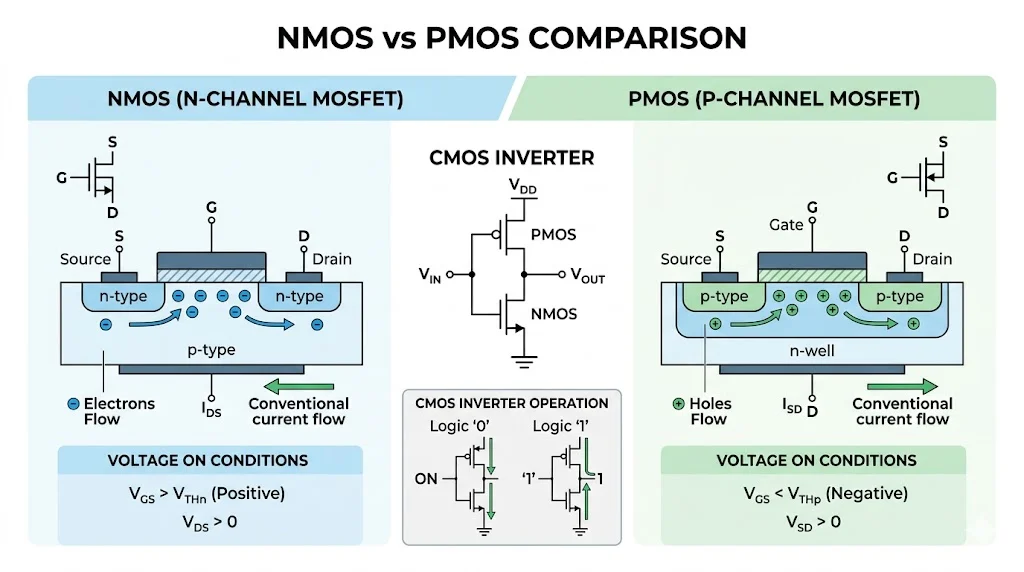
NMOS stands for N-type Metal Oxide Semiconductor. It is a type of MOSFET where the majority charge carriers are electrons. These electrons move quickly, allowing faster switching speed and better performance in digital circuits.
In NMOS:
- Source and drain are made of N-type material
- Substrate is P-type
- Current flows when gate voltage is high
What is PMOS
PMOS stands for P-type Metal Oxide Semiconductor. It is a type of MOSFET where the majority charge carriers are holes. These holes move slower compared to electrons.
In PMOS:
- Source and drain are made of P-type material
- Substrate is N-type
- Current flows when gate voltage is low
Basic Working Principle
Both PMOS and NMOS work by controlling the flow of current between source and drain using an electric field applied at the gate. This makes them voltage-controlled devices.
PMOS vs NMOS Working Principle
NMOS Working
When a positive voltage is applied to the gate of an NMOS transistor:
- Electrons are attracted toward the gate region
- A conductive channel forms between source and drain
- Current flows easily
This makes NMOS ideal for fast switching applications.
PMOS Working
When the gate voltage is low or negative:
- Holes are attracted toward the channel region
- A conductive path is created
- Current flows from source to drain
PMOS devices are commonly used in pull-up networks.
PMOS vs NMOS Comparison Table
| Feature | NMOS | PMOS |
| Charge carriers | Electrons | Holes |
| Mobility | High | Low |
| Speed | Faster | Slower |
| ON condition | High gate voltage | Low gate voltage |
| Power consumption | Lower | Higher |
| Usage | Pull-down network | Pull-up network |
| Symbol arrow direction | Outward | Inward |
Advantages and Disadvantages of PMOS vs NMOS
Advantages of NMOS
- Faster switching speed
- High electron mobility
- Better performance in logic circuits
- Lower power consumption in CMOS design
Disadvantages of NMOS
- Requires more complex design in isolation circuits
- Higher leakage current in some cases
Advantages of PMOS
- Easier to fabricate in complementary circuits
- Useful in pull-up networks
- Better noise immunity in some designs
Disadvantages of PMOS
- Slower switching speed
- Lower carrier mobility
- Larger size needed for same performance
Real-World Applications of PMOS vs NMOS
Digital Electronics
PMOS vs NMOS transistors are used in:
- Logic gates (AND, OR, NOT)
- Flip-flops
- Microprocessors
- Memory chips
CMOS Technology
The most important application is CMOS (Complementary MOS), which combines both PMOS and NMOS.
In CMOS:
- NMOS is used for pulling output to ground
- PMOS is used for pulling output to VDD
This design reduces power consumption significantly.
Microprocessors
Modern CPUs use billions of PMOS vs NMOS transistors to perform calculations and store data.
Smartphones
Every smartphone chip relies on CMOS technology built from PMOS and NMOS.
PMOS vs NMOS in CMOS Inverter
A CMOS inverter uses both PMOS and NMOS.
- When input is HIGH:
- NMOS turns ON
- PMOS turns OFF
- Output becomes LOW
- When input is LOW:
- PMOS turns ON
- NMOS turns OFF
- Output becomes HIGH
This simple structure is the foundation of digital logic.
Regional and Global Usage of PMOS vs NMOS Technology
Global Semiconductor Industry
PMOS vs NMOS technology is used worldwide in:
- United States semiconductor companies
- Taiwan chip manufacturing (TSMC)
- South Korea memory production (Samsung, SK Hynix)
- Europe microelectronics industry
Academic Usage
Universities use PMOS vs NMOS to teach:
- VLSI design
- Digital electronics
- Semiconductor physics
Common Mistakes in Understanding PMOS vs NMOS
Mistake 1: Thinking Both Work the Same
Many beginners assume PMOS and NMOS are identical. In reality, their carriers and voltage conditions are opposite.
Mistake 2: Confusing ON Conditions
- NMOS turns ON with HIGH voltage
- PMOS turns ON with LOW voltage
Mistake 3: Ignoring Mobility Difference
Electron mobility in NMOS is much higher than hole mobility in PMOS.
Mistake 4: Misreading Symbols
Arrow direction in symbols indicates current flow type and is often misunderstood.
Exercises with Answers on PMOS vs NMOS
Exercise 1
Which transistor is faster, PMOS vs NMOS?
Answer: NMOS is faster due to higher electron mobility.
Exercise 2
What charge carriers are used in PMOS vs NMOS?
Answer: PMOS uses holes, NMOS uses electrons.
Exercise 3
What happens when NMOS gate is HIGH?
Answer: NMOS turns ON and current flows.
Exercise 4
What is the main use of PMOS in circuits?
Answer: PMOS is mainly used in pull-up networks in CMOS design.
Exercise 5
Why is CMOS preferred over using only PMOS vs NMOS?
Answer: Because CMOS reduces power consumption and improves efficiency.
Related Concepts and Comparisons
PMOS vs NMOS vs CMOS
- PMOS: Pull-up transistor
- NMOS: Pull-down transistor
- CMOS: Combination of both
MOSFET vs BJT
- MOSFET (PMOS/NMOS) is voltage-controlled
- BJT is current-controlled
Enhancement vs Depletion Mode
Both PMOS vs NMOS can operate in different modes depending on design.
FAQs
What is PMOS vs NMOS in simple terms?
PMOS and NMOS are two types of transistors used to control current in electronic circuits.
Which is faster, PMOS vs NMOS?
NMOS is faster because electrons move more quickly than holes.
Why is NMOS used more than PMOS?
NMOS has higher efficiency and speed, making it more suitable for modern circuits.
Can PMOS and NMOS work together?
Yes, they are combined in CMOS technology for better performance.
What is the main difference in PMOS vs NMOS?
The main difference is the type of charge carriers and gate voltage requirements.
Where are PMOS vs NMOS used?
They are used in CPUs, memory chips, logic gates, and digital systems.
Why does PMOS turn ON with low voltage?
Because it is a P-type device that conducts when gate voltage is negative relative to source.
Is CMOS better than PMOS vs NMOS alone?
Yes, CMOS is more power-efficient and widely used in modern electronics.
What is the symbol difference in PMOS vs NMOS?
NMOS has an outward arrow, while PMOS has an inward arrow.
Why is PMOS still needed if NMOS is better?
Because PMOS is essential for creating complementary logic in CMOS circuits.
Conclusion
The comparison of PMOS vs NMOS is essential for understanding modern electronics. NMOS is faster and uses electrons, making it ideal for high-speed switching. PMOS uses holes and is slower, but it plays a critical role in balanced circuit design.
When combined, PMOS vs NMOS form CMOS technology, which is the backbone of almost all digital devices today. From smartphones to supercomputers, this combination ensures low power consumption and high efficiency.
For students and engineers, mastering PMOS vs NMOS is the first step toward understanding VLSI design, microelectronics, and semiconductor physics. A strong foundation in these concepts helps in designing better and more efficient electronic systems.

Justin Powell is a writer at GramBrix.com who focuses on grammar, clarity and effective communication, helping readers strengthen their language skills.