Last Updated on June 16, 2026
Progressive vs bifocal lenses are two types of prescription glasses used to correct presbyopia and vision changes with age. Bifocal lenses have two distinct optical zones for near and distance vision, while progressive lenses offer a smooth, gradual transition between multiple vision zones without visible lines. Progressive lenses provide a more natural viewing experience, whereas bifocals are often simpler and easier to adjust to initially.
Choosing the right eyeglasses becomes more important as we age, especially when reading small text or seeing distant objects clearly becomes difficult. Many people face confusion when selecting between progressive vs bifocal lenses. Both are designed to solve vision problems caused by presbyopia, but they work in very different ways.
This confusion often leads to wrong choices, discomfort, or repeated changes in glasses. Some people prefer the simplicity of bifocals, while others want the smooth vision of progressive lenses. However, understanding how each lens works can make your decision much easier.
In this guide, we will break down everything about progressive vs bifocal lenses in simple language. You will learn how they work, their pros and cons, real-world examples, common mistakes, and how to choose the right one for your lifestyle. Whether you are a first-time wearer or upgrading your eyewear, this article will help you make a confident decision.
Quick Overview of Progressive vs Bifocal
Before going deep, here is a simple comparison.
- Bifocal lenses: Have two clear sections (near and distance vision)
- Progressive lenses: Have multiple vision zones with smooth transitions
Key Idea
- Bifocal = “two-in-one lens”
- Progressive = “all-in-one smooth lens”
What Are Bifocal Lenses?
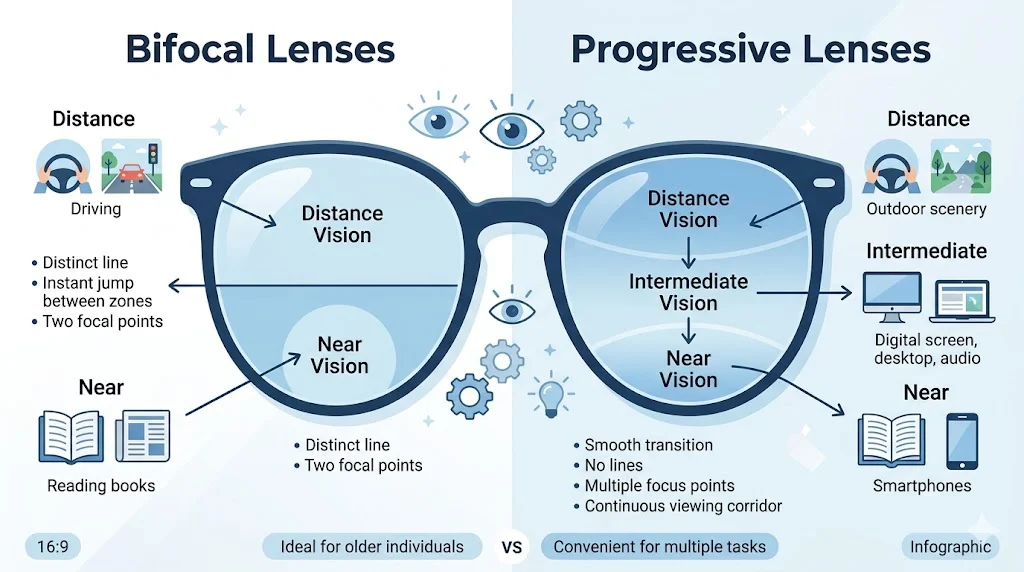
Bifocal lenses are eyeglasses that contain two different optical powers in one lens. The upper part helps you see far objects clearly, while the lower part helps you read or focus on close objects.
How Bifocal Lenses Work
The lens is divided into two visible sections:
- Upper part: Distance vision (driving, walking, watching TV)
- Lower part: Near vision (reading, phone use, writing)
The line separating these two areas is clearly visible.
History of Bifocal Lenses
Bifocals were popularized by Benjamin Franklin. They were one of the earliest solutions for presbyopia and are still widely used today due to their simplicity and affordability.
What Are Progressive Lenses?
Progressive lenses are modern eyeglass lenses designed to provide multiple vision zones without visible lines. They allow a smooth transition from distance to intermediate to near vision.
How Progressive Lenses Work
Progressive lenses gradually change power from top to bottom:
- Top: Distance vision
- Middle: Intermediate vision (computer, dashboard)
- Bottom: Near vision (reading)
There is no visible separation between zones.
Why They Are Called “Progressive”
The power “progresses” smoothly from one level to another, instead of switching suddenly like bifocals.
Progressive vs Bifocal: Key Differences Explained
Understanding progressive vs bifocal lenses becomes easier when compared side by side.
| Feature | Bifocal Lenses | Progressive Lenses |
| Vision zones | 2 (near & distance) | 3+ (near, intermediate, distance) |
| Visible line | Yes | No |
| Transition | Sudden | Smooth |
| Adaptation time | Faster | Slower |
| Appearance | Older style look | Modern and aesthetic |
| Cost | Lower | Higher |
| Comfort | Basic | More natural |
Advantages and Disadvantages of Bifocal Lenses
Advantages of Bifocal Lenses
- Easy to understand and use
- Faster adaptation for new users
- More affordable than progressive lenses
- Clear separation of vision zones
- Good for people who only need near and distance correction
Disadvantages of Bifocal Lenses
- Visible line on lens
- No intermediate vision support
- Image jump between zones
- Less aesthetic appeal
- Can feel outdated
Advantages and Disadvantages of Progressive Lenses
Advantages of Progressive Lenses
- No visible line on lenses
- Natural vision transition
- Supports near, intermediate, and distance vision
- Modern and stylish appearance
- Better for computer users and multitaskers
Disadvantages of Progressive Lenses
- Higher cost
- Requires adaptation time
- Peripheral distortion (in some cases)
- Not suitable for all users
Progressive vs Bifocal: Real-World Examples
Example of Bifocal Use
Imagine reading a book and then looking at a distant TV. With bifocals:
- You look through the bottom for reading
- You lift your head slightly for distance vision
The switch is immediate but noticeable.
Example of Progressive Use
Now imagine using progressive lenses:
- You slowly move your eyes downward to read
- You shift slightly upward for computer work
- You look straight for distance vision
Everything feels smooth and natural.
Who Should Choose Bifocal Lenses?
Bifocal lenses are suitable for:
- People over 50 who prefer simple vision correction
- Users who only need near and distance vision
- Those on a tight budget
- First-time users who want easy adaptation
Who Should Choose Progressive Lenses?
Progressive lenses are ideal for:
- Professionals using computers daily
- People who want a modern appearance
- Users needing smooth vision at all distances
- Drivers, office workers, and multitaskers
Progressive vs Bifocal: Comfort and Adaptation
Bifocal Adaptation
Most users adapt quickly because:
- Two simple zones
- Clear division
- No distortion in transition
Progressive Adaptation
Some users may need time because:
- Side distortion may occur
- Eye movement adjustment required
- Learning curve for zones
Common Mistakes When Choosing Progressive vs Bifocal
Mistake 1: Ignoring Lifestyle Needs
Many people choose based on price instead of usage.
Mistake 2: Expecting Instant Comfort with Progressives
Progressive lenses require adjustment time.
Mistake 3: Choosing Bifocals for Modern Screen Use
Bifocals lack intermediate vision, which is important for screens.
Mistake 4: Wrong Frame Selection
Improper frame height affects progressive lens performance.
Mistake 5: Not Consulting an Eye Specialist
Self-selection often leads to discomfort.
Comparison of Visual Experience
Bifocal Vision Experience
- Sudden jump between zones
- Visible lens line
- Clear but segmented vision
Progressive Vision Experience
- Smooth visual flow
- No visible lines
- Natural eye movement
Exercises: Test Your Understanding
Exercise 1
Which lens has a visible line between vision zones?
Answer: Bifocal lenses
Exercise 2
Which lens provides intermediate vision?
Answer: Progressive lenses
Exercise 3
Fill in the blank: Progressive lenses provide a ______ transition between vision zones.
Answer: smooth
Exercise 4
True or False: Bifocal lenses are more expensive than progressive lenses.
Answer: False
Exercise 5
Which lens is better for computer work?
Answer: Progressive lenses
Progressive vs Bifocal: Cost Comparison
Bifocal Cost Factors
- Lower manufacturing cost
- Simple design
- Widely available
Progressive Cost Factors
- Advanced technology
- Customized lens design
- Higher precision manufacturing
Summary
Progressive lenses are generally more expensive due to their advanced design and comfort benefits.
Regional and Global Usage Trends
Bifocal Usage
- More common in developing regions
- Preferred by older generations
- Used where affordability matters
Progressive Usage
- Popular in developed countries
- Preferred by professionals
- Increasing global adoption
Maintenance and Care Tips
For Both Lens Types
- Clean with microfiber cloth
- Use lens cleaning solution
- Avoid scratching surfaces
- Store in protective case
Extra Care for Progressive Lenses
- Ensure proper fitting
- Avoid incorrect frame adjustments
- Regular eye check-ups
Progressive vs Bifocal: Which Is Better?
There is no universal answer. The choice depends on:
- Age
- Budget
- Lifestyle
- Work requirements
- Comfort preference
Simple Rule
- Choose bifocal if you want simplicity and low cost
- Choose progressive if you want comfort and modern vision
FAQs
What is the main difference between progressive vs bifocal lenses?
Bifocals have two vision zones with a visible line, while progressive lenses offer smooth transitions without lines.
Are progressive lenses better than bifocals?
Progressive lenses are more advanced and comfortable, but bifocals are easier to use and cheaper.
Do progressive lenses take time to adjust?
Yes, most users need a few days to a few weeks to fully adapt.
Why do bifocal lenses have a line?
The line separates near and distance vision zones clearly.
Which is more expensive, progressive vs bifocal?
Progressive lenses are generally more expensive due to advanced design.
Can I use progressive lenses for computer work?
Yes, they are ideal for intermediate distances like computer screens.
Are bifocal lenses outdated?
Not outdated, but they are less commonly used compared to progressive lenses.
Do progressive lenses cause dizziness?
Some users may feel mild dizziness initially, but it usually goes away with time.
Which is better for driving, progressive vs bifocal?
Progressive lenses are often better due to smoother vision transitions.
Can I switch from bifocal to progressive lenses easily?
Yes, but expect a short adjustment period when switching.
Conclusion
Understanding progressive vs bifocal lenses is essential for making the right eyewear choice. Bifocal lenses are simple, affordable, and easy to use, making them suitable for basic vision needs. On the other hand, progressive lenses offer a modern, smooth, and natural vision experience that supports all distances without visible lines.
If you value comfort, aesthetics, and multitasking ability, progressive lenses are a strong choice. If you prefer simplicity and lower cost, bifocal lenses may be more practical.
The best decision depends on your lifestyle, work habits, and budget. Consulting an eye care professional ensures the most accurate prescription and frame fitting. With the right choice, you can significantly improve your daily visual comfort and overall quality of life.

Victoria Lane is a grammar-focused writer at GramBrix.com, passionate about helping readers master the rules of language. She provides clear explanations and practical examples that make writing more accurate, polished and confident.