
Last Updated on July 15, 2026
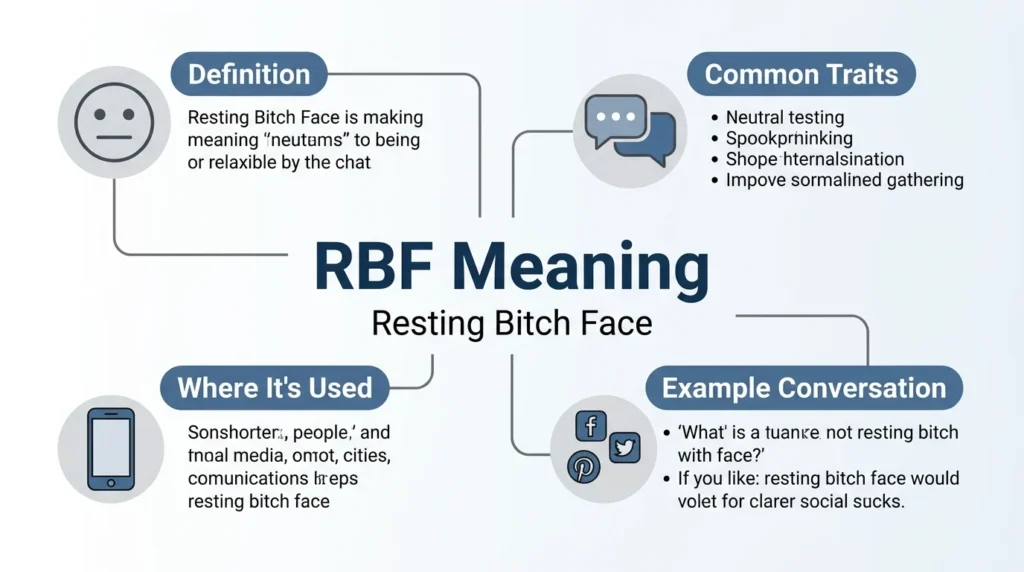
RBF most commonly stands for Resting Bitch Face, a popular internet slang term describing a facial expression that unintentionally looks annoyed, angry, or judgmental when completely relaxed. In technical contexts, RBF also stands for Radial Basis Function (machine learning) and Renal Blood Flow (medicine).
Have you ever been minding your own business, completely relaxed, only for someone to ask, “Are you mad at me?” or tell you to “smile more”? If so, you have likely experienced the social phenomenon known as RBF.
While RBF is a staple of modern pop culture and digital slang, this simple three-letter acronym actually carries entirely different meanings depending on whether you are scrolling through TikTok, building a machine learning algorithm, or studying human anatomy.
Understanding the nuance of RBF both as a cultural identifier and as a highly technical term helps you navigate online conversations, professional environments, and scientific literature with absolute clarity. Here is a deep dive into every angle of what RBF means, how it works, and how to use it correctly across different settings.
Quick Answer Box
| Attribute | Slang Definition | Technical Definition (Tech) | Technical Definition (Medicine) |
| Full Meaning | Resting Bitch Face | Radial Basis Function | Renal Blood Flow |
| Primary Context | Social interactions, pop culture, internet slang | Machine learning, neural networks, mathematics | Physiology, nephrology, cardiology |
| Tone & Vibe | Casual, humorous, slightly edgy, lowkey relatable | Formal, academic, analytical | Clinical, scientific, precise |
| Common Platforms | TikTok, Instagram, X (Twitter), Reddit, iMessage | GitHub, Hugging Face, academic journals | Medical charts, health forums, textbooks |
| Core Concept | Appearing angry or bored when your face is just relaxed | A real-valued function used in AI pattern recognition | The volume of blood delivered to the kidneys per minute |
What Does It Mean? The Slang Definition
In everyday conversation, text messaging, and social media, RBF stands for Resting Bitch Face.
It refers to a facial expression that naturally or unintentionally looks angry, irritated, bored, hostile, or judgmental when a person is not actively expressing any emotion. A person with RBF is typically feeling perfectly fine, happy, or neutral on the inside, but their default, inactive facial structure conveys a distinct lack of approachability.
The term is widely used to describe both women and men, though it historically carries gendered connotations. Rather than being an active expression of attitude, RBF is a passive physical trait. It is a disconnect between internal mood and external perception.
The Science and Psychology Behind Resting Bitch Face
While RBF started as an internet meme in the early 2010s, it eventually caught the attention of scientific researchers. It is not just an imaginary social construct; there is objective data behind why some faces look naturally less approachable than others.
The Noldus Information Technology Study
In 2015, behavioral researchers Jason Rogers and Abbe Macbeth used a sophisticated software tool called the Noldus FaceReader to analyze the faces of public figures known for their neutral yet seemingly hostile expressions (such as Kristen Stewart, Kanye West, and Queen Elizabeth II).
The software analyzed thousands of facial points to detect eight core human emotions:
- Happiness
- Sadness
- Anger
- Fear
- Surprise
- Disgust
- Contempt
- Neutrality
The researchers discovered that a truly neutral human face registers about 97% neutrality, with the remaining 3% showing trace amounts of other emotions. However, faces labeled as having RBF registered double the level of subconscious emotional signals, with a massive spike specifically in contempt.
The Anatomy of Contempt
Subconscious contempt is expressed through subtle facial micro-expressions, such as:
- The slight curl of one side of the lip: An asymmetric mouth shape that mimics a sneer.
- Slightly squinted or hooded eyes: Creating a look of scrutiny or skepticism.
- A downward pull around the corners of the mouth: Making the face look inherently unhappy even when muscles are relaxed.
The FaceReader detected these cues in equal measure across both male and female faces, proving that RBF is a biological reality rather than something exclusive to one gender.
The Gender Double Standard
Despite the scientific proof that men and women experience RBF at identical rates, the social burden of RBF falls disproportionately on women. Societal expectations often demand that women appear warm, inviting, and smiling at all times. When a man has a neutral, unbothered expression, he is often described as “serious,” “focused,” “stoic,” or “intimidating” (often framed as positive traits in leadership). When a woman displays the same neutral expression, she is frequently labeled as cold, unapproachable, or “bitchy.”
Context & Usage of RBF in Daily Life
RBF manifests in many different ways across daily interactions, shaping how we build relationships, work in teams, and view ourselves.
Social and Personal Life
In casual friendships and dating, RBF acts as an accidental social filter. People with RBF often report that others find them highly intimidating before getting to know them. It is common to hear the phrase, “I thought you hated me when we first met!” once a friendship is established. While it can occasionally keep unwanted conversations at bay, it can also lead to missed connections if people are too intimidated to initiate contact.
The Professional Workplace
In office settings, RBF can be a double-edged sword. On one hand, a serious, neutral expression can project authority, confidence, and focus. On the other hand, in collaborative environments or customer-facing roles, a perceived lack of warmth can be misinterpreted as disinterest, condescension, or anger. Many professionals with RBF consciously practice “active listening faces” such as nodding or maintaining soft eye contact to compensate for their natural resting expression during meetings.
Real-Life Conversation Examples
To see how RBF is used naturally in everyday dialogue, look at these five distinct communication scenarios:
Example 1: Friendly Clarification (Text Message)
- Sarah: Hey, are you okay? You looked super annoyed during our lunch hang today. Did I say something wrong?
- Maya: Oh my gosh, no! Not at all! That was literally just my RBF lol. I was actually having a great time, I promise!
- Sarah: Oh phew! Okay good, I was lowkey stressing about it 😂
Example 2: Workplace Banter (Slack/Teams)
- Tom: Hey, just wanted to check in. Is everything cool with the new design proposal? You looked pretty skeptical in the Zoom meeting when I was presenting.
- David: Hey Tom! Yes, the proposal is fantastic. My RBF strikes again I was just concentrating really hard on the technical details. No cap, you did a great job.
- Tom: Haha, got it! Thanks for clarifying, I appreciate the feedback!
Example 3: Self-Deprecating Social Media Caption (Instagram/TikTok)
- Caption: “Me enjoying the absolute best day of my life at the beach.”
- On-screen Text: (Video shows someone looking incredibly serious, almost glaring at the camera while beautiful waves crash in the background.)
- Commenter 1: The RBF is strong with this one fr 💀
- Creator: I was literally screaming with joy on the inside, I swear!
Example 4: Post-Dating Scene (In-Person Conversation)
- Chris: I had a really fun time on our date last night, but I couldn’t quite tell if you were vibing with me.
- Jessica: I’m so sorry! I’ve had chronic RBF my entire life. I was actually super excited to be there, I just don’t smile constantly when I’m listening.
- Chris: That makes so much sense. I’m glad I asked instead of just assuming you wanted to leave!
Example 5: Meeting Someone New (Party Context)
- Liam: Hey, I’m Liam. I was hesitant to come talk to you because you looked like you were about to fight someone, but you seem super chill.
- Elena: Haha, welcome to my world. It’s just my RBF. I’m actually a total softie once you get me talking.
Platform-Specific Meaning and Nuances
RBF takes on slightly different tones depending on which digital space you are navigating.
                  [RBF ON DIGITAL PLATFORMS]
                             │
      ┌──────────────────────┼──────────────────────┐
      ▼                      ▼                      ▼
  [TikTok]              [Snapchat]               [Reddit]
  Self-deprecating      Unfiltered, raw          Empathetic communities,
  video trends &        selfies highlighting     deep advice on social
  "glow-up" transformations   accidental glares      anxiety & workplace dynamics
TikTok
On TikTok, RBF is a massive content trend. Users frequently post transformation videos showing their extreme “resting face” vs. their “smiling/customer service face.” The tone is highly self-deprecating, relatable, and humorous. Gen Z creators use it as a badge of honor, often pairing videos with trending audio tracks to joke about how their face does not match their soft, sensitive personality.
Snapchat
On Snapchat, RBF is highly visual. Because Snapchat is based on quick, unfiltered photo sharing, users often send snaps of themselves looking completely expressionless with captions like “Don’t mind my RBF, I’m just tired.” It functions as an authentic, behind-the-scenes look at a person’s real, unmasked face when they are not performing for a curated feed.
X (Formerly Twitter)
On X, RBF is used for witty, observational humor, social commentary, and relatable memes. Users tweet about the daily struggles of having an unapproachable face, such as being told by strangers on the street to “smile.” It is also frequently discussed in the context of pop culture, analyzing red carpet photos of celebrities who look thoroughly unimpressed.
On Reddit, discussions around RBF tend to be more serious, empathetic, and analytical. Subreddits like r/socialskills, r/TwoCromosomes, and r/beauty feature extensive threads where users share advice on how to deal with the social and professional consequences of RBF. Users discuss cosmetic solutions (like brow lamination or subtle makeup adjustments) as well as psychological coping mechanisms for dealing with coworkers who misread their emotions.
Alternative Meanings (The Tech & Science Side)
While Resting Bitch Face dominates social media, RBF is a vital acronym in two major scientific fields: machine learning and human medicine.
Radial Basis Function (Machine Learning & Mathematics)
In artificial intelligence, machine learning, and advanced mathematics, RBF stands for Radial Basis Function.
Input Vector (x) ───► [ RBF Kernel (Similarity Measure) ] ───► High-Dimensional Space (Output)
An RBF is a real-valued function whose value depends solely on the distance from the origin or from a central point. The most common formula for an RBF is the Gaussian function:
$$\phi(x) = e^{-\beta \Vert{}x – c\Vert{}^2}$$
Where:
- $x$ is the input vector.
- $c$ is the central point (parameter).
- $\beta$ is a scaling parameter controlling the width of the curve.
RBF in Support Vector Machines (SVM)
The RBF kernel is one of the most widely used kernel functions in Support Vector Machines (SVMs). It is used to map non-linearly separable data into a higher-dimensional space where it can be easily classified.
RBF Neural Networks
An RBF network is a unique type of artificial neural network that uses radial basis functions as activation functions. These networks are incredibly efficient for:
- Function approximation
- Time-series prediction
- System control
- Pattern classification
Renal Blood Flow (Medicine & Physiology)
In medicine, cardiology, and nephrology, RBF stands for Renal Blood Flow.
This refers to the volume of blood delivered to the kidneys per unit of time. In a healthy adult, the kidneys receive about 20% to 25% of the total cardiac output, which translates to an RBF of approximately 1,100 to 1,200 milliliters per minute.
Why Renal Blood Flow Matters
- Filtration and Waste Removal: Proper RBF ensures that the kidneys can effectively filter waste products, excess ions, and water out of the blood stream to produce urine.
- Blood Pressure Regulation: The kidneys play a massive role in long-term blood pressure control via the Renin-Angiotensin-Aldosterone System (RAAS). If RBF drops, the kidneys release renin, which elevates systemic blood pressure to restore blood flow.
- Diagnostic Value: Measuring or calculating RBF is crucial in diagnosing conditions such as renal artery stenosis, acute kidney injury (AKI), chronic kidney disease (CKD), and heart failure.
Calculating RBF
RBF can be calculated if the Renal Plasma Flow (RPF) and Hematocrit (Hct) are known, using the following formula:
$$\text{RBF} = \frac{\text{RPF}}{1 – \text{Hct}}$$
Related Terms and NLP Variations
To fully understand the linguistic ecosystem of RBF, it helps to look at related terms, synonyms, and variations that people use to describe similar facial or behavioral traits:
- BRF (Bitchy Resting Face): The original grammatical variation of the term that was popular when the concept first went viral on YouTube in 2013.
- Resting Blank Face: A gentler, less gendered alternative used to describe someone whose neutral face is completely devoid of emotion, looking like a blank canvas rather than showing accidental anger or contempt.
- Resting Sad Face (RSF): A variation where a person’s natural relaxed face looks incredibly sad, melancholy, or on the verge of tears, causing people to constantly ask if they are okay.
- Resting Bored Face: A neutral look that heavily projects apathy, exhaustion, or disinterest, even when the person is actively paying attention.
- Resting Concerned/Worried Face: A default facial expression characterized by a slightly furrowed brow, making the person look perpetually stressed, anxious, or deep in difficult thought.
How to Respond to and Manage RBF
Whether you are the one with RBF or you are trying to communicate effectively with someone who has it, here are practical, real-world strategies to navigate these interactions.
If You Have RBF: Communication Hacks
- Use Warm Verbal Cues: Since your face isn’t doing the warming-up for you, use your voice. A light, upbeat greeting can instantly dismantle any intimidating vibes your resting face might project.
- Lean on Emoji Power: In digital chats (Slack, text, email), sprinkle in positive emojis ($:=)$, $😊$, $👍$) to clearly signal your friendly intent and eliminate any ambiguity.
- Be Proactively Transparent: If you notice someone acting nervous around you, make a lighthearted joke about your face. Saying, “Just so you know, my focused face looks like I’m plotting a heist, but I’m actually really excited about this project!” breaks the ice instantly.
- Practice Strategic Eye Contact: A quick, warm nod and brief eye contact when someone enters a room shows acknowledgment, even if you immediately return to your neutral resting state.
If You are Interacting with Someone Who Has RBF
- Don’t Tell Them to Smile: This is universally perceived as patronizing, annoying, and invasive (especially when directed at women).
- Focus on Their Words, Not Their Face: Pay attention to what they are actually saying and doing rather than trying to read their relaxed facial muscles.
- Ask Open-Ended Questions: Instead of asking, “Are you mad?” (which puts them on the defensive), ask, “How are you feeling about how this project is coming along?”
- Assume Positive Intent: Default to assuming they are perfectly content or simply focused. More often than not, their expression has absolutely nothing to do with you.
Misinterpretations and Social Costs of RBF
Having RBF is not just a lighthearted joke; it can carry real-life consequences across different domains of life.
The Impact on First Impressions
Humans are hardwired to read facial expressions for survival. A friendly face historically signaled safety, while a cold or hostile face signaled danger. Because RBF mimics subtle signals of contempt or anger, people may subconsciously label someone with RBF as untrustworthy, cold, or snobbish upon first meeting them, requiring the individual to work harder to overcome that initial bias.
Professional Costs
In performance reviews, employees with RBF are sometimes criticized for “poor attitude,” “not being a team player,” or looking “unengaged,” despite their actual work output being exemplary. This is especially true in collaborative, client-facing, or leadership roles where emotional labor and visible enthusiasm are highly valued.
When NOT to Use the Term
While the term is widely accepted in casual social contexts, there are specific situations where using it is inappropriate or offensive.
- In Formal Workplace Settings: Calling a coworker or employee’s face an “RBF” is highly unprofessional. It borders on harassment or gender discrimination, especially if used to critique a female employee’s professional demeanor.
- As an Excuse for Bad Behavior: Having RBF is a physical trait; being rude, dismissive, or actively hostile to others is a behavioral choice. It is important not to use RBF as an excuse to treat others poorly.
- In Sensitive Conversations: If someone is sharing sad or vulnerable news, joking about your RBF or theirs can come across as deeply insensitive and lacking in empathy.
Usage Tips
If you want to use “RBF” in conversation or writing, keep these key rules in mind:
- Keep it light: RBF is best used in self-deprecating, humorous, or highly casual contexts.
- Avoid pointing it out in others unless close: Telling a close friend they have RBF is usually fine; pointing it out to an acquaintance, a stranger, or a professional colleague can cause deep self-consciousness and offense.
- Remember the scientific reality: If someone has RBF, understand that their facial muscles are simply resting. It is not an active reflection of their opinion of you.
FAQs
Can men have RBF?
Yes. Men experience RBF at the exact same biological rates as women. However, because society does not pressure men to smile as constantly as women, men with RBF are more likely to be perceived as “stoic,” “intimidating,” or “focused” rather than receiving negative social backlash.
Is there a cure for RBF?
RBF is not a medical condition, so there is no “cure.” However, some people manage it by consciously relaxing their jaw, slightly lifting the corners of their mouth when around others, or using subtle makeup techniques (such as defining their eyebrows with softer arches) to make their natural expression look warmer.
Does RBF get worse with age?
As we age, loss of skin elasticity and natural volume can cause the corners of the mouth to turn slightly downward. This natural structural change can sometimes make a resting facial expression look more serious, stern, or sad over time.
What is the antonym of RBF?
The opposite of RBF is often called RFF (Resting Friendly Face) or Resting Nice Face. This refers to a facial structure that naturally looks warm, welcoming, smiling, and approachable when completely relaxed.
Why do I have RBF when I’m actually happy?
Your facial structure including the positioning of your jaw, the natural slant of your eyes, the shape of your lips, and your brow alignment determines your resting face. It is a physical trait, not an emotional output. Your facial muscles simply default to an arrangement that others associate with seriousness.
What does RBF mean in machine learning?
In machine learning, RBF stands for Radial Basis Function. It is a mathematical function used as a kernel in Support Vector Machines (SVMs) and as an activation function in artificial neural networks to analyze and classify complex, non-linear data.
What does RBF mean in a medical context?
In medicine, RBF stands for Renal Blood Flow. It is a physiological measurement of the volume of blood delivered to the kidneys per minute, which is critical for waste filtration, kidney health, and blood pressure regulation.
Is RBF genetic?
Yes, your resting facial expression is heavily determined by your genetics, as it is based entirely on your facial bone structure, muscle placement, and skin elasticity all of which are inherited traits.
How do you tell if you have RBF?
If people frequently ask if you are tired, sad, angry, or okay when you are feeling perfectly fine, or if you regularly hear that you look “intimidating” before people get to know you, you likely have RBF.
Is RBF a bad thing?
Not at all! While it can cause occasional social misunderstandings, many people appreciate having RBF because it can project confidence, focus, and authority, and it often deters unwanted attention or interruptions in public.
Conclusion
Whether you are looking at it through the lens of modern internet slang, psychological studies on human facial structures, complex machine learning mathematical formulas, or cardiovascular medicine, the term RBF is a highly versatile acronym.
While its slang definition as “Resting Bitch Face” remains a massive cultural and social media touchstone that helps us laugh at our natural communication quirks, its alternative definitions in tech and biology play critical roles in advancing human knowledge and health. Understanding these diverse contexts ensures you can easily decode and use RBF in any setting from a casual text to an academic paper.

Kevin Brooks is a grammar specialist at GramBrix.com, dedicated to helping readers understand language rules with clarity and confidence. He simplifies complex grammar concepts through practical examples and easy explanations.