Last Updated on July 10, 2026
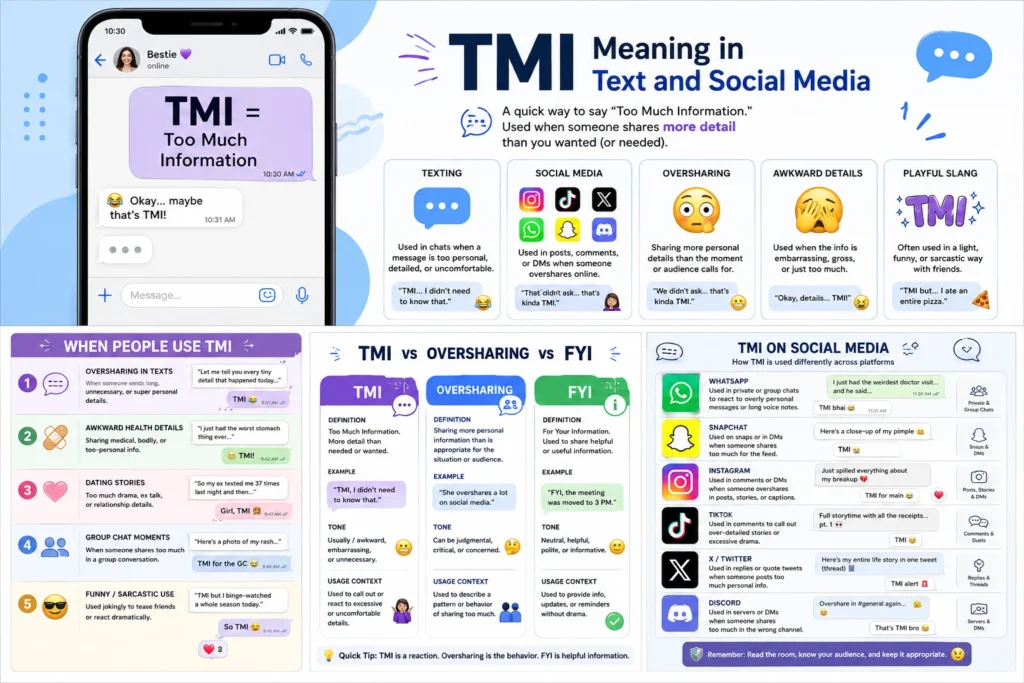
TMI stands for “too much information.” People use it when someone shares details that feel overly personal, awkward, unnecessary, or more than the listener wanted to know. It’s common in texting, social media, group chats, and casual conversation, and its tone can be playful, joking, uncomfortable, or mildly critical depending on context.
If you’ve seen TMI in a text, comment, meme, or group chat and wondered what it actually means, the short version is simple: TMI means “too much information.” But the way people use it can vary a lot. Sometimes it’s a funny reaction to an oversharing friend. Sometimes it’s a polite way to say, “I really didn’t need to know that.” And sometimes it’s used sarcastically online when someone shares a random detail that’s technically harmless but still feels like… a lot.
In this guide, you’ll get the full meaning of TMI, how it’s used in texting and social media, what tone it carries, how to respond when someone says it to you, when it’s okay to use, when it can sound rude, and how it compares to similar internet slang. You’ll also see realistic conversation examples, platform-specific usage, alternative meanings, misinterpretations, and 10 practical FAQs so you can understand the term in context, not just as a dictionary definition.
Quick Answer Box
| Topic | Answer |
|---|---|
| Meaning | TMI = Too Much Information |
| Main Use | Used when someone shares something overly personal, awkward, unnecessary, or too detailed |
| Common Contexts | Text messages, DMs, social media comments, group chats, memes, casual conversation |
| Typical Tone | Playful, teasing, awkward, uncomfortable, lightly critical, sometimes sarcastic |
| Example | “I don’t need the details of your dentist appointment lol, TMI.” |
| Platforms | Texting, WhatsApp, Snapchat, Instagram, TikTok comments, X/Twitter, Reddit, Discord |
| Can It Be Rude? | Yes, if used sharply or in a serious conversation |
| Best Response if Someone Says TMI | “Fair lol, I overshared” or “Okay, I’ll spare the details.” |
What Does TMI Mean?
TMI stands for “too much information.”
People use it when someone gives more personal, graphic, awkward, or unnecessary detail than the listener wanted. It usually signals that the information crossed a comfort line, even if only slightly. That line depends on the relationship, the topic, and the setting.
At its core, TMI is a reaction to oversharing.
Simple definition of TMI
TMI means:
- You shared more detail than needed
- The detail was too personal or awkward
- The listener didn’t really want to know that much
- The topic may feel inappropriate for the moment
- The information made the conversation weird, uncomfortable, or unexpectedly intimate
Basic example
If someone says:
“My stomach was so bad this morning that I had to run to the bathroom three times before work.”
A friend might reply:
“TMI 😭”
That reply usually means:
“I get what you’re saying, but that was more detail than I wanted.”
Full Definition of TMI
TMI is one of those internet acronyms that looks simple but carries a lot of social meaning. It doesn’t just describe information quantity. It also comments on boundaries, comfort level, context, and social awareness.
The literal meaning
Literally, too much information means an excessive amount of detail.
But in actual conversation, TMI usually refers to one of these:
- Personal details that feel private
- Graphic body-related details
- Relationship or dating details that feel too intimate
- Medical or health details shared too casually
- Embarrassing stories with unnecessary specifics
- A random level of detail nobody asked for
- An awkward confession in the wrong setting
The social meaning behind TMI
When someone says TMI, they may be implying one or more of the following:
- “That was more personal than I expected.”
- “I didn’t need that level of detail.”
- “This conversation just got awkward.”
- “You could’ve kept that part to yourself.”
- “I’m joking, but wow, that was a lot.”
- “Please stop before this gets worse.”
- “This is funny, but also kind of disgusting.”
- “Wrong audience, wrong moment, or wrong amount of detail.”
TMI doesn’t always mean “bad”
That’s important. TMI is not always a serious criticism. A lot of the time, it’s used in a playful, low-stakes way between friends. For example:
- “I’m on day 2 of this face mask and now my skin is peeling in weird chunks.”
- “TMI but also… are you okay?”
Here, TMI is half-joke, half-reaction. The person isn’t offended; they’re just acknowledging that the detail was a lot.
Context and Usage of TMI
To understand TMI, you need to look at where it’s being used, who’s talking, and what kind of detail was shared. The exact same message can sound funny in one chat and inappropriate in another.
Why people use TMI
People say TMI for a few common reasons:
- To react to oversharing
- To lightly set a boundary
- To tease a friend who shared something gross or awkward
- To avoid engaging with a detail they didn’t want
- To keep a conversation from getting too personal
- To add humor when the information is unexpectedly intense
Common types of information that trigger a TMI response
Personal body details
These are some of the most common TMI situations.
Examples:
- bathroom stories
- period details
- stomach issues
- skin issues in graphic detail
- medical symptoms described very specifically
Relationship details
TMI is often used when someone reveals something intimate about dating, hookups, or private arguments.
Examples:
- “He texted me at 2 a.m. after we kissed and then sent me a shirtless pic.”
- “TMI omg.”
Family or home drama
Sometimes someone shares a deeply awkward family story in a casual setting.
Examples:
- “My parents got into a screaming match over who forgot to buy toilet paper.”
- “Okay… TMI for the work group chat.”
Hyper-specific unnecessary detail
Not all TMI is personal. Sometimes it’s just excessive.
Example:
- “I counted 17 mosquito bites on my left leg and 11 on the right.”
- “That is incredibly specific. TMI.”
The Tone of TMI: Funny, Rude, or Just Honest?
Tone matters a lot with this acronym. TMI can be funny, affectionate, awkward, dismissive, or rude depending on how it’s used.
Playful tone
This is the most common use among friends.
Examples:
- “TMI lol”
- “Omg TMI 😂”
- “Bestie that is TMI”
- “No because why did you tell me that 😭 TMI”
This tone usually means:
- “That was wild”
- “You overshared, but I’m laughing”
- “I’m not actually upset”
Mildly uncomfortable tone
Sometimes the person really does want the conversation to stop.
Examples:
- “Okay, TMI.”
- “That’s kind of TMI for me.”
- “I did not need that visual.”
This tone means:
- “I’m uncomfortable”
- “Please change the topic”
- “That crossed a line for me”
Sarcastic tone
Online, people also use TMI sarcastically when the information is not actually that personal.
Example:
- “I had toast for breakfast.”
- “Wow. TMI.”
This sarcastic version mocks the idea of oversharing by applying it to something harmless.
Rude or dismissive tone
In serious conversations, TMI can come off cold.
Example:
- Person A: “I’ve been having a rough time physically after surgery.”
- Person B: “TMI.”
That can sound insensitive because the person may be sharing something vulnerable, not trying to overshare for attention or humor.
Real-Life Examples of TMI in Conversation
Below are realistic examples so you can see how TMI actually works in text, chat, and everyday language.
Conversation Example 1: Bathroom overshare
Scenario
A friend gives way too much detail about being sick.
Friend 1: “I had food poisoning last night and I was literally lying on the bathroom floor at 3 a.m.”
Friend 2: “Nooo 😭”
Friend 1: “And then I threw up twice and spilled electrolyte drink on my hoodie.”
Friend 2: “TMI but also that sounds horrible.”
Meaning here
TMI is being used playfully. The second friend is reacting to the gross detail but still being supportive.
Conversation Example 2: Dating details
Scenario
Someone shares a little too much about their romantic life.
Person 1: “He sent me a voice note right after our date saying he couldn’t stop thinking about kissing me.”
Person 2: “Okayyy 👀”
Person 1: “Then he called again at midnight and asked what I was wearing.”
Person 2: “TMI bestie omg.”
Meaning here
The reply means: “That’s way more detail than I expected, but I’m invested.”
Conversation Example 3: Group chat awkwardness
Scenario
Someone forgets they’re not talking one-on-one.
Coworker 1: “Running 10 mins late, had a weird stomach issue this morning.”
Coworker 2: “Hope you’re okay!”
Coworker 1: “Yeah I’m fine now, I think it was the leftover shrimp because things got very aggressive.”
Coworker 3: “TMI for the team chat 😭”
Meaning here
This is a boundary-setting use. It says: “Wrong audience for those details.”
Conversation Example 4: Self-aware oversharing
Scenario
The speaker knows it’s TMI before anyone else says it.
Friend 1: “TMI but I popped a pimple and now I regret everything.”
Friend 2: “Why would you start a sentence like that 💀”
Meaning here
People often use “TMI but…” to warn others that what comes next may be gross, personal, or weirdly specific.
Conversation Example 5: Joke use
Scenario
TMI is used sarcastically for something harmless.
Person 1: “I cried because I dropped my fries.”
Person 2: “TMI.”
Person 1: “That’s not even personal.”
Person 2: “I know, I’m being dramatic.”
Meaning here
This isn’t a real boundary complaint. It’s just playful exaggeration.
Platform-Specific Meaning of TMI
The core meaning of TMI stays the same across platforms, but the tone and style change depending on where it appears.
TMI in text messages
In texting, TMI is usually used as a quick reaction to oversharing.
Examples:
- “TMI 😭”
- “Girl that was TMI”
- “Okay I did not need all that lol”
- “TMI but continue…”
What it usually means in texts
- You shared a lot
- I’m reacting in real time
- I may be uncomfortable, amused, or both
- We probably know each other well enough to joke like this
Texting TMI often includes emojis because emojis soften the tone.
Examples:
- TMI 😂 = playful
- TMI 😭 = overwhelmed but amused
- TMI 😐 = uncomfortable
- TMI pls = stop talking
TMI on WhatsApp
On WhatsApp, TMI works much like texting because most conversations are personal or group-based.
Common WhatsApp situations
- friend group chats
- family groups
- one-on-one conversations
- voice note reactions
Examples:
- “Bro TMI, I’m eating.”
- “That’s TMI for 8 in the morning.”
- “Not in the family group chat 😭 TMI.”
WhatsApp nuance
Because WhatsApp often includes family chats and mixed-age groups, TMI there can also mean:
- “This is not appropriate for this audience”
- “Please remember who’s in this group”
TMI on Snapchat
On Snapchat, TMI often appears in casual, messy, unfiltered friend conversations.
Why it fits Snapchat culture
Snapchat is fast, informal, and built around spontaneous updates. People send:
- random life updates
- chaotic selfies
- story-time snaps
- voice notes
- half-serious confessions
So TMI on Snapchat often has a very joking tone.
Examples:
- “TMI but I haven’t washed my hair in 4 days.”
- “You did not need to snap me that. TMI.”
- “That caption is pure TMI and I respect it.”
Snapchat vibe
On Snapchat, TMI can almost be a badge of chaotic honesty. It’s less formal and more “bestie oversharing at 1 a.m.” energy.
TMI on Instagram
On Instagram, TMI usually appears in:
- DMs
- comments
- story replies
- meme pages
- oversharing captions
Common uses on Instagram
- Reacting to an oversharing story
- “TMI but hilarious”
- Commenting on a dramatic caption
- “This is so TMI and I’m seated”
- Joking about vulnerability
- “I posted that at 2 a.m. and it was lowkey TMI”
Instagram nuance
Because Instagram blends public image with personal storytelling, TMI there often points to the line between:
- authentic sharing
- oversharing for the timeline
Someone might say a caption is TMI if it includes:
- relationship details
- breakup specifics
- body issues
- medical updates with graphic detail
- emotional venting that feels extremely private
TMI on TikTok
TikTok is one of the biggest spaces for self-disclosure, storytimes, and “get ready with me while I tell you…” content. So TMI on TikTok often appears as a joke, warning label, or comment reaction.
Common TikTok uses
- “TMI warning”
- “This storytime is pure TMI”
- “Girl the internet did not need to know this”
- “Not the TMI dump before breakfast 😭”
In TikTok videos
Creators often say:
- “TMI alert”
- “This is probably TMI but…”
- “Sorry if this is TMI”
They do that when discussing:
- skincare problems
- dating disasters
- period stories
- embarrassing medical moments
- weird body stuff
- ex drama
TikTok nuance
Because TikTok rewards raw storytelling, TMI can be part of the entertainment. Viewers may say “TMI” while still watching the entire story. So the term often means:
- “This is unhinged”
- “This is very personal”
- “I can’t believe you posted this”
- “I’m uncomfortable but invested”
TMI on X/Twitter
On X, TMI is often used sarcastically, ironically, or in commentary style.
Examples:
- “Nobody asked but here’s my entire medical history.”
- “This app is just TMI and hot takes.”
- “That tweet was TMI fr.”
Common X/Twitter tone
- witty
- snarky
- exaggerated
- performative
- observational
TMI on X can also refer to public oversharing more than private oversharing. It’s not just about a friend telling you too much. It’s about someone posting something that maybe should’ve stayed in the drafts.
TMI on Reddit
On Reddit, TMI often shows up in comment threads when someone shares very detailed personal context, especially in advice forums, health discussions, relationships, or “off my chest” style posts.
Reddit nuance
Unlike texting, Reddit has more anonymous sharing, so TMI can be used in two opposite ways:
- As a joke
“That was TMI but honestly useful.” - As a real warning
“You may want to remove some TMI from your post if you want privacy.”
In Reddit-style spaces, TMI can sometimes be practical advice rather than a joke.
TMI on Discord and gaming chats
In Discord servers, TMI usually depends on how close the server members are and whether the server is casual, fandom-based, or gaming-focused.
Examples:
- “TMI for general chat.”
- “Bro why are you telling us this in the raid channel.”
- “That’s very TMI but congrats I guess.”
Discord nuance
Discord has lots of subcultures, so the same TMI message can mean different things:
- playful in a private friend server
- not okay in a large community server
- a moderation issue if the content gets explicit
Alternative Meanings of TMI
The main meaning of TMI is “too much information,” and that’s what most people mean in texting, social media, and everyday online communication.
Still, it’s useful to know whether TMI can stand for anything else.
The dominant meaning: Too Much Information
This is by far the most common meaning in:
- text messages
- social media
- memes
- internet slang
- casual speech
Rare alternate meanings
In niche business, technical, or organization-specific contexts, TMI could stand for other phrases, but these are not the standard internet meaning. If you see TMI in a casual conversation, DM, comment, or meme, assume it means “too much information.”
How to tell which meaning is intended
Ask yourself:
- Is the conversation casual or social?
- Did someone just share a personal detail?
- Is the response emotional, joking, or awkward?
If yes, it almost certainly means too much information.
Related Terms and NLP Variations
TMI is part of a broader group of internet expressions people use to react to awkwardness, oversharing, and boundary-crossing detail. If you’re trying to understand slang naturally, it helps to know the nearby terms too.
Similar expressions to TMI
Oversharing
This is the closest concept.
- TMI = reaction to oversharing
- Oversharing = the act itself
Example:
- “I was oversharing.”
- “Yeah, that was TMI.”
“I didn’t need to know that”
This is basically the long-form version of TMI.
Example:
- “You could’ve just said you were late. I didn’t need the bathroom details.”
“No one asked”
This is more dismissive than TMI. It implies the information was unnecessary and unwanted, not just overly detailed.
“Keep that to yourself”
This is a stronger, harsher version of TMI.
“Too much”
Sometimes people just say:
- “That’s too much.”
- “You’re doing too much.”
- “This is a lot.”
These can overlap with TMI but are broader.
Related slang and internet reactions
“Trauma dump”
This refers to unloading heavy emotional or personal issues, often without warning or appropriate context. It’s not the same as TMI, but there can be overlap.
“Unhinged”
Used when someone shares something chaotic, wild, or socially unexpected online.
“Wild”
A general reaction meaning surprising, messy, or shocking.
“I’m crying”
Often used jokingly after TMI-level details, especially if the story is gross or absurd.
“Please delete this”
A humorous online reaction to something embarrassing or overshared.
How to Respond if Someone Says TMI to You
If someone replies “TMI” after you say something, don’t panic. In a lot of situations, it’s not a big deal. The best response depends on tone, relationship, and whether the oversharing was playful or genuinely uncomfortable.
Casual responses if the vibe is joking
These work well with friends:
- “Fair lol.”
- “Okay, I overshared.”
- “You’re right, that was a lot.”
- “My bad 😭”
- “TMI but accurate.”
- “I’ll spare you the rest.”
- “You got the premium details for free.”
- “I said what I said.”
Example
You: “I had to pull over because my stomach was fighting for its life.”
Friend: “TMI 😭”
You: “Fair. I’ll edit the director’s cut.”
That keeps the tone light.
Respectful responses if the other person seems uncomfortable
If the TMI feels serious rather than playful, respond with awareness.
Good options:
- “Sorry, I got too detailed.”
- “Got it, I’ll keep it short.”
- “My bad, didn’t mean to overshare.”
- “Thanks for telling me.”
- “Understood. I’ll leave out the details.”
These are useful in:
- work chats
- newer friendships
- mixed group settings
- family chats
- conversations about body/medical topics
What not to do when someone says TMI
Avoid escalating the awkwardness with replies like:
- “You’re too sensitive.”
- “I can say whatever I want.”
- “It’s not even that bad.”
- “Fine, I just won’t tell you anything ever again.”
Those responses make a small social correction turn into unnecessary conflict.
Misinterpretations of TMI
Because TMI is short and casual, people sometimes misunderstand what it means. Here are the most common mistakes.
Misinterpretation 1: TMI always means the speaker is offended
Not true. Often it’s just teasing.
If your friend says:
- “TMI 😂”
they may simply mean: - “That was gross/funny/unexpected.”
The emoji and relationship matter.
Misinterpretation 2: TMI only applies to gross topics
No. TMI can refer to:
- romantic details
- family drama
- money details
- emotional confessions
- medical information
- weirdly specific stories
- embarrassing moments
It’s broader than “gross.”
Misinterpretation 3: TMI means “stop talking to me”
Usually not. It often just means:
- “Please edit the details”
not - “I don’t want to hear from you.”
Misinterpretation 4: TMI is always rude
It can be rude, but it isn’t automatically rude. Among close friends, it’s often playful shorthand. In a serious emotional conversation, though, it can absolutely come off as dismissive.
Misinterpretation 5: TMI is only used by teens
Not at all. TMI has been around for years and is used by:
- teens
- college students
- millennials
- adults in casual conversation
- internet communities of all kinds
The tone may vary by age group, but the phrase is widely understood.
When Not to Use TMI
Even though TMI is common and often funny, there are situations where using it is a bad idea.
Don’t use TMI when someone is being vulnerable in a serious way
If someone is opening up about:
- illness
- grief
- mental health
- trauma
- a difficult family situation
- a scary medical event
responding with “TMI” can feel cold or mocking, even if that wasn’t your intention.
Better responses in serious situations
Instead of TMI, try:
- “I’m sorry you’re dealing with that.”
- “That sounds really hard.”
- “Do you want to talk about it?”
- “I hope you’re okay.”
- “Thanks for telling me.”
Don’t use TMI in professional settings unless you know the culture very well
At work, TMI can sound immature or dismissive, especially in writing.
Example:
- Coworker: “I may be late because I’m dealing with a medical issue.”
- Bad reply: “TMI.”
That’s not a good look.
If you need to redirect the conversation, use something like:
- “No worries, hope you feel better.”
- “Thanks for the heads-up.”
- “Take care of what you need.”
Don’t use TMI to embarrass someone publicly
If someone accidentally overshares in a group setting, calling it out loudly can make it worse. If the goal is kindness, it’s better to gently move on or message them privately if needed.
Don’t use TMI if the person clearly doesn’t understand your tone
Some people read messages very literally. A playful “TMI lol” to one friend may feel harsh to someone else, especially if:
- they’re not close to you
- they’re already anxious
- they’re sharing something personal
- there are no tone cues like emojis or humor
Usage Tips: How to Use TMI Naturally
If you want to use TMI in a way that sounds natural and not weirdly aggressive, these tips help.
1) Match the relationship
TMI works best with:
- close friends
- siblings
- casual chats
- meme-style conversations
- playful group chats
Use more caution with:
- coworkers
- teachers
- clients
- older relatives
- people you don’t know well
2) Match the tone to the situation
If you’re joking, soften it:
- “TMI 😂”
- “Bestie that is TMI”
- “Okay wow TMI but go on”
If you’re actually uncomfortable, be clear but not mean:
- “A little TMI for me, not gonna lie.”
- “I’m gonna skip the details on this one.”
3) Use “TMI but…” as a warning if you’re the one oversharing
This is a very common internet and texting move.
Examples:
- “TMI but I think I’m allergic to this face serum.”
- “TMI but my braces cut the inside of my mouth.”
- “TMI but I’m never eating gas station sushi again.”
Using “TMI but…” signals:
- I know this is a lot
- I’m self-aware
- proceed at your own risk
4) Know the difference between honesty and oversharing
Online culture often encourages being “real,” but there’s still a line between:
- relatable detail
- intimate detail nobody asked for
TMI is one way people mark that line.
5) Don’t assume all TMI is negative
Sometimes TMI is almost affectionate. It can mean:
- “You’re chaotic”
- “I can’t believe you told me that”
- “This is gross but funny”
- “You overshared and I’m entertained”
Context is everything.
Edge Cases: Situations Where TMI Can Mean Different Things
“TMI” after a harmless comment
Sometimes people say TMI sarcastically for something that’s not personal at all.
Example:
- “I’m wearing mismatched socks.”
- “TMI.”
Meaning: just joking.
“TMI” in flirt texting
Sometimes TMI is used as playful teasing in romantic chats.
Example:
- “I’ve been thinking about your voice all day.”
- “TMI 😳”
This doesn’t always mean “stop.” It can mean:
- “That’s intense”
- “You’re making me blush”
- “You’re being bold”
You still need to read the broader vibe, though.
“TMI” in health or support communities
In health-focused spaces, personal detail may be normal. Something that would be TMI in a work chat may be completely appropriate in a support group. Context changes the standard.
“TMI” from someone older vs younger
A younger friend might say “TMI 😭” as a joke. An older relative might say “That’s too much information” more literally. Same idea, different style.
TMI vs Similar Acronyms
Internet slang gets confusing fast, especially when multiple acronyms show up in the same chat. Here’s how TMI compares to a few common ones.
TMI vs FYI
- TMI = too much information
- FYI = for your information
Example:
- “FYI, the meeting moved to 2.”
- “TMI, I had food poisoning before the meeting.”
FYI gives useful info. TMI reacts to info that feels excessive.
TMI vs IDC
- IDC = I don’t care
- TMI = you shared more than I wanted to know
IDC is more dismissive. TMI is more about boundaries and detail level.
TMI vs LOL
- LOL = laughing
- TMI = too much information
These often appear together:
- “TMI LOL”
That means: - “You overshared and I’m laughing.”
TMI vs NSFW
- NSFW = not safe for work
- TMI = too much information
NSFW warns that content is sexually explicit, graphic, or inappropriate for work settings. TMI is broader and often more casual.
TMI vs Oversharing
These are close, but not identical.
- Oversharing describes the act
- TMI is the reaction
Example:
- “I was oversharing.”
- “Yeah, it was TMI.”
FAQs
1. What does TMI stand for in texting?
In texting, TMI stands for “too much information.” It’s used when someone shares details that feel overly personal, awkward, graphic, or just more than the other person wanted to know.
2. Is TMI rude?
It can be, but not always. Among friends, TMI is often playful and funny. In serious conversations or with people you don’t know well, it can sound dismissive or insensitive.
3. What does TMI mean from a girl or guy in chat?
It means the same thing regardless of who says it: “That’s more detail than I wanted.” The real difference is tone, not gender. It could be joking, flirty, awkward, or genuinely uncomfortable depending on the conversation.
4. What does “TMI but…” mean?
“TMI but…” is a warning that the speaker is about to share something personal, awkward, gross, or overly detailed. It’s a self-aware way of saying, “I know this might be oversharing, but I’m saying it anyway.”
Example:
- “TMI but I think I slept in my makeup and now my face hates me.”
5. Is TMI a bad thing?
Not necessarily. Sometimes it’s just harmless oversharing between friends. Other times it means the information crossed a boundary or felt inappropriate for the situation. Whether it’s “bad” depends on context.
6. What should I reply if someone says TMI?
If the vibe is casual, you can say:
- “Fair lol”
- “Okay, I overshared”
- “My bad 😭”
- “I’ll spare you the details”
If they sound genuinely uncomfortable, go with:
- “Sorry, I got too detailed”
- “Understood, I’ll keep it short”
7. What does TMI mean on Snapchat or TikTok?
On Snapchat and TikTok, TMI usually means someone shared something very personal, messy, embarrassing, or chaotic. It’s often used jokingly in reaction to storytimes, confessions, or gross/funny updates.
8. Can TMI be flirty?
Sometimes, yes. In flirty chats, “TMI” can be a teasing response to a bold message. It may mean:
- “That’s a lot”
- “You’re making me blush”
- “You’re being very forward”
But it can also mean “slow down,” so context matters.
9. Is TMI only about gross details?
No. TMI can refer to:
- body details
- dating details
- emotional oversharing
- family drama
- medical information
- random unnecessary detail
It’s about too much personal or unnecessary information, not just gross topics.
10. Do people still say TMI?
Yes. TMI is still widely understood and commonly used in texting, memes, DMs, comments, and casual online conversation. It may not always be the trendiest slang of the moment, but it’s still very active and recognizable.
Conclusion
TMI means “too much information.” It’s a common slang reaction used when someone shares more detail than feels necessary, comfortable, or appropriate for the moment. In texting and social media, it can be funny, teasing, awkward, mildly critical, or occasionally rude depending on tone and context.
The key to understanding TMI is not just memorizing the acronym but reading the situation around it. If it shows up in a group chat after someone shares a bathroom story, it probably means “wow, overshare.” If it appears in a TikTok comment under a deeply personal storytime, it may mean “this is wild, but I’m still watching.” If it’s used during a serious personal conversation, it can land badly.
So if you see TMI in a text, DM, caption, or comment, the safest interpretation is:
“That was more information than I needed.”
Sometimes that’s said with a laugh. Sometimes it’s a boundary. Sometimes it’s both.
If you want to use TMI naturally, keep it for casual settings, read the room, and pay attention to tone. Used well, it’s a funny shorthand for oversharing. Used badly, it can sound dismissive. And that’s really the whole vibe of internet slang in one acronym: same words, very different energy depending on who says it, where they say it, and why.

Justin Powell is a writer at GramBrix.com who focuses on grammar, clarity and effective communication, helping readers strengthen their language skills.