Last Updated on July 11, 2026
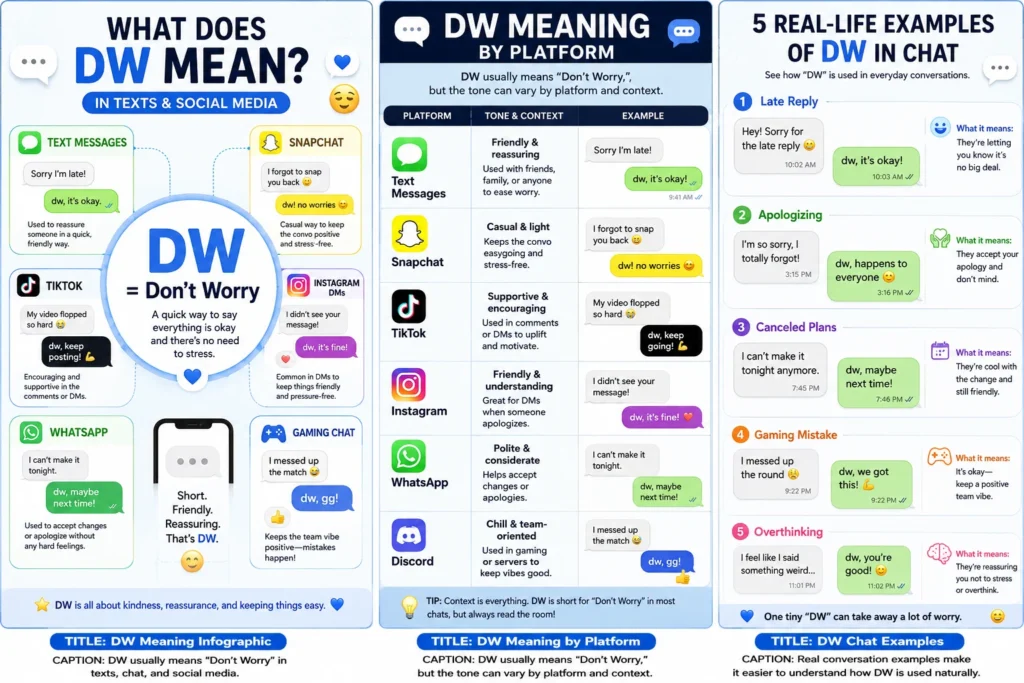
DW usually means “Don’t Worry” in texting and online chat. People use it to reassure someone, keep the conversation casual, or respond when a person apologizes, overthinks, or feels stressed. Depending on context, DW can also mean other things, but in most messages and social media conversations, “Don’t Worry” is the most common meaning.
If you’ve seen DW in a text, Snapchat streak, TikTok comment, Instagram DM, or group chat, you’ve probably wondered what it actually means. The short answer is simple: DW usually means “Don’t Worry.” It’s a quick, casual way to reassure someone, calm them down, or tell them not to stress about something.
But like a lot of internet shorthand, DW meaning depends on context. In one chat, it can be a friendly “it’s okay.” In another, it can sound warm, dismissive, playful, sarcastic, or even slightly passiveaggressive depending on the tone of the conversation. That’s why understanding how DW is used, where it shows up, and what other meanings it can have matters just as much as knowing the definition.
In this guide, you’ll get the full breakdown of DW meaning in text, social media, and messaging apps. We’ll cover the main definition, platformspecific usage, real conversation examples, alternate meanings, reply ideas, common misunderstandings, and when you probably should not use it.
Quick Answer Box
| Element | Meaning |
| DW meaning | Don’t Worry |
| Main use | To reassure someone or tell them not to stress |
| Tone | Casual, friendly, comforting, sometimes blunt depending on context |
| Used on | Text messages, WhatsApp, Snapchat, Instagram DMs, TikTok comments, Discord, gaming chat |
| Example | “Sorry I replied late.” → “DW, it’s all good.” |
| Best understood as | A short version of “it’s okay,” “no problem,” or “don’t stress about it” |
| Can it have other meanings? | Yes, but Don’t Worry is the most common in casual online chat |
What Does DW Mean?
DW means “Don’t Worry.”
It’s a shorthand phrase people use in digital conversations when they want to reassure someone. Instead of typing out “don’t worry about it,” “it’s fine,” or “no problem,” they just type DW.
The simplest DW meaning in chat
In everyday texting, DW usually means one of these:
- Don’t worry
- It’s okay
- No problem
- You’re good
- Don’t stress about it
- No need to apologize
- It’s not a big deal
So if someone says:
- “Sorry I forgot to send that.”
- “I’m late, my bad.”
- “I think I messed this up.”
- “I hope I didn’t annoy you.”
A reply like “dw” is basically a quick way of saying, “It’s okay, don’t worry about it.”
Why people use DW instead of writing it out
People use DW because it’s:
- fast
- casual
- easy to type
- common in texting culture
- useful for lowpressure, everyday conversations
It fits the tone of platforms where short replies are normal. Instead of writing a full reassuring sentence, DW keeps the message quick and relaxed.
Full Definition of DW Meaning
To really understand DW meaning, it helps to go beyond the oneline definition.
DW = a reassurance phrase
At its core, DW is a reassurance signal. It tells the other person:
- you’re not upset
- they don’t need to panic
- the issue isn’t serious
- you forgive the mistake
- the conversation is still okay
It’s often used after:
- apologies
- mistakes
- delays
- awkward moments
- accidental misunderstandings
- anxious or overthinking messages
DW often works like emotional shorthand
Even though it’s only two letters, DW can carry emotional meaning. It can mean:
- comfort — “Don’t stress, it’s okay.”
- forgiveness — “I’m not mad.”
- deescalation — “This isn’t a problem.”
- casual reassurance — “You’re fine.”
- conversation smoothing — “No awkwardness here.”
That’s why DW is more than just an abbreviation. It’s also a tonesetting response. It helps keep a conversation from getting heavier than it needs to be.
The most natural fullsentence versions of DW
Depending on context, DW can stand in for phrases like:
- “Don’t worry about it.”
- “No worries.”
- “It’s totally fine.”
- “You’re okay.”
- “No stress.”
- “No problem at all.”
- “All good.”
- “It’s nothing.”
- “No big deal.”
- “You didn’t do anything wrong.”
Context and Usage of DW
Knowing what DW means is useful, but knowing how people actually use it is what makes it click. Context changes everything.
When people use DW in conversations
1. After an apology
This is one of the most common uses of DW.
Example:
- Person 1: “Sorry I missed your message.”
- Person 2: “DW, I just saw this too.”
Here, DW means “don’t worry, it’s fine.”
2. When someone is stressed or overthinking
If someone seems anxious, worried, or guilty, DW can calm the situation.
Example:
- “I think I ruined the plan.”
- “DW, we can fix it.”
This use is reassuring and practical at the same time.
3. When something wasn’t a big deal
Sometimes someone apologizes for something small, and DW is used to signal that it really doesn’t matter.
Example:
- “Sorry I took the last charger.”
- “DW lol I found another one.”
4. To keep the tone casual
A full sentence can sound more formal. DW keeps the conversation light.
Compare these:
- “Don’t worry, it’s completely fine.”
- “dw, it’s fine”
The second one feels more relaxed and natural in chat.
5. As a fast reaction in group chats
In fastmoving chats, people don’t always want to type full emotional responses. DW is efficient and understood quickly.
Example:
- “Oops I sent the wrong file”
- “dw just resend”
The tone of DW: friendly, neutral, or rude?
This is where DW meaning gets more nuanced. The phrase itself is neutraltofriendly, but the tone depends on context.
DW can sound friendly when:
- the conversation is casual
- you already know the person well
- it’s paired with emojis or warmth
- it follows a minor apology or mistake
Examples:
- “dw 😭 it’s okay”
- “DW haha you’re good”
- “dw no worries at all”
DW can sound neutral when:
- it’s used quickly in a practical chat
- there’s no emotional tension
- the message is just about moving on
Example:
- “DW, I fixed it.”
DW can sound cold or dismissive when:
- someone is upset and you respond too briefly
- the issue is serious but you use a supershort reply
- the relationship is formal
- the person needed empathy, not just reassurance
Example:
- “I feel really bad about what happened.”
- “dw”
That can sound a bit dry if the situation is emotional. In that case, a fuller response works better, like:
- “Don’t worry about it, seriously. I’m not upset.”
- “It’s okay, I understand what happened.”
- “No worries at all, thanks for explaining.”
RealLife Examples of DW Meaning in Conversation
Below are realistic chat examples so you can see DW in action.
Conversation Example 1: Late reply
Scenario
A friend apologizes for replying late.
Chat:
- A: Sorryyy I just saw your message
- B: dw lol I’m bad at replying too
Meaning
Here DW means “don’t worry about replying late, it’s okay.”
Conversation Example 2: Missed call
Scenario
Someone feels bad for missing your call.
Chat:
- A: Sorry I missed your call, I was driving
- B: DW, all good. I’ll call you later
Meaning
It reassures the other person and removes pressure.
Conversation Example 3: Mistake at school or work
Scenario
A classmate forgot to attach a file.
Chat:
- A: I sent the assignment without the attachment by accident 💀
- B: dw just send it again before the deadline
Meaning
Here DW means “don’t panic, it can still be fixed.”
Conversation Example 4: Social awkwardness
Scenario
Someone worries they said something embarrassing.
Chat:
- A: omg I think I sounded weird on that call
- B: dw you didn’t, you were fine fr
Meaning
The speaker is reassuring the other person emotionally.
Conversation Example 5: Canceling plans
Scenario
A friend has to cancel.
Chat:
- A: I’m so sorry, I can’t make it tonight
- B: dw, we can reschedule
Meaning
This version is calm, understanding, and lowpressure.
Conversation Example 6: Relationship reassurance
Scenario
Someone worries they upset the other person.
Chat:
- A: are you mad at me?
- B: no dw, I’m just tired today
Meaning
In this case, DW helps lower emotional tension and clarify that there’s no problem.
Conversation Example 7: Gaming chat
Scenario
A teammate apologizes after making a mistake.
Chat:
- Player 1: my bad I threw that round
- Player 2: dw we still got this
Meaning
It means “don’t worry, keep going.” It also helps team morale.
PlatformSpecific Meaning of DW
The core DW meaning usually stays the same across apps, but the tone and style can shift depending on the platform.
DW meaning in text messages
In standard texting, DW almost always means “Don’t Worry.”
It’s often used in:
- oneonone chats
- family conversations
- friend groups
- dating messages
- school or college chats
Common text examples
- “DW, I already handled it.”
- “dw I’m not mad”
- “DW about the money, pay me later”
- “dw I know what you meant”
In texting, DW is usually casual and reassuring. If the conversation is serious, people may type out the full phrase instead.
DW meaning on Snapchat
On Snapchat, DW still usually means “Don’t Worry,” but the vibe is often more playful and casual.
Because Snapchat conversations are fast, streakbased, and informal, abbreviations like DW, TBH, NGL, and IDK show up a lot.
Snapchatstyle examples
- “Sorry I left you on delivered 😭”
- “dw lol”
- “I look so bad in this snap”
- “DW you look fine”
- “I forgot to answer”
- “dw I do that too”
On Snapchat, DW often appears in lowercase (dw) because that feels more natural and less formal.
DW meaning on TikTok
On TikTok, DW can show up in comments, captions, replies, and DMs. The most common meaning is still “Don’t Worry.”
How it’s used on TikTok
- reassuring someone in the comments
- reacting to an apology
- joking in a casual comment thread
- responding to embarrassment or overthinking
Examples
- “I deleted the wrong draft by accident”
- “dw we’ve all done that”
- “sorry if this is a foolish question”
- “DW it’s not foolish”
Tone on TikTok
TikTok comments can be playful, dramatic, sarcastic, or super casual, so DW sometimes comes with internet tone markers like:
- dw lol
- dw fr
- dw you’re good
- dw no one noticed
- dw that’s lowkey relatable
DW meaning on Instagram
On Instagram, DW often appears in DMs and comment replies.
Common Instagram uses
- reassuring a friend in DMs
- replying to late responses
- calming someone after they post or send something embarrassing
- softening awkward social moments
Examples:
- “sorry for spamming your DMs”
- “dw I love the updates”
- “I think I posted the wrong photo”
- “dw it still looks good”
Instagram usage is usually friendly and lowstakes. It’s part of that casual social media language where people want to sound relaxed rather than formal.
DW meaning on WhatsApp
On WhatsApp, DW is common in personal chats, family groups, friend groups, and even some informal work or study chats.
Examples on WhatsApp
- “Sorry I’m late”
- “DW, we haven’t started yet”
- “I forgot to bring the notes”
- “dw, I have pictures of them”
- “I can’t make the meeting today”
- “dw, I’ll update you later”
WhatsApp is interesting because it can be both personal and semiformal. In close personal chats, DW is totally normal. In more professional or formal group chats, writing “No worries” or “No problem” may be better.
DW meaning on Discord and gaming chat
In Discord servers, multiplayer games, and live chat environments, DW is especially common because speed matters.
Why it fits gaming culture
- short and fast to type
- lowers tension after mistakes
- keeps teammates focused
- avoids overexplaining
Examples
- “my mic lagged sorry”
- “dw”
- “I sold that round my bad”
- “dw we reset next game”
- “sorry I was AFK”
- “dw you’re back now”
In gaming spaces, DW often means “don’t dwell on it, move on.” It can be supportive, but it can also be blunt if the chat is highly competitive.
Alternative Meanings of DW
Although “Don’t Worry” is by far the most common meaning in chat, DW can stand for other things too. Context matters a lot.
DW as “Don’t Worry” vs other meanings
Here are some alternate meanings you might see in other settings:
1. DW = Dear Wife
This sometimes appears in forums, relationship posts, parenting communities, or older internet shorthand.
Example:
- “My DW wants to redecorate the kitchen.”
Here DW means Dear Wife, not Don’t Worry.
2. DW = Deutsche Welle
In news or media contexts, DW can refer to the German international broadcaster Deutsche Welle.
Example:
- “I saw a report on DW about the election.”
That has nothing to do with texting slang.
3. DW = Doctor Who
In fan communities, TV discussions, or entertainment threads, DW may mean Doctor Who.
Example:
- “DW season rankings are always chaotic.”
4. DW = Data Warehouse or technical meanings
In business, analytics, or software discussions, DW can stand for Data Warehouse or other domainspecific terms.
Example:
- “The DW pipeline needs to be updated.”
How to tell which DW meaning is correct
Ask yourself these questions:
Is this a personal message or casual chat?
If yes, DW almost always means “Don’t Worry.”
Is it in a relationship forum or parenting post?
It might mean Dear Wife.
Is it in a media or international news context?
It could mean Deutsche Welle.
Is it in a fandom discussion?
It may mean Doctor Who.
Is it in a tech or business setting?
It might refer to Data Warehouse or another professional term.
Rule of thumb:
If you’re reading a text, DM, comment thread, or friend chat, assume DW = Don’t Worry unless the sentence clearly points to something else.
Related Terms and NLP Variations
If someone searches dw meaning, they often also want to know related phrases and similar shorthand. Here are the most relevant variations.
Common phrases similar to DW
No worries
This is the closest natural equivalent.
- “Sorry I’m late.”
- “No worries.”
No problem
A slightly more neutral alternative.
- “Sorry I forgot.”
- “No problem.”
All good
Very common in casual texting.
- “My bad.”
- “All good.”
You’re good
Friendly and reassuring.
- “Sorry for asking so many questions.”
- “You’re good.”
It’s okay / It’s fine
A more standard fullsentence version of the same idea.
Don’t stress
Very close in emotional meaning, especially when someone is anxious.
Slang and abbreviation terms related to DW
These aren’t exact synonyms, but they often appear in the same kinds of conversations:
- NVM — Never mind
- IDK — I don’t know
- TBH — To be honest
- IMO — In my opinion
- BRB — Be right back
- IKR — I know, right?
- FS — For sure
- NGL — Not gonna lie
- LMK — Let me know
- OMW — On my way
Why these matter
People often use DW in the same texting environment as these abbreviations, so understanding the broader style helps you read tone better.
Example:
- “sorry i’m late”
- “dw lol, lmk when you’re outside”
That’s very normal internet chat language.
How to Respond When Someone Says DW
If someone texts DW, your reply depends on what they meant and where the conversation is going.
If DW means “don’t worry, it’s okay”
You can respond naturally with:
- “Thanks”
- “Okay good 😭”
- “Appreciate it”
- “Haha okay”
- “You’re the best”
- “Got it”
- “Okay, I was stressing for no reason”
- “Thanks for understanding”
Example replies
Chat:
- You: Sorry I forgot to send the file
- Them: dw
- You: thanks, I’ll send it now
Chat:
- You: I thought I offended you
- Them: dw you didn’t
- You: okay good 😅
If you want to sound warmer than “thanks”
Sometimes a slightly more personal reply fits better:
- “Thanks for being chill about it”
- “I appreciate that”
- “Okay, that makes me feel better”
- “Thanks for understanding fr”
- “You just saved me from overthinking lol”
If you still need clarification
Sometimes DW doesn’t fully answer your question.
Example:
- “Did I mess anything up?”
- “dw”
You can follow up with:
- “Okay, but should I still fix anything?”
- “Got it do you want me to change anything though?”
- “Okay cool, just making sure.”
Misinterpretations of DW
Because it’s short, DW can be misunderstood in a few ways.
1. Thinking DW always sounds caring
Not always. DW can sound comforting, but it can also sound rushed if the conversation is emotional.
Example of a mismatch
- Person 1: “I feel awful about what happened.”
- Person 2: “dw”
That might feel too short. A better reply could be:
- “Don’t worry about it. I know you didn’t mean it.”
- “It’s okay, seriously. I’m not upset.”
2. Assuming it means the same thing in every context
As covered above, DW can mean other things outside casual chat. Always read the full sentence and the setting.
3. Reading it as rude when it wasn’t meant that way
Some people type very briefly online. A plain dw may not be cold at all it may just be their normal texting style.
Things that make DW feel softer:
- emoji
- lowercase letters
- extra context
- followup reassurance
Examples:
- “dw haha”
- “dw you’re okay”
- “dw, seriously”
- “dw it’s all good”
4. Using DW in a formal situation
DW is internet shorthand. It works best in casual conversation. In formal or professional settings, it can seem too informal.
When NOT to Use DW
Even though DW is common, there are situations where it’s not the best choice.
1. In very formal professional communication
If you’re emailing a professor, manager, client, or someone you don’t know well, DW can look too casual.
Better alternatives
- “No problem at all.”
- “Please don’t worry about it.”
- “That’s absolutely fine.”
- “No worries, thanks for letting me know.”
Example
Instead of:
- “DW about the delay”
Use:
- “No worries about the delay thanks for the update.”
2. When the other person is deeply upset
If someone is anxious, embarrassed, or emotional, a twoletter reply may feel too thin.
Better alternatives
- “It’s okay, really. I understand.”
- “Please don’t worry about it. I’m not upset.”
- “You’re okay thanks for telling me.”
3. When the issue actually does matter
If there really is a problem, saying DW can send mixed signals.
Example
If someone missed an important deadline, replying with “dw” when you actually need them to fix it can create confusion.
A better reply:
- “It’s okay, but I do need it by tonight.”
- “No worries just please resend it when you can.”
4. When clarity matters more than speed
Sometimes a full response is simply better than shorthand.
Instead of:
- “dw”
Try:
- “Don’t worry about it I already took care of it.”
- “No stress, I know what happened.”
- “You’re fine. It wasn’t a big deal.”
Usage Tips for DW
If you want to use DW naturally, these tips help.
Tip 1: Use it mostly in casual chats
Best places:
- texts with friends
- Snapchat
- Instagram DMs
- group chats
- Discord
- gaming chat
- casual classmate conversations
Tip 2: Add context if the moment feels emotional
Instead of only dw, write:
- “dw, it’s okay”
- “dw I’m not upset”
- “dw, seriously”
- “dw you’re good”
This feels more human and less abrupt.
Tip 3: Match the other person’s tone
If they’re joking, casual dw lol works.
If they’re worried, a fuller reply works better.
Casual tone
- “dw haha”
- “dw ur fine”
- “dw it’s chill”
Reassuring tone
- “dw, seriously, it’s okay”
- “don’t worry about it, I get it”
Tip 4: Don’t use DW to dismiss real feelings
If someone is genuinely hurt or stressed, reassurance should feel thoughtful, not like a shortcut.
Tip 5: Remember that lowercase “dw” is most common
You’ll often see:
- dw
- DW
- dw lol
- dw fr
- dw it’s okay
All of these mean basically the same thing, but lowercase tends to feel more natural in texting culture.
DW Meaning by Tone and Situation
Sometimes the best way to understand slang is to see how meaning changes slightly by tone.
| Situation | What “DW” Usually Means | Tone |
| Someone apologizes for replying late | “It’s okay, no problem” | Casual, forgiving |
| Someone worries they upset you | “I’m not mad, don’t stress” | Reassuring |
| Someone made a small mistake | “No big deal” | Calm, practical |
| A friend cancels plans | “That’s okay, we’ll reschedule” | Understanding |
| A teammate messes up in a game | “Move on, we’re fine” | Supportive or blunt |
| Someone is spiraling emotionally | “Try not to stress” | Could be caring or too short depending on wording |
DW vs Similar Texting Phrases
DW vs “No worries”
These are very close.
- DW = shorter, more textstyle
- No worries = slightly more natural in full writing
DW vs “It’s fine”
It’s fine can sound okay, but depending on tone it can also sound annoyed or passiveaggressive.
DW usually sounds softer in casual chat.
DW vs “All good”
All good feels relaxed and modern, similar to DW.
DW vs “Don’t stress”
Don’t stress focuses more on anxiety, while DW is broader and can apply to apologies, mistakes, and awkward moments too.
Emotional Meaning of DW in Online Communication
A lot of people search slang terms because they don’t just want the dictionary definition they want the social meaning. That matters here.
DW often signals social reassurance
When someone types DW, they’re usually doing one or more of these things:
- reducing awkwardness
- protecting the vibe of the conversation
- showing patience
- making the other person feel less guilty
- avoiding conflict
- moving the chat forward without drama
That’s why DW is common in friendships, dating chats, and group conversations. It’s tiny, but it does social work.
Example:
- “Sorry I double texted”
- “dw lol”
That reply doesn’t just mean “don’t worry.” It also means:
- “you didn’t break any social rule”
- “I’m not judging you”
- “this is still a chill conversation”
Edge Cases: When DW Can Feel Different
DW in dating chats
In dating or talkingstage conversations, DW can feel sweet, casual, or a little distant depending on the context.
Example: warm
- “Sorry I fell asleep”
- “dw, sleep is important 😭”
This feels playful and affectionate.
Example: distant
- “Sorry if I bothered you”
- “dw”
That might feel emotionally flat if there’s already tension.
DW after conflict
If there was a real disagreement, DW can sometimes mean:
- “I’m over it”
- “let’s drop it”
- “I don’t want to keep discussing this”
That doesn’t always mean the problem is fully solved. Tone and timing matter.
DW used sarcastically
Most of the time DW is sincere, but like almost any short internet phrase, it can be used sarcastically.
Example:
- “I accidentally deleted the whole project”
- “dw, only our entire week is ruined 😀”
Obviously that’s not literal reassurance. The sarcasm comes from the rest of the sentence.
So if DW is followed by dramatic wording, eyeroll emojis, or an obviously negative comment, it may not mean calm reassurance at all.
FAQs
1. What does DW mean in text?
In texting, DW usually means “Don’t Worry.” It’s a quick way to say it’s okay, no problem, or don’t stress about it.
2. What does DW mean from a girl or guy?
Usually the same thing: Don’t Worry. The meaning doesn’t change based on gender. What changes is tone, which depends on the relationship and the conversation.
3. Is DW rude?
Not usually. It’s generally casual and reassuring. But if someone is upset and you reply with only “dw”, it can sound a little cold or dismissive.
4. What does DW mean on Snapchat?
On Snapchat, DW usually means Don’t Worry. It’s often used after apologies, awkward moments, or delayed replies.
5. What does DW mean on TikTok?
On TikTok, DW most commonly means Don’t Worry in comments, captions, and DMs. It’s used casually to reassure or joke with someone.
6. Can DW mean something other than Don’t Worry?
Yes. In other contexts, DW can mean Dear Wife, Doctor Who, Deutsche Welle, or technical phrases like Data Warehouse. But in regular chat, Don’t Worry is the most common meaning.
7. How do you reply to DW?
Simple replies include:
- “Thanks”
- “Okay good”
- “Appreciate it”
- “Haha okay”
- “Thanks for understanding”
8. Is DW formal or informal?
DW is informal. It’s best for texting, social media, and casual chat not formal emails or professional communication.
9. Is DW the same as no worries?
Pretty much, yes. In most chats, DW and no worries communicate the same idea.
10. Why do people say DW instead of typing “don’t worry”?
Because it’s faster, more casual, and fits the style of texting and social media conversations.
Conclusion
So, what is the real DW meaning?
In most texts, DMs, and social media chats, DW means “Don’t Worry.” It’s a short, casual way to reassure someone, accept an apology, calm overthinking, or say “it’s okay,” “no problem,” or “you’re good.” You’ll see it all over texting, Snapchat, TikTok, Instagram, WhatsApp, Discord, and gaming chats because it’s quick, familiar, and lowpressure.
The key is context. In casual conversation, DW almost always means Don’t Worry. But outside of chat like in fandom spaces, forums, news, or technical discussions it can stand for something completely different. That’s why reading the surrounding message matters.
If you want the safest takeaway, it’s this:
When someone texts “DW,” they’re usually telling you not to stress because everything’s okay.

Kevin Brooks is a grammar specialist at GramBrix.com, dedicated to helping readers understand language rules with clarity and confidence. He simplifies complex grammar concepts through practical examples and easy explanations.