
Last Updated on July 11, 2026
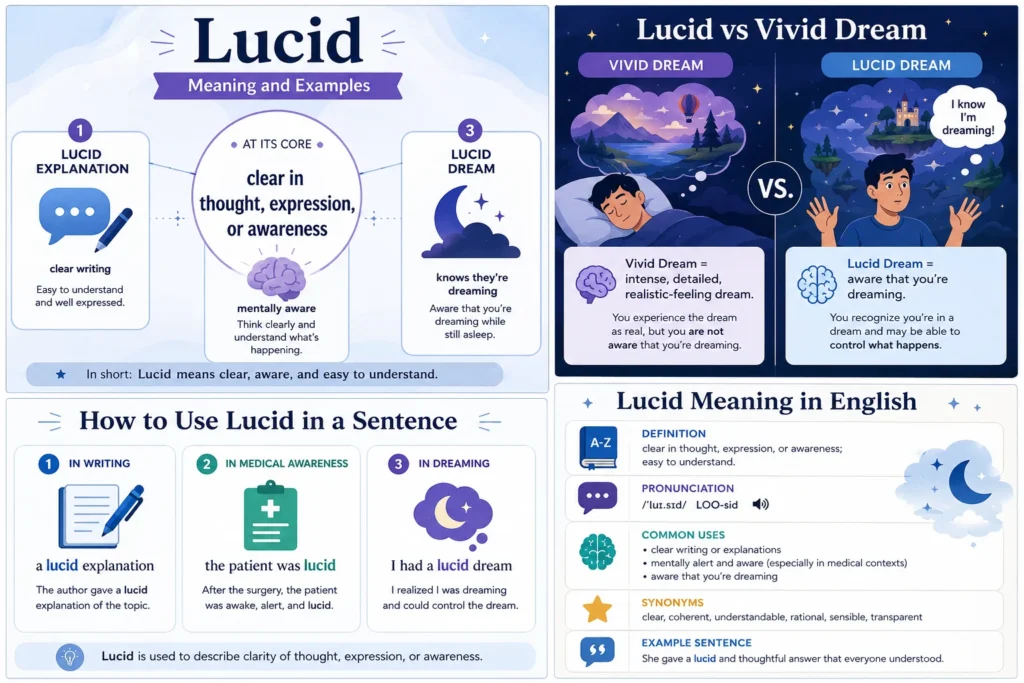
Lucid means clear, easy to understand, and mentally sharp. It is commonly used to describe writing, speech, thinking, dreams, and moments of awareness. For example, a lucid explanation is clear and wellexpressed, while a lucid dream is a dream in which you know you are dreaming.
If you’ve seen the word lucid in a book, classroom, article, psychology discussion, or even in conversations about dreaming, you might be wondering what it actually means in everyday English. The good news is that lucid is a useful and flexible word with a very clear core idea: clarity.
In most cases, lucid meaning comes down to being clear in thought, clear in expression, or fully aware of what is happening. You might hear someone say a writer has a lucid style, a patient is lucid and responsive, or a person had a lucid dream last night. Those all use the same root idea, but in slightly different contexts.
This guide breaks down the meaning of lucid in plain US English with examples, platformstyle usage, differences from similar words, common mistakes, reply strategies, FAQs, and image SEO assets. By the end, you’ll know exactly what lucid means, how to use it naturally, and when it fits better than words like clear, coherent, or vivid.
Quick Answer Box
| Topic | Quick Answer |
| Word | Lucid |
| Core meaning | Clear, easy to understand, mentally aware |
| Main use cases | Writing, speech, thinking, medical awareness, dreaming |
| Tone | Neutral to formal; educated everyday English |
| Common example | “She gave a lucid explanation of the problem.” |
| Dream meaning | A lucid dream is a dream where you know you’re dreaming |
| Medical use | “Lucid” can describe someone who is mentally clear and aware |
| Similar words | clear, coherent, articulate, rational |
| Not always the same as | vivid, intelligent, conscious, awake |
| Best way to understand it | Think: clear mind + clear expression + awareness |
What Does Lucid Mean?
Lucid is an adjective that usually means one of these three things:
- Clear and easy to understand
- Mentally sharp, rational, or aware
- Conscious within a dream that you are dreaming
At its core, the word suggests light, clarity, and understanding. If something is lucid, it isn’t confusing, messy, foggy, or disorganized. It makes sense. It feels mentally “clear.”
Simple definition of lucid
In simple English, lucid means clear—clear in language, thinking, or awareness.
Here are the easiest ways to understand it:
- Lucid explanation = a very clear explanation
- Lucid thinking = thinking in a rational, focused way
- Lucid patient = a patient who is mentally aware and responsive
- Lucid dream = a dream where the dreamer knows they are dreaming
Lucid in one sentence
Lucid means clearminded or clearly expressed.
That’s the shortest and most useful everyday definition.
Full Definition of Lucid
To fully understand lucid meaning, it helps to look at the word across its main contexts instead of trying to force one narrow definition.
Lucid as “clear and understandable”
This is one of the most common uses. If speech, writing, teaching, or an explanation is lucid, it is easy to follow and makes sense without confusion.
Examples:
- “The professor gave a lucid explanation of quantum theory.”
- “Her essay is lucid and well organized.”
- “I liked the article because it was lucid without being too basic.”
In this sense, lucid often overlaps with:
- clear
- coherent
- understandable
- wellexplained
- easy to follow
Lucid as “mentally aware or rational”
Lucid can also describe a person who is mentally present, aware, and able to think clearly. This is common in medical, emotional, and serious reallife situations.
Examples:
- “After the medication wore off, he became lucid again.”
- “She was tired, but still lucid enough to answer questions.”
- “The patient was awake and lucid.”
In this use, lucid suggests:
- mentally sharp
- aware of surroundings
- coherent in speech
- not confused or disoriented
Lucid in dreams
A lucid dream is a dream in which the dreamer realizes they are dreaming while the dream is still happening. Sometimes they can even influence what happens in the dream.
Examples:
- “I had a lucid dream and knew the whole thing wasn’t real.”
- “Some people practice techniques to trigger lucid dreaming.”
This is a very specific and popular use of the word, especially online.
The Core Idea Behind Lucid
Even though lucid appears in different contexts, the core idea is the same:
Lucid = mental clarity or clear expression.
That clarity can show up in different ways:
- clear words
- clear thought
- clear awareness
- clear recognition of reality vs dream
Think of lucid as the opposite of:
- confused
- foggy
- incoherent
- disoriented
- rambling
- unclear
If someone explains a complicated topic in a way that instantly clicks, that explanation is lucid. If a person is recovering after confusion and becomes mentally present again, they’re lucid. If someone realizes in a dream that they’re dreaming, they’re having a lucid dream.
Context and Usage of Lucid
The meaning of lucid changes slightly depending on the setting. That’s why context matters so much.
Lucid in everyday language
In general conversation, lucid often sounds a little more polished than just saying clear. People use it when they want to describe something as not just understandable, but especially well expressed or mentally sharp.
Examples:
- “That was a lucid summary.”
- “He sounded surprisingly lucid after being awake all night.”
- “I need a lucid explanation, not a bunch of jargon.”
In casual speech, people may not use lucid every day, but it’s still common enough that educated English speakers understand it easily.
Common everyday contexts
You may see or hear lucid used for:
- school essays
- presentations
- public speaking
- interviews
- medical updates
- psychology discussions
- dream content
- selfhelp or mindfulness content
- reviews of books, articles, and lectures
Lucid in academic and professional writing
In professional or academic settings, lucid is often used as praise. It suggests that someone can explain a difficult topic clearly and intelligently.
Examples:
- “The report offers a lucid analysis of the market.”
- “Her lecture was lucid, concise, and persuasive.”
- “This textbook is lucid enough for beginners.”
In these settings, lucid doesn’t just mean “simple.” It often means clear without losing depth.
That’s an important distinction.
A lucid explanation is not necessarily childish or basic. It can still be advanced. It’s just well structured, coherent, and easy to follow.
Lucid in medical and caregiving contexts
This is one of the most emotionally loaded uses of the word.
When someone says a person is lucid, they usually mean the person is:
- awake
- aware
- mentally present
- able to understand and respond coherently
Examples:
- “Grandpa had a lucid moment this morning.”
- “She was weak, but lucid.”
- “The nurse said he was alert and lucid.”
This use often appears when discussing:
- illness
- medication
- recovery
- aging
- confusion
- memory conditions
- temporary disorientation
In this context, lucid does not necessarily mean perfectly healthy. It just means the person is mentally clear enough to understand and communicate.
Lucid in psychology and dream culture
Online, one of the most searched uses of lucid is tied to lucid dreaming. This is especially common in:
- TikTok discussions
- YouTube videos
- Reddit threads
- dream journals
- selfexperiment communities
- meditation and sleep content
Here, lucid means being consciously aware during a dream. Some people also use the phrase to talk about dream control, though awareness is the key part.
Examples:
- “I became lucid in the middle of the dream.”
- “My lucid dream felt unbelievably real.”
- “I’m trying to learn lucid dreaming techniques.”
RealLife Examples of Lucid
The best way to master the lucid meaning is to see it in realistic examples.
Lucid example sentences
Here are everyday sentence examples across different contexts:
- Writing
- “Her article gives a lucid explanation of climate anxiety.”
- Speech
- “He was nervous, but his answers stayed lucid and focused.”
- Teaching
- “The tutor made algebra feel simple with a lucid stepbystep method.”
- Medical
- “The patient was awake and lucid after surgery.”
- Emotional clarity
- “After a few hours of rest, I finally felt lucid enough to think.”
- Dreams
- “I had a lucid dream and decided to fly.”
- Leadership
- “The manager gave a lucid overview of the company’s goals.”
- Books
- “It’s a lucid introduction to economics for beginners.”
- Stress recovery
- “I was overwhelmed earlier, but I’m lucid now.”
- Debate
- “She made a lucid argument without getting defensive.”
Conversation Example 1: School context
Dialogue
Aisha: Did you understand the chapter on genetics?
Maya: Not at first, but the video gave a really lucid explanation.
Aisha: So it actually made sense?
Maya: Yeah, way more than the textbook.
Why lucid works here
The explanation was not just “good.” It was clear, organized, and easy to understand.
Conversation Example 2: Medical context
Dialogue
Son: How’s my dad doing?
Doctor: He’s tired, but he’s awake and lucid. He can answer questions and recognize people.
Son: That’s a relief.
Why lucid works here
Here lucid means mentally aware and coherent, not just physically awake.
Conversation Example 3: Work context
Dialogue
Manager: Can you explain the issue to the client?
Analyst: Yes. I’ll keep it short and lucid so they can see the actual cause of the delay.
Manager: Perfect.
Why lucid works here
A lucid explanation is clear and easy to follow, especially when the topic could otherwise be confusing.
Conversation Example 4: Stress and mental clarity
Dialogue
Friend 1: You’ve been staring at the screen for an hour.
Friend 2: I know. I’m too tired to think straight.
Friend 1: Take a break and come back when you’re lucid.
Friend 2: Fair. My brain is fried.
Why lucid works here
In casual speech, lucid can mean mentally clear enough to think properly again.
Conversation Example 5: Dreaming
Dialogue
Jenna: I had the weirdest dream last night.
Chris: Weird how?
Jenna: I realized I was dreaming, and then I started changing things on purpose.
Chris: So it was a lucid dream?
Jenna: Exactly.
Why lucid works here
This is the dreamspecific use: aware inside the dream.
PlatformSpecific Meaning of Lucid
The word lucid is not slang in the way words like sus, delulu, or ate are. It’s a standard English adjective. Still, how it appears online can vary by platform and community.
Lucid on TikTok
Dream and sleep content
On TikTok, lucid most often appears in videos about:
- lucid dreams
- dream control
- sleep routines
- dream journaling
- “how to lucid dream” tutorials
Example captions:
- “I had my first lucid dream last night.”
- “POV: you realize you’re lucid and try not to wake up.”
- “Lucid dreaming tips that actually helped me.”
Productivity and mindset content
Some creators also use lucid in a more general selfawareness sense:
- “I finally had a lucid moment about my life choices.”
- “Journaling helps me feel more lucid.”
That use is less formal than dictionarystyle English, but still understandable.
Lucid on Reddit
Reddit uses lucid heavily in:
- dream forums
- psychology threads
- philosophy discussions
- book reviews
- health or caregiving conversations
Examples:
- “How do you stay calm in a lucid dream?”
- “My grandmother has lucid days and confused days.”
- “The author’s writing is lucid without oversimplifying the topic.”
Reddit tends to preserve the full nuance of the word, especially in longform discussions.
Lucid on YouTube
On YouTube, lucid is common in:
- lucid dreaming channels
- educational content
- book analysis
- psychology explainers
- commentary about memory and consciousness
Typical examples:
- “Beginner’s guide to lucid dreaming”
- “A lucid explanation of inflation”
- “How to become lucid during REM sleep”
Lucid in texting and chat
In direct messages or texting, lucid is less common than clear or awake, but it still shows up in certain situations.
Examples:
- “Sorry, I wasn’t lucid enough to reply last night.”
- “Send me a lucid version of that idea lol.”
- “I need coffee before I become lucid.”
This can sound playful, dramatic, or slightly intellectual depending on the person.
Lucid on X, Threads, and online commentary
Writers, journalists, academics, and opinion posters sometimes use lucid as a compliment for a post, essay, thread, or argument.
Examples:
- “This is the most lucid thread I’ve seen on the issue.”
- “A lucid take on what’s actually happening.”
- “Thank you for making a complicated topic readable.”
In this environment, lucid often signals both clarity and respect for the writer’s intelligence.
Alternative Meanings of Lucid
Although lucid has a central meaning, people encounter it in different ways. Here are the main interpretations you should know.
Lucid as “clear and understandable”
This is the broadest and most common meaning.
Examples:
- lucid explanation
- lucid writing
- lucid summary
- lucid argument
- lucid instructions
Lucid as “mentally coherent”
This is common in healthcare, emotional conversations, and reallife descriptions of someone’s mental state.
Examples:
- lucid after surgery
- lucid during the interview
- not fully lucid after taking medication
- lucid enough to sign paperwork
Lucid as “aware in a dream”
This is the meaning behind lucid dreaming.
Examples:
- becoming lucid during a dream
- trying to induce a lucid dream
- staying lucid without waking up
Rare poetic sense of lucid
In literary or older writing, lucid can also suggest brightness, light, or shining clarity. You won’t hear this version every day, but it appears in poetry and descriptive prose.
Example:
- “The lake reflected a lucid sky.”
That usage is less common in modern everyday speech, but it comes from the same root idea of light and clarity.
Related Terms and NLP Variations
If you’re targeting the topic lucid meaning, you also need to understand nearby terms and semantic variations. Some are true synonyms, while others overlap only in specific contexts.
Words similar to lucid
Clear
The closest everyday substitute.
- “She gave a clear explanation.”
- “She gave a lucid explanation.”
Difference: Clear is more common and casual. Lucid sounds more polished and deliberate.
Coherent
Often overlaps with lucid when talking about thought or speech.
- “He wasn’t coherent after the accident.”
- “He became lucid and coherent.”
Difference: Coherent emphasizes logical connection and consistency. Lucid emphasizes mental clarity and understandability.
Articulate
Used when someone expresses ideas well.
- “She’s articulate and lucid.”
Difference: Articulate focuses on speaking skill. Lucid focuses on clarity of thought or explanation.
Rational
Close to lucid in discussions of mental state.
- “He was calm, lucid, and rational.”
Difference: Rational emphasizes logic and sound judgment; lucid emphasizes clarity and awareness.
Vivid
This one causes confusion because it often appears in dream discussions.
- “It was a vivid dream.”
- “It was a lucid dream.”
These are not the same.
A vivid dream feels detailed and intense.
A lucid dream is a dream where you know you’re dreaming.
A dream can be:
- vivid but not lucid
- lucid but not vivid
- both vivid and lucid
Related phrases using lucid
Here are common collocations, meaning words that naturally pair with lucid:
- lucid explanation
- lucid account
- lucid analysis
- lucid prose
- lucid argument
- lucid state
- lucid interval
- lucid patient
- lucid thought
- lucid dream
- lucid awareness
- lucid moment
Lucid interval meaning
A lucid interval usually refers to a period when someone becomes temporarily clearminded after confusion, illness, emotional instability, or mental impairment.
Example:
- “She had a lucid interval in the afternoon and recognized everyone.”
This phrase often appears in literature, law, medicine, and caregiving discussions.
How to Respond When Someone Uses Lucid
Sometimes you won’t be the one using the word—you’ll be reacting to it. The right reply depends on context.
If someone says “I had a lucid dream”
Possible replies:
- “That’s wild. Did you realize it during the dream?”
- “Could you control what happened?”
- “I’ve heard of lucid dreaming but never experienced it.”
- “Did it feel realistic?”
These responses keep the conversation going naturally.
If someone says “He’s lucid now”
Possible replies:
- “That’s good to hear.”
- “Is he able to talk normally?”
- “Does he recognize everyone?”
- “I’m glad he’s more aware.”
This is often a sensitive context, so a calm and respectful reply works best.
If someone says “That article was really lucid”
Possible replies:
- “So it explained the topic clearly?”
- “Nice, I’ll read it then.”
- “I love when complicated topics are written that way.”
- “That’s exactly what I need right now.”
If someone calls your explanation lucid
Possible replies:
- “Thanks—I was trying to keep it simple.”
- “I’m glad it made sense.”
- “Appreciate it.”
- “That means a lot, especially since the topic is messy.”
Misinterpretations of Lucid
Because the word sounds a bit formal and appears in multiple contexts, people sometimes misunderstand it. Here are the most common mistakes.
Mistake 1: Thinking lucid just means “smart”
Not exactly.
A person can be intelligent without sounding lucid, and someone can give a lucid explanation without being an expert genius. Lucid is about clarity, not IQ.
Wrong assumption:
- “Lucid means highly intelligent.”
Better understanding:
- “Lucid means mentally clear or clearly expressed.”
Mistake 2: Thinking lucid and vivid mean the same thing
They don’t.
- Vivid = strong, detailed, intense imagery
- Lucid = clear awareness or clarity
In dreams, people mix these up all the time.
Mistake 3: Thinking lucid always refers to dreams
Lucid dreaming is popular online, but it’s only one use of the word. In everyday English, lucid is often about explanations, mental clarity, and coherent awareness.
Mistake 4: Thinking lucid means fully healthy
In medical situations, saying someone is lucid does not automatically mean they’re fine. It only means they’re mentally clear at that moment or clear enough to communicate.
Mistake 5: Using lucid for anything positive
Lucid is not just a fancy compliment for “good.” It has a specific flavor of clarity, coherence, or awareness.
Less natural:
- “That pizza was lucid.”
- “Your outfit is lucid.”
Natural:
- “Your explanation was lucid.”
- “He seems lucid now.”
- “I had a lucid dream.”
When NOT to Use Lucid
Understanding when not to use a word is just as important as knowing what it means.
Don’t use lucid for physical objects unless clarity is the point
Lucid is usually about:
- thought
- language
- awareness
- dreams
It’s not commonly used for random objects unless you’re writing poetically.
Awkward:
- “This chair is lucid.”
Natural:
- “The instructions for assembling the chair are lucid.”
Don’t use lucid when you just mean “awake”
Someone can be awake but not lucid. Lucid implies mental clarity, not just open eyes.
- Awake = not asleep
- Lucid = mentally clear and coherent
Don’t use lucid as a replacement for every synonym of “clear”
Sometimes simple, clear, organized, or coherent is a better fit depending on tone.
For example:
- “The label is clear” sounds more natural than “The label is lucid.”
- “The speaker was coherent” may be better if you want to stress logical flow.
Don’t force lucid into casual slangheavy messages if it sounds unnatural
If you and your friends usually speak very casually, saying “Your explanation was lucid” might sound overly formal unless that’s your vibe.
You could say:
- “That actually made sense.”
- “You explained it clearly.”
- “Okay, now I get it.”
But if you like a polished tone, lucid works just fine.
Usage Tips for Lucid
If you want to use lucid naturally, these tips help a lot.
Use lucid when clarity is unusually strong
A good time to use lucid is when something isn’t just understandable—it’s impressively clear.
Examples:
- “Her lecture on taxes was surprisingly lucid.”
- “He gave a lucid account of what happened.”
- “The documentary offered a lucid explanation of the crisis.”
Use lucid in thoughtful, reflective, academic, or serious contexts
Lucid fits well in:
- essays
- reviews
- presentations
- medical updates
- psychological discussions
- dream journals
- interviews
- book commentary
Pair lucid with the right nouns
The word sounds most natural with nouns like:
- explanation
- account
- analysis
- writing
- speech
- response
- patient
- moment
- dream
- state
Remember the three big buckets
If you ever forget the lucid meaning, come back to these:
1. Clear expression
- lucid writing
- lucid speech
- lucid explanation
2. Clear mind
- lucid patient
- lucid state
- lucid moment
3. Dream awareness
- lucid dream
- becoming lucid in a dream
Lucid vs Similar Words
Choosing between lucid and nearby words can make your English sound more natural.
Lucid vs clear
Clear is the simpler, broader word.
Lucid is a slightly more refined version when talking about thought or expression.
- “That was a clear explanation.”
- “That was a lucid explanation.”
Both work, but lucid sounds more elevated.
Lucid vs coherent
Coherent emphasizes connected logic and consistency.
Lucid emphasizes mental clarity and understandability.
Someone after anesthesia may become lucid.
An essay with strong structure may be coherent.
A great explanation can be both.
Lucid vs articulate
Articulate focuses on a person’s ability to express ideas well.
Lucid focuses on the quality of the explanation or state of mind.
- “She’s articulate.” = She speaks well.
- “Her explanation was lucid.” = The explanation was clear.
Lucid vs conscious
Conscious only means awake and aware at a basic level.
Lucid goes further and implies mental clarity.
A person may be conscious but confused.
A lucid person is typically conscious and mentally clear.
Lucid vs vivid
Again, this one matters in dream discussions.
- Vivid dream = highly detailed, sensory, intense
- Lucid dream = you know it’s a dream
Emotional and Social Meaning of Lucid
Even though lucid is a dictionary word rather than slang, it can still carry emotional weight depending on how it’s used.
Lucid can signal relief
In medical or family contexts, hearing that someone is lucid often brings relief because it means they are mentally present.
Example:
- “She’s lucid and asking for water.”
That sentence says a lot emotionally, even though the word itself is neutral.
Lucid can signal respect
Calling someone’s writing or speech lucid is a strong compliment. It suggests they can take complexity and make it understandable without talking down to people.
Example:
- “Your article on student debt was lucid and fair.”
That’s more thoughtful than just saying “good article.”
Lucid can signal selfawareness
In conversations about emotions, burnout, or mental overload, someone may use lucid to describe a return to clarity.
Examples:
- “I wasn’t lucid enough to make that decision yesterday.”
- “After journaling, I felt more lucid about what I actually wanted.”
Here the word can imply emotional honesty, calm, and mental grounding.
Edge Cases and Less Common Uses
To cover the full topic ecosystem, it helps to look at situations where lucid might appear in less obvious ways.
Can lucid describe art or style?
Yes, especially in reviews.
Examples:
- “The film offers a lucid portrait of grief.”
- “The author has a lucid narrative style.”
- “The essay is lucid, restrained, and elegant.”
In criticism, lucid can describe not only literal explanation but also the clarity of structure, thought, and expression.
Can lucid be used sarcastically?
Yes, though it depends on tone.
Examples:
- “Oh wow, that was a very lucid explanation,” said after someone rambles for ten minutes.
- “I’m definitely not lucid before my first coffee.”
Online and in speech, people sometimes use it lightly or ironically.
Can lucid describe decisionmaking?
Yes.
Examples:
- “I wasn’t lucid enough to agree to anything at 3 a.m.”
- “Try making the decision when you’re more lucid.”
- “Once the panic passed, she became more lucid about the situation.”
This is a natural extension of the “clearminded” meaning.
Is lucid formal or casual?
It sits in the middle.
- It is not slang
- It is not highly technical
- It can sound slightly formal or polished
- It is still very usable in everyday English
You probably won’t hear it as often as clear or smart, but it’s absolutely normal English.
Five More Natural Conversation Scenarios
To make the meaning even more practical, here are five additional miniscenarios.
Scenario 1: Book review
Dialogue
Noah: Is that philosophy book impossible to read?
Lena: Surprisingly no. It’s actually pretty lucid.
Noah: So beginnerfriendly?
Lena: Yeah, it doesn’t assume you already know everything.
Meaning here: clear and understandable.
Scenario 2: After medication
Dialogue
Nurse: She’s more lucid than she was an hour ago.
Family member: Can she understand us now?
Nurse: Yes, she can respond clearly.
Meaning here: mentally coherent and aware.
Scenario 3: Office presentation
Dialogue
Coworker 1: Your slide deck was really lucid.
Coworker 2: Thanks. I cut a lot of the extra jargon out.
Meaning here: well explained and easy to follow.
Scenario 4: Dream chat
Dialogue
Sam: I knew I was dreaming, but I still couldn’t control anything.
Rae: That still counts as lucid if you were aware.
Sam: Good to know.
Meaning here: conscious awareness inside the dream.
Scenario 5: Burnout moment
Dialogue
Friend: Do you want to talk about it tonight?
You: Tomorrow would be better. I want to be more lucid before I answer.
Friend: Totally fair.
Meaning here: mentally clear enough to think and communicate well.
Common Sentence Patterns With Lucid
If you want to start using the word naturally, these sentence frames are useful.
Pattern 1: Lucid + noun
- a lucid explanation
- a lucid argument
- a lucid summary
- a lucid account
- a lucid dream
Pattern 2: Be + lucid
- “He was lucid after the operation.”
- “She’s lucid now.”
- “I wasn’t lucid this morning.”
Pattern 3: Become / feel / stay lucid
- “He became lucid for a few minutes.”
- “I finally felt lucid after sleeping.”
- “She tried to stay lucid during the dream.”
Pattern 4: Lucid enough to…
- “I wasn’t lucid enough to drive.”
- “He was lucid enough to answer questions.”
- “She wasn’t lucid enough to make a decision.”
FAQs
What does lucid mean in simple words?
Lucid means clear and easy to understand, or mentally aware and able to think clearly. In dream discussions, it means knowing you are dreaming while the dream is happening.
Does lucid mean smart?
Not exactly. Lucid is more about clarity than intelligence. A lucid person or explanation is clear, coherent, and easy to understand.
What is a lucid dream?
A lucid dream is a dream in which you become aware that you are dreaming. Some people can also influence what happens in the dream after becoming lucid.
Is lucid a positive word?
Usually yes. It often has a positive tone because it suggests clarity, awareness, and strong communication. But in medical contexts it can be neutral and descriptive rather than complimentary.
Can lucid describe a person?
Yes. It can describe a person who is mentally clear, aware, and coherent.
Example:
- “She was tired but lucid.”
Can lucid describe writing?
Absolutely. A lucid writing style means the writing is clear, logical, and easy to follow.
Example:
- “The book gives a lucid explanation of the law.”
What is the difference between lucid and clear?
Clear is broader and more common. Lucid is a more specific and polished way to say something is clearly expressed or mentally coherent.
Is lucid formal?
It’s slightly more formal than everyday words like clear, but it’s still normal and widely understood in common English.
What does lucid mean in a hospital or medical setting?
In a medical context, lucid usually means the person is mentally alert, aware, and able to respond coherently.
Does lucid mean conscious?
Not exactly. A person can be conscious but confused. Lucid suggests not just wakefulness, but clear mental awareness.
Can a dream be vivid but not lucid?
Yes. A vivid dream can feel intense and realistic without you realizing it’s a dream. A lucid dream specifically involves awareness that you’re dreaming.
What is a lucid interval?
A lucid interval is a period when a person becomes temporarily mentally clear after confusion, illness, or impairment.
Is lucid used in texting?
Sometimes, yes. It’s less common than clear or awake, but people do use it in texts, especially jokingly or in thoughtful conversations.
Example:
- “I’ll reply when I’m more lucid.”
Is lucid slang?
No. Lucid is not slang. It’s a standard English adjective used in writing, speaking, medical contexts, and dream discussions.
Can lucid mean calm?
Not directly. A person may be calm and lucid at the same time, but lucid specifically refers to mental clarity and awareness, not emotional calmness by itself.
Conclusion
The simplest way to understand lucid meaning is this: lucid means clear—clear in language, clear in thought, or clear in awareness.
If someone gives a lucid explanation, they’ve made something easy to understand. If a person is lucid, they are mentally aware and coherent. If someone has a lucid dream, they know they are dreaming while it’s happening.
So instead of memorizing three separate definitions, remember the one core idea behind them all:
Lucid is about clarity of mind, clarity of expression, or clarity of awareness.
That’s why the word works in classrooms, books, hospitals, essays, dream discussions, and everyday conversations. It’s a compact word, but it carries a lot of meaning.
If you want a quick rule for using it naturally, use lucid when you want to describe something as more than just understandable—something especially clear, mentally present, coherent, or selfaware.

Justin Powell is a writer at GramBrix.com who focuses on grammar, clarity and effective communication, helping readers strengthen their language skills.