Last Updated on July 9, 2026
Obsequious means excessively eager to please, obey, or flatter someone, usually a person with power or authority. The word often carries a negative meaning because it suggests insincere, submissive, or overly flattering behavior intended to gain approval or favor.
Have you ever seen someone agree with everything their boss says, laugh at every joke, and constantly offer praise even when it seems exaggerated? Many people would describe that behavior as obsequious.
Understanding the obsequious meaning can help you improve your vocabulary, recognize social dynamics, and communicate more precisely in professional, academic, and everyday situations. This word frequently appears in literature, workplace discussions, news articles, and personality descriptions.
In this guide, you’ll learn the complete definition of obsequious, how it is used, examples in conversations, platform specific interpretations, related terms, common mistakes, response strategies, and much more.
Quick Answer Box
| Element | Explanation |
|---|---|
| Meaning | Excessively eager to please or obey someone |
| Context | Social, workplace, academic, literary, and personal interactions |
| Usage | Describing overly submissive or flattering behavior |
| Common Platforms | Social media, workplace discussions, forums, literature |
| Example | “His obsequious behavior toward the manager annoyed his coworkers.” |
| Tone | Usually negative or critical |
| Part of Speech | Adjective |
| Pronunciation | uhb-SEE-kwee-us |
What Does Obsequious Mean?
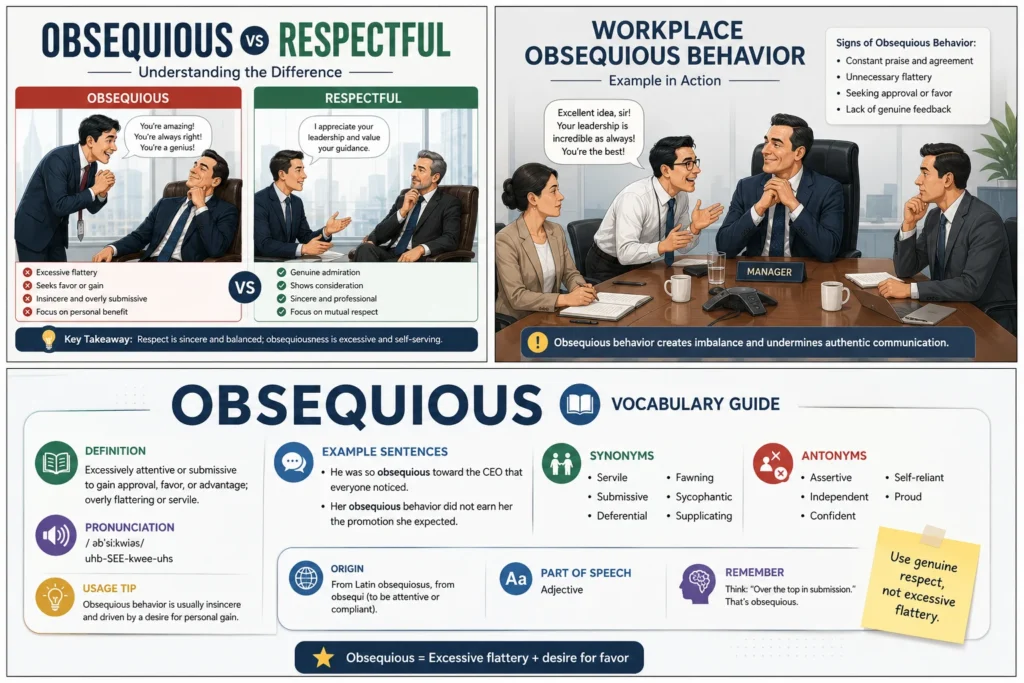
The word obsequious describes a person who is overly obedient, submissive, or eager to gain favor from someone perceived as more powerful.
Unlike ordinary politeness or respect, obsequious behavior goes beyond what is considered normal. It often appears forced, excessive, or motivated by personal gain.
For example:
“The employee became obsequious whenever senior executives visited the office.”
In this sentence, the employee is not simply being respectful. The implication is that the employee is trying too hard to impress or please those in authority.
Key Characteristics of Obsequious Behavior
- Excessive flattery
- Constant agreement
- Unquestioning obedience
- Overly submissive attitude
- Desire to gain approval
- Insincere praise
- Avoidance of disagreement
Full Definition
According to standard English usage, obsequious means:
Excessively attentive, obedient, or eager to please another person, especially someone important or powerful.
The term often implies that the behavior lacks authenticity and is motivated by self-interest.
Pronunciation
Obsequious
Pronounced as:
uhb-SEE-kwee-us
Syllable Breakdown
Ob-se-qui-ous
Word Origin
The word comes from the Latin term obsequiosus, meaning compliant, yielding, or dutiful.
Over time, the English meaning developed a more negative tone, referring to exaggerated compliance or flattery.
Context and Usage
Understanding context is important because not all respectful behavior is obsequious.
Respectful vs Obsequious
| Respectful | Obsequious |
|---|---|
| Genuine politeness | Excessive flattery |
| Honest admiration | Insincere praise |
| Professional courtesy | Extreme submission |
| Balanced communication | Constant agreement |
| Authentic behavior | Behavior driven by approval-seeking |
For example:
Respectful:
“I appreciate your guidance on this project.”
Obsequious:
“You’re the most brilliant manager in the entire company. Everything you do is perfect.”
The second statement sounds exaggerated and potentially insincere.
Workplace Usage
The workplace is one of the most common environments where the term appears.
Examples include:
- Constantly agreeing with supervisors
- Praising every decision without critical thinking
- Trying excessively hard to impress leadership
- Avoiding honest feedback
Example:
“His obsequious attitude toward upper management made him unpopular among coworkers.”
Social Usage
The word may also describe personal relationships.
Example:
“She disliked people who became obsequious around celebrities.”
Academic Usage
Students often encounter this word in:
- Literature classes
- Vocabulary exams
- SAT preparation
- GRE preparation
- Academic writing
Real-Life Examples
Understanding examples makes the meaning much easier to remember.
Example 1: Office Environment
A manager suggests an unrealistic plan.
Everyone remains cautious except one employee who immediately says:
“That’s the greatest idea I’ve ever heard.”
Even though the plan has obvious flaws, the employee praises it excessively.
This behavior may be considered obsequious.
Example 2: Celebrity Interaction
A fan meets a famous actor and continuously says:
“Everything you’ve ever done is perfect. You’re better than everyone else.”
The excessive praise could be viewed as obsequious.
Example 3: Politics
Political commentators sometimes describe advisors as obsequious when they never challenge leaders and constantly praise them.
Example 4: School Setting
A student repeatedly compliments a teacher and agrees with every opinion solely to gain favor.
This may be described as obsequious behavior.
Example 5: Family Situation
A relative constantly flatters a wealthy family member in hopes of receiving financial benefits.
That behavior could also be called obsequious.
Real-Life Conversation Examples
Conversation Example 1
Sarah: Why does Tom always agree with the director?
Mike: Sometimes he seems a little obsequious.
Sarah: Yeah, he never questions anything.
Conversation Example 2
Emma: Did you hear how much praise he gave the CEO?
Liam: It sounded pretty obsequious.
Emma: I thought the same thing.
Conversation Example 3
Alex: Why was everyone laughing at that joke?
Jordan: Most weren’t. One guy was just being obsequious.
Conversation Example 4
Teacher: What did you think of the book?
Student: It was absolutely flawless and perfect in every way.
Teacher: That response sounds a little obsequious.
Conversation Example 5
Chris: Why does he compliment the boss every day?
Taylor: He’s probably trying to get promoted.
Chris: That’s pretty obsequious.
Platform-Specific Meaning
Although the core definition remains the same, people may encounter the word differently across various digital platforms.
Social Media
On social media, users may call someone obsequious when they constantly praise influencers, celebrities, or public figures.
Example:
“The comments section was full of obsequious fans.”
Online Forums
Forum users may use the term when discussing people who always support authority figures without criticism.
Example:
“Some members became obsequious toward the moderators.”
Professional Networking Platforms
In professional discussions, the word may describe employees who excessively praise executives or leaders.
Example:
“Authenticity is valued more than obsequious behavior.”
Educational Platforms
Students often encounter obsequious in vocabulary lessons, literature discussions, and writing exercises.
Workplace Chat Applications
In workplace communication tools, employees may jokingly use the term to describe coworkers who overly flatter management.
Alternative Meanings
Generally, obsequious has a single core meaning.
However, the specific interpretation may vary slightly depending on context.
Excessive Flattery
Focuses on praise and admiration.
Example:
“His obsequious compliments sounded fake.”
Excessive Obedience
Focuses on submission and compliance.
Example:
“The assistant was obsequious toward her supervisor.”
Approval-Seeking Behavior
Focuses on gaining benefits or recognition.
Example:
“His obsequious actions were intended to secure a promotion.”
Related Terms and NLP Variations
People searching for obsequious meaning may also look for related vocabulary.
Synonyms
Common synonyms include:
- Submissive
- Servile
- Fawning
- Sycophantic
- Groveling
- Deferential
- Compliant
- Bootlicking
- Flattering
- Subservient
Near Synonyms
These words are similar but not identical:
- Respectful
- Courteous
- Polite
- Cooperative
- Attentive
Antonyms
Words with opposite meanings include:
- Independent
- Assertive
- Confident
- Self-respecting
- Courageous
- Honest
- Unyielding
- Autonomous
Related Phrases
- Teacher’s pet
- Brown-nosing
- Kissing up
- Seeking favor
- Playing politics
Emotional and Social Meaning
Language often carries emotional implications beyond dictionary definitions.
Why Is Obsequious Usually Negative?
Most people value:
- Authenticity
- Honesty
- Confidence
- Independent thinking
Obsequious behavior may suggest:
- Manipulation
- Lack of sincerity
- Low self-confidence
- Hidden motives
As a result, the word is usually used critically rather than positively.
Social Perception
People often distrust individuals who appear excessively flattering.
This is because observers may believe:
- The praise is not genuine.
- The person wants something in return.
- The person lacks independent judgment.
How to Respond When Someone Uses the Word Obsequious
You might encounter the term in conversations, reviews, discussions, or workplace feedback.
If Someone Calls Behavior Obsequious
A good response might be:
“I understand why it came across that way, but I was simply trying to be respectful.”
If You’re Unsure What It Means
You can ask:
Do you mean overly flattering or excessively eager to please?
If You’re Describing Someone Else
Use the term carefully.
Example:
“His behavior seemed obsequious rather than genuinely respectful.”
This sounds more professional than making direct personal attacks.
Misinterpretations and Common Mistakes
Many learners misunderstand the word.
Mistake 1: Assuming It Means Respectful
Not necessarily.
Respectful behavior is usually positive.
Obsequious behavior is generally excessive and negative.
Mistake 2: Using It for Kindness
Being kind does not automatically mean being obsequious.
Example:
Helping a coworker is kind.
Constantly flattering a coworker for personal gain may be obsequious.
Mistake 3: Confusing It with Loyal
A loyal person may disagree when necessary.
An obsequious person often avoids disagreement entirely.
Mistake 4: Thinking It Is Always Intentional
Sometimes people appear obsequious without realizing it.
Others may simply be naturally deferential.
Context matters.
When NOT to Use the Word
Although useful, obsequious is not appropriate in every situation.
Genuine Respect
Do not use it when someone is sincerely respectful.
Example:
Thanking a teacher for help is not obsequious.
Professional Courtesy
Normal workplace etiquette is not obsequious.
Example:
Greeting your manager politely is standard professionalism.
Cultural Differences
Some cultures place a stronger emphasis on deference and respect.
What seems obsequious in one culture may be normal courtesy in another.
Limited Information
Avoid labeling someone obsequious if you do not know their motivations.
Usage Tips
To use the word accurately, keep these guidelines in mind.
Look for Excessiveness
The key feature is “too much.”
Ask:
- Is the praise exaggerated?
- Is the obedience excessive?
- Is the agreement constant?
Consider Motivation
Obsequious behavior often appears connected to:
- Gaining approval
- Receiving rewards
- Avoiding criticism
- Seeking advancement
Watch Tone
The word usually carries criticism.
Example:
“The review described him as obsequious.”
This is rarely a compliment.
Use in Professional Writing
The word is common in:
- Essays
- Articles
- Reviews
- Literary analysis
- Workplace commentary
Obsequious in Literature and Media
Writers frequently use this word when describing characters.
Villains’ Assistants
Many fictional assistants are portrayed as obsequious toward powerful leaders.
Court Advisors
Historical dramas often depict advisors who flatter kings and rulers excessively.
Corporate Characters
Business stories sometimes include employees who constantly praise executives.
Satirical Works
Comedy and satire often mock obsequious behavior to highlight social power dynamics.
Comparison With Similar Words
Obsequious vs Submissive
Submissive
- Willing to yield
- Not always flattering
Obsequious
- Excessively submissive
- Often includes flattery
Obsequious vs Sycophantic
Sycophantic
- Focuses heavily on flattery
Obsequious
- Includes flattery, obedience, and submission
Obsequious vs Deferential
Deferential
- Respectful and polite
Obsequious
- Excessively respectful to the point of appearing insincere
Obsequious vs Servile
Servile
- Extremely submissive
Obsequious
- Often emphasizes eagerness to please
Practical Scenarios
Scenario 1: Job Interview
Appropriate:
“I admire your company’s mission.”
Obsequious:
“Your company is perfect in every possible way.”
Scenario 2: Performance Review
Appropriate:
“I appreciate your feedback.”
Obsequious:
“Everything you say is brilliant.”
Scenario 3: Classroom Discussion
Appropriate:
“I agree with your point.”
Obsequious:
“Your opinion is always right.”
Scenario 4: Social Media Comment
Appropriate:
“Great post.”
Obsequious:
“You are the smartest human being on Earth.”
Scenario 5: Political Discussion
Appropriate:
“I support this policy.”
Obsequious:
“Every decision this leader makes is perfect.”
FAQs
What is the simple meaning of obsequious?
Obsequious means excessively eager to please, obey, or flatter someone, usually in a way that appears insincere.
Is obsequious a positive or negative word?
It is generally a negative word because it suggests excessive flattery or submission.
What is an example of obsequious behavior?
Constantly praising a boss and agreeing with everything they say to gain favor is a common example.
What is the difference between respectful and obsequious?
Respectful behavior is genuine and balanced, while obsequious behavior is excessive and often insincere.
Can obsequious be used in professional writing?
Yes. It is commonly used in essays, reviews, articles, and workplace discussions.
What part of speech is obsequious?
Obsequious is an adjective.
What is the pronunciation of obsequious?
It is pronounced uhb-SEE-kwee-us.
What are some synonyms for obsequious?
Synonyms include servile, fawning, sycophantic, submissive, and subservient.
Is obsequious the same as sycophantic?
They are similar, but sycophantic focuses more on flattery, while obsequious includes obedience and submissiveness.
How can I remember the meaning of obsequious?
Think of someone trying too hard to please a powerful person through constant praise and agreement.
Conclusion
The obsequious meaning refers to behavior that is excessively eager to please, obey, or flatter someone, particularly a person in a position of power. While respect, courtesy, and professionalism are positive qualities, obsequious behavior goes beyond normal social expectations and often appears insincere or self-serving.
Understanding this word helps you recognize important social dynamics, improve your vocabulary, and communicate with greater precision. Whether you encounter it in literature, workplace discussions, news articles, academic writing, or everyday conversations, remembering the key idea of excessive submission and flattery will help you use the term correctly and confidently.
In short, if someone’s praise, agreement, or obedience seems exaggerated and motivated by a desire to gain favor, the word obsequious is often the perfect description.

Justin Powell is a writer at GramBrix.com who focuses on grammar, clarity and effective communication, helping readers strengthen their language skills.