
Last Updated on July 16, 2026
| Term | Meaning |
|---|---|
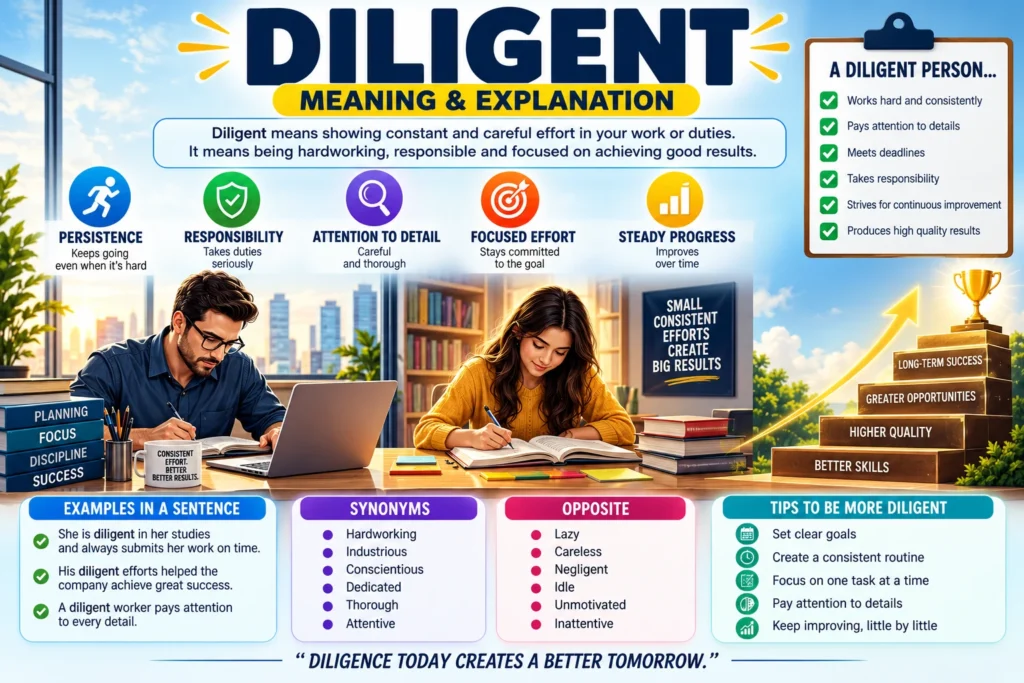
| Diligent | Showing careful, consistent, and hardworking effort to complete tasks properly and responsibly. |
| Common Context | Work, school, business, personal goals, and professional development |
| Tone | Positive and complimentary |
| Example | “She is a diligent employee who always meets deadlines.” |
The word diligent appears frequently in workplaces, schools, performance reviews, job descriptions, and everyday conversations. However, many people still wonder about the exact diligent meaning and how to use it correctly.
In simple terms, a diligent person works carefully, consistently, and responsibly. They pay attention to details and put steady effort into completing tasks well. Because diligence often leads to success, the word carries a highly positive meaning.
In this guide, you will learn the complete definition of diligent, how people use it in different situations, common examples, platform-specific usage, related terms, mistakes to avoid, and much more.
Quick Answer Box
Meaning: Careful and persistent in work or effort.
Context: Work, education, business, personal growth, and responsibilities.
Usage: Used to describe someone who consistently works hard and pays attention to details.
Platforms: LinkedIn, email, workplace communication, schools, and social media.
Example: “The diligent student reviewed her notes every day before the exam.”
Tone: Positive, respectful, and professional.
What Does It Mean?
The diligent meaning refers to showing steady effort, attention, and commitment toward a task or responsibility.
A diligent person does not rely on luck. Instead, they achieve results through consistency, focus, and dedication.
For example:
- A diligent employee completes assignments on time.
- A diligent student studies regularly.
- A diligent business owner monitors important details.
- A diligent athlete trains consistently.
Therefore, diligence is less about talent and more about reliable effort.
Full Definition
The dictionary definition of diligent is:
Having or showing care and conscientiousness in one’s work or duties.
Several key characteristics define diligence:
- Consistency
- Responsibility
- Attention to detail
- Persistence
- Strong work ethic
- Reliability
- Commitment to quality
Moreover, diligence involves doing tasks thoroughly rather than rushing through them.
Someone can be intelligent without being diligent. Similarly, a diligent person may not be the most naturally gifted individual, but their consistent effort often produces excellent results.
Context and Usage
The word diligent appears in many situations. Understanding the context helps you use it correctly.
Workplace Usage
Employers frequently praise diligent workers.
Examples:
- “She is diligent and dependable.”
- “His diligent approach improved productivity.”
- “The manager appreciated her diligent work.”
In professional environments, diligence often leads to promotions and leadership opportunities.
Academic Usage
Teachers often use diligent to describe students who work consistently.
Examples:
- “He is a diligent learner.”
- “The diligent student earned top grades.”
- “Her diligent preparation paid off.”
Academic success frequently depends on diligence rather than natural ability alone.
Personal Development Usage
People also use diligent when discussing habits and self-improvement.
Examples:
- “She remained diligent with her fitness routine.”
- “He was diligent about saving money.”
- “They stayed diligent throughout the project.”
Business Usage
Business professionals often value diligence because it reduces mistakes and improves outcomes.
Examples include:
- Financial reviews
- Project management
- Customer service
- Quality control
- Strategic planning
Real-Life Examples
Understanding real situations makes the diligent meaning easier to remember.
Example 1: Student Success
A student studies one hour every evening instead of cramming the night before an exam.
That student demonstrates diligence because they maintain consistent effort.
Example 2: Workplace Excellence
An employee double-checks reports before submitting them.
As a result, errors decrease significantly.
This behavior reflects diligence.
Example 3: Fitness Goals
Someone exercises four days each week for six months.
Although progress may seem slow initially, consistent effort eventually produces results.
That is diligence in action.
Example 4: Entrepreneurship
A small business owner tracks expenses carefully and responds promptly to customers.
Consequently, the business grows steadily.
Example 5: Learning a Skill
A musician practices daily.
Meanwhile, others practice only occasionally.
Over time, the diligent musician develops stronger skills.
Platform-Specific Meaning
Although the definition remains similar, people use the word differently across platforms.
LinkedIn users often describe professional qualities.
Examples:
- “A diligent project manager.”
- “Known for diligent research.”
- “Diligent and results-driven professional.”
Here, the word highlights reliability and professionalism.
Email Communication
Managers frequently use diligent in employee recognition.
Example:
“Thank you for your diligent efforts on this project.”
The tone is respectful and appreciative.
Workplace Chat Apps
In applications like Slack or Microsoft Teams, diligence often appears in team feedback.
Examples:
- “Great job. Your diligent work helped the team succeed.”
- “Thanks for the diligent review.”
Educational Platforms
Teachers often use diligent in comments and evaluations.
Examples:
- “A diligent student who participates actively.”
- “Shows diligent attention to detail.”
Social Media
People sometimes use diligent to motivate others.
Examples:
- “Stay diligent and trust the process.”
- “Success comes from diligent effort.”
Alternative Meanings
While diligent usually relates to hard work and careful effort, slight variations exist depending on context.
Diligent as Consistent
Sometimes diligent emphasizes consistency more than effort.
Example:
“She remained diligent with her daily routine.”
Diligent as Careful
In other cases, diligence highlights accuracy.
Example:
“He performed a diligent inspection.”
Diligent as Responsible
Sometimes the focus shifts toward accountability.
Example:
“She was diligent in fulfilling her duties.”
Therefore, context determines the specific emphasis.
Related Terms and NLP Variations
Several words share similar meanings with diligent.
Synonyms
Common synonyms include:
- Hardworking
- Industrious
- Dedicated
- Persistent
- Conscientious
- Careful
- Thorough
- Reliable
- Committed
- Responsible
Near Synonyms
These words relate closely but differ slightly:
- Ambitious
- Motivated
- Determined
- Disciplined
- Focused
Antonyms
Opposite words include:
- Lazy
- Careless
- Negligent
- Irresponsible
- Inattentive
- Unreliable
Related Phrases
People often use these expressions alongside diligent:
- Strong work ethic
- Attention to detail
- Consistent effort
- Professional dedication
- Commitment to excellence
- Reliable performance
How to Respond or Reply
If someone calls you diligent, they are usually giving a compliment.
Here are several ways to respond.
Professional Response
“Thank you. I appreciate your feedback.”
Humble Response
“Thanks. I try to stay focused and consistent.”
Team-Oriented Response
“Thank you. The team’s support helped make it possible.”
Casual Response
“Thanks. I’m glad the effort paid off.”
Leadership Response
“I appreciate that. Consistency and quality are always priorities for me.”
Conversation Examples
Conversation Example 1: Workplace
Manager: You handled this project very well.
Employee: Thank you.
Manager: Your diligent work helped us meet every deadline.
Employee: I appreciate that feedback.
Conversation Example 2: School
Teacher: Sarah is one of the most diligent students in class.
Parent: That’s wonderful to hear.
Teacher: She consistently completes assignments and participates actively.
Conversation Example 3: Business
Business Owner: Why are your customer reviews so strong?
Manager: Our team takes a diligent approach to customer service.
Conversation Example 4: Personal Goals
Friend: How did you learn Spanish so quickly?
Friend 2: I stayed diligent and practiced every day.
Conversation Example 5: Fitness
Trainer: You’ve made impressive progress.
Client: Thanks.
Trainer: Your diligent training schedule made the difference.
Misinterpretations
Many people misunderstand the word diligent.
Mistake 1: Diligent Means Intelligent
Not necessarily.
Intelligence and diligence are different qualities.
A person can be highly intelligent but inconsistent. Likewise, someone with average ability can achieve outstanding results through diligence.
Mistake 2: Diligent Means Working Long Hours
Working longer does not automatically mean working diligently.
Diligence focuses on quality, consistency, and attention.
Mistake 3: Diligent Means Perfection
Diligent people still make mistakes.
However, they actively work to improve and correct them.
Mistake 4: Diligence Guarantees Success
Diligence increases the chances of success.
Nevertheless, other factors also influence outcomes.
When NOT to Use It
Although diligent is a positive word, certain situations make it inappropriate.
When Referring to Natural Talent
Talent and diligence are different concepts.
Instead of saying:
“He is diligent at basketball.”
You might say:
“He practices diligently.”
When Describing One-Time Effort
Diligence implies ongoing effort.
A single action usually does not demonstrate diligence.
When Evidence Is Missing
Avoid labeling someone diligent without observing consistent behavior.
When You Mean Speed
Diligence focuses on careful effort.
Fast work and diligent work are not always the same thing.
Usage Tips
Use It as a Compliment
Diligent is often an excellent professional compliment.
Example:
“She is a diligent employee.”
Pair It With Achievements
Examples:
- Diligent researcher
- Diligent student
- Diligent worker
- Diligent manager
Use It in Performance Reviews
Managers frequently use the word because it emphasizes professionalism.
Include Specific Examples
Instead of saying:
“He is diligent.”
Say:
“He is diligent and consistently delivers accurate reports.”
Specific examples make the compliment stronger.
Use It in Resumes Carefully
Candidates often include diligence-related achievements.
For example:
“Demonstrated diligent attention to detail while managing client accounts.”
Diligent vs Similar Words
Diligent vs Hardworking
A hardworking person invests effort.
A diligent person invests effort carefully and consistently.
Diligent vs Dedicated
Dedication reflects commitment.
Diligence reflects commitment plus consistent action.
Diligent vs Disciplined
Discipline focuses on self-control.
Diligence focuses on careful effort.
Diligent vs Persistent
Persistence means not giving up.
Diligence means continuing carefully and responsibly.
Therefore, these words overlap but are not identical.
Why Diligence Matters in Modern Life
In today’s competitive environment, diligence remains one of the most valuable personal qualities.
Employers value diligent workers because they:
- Produce reliable results
- Make fewer mistakes
- Require less supervision
- Improve team performance
Similarly, students benefit from diligence because regular study habits often outperform last-minute preparation.
Furthermore, entrepreneurs rely on diligence to manage finances, customers, operations, and growth.
Even in personal relationships, diligence matters. Consistent effort helps build trust and strengthen connections.
As a result, diligence supports success across nearly every area of life.
FAQs
What is the simple meaning of diligent?
Diligent means showing careful, consistent, and hardworking effort toward a task or responsibility.
Is diligent a positive word?
Yes. People usually use it as a compliment because it highlights responsibility and dedication.
What is an example of diligent?
A student who studies every day before an exam demonstrates diligence.
Does diligent mean hardworking?
Partly. However, diligent also includes careful attention and consistency.
Can a person be diligent without being talented?
Yes. Many successful people achieve results through diligence rather than natural talent alone.
What is the opposite of diligent?
Common opposites include lazy, careless, negligent, and irresponsible.
Is diligent a professional word?
Yes. Employers, managers, teachers, and business leaders commonly use it.
How do you use diligent in a sentence?
Example: “The diligent employee completed every assignment accurately and on time.”
What qualities make someone diligent?
Consistency, responsibility, attention to detail, persistence, and reliability.
Why is diligence important?
Diligence helps people achieve goals, improve performance, reduce mistakes, and build trust.
Conclusion
The diligent meaning centers on careful, consistent, and responsible effort. A diligent person does not simply work hard. Instead, they work thoughtfully, pay attention to details, and remain committed over time.
Whether in school, business, professional environments, or personal development, diligence often separates average results from exceptional outcomes. Moreover, diligence builds trust, improves performance, and supports long-term success.
Therefore, when someone describes a person as diligent, they are recognizing a valuable quality that combines persistence, reliability, responsibility, and attention to detail. In a world that often rewards consistency, diligence remains one of the strongest predictors of meaningful achievement.

Kevin Brooks is a grammar specialist at GramBrix.com, dedicated to helping readers understand language rules with clarity and confidence. He simplifies complex grammar concepts through practical examples and easy explanations.