Last Updated on August 8, 2026
Tempus AI (TEM) is a health-tech company that achieved its first GAAP profit in Q2 2026, reporting $5.6 million in net income on $382.5 million in revenue, up 22% year-over-year. The company operates a dual-engine model: Diagnostics (75% of revenue, $289.3 million in Q2, up 20%) and Data and Applications (25% of revenue, $93.2 million, up 28%). MRD test volumes reached 9,000 in Q2, up 38% quarter-over-quarter. Tempus received FDA approval for its xT CDx test, expected to add $85 million in annual revenue from 2027. The company is acquiring Personalis for $1.5 billion to expand its MRD capabilities. Tempus has $820.7 million in cash and raised 2026 revenue guidance to $1.595-$1.605 billion with approximately $65 million in adjusted EBITDA. The stock is down 58% from its 52-week high of $104.32, trading at $43.87 near its low. Analysts rate it Moderate Buy with a $67.06 average price target, implying ~53% upside, but the stock faces concerns around debt ($1.44 billion), dilution from the Personalis acquisition, insider selling, and high short interest.
What Is Tempus AI?
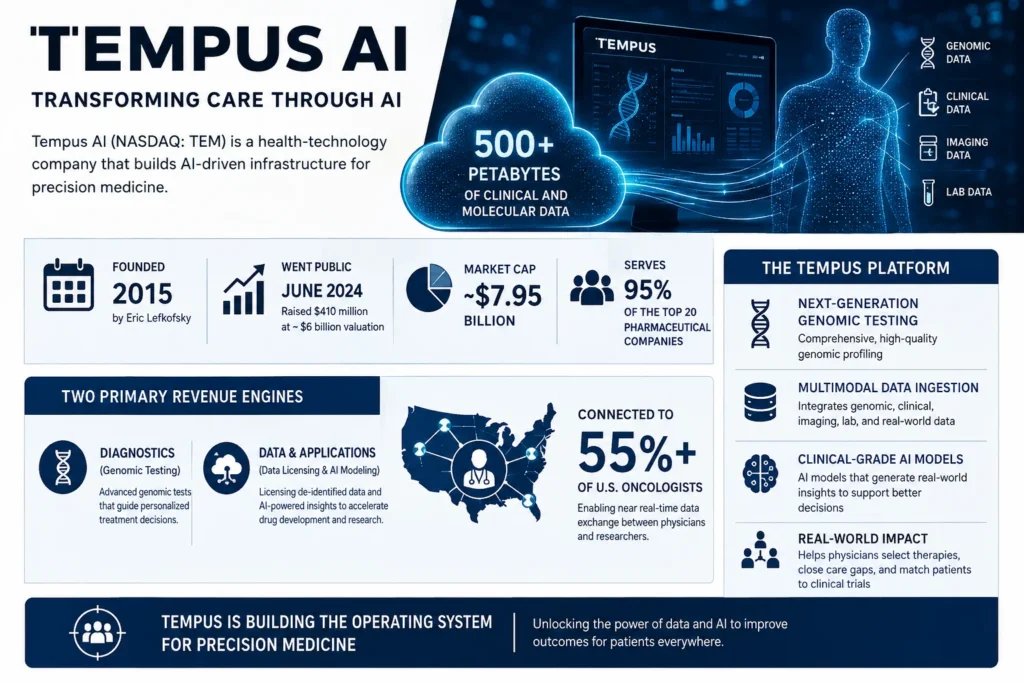
Tempus AI (NASDAQ: TEM) is a health-technology company that builds AI-driven infrastructure for precision medicine. The company operates one of the largest clinical and molecular data libraries in healthcare, with more than 500 petabytes of data stored in its cloud environment. Its full-stack platform integrates next-generation genomic testing, multimodal data ingestion, and clinical-grade AI models to help physicians select therapies, close care gaps, and match patients to clinical trials.
Founded in 2015 by Eric Lefkofsky, Tempus went public in June 2024, raising $410 million at an approximately $6 billion valuation. Today, the company has a market capitalization of approximately $7.95 billion and serves 95% of the top 20 pharmaceutical companies as clients.
The company’s platform is built on two primary revenue engines: Diagnostics (genomic testing) and Data and Applications (data licensing and AI modeling). Tempus connects to more than 55% of U.S. oncologists, enabling near real-time data exchange between physicians and researchers .
Tempus AI Stock Performance: The Numbers
Current Price and Key Metrics
As of July 31, 2026, Tempus AI stock (TEM) trades at approximately $43.87 per share. Here’s where things stand :
| Metric | Value |
|---|---|
| Current Price | $43.87 |
| 52-Week High | $104.32 |
| 52-Week Low | $40.77 |
| Market Cap | ~$7.95 billion |
| YTD Performance | -29.64% |
| Beta | 3.46 (highly volatile) |
| Shares Outstanding | ~180 million |
Stock Price History
Tempus has had a volatile time on Wall Street over the past year. The stock surged to a 52-week high of $104.32, only to crash approximately 58% to its current levels. Investors remain concerned about the company’s continued lack of profitability and macroeconomic challenges, primarily stemming from trade tensions affecting the health-tech sector .
Key technical indicators:
- 50-day moving average: ~$51.45
- 200-day moving average: ~$52.77
- Short interest: ~30.6 million shares
- 52-week range: $40.77 – $104.32
The high short interest suggests skepticism about the company’s path to consistent profitability, despite its improving financials.
Analyst Ratings and Price Targets
Wall Street analysts hold a soundly bullish view on Tempus AI .
| Metric | Value |
|---|---|
| Analyst Consensus | Moderate Buy |
| Average Price Target | $67.06 |
| Street-High Target | $100 |
| Potential Upside | ~53-128% |
The consensus of 21 analysts comprises seven Strong Buys, two Moderate Buys, eight Holds, and one Moderate Sell. Recent ratings include :
| Firm | Rating | Target Price |
|---|---|---|
| Needham | Buy | $75 |
| BTIG | Buy | $80 |
| HC Wainwright | Buy | $64 |
| Piper Sandler | Hold | $58 |
| Robert W. Baird | Buy | $59 |
Despite the bullish consensus, Tempus carries a Zacks Rank #4 (Sell), reflecting near-term earnings estimate trends.
Tempus AI Financials: Revenue Growth and First Profit
Q2 2026 Performance: The Turning Point
Tempus AI reported Q2 2026 results on July 30, 2026, marking a historic milestone: the company’s first quarterly GAAP profit .
| Metric | Q2 2026 | Q2 2025 | Change |
|---|---|---|---|
| Revenue | $382.5M | $314.6M | +22% |
| Gross Profit | $246.5M | $195.0M | +26% |
| Net Income (Loss) | $5.6M | ($42.8M) | +113% |
| Adjusted EBITDA | $8.0M | ($5.6M) | +244% |
| Non-GAAP Net Loss | ($7.7M) | ($37.3M) | -79% |
| Non-GAAP EPS | ($0.04) | ($0.22) | -82% |
Q2 2026 revenue breakdown :
- Diagnostics revenue: $289.3 million, up 20% year-over-year
- Data and Apps revenue: $93.2 million, up 28% year-over-year
- Hereditary revenue: $107.4 million, up 5% year-over-year
- Data licensing and modeling: grew 36% in the quarter
Operational highlights :
- MRD test volumes: ~9,000 tests in Q2, up 38% quarter-over-quarter from ~6,500 in Q1
- Oncology volume growth: 31% in Q2
- Cash position: $820.7 million at quarter-end, up from $643.8 million in Q1
Q1 2026 Performance
Q1 2026 results showed strong growth momentum:
| Metric | Q1 2026 | Q1 2025 | Change |
|---|---|---|---|
| Revenue | $348.1M | $255.7M | +36.1% |
| Diagnostics Revenue | $261.1M | $193.8M | +34.7% |
| Data and Apps Revenue | $87.0M | $61.9M | +40.5% |
Full-Year 2025 Results
| Metric | 2025 |
|---|---|
| Revenue | $1.27 billion (+83.4% YoY) |
| Gross Margin | 62.74% |
| Net Loss | ($245.0 million) |
| EPS | ($0.61) |
The company’s revenue more than doubled in 2025, growing from $693 million in 2024 to $1.27 billion in 2025 .
Full-Year 2026 Outlook
Tempus raised its full-year 2026 revenue guidance to $1.595-$1.605 billion, representing approximately 25% growth year-over-year. Adjusted EBITDA is projected at approximately $65 million, a $72 million improvement over 2025 .
For Q3 2026, the company expects:
- Revenue of $405-$410 million
- Continued strong oncology growth
- Data & Applications growth of ~28% versus Q3 2025
- Adjusted EBITDA of $15-$20 million
Analysts project full-year 2026 EPS of approximately -$0.35, improving to -$0.06 in 2027 .
Diagnostics: The Core Revenue Engine
Diagnostics is Tempus’s larger business, generating approximately 75% of total revenue. In 2025, Diagnostics generated $955.4 million.
Oncology Testing Portfolio
Tempus offers a comprehensive suite of genomic tests:
| Test Type | Description |
|---|---|
| xT | DNA-based tissue testing for therapy selection |
| xF | Liquid biopsy (blood-based) testing |
| xR | RNA-based testing for gene expression |
| xM | Minimal Residual Disease (MRD) monitoring |
| xE | Epigenetic and other specialized assays |
Oncology volume growth: Q2 2026 saw oncology volume growth of 31%, driven by 28% growth in Q1. In Q4 2025, oncology volumes grew 29% year-over-year.
MRD is the biggest growth driver: MRD test volumes reached approximately 9,000 tests in Q2 2026, up 500% year-over-year. This segment is expanding rapidly as long-term cancer monitoring becomes increasingly important .
Hereditary Testing
The February 2025 acquisition of Ambry Genetics significantly expanded hereditary testing capabilities. Ambry brings:
- Inherited cancer risk screening
- Rare disease panels
- Expanded testing portfolio
Hereditary revenue reached $107.4 million in Q2 2026, up 5% year-over-year. For Q1 2026, hereditary volume grew 54% year-over-year (7% growth when accounting for Ambry’s 2025 pre-acquisition volumes given February’s closing date).
Regulatory Milestones
FDA approval for xT CDx: In July 2026, Tempus received FDA approval for its tumor-only xT CDx, enabling unified ADLT pricing and an estimated $85 million annual revenue uplift starting in 2027 .
Other regulatory clearances:
- 510(k) clearance for xR IVD
- Updates to Pixel imaging platform
- ECG-Low ejection fraction software
Data and Applications: The Second Growth Engine
Data and Applications represents about 25% of total revenue but is growing faster than diagnostics. In 2025, this segment generated $316.4 million.
Insights: Data Licensing and Modeling
Insights commercializes de-identified clinical and molecular data for pharmaceutical and biotechnology companies. In Q2 2026, data licensing and modeling revenue grew 36% year-over-year .
Key metrics:
- Signed approximately $200 million in new Data and Applications licenses in Q2
- Net Revenue Retention: 126%, indicating strong expansion within the installed base
- More than 1,100 health system partners
- Over 5,000 clinical trial sites in the network
Recent customer wins:
- Delivered the first version of its foundation model to AstraZeneca, which met acceptance criteria
- Signed a large multiyear data licensing and modeling agreement with BioNTech
AI Applications Beyond Testing
Tempus is also building AI applications that extend beyond core testing:
| Application | Purpose |
|---|---|
| Tempus Next | Care gap identification, helping providers flag patients who may benefit from additional interventions |
| Tempus Pixel | Imaging platform that integrates AI into diagnostic workflows |
| AI-driven HRD-RNA model | Predicting homologous recombination deficiency from RNA data |
| Foundation models | Large-scale models trained on proprietary datasets for increasingly advanced insights |
Data flywheel effect: Tempus’s AI models improve as more data is ingested. Better models attract more customers, generating more data in a virtuous cycle.
The $1.5 Billion Personalis Acquisition
What Is Personalis?
Personalis (PSNL) is a seller of advanced cancer genomics tests, specializing in minimal residual disease (MRD) technology. Tempus is acquiring Personalis for $16.25 per share in stock-based consideration, representing a total enterprise value of $1.5 billion (net of Tempus’ existing ownership interest). The premium represents 5.6% to the last close of Personalis shares .
Background: Tempus and Personalis have had a relationship since November 2023, when Tempus invested in Personalis to commercialize the NeXT Personal MRD test .
Strategic Rationale
The acquisition is expected to :
- Expand Tempus’s capabilities in the MRD market
- Integrate Personalis’ MRD technology with Tempus’s multimodal data platform
- Expand access to longitudinal monitoring
- Enhance personalized cancer care
Market context: With about 2.1 million new cancer diagnoses in the U.S. this year and more people living longer after initial diagnoses, long-term monitoring is becoming increasingly important .
Investor Concerns
Investors have not reacted particularly positively to the announcement. After the news release, the stock dropped 7.74% intraday on July 20, 2026 .
Primary concerns:
- Dilution fears: The stock-based consideration could dilute existing shareholders, especially since the stock trades near its 52-week low
- Integration uncertainty: Combining two companies is never easy, and both operate in complex regulatory environments
- Financial impact: The acquisition adds to Tempus’s debt load (already $1.44 billion)
Management’s view: Tempus CEO Eric Lefkofsky noted: “The reason we didn’t do this a year or two ago is we wanted to be at the point in the curve where this was going to quickly turn into a really healthy business from a gross profit and a margin perspective” . Needham analysts believe the acquisition significantly increases Tempus’s offerings in the MRD market. The deal is expected to close in late 2026 or early 2027 .
Competitive Landscape: How Tempus AI Stacks Up
Tempus faces competition from several directions:
| Competitor | Ticker | Key Differentiator |
|---|---|---|
| Palantir | PLTR | Data analytics platform, government contracts |
| C3.ai | AI | Enterprise AI across industrial and government sectors |
| Veeva Systems | VEEV | Healthcare cloud software, commercial focus |
| PathAI | Private | AI-powered pathology solutions |
| Prognos Health | Private | AI-powered clinical lab test data platform |
How TEM compares to peers :
| Metric | Tempus AI | Industry Average |
|---|---|---|
| Forward P/S | 4.85 | 3.66 |
| Beta (volatility) | 3.46 | ~1.0 |
Tempus is trading at a premium to the industry average, reflecting its high growth rate but also its unprofitability. The stock’s beta of 3.46 indicates it is 246% more volatile than the broader market.
Should You Buy, Hold, or Sell TEM Stock?
The Bull Case
First GAAP profit achieved: Q2 2026 delivered $5.6 million in net income, a major milestone .
Strong revenue growth: Q2 2026 revenue of $382.5 million, up 22% year-over-year, with 25% growth projected for the full year.
Data and Applications as high-margin growth engine: Data licensing and modeling grew 36% in Q2 with 126% net revenue retention. Signed approximately $200 million in new licenses .
MRD expansion: 9,000 test volumes in Q2, up 500% year-over-year, accelerated by the Personalis acquisition.
FDA approval for xT CDx: $85 million annual revenue uplift projected from 2027 .
Strong balance sheet: $820.7 million in cash and marketable securities as of Q2 2026 .
Analyst bullishness: 21 analysts with a Moderate Buy consensus and average $67.06 price target, implying ~53% upside .
Convertible note offering: $460 million 0.0% convertible notes saves over $30 million annually in interest expense. Management expects to be cash flow positive by year-end 2026 .
Growing backlog: The company believes there is “good tailwinds” from therapy selection volume growth and average selling price improvements .
The Bear Case
Persistent GAAP losses: Despite the Q2 profit, trailing twelve-month net loss is still significant.
Stock volatility: Down 58% from its 52-week high of $104.32, with a beta of 3.46.
High valuation: Forward P/S of 4.85 vs. industry average of 3.66. The stock is trading at a premium to an unprofitable company.
Debt burden: Total debt of $1.44 billion.
Dilution risk: The Personalis acquisition is stock-based, and shares outstanding have increased.
Integration risk: The Personalis acquisition adds execution risk and complexity to the business.
Zacks Rank #4 (Sell): Near-term earnings estimates are trending negatively.
High short interest: Short interest remains elevated, reflecting skepticism.
Insider selling: CEO Eric Lefkofsky sold 250,000 shares for approximately $10.5 million, reducing his direct ownership by 55.56% to 200,000 shares . Director Jennifer Doudna also sold shares.
The Verdict
Tempus AI has achieved a historic milestone with its first GAAP profit in Q2 2026. The company’s dual-engine model—Diagnostics generating scale and Data and Applications driving margin expansion—is working. The FDA approval for xT CDx could add $85 million in annual revenue, and the Personalis acquisition expands the high-growth MRD market opportunity. With $820 million in cash, no near-term liquidity concerns, and management guiding toward positive free cash flow by year-end, the fundamentals are improving dramatically.
However, the bear case remains significant. The stock is down 58% from its high for a reason. The valuation is still premium-priced for an unprofitable company, debt is rising, integration risk from Personalis is real, and investor sentiment remains skeptical as shown by high short interest and insider selling.
Our honest recommendation: Tempus AI’s Q2 2026 results represent a legitimate turning point. The company has demonstrated it can grow revenue, expand margins, and achieve GAAP profitability—a combination that’s rare in the AI and health-tech space. For long-term investors who believe in the precision medicine thesis and can tolerate volatility, TEM at $43.87, near its 52-week low of $40.77, could be an attractive entry point with significant upside if analyst targets are achieved.
But for risk-averse investors or those needing near-term returns, caution is warranted. The Personalis acquisition integration, dilution risk, and high volatility all suggest that TEM remains a high-risk, high-reward speculation, not a conservative investment.
Frequently Asked Questions
Is Tempus AI stock a buy right now?
Analysts rate it Moderate Buy with an average $67.06 price target, implying ~53% upside. The company just achieved its first GAAP profit in Q2 2026. However, the stock is highly volatile (beta 3.46) and faces dilution risk from the $1.5 billion Personalis acquisition.
Why is Tempus AI stock down so much?
The stock is down 58% from its 52-week high due to concerns about persistent losses, debt, dilution from the Personalis acquisition, and macroeconomic headwinds affecting the health-tech sector. The stock trades near its 52-week low of $40.77.
What is Tempus AI’s revenue growth?
Q2 2026 revenue grew 22% year-over-year to $382.5 million. Full-year 2026 revenue guidance is $1.595-$1.605 billion, representing approximately 25% growth.
Is Tempus AI profitable?
Yes, for Q2 2026. Tempus reported GAAP net income of $5.6 million in Q2, its first quarterly profit. Analysts project full-year 2026 adjusted EBITDA of approximately $65 million.
What is the Personalis acquisition?
Tempus is acquiring Personalis (PSNL) for $1.5 billion in stock-based consideration. Personalis specializes in MRD (minimal residual disease) testing. The deal is expected to close in late 2026 or early 2027.
What is Tempus AI’s data advantage?
Tempus has one of the largest clinical and molecular data libraries in healthcare, with over 500 petabytes of data, connections to more than 55% of U.S. oncologists, and 95% of the top 20 pharma companies as clients. This creates a powerful data flywheel effect.
Conclusion
Tempus AI has finally done what investors have been waiting for: proven it can grow revenue and achieve GAAP profitability. The Q2 2026 results represent a turning point for the company, validating its dual-engine model of Diagnostics and Data and Applications. The FDA approval for xT CDx adds a clear revenue catalyst for 2027, and the Personalis acquisition positions the company as a leader in the high-growth MRD market.
But the stock market remains skeptical. TEM is down 58% from its high. Short interest remains elevated. The valuation is still premium-priced for a company that, despite the Q2 profit, still has a trailing net loss. Debt is rising, dilution is a real risk from the Personalis acquisition, and integration execution is uncertain. Insider selling by the CEO also gives some investors pause.
Our honest recommendation: Tempus AI’s long-term story is more compelling now than ever. The company is executing on its plan to become the leading precision medicine AI platform. If you believe in this thesis and have a multi-year time horizon, TEM at $43.87 near its 52-week low could be an attractive entry point. The analyst consensus suggests ~53% upside, and management’s guidance toward positive free cash flow by year-end adds credibility.
But if you’re risk-averse, caution is warranted. The high short interest means any disappointment could trigger further declines. The Personalis acquisition integration could face challenges. And the stock’s 3.46 beta means it will continue to be a wild ride. As one analyst put it, investors should weigh the company’s strong performance against dilution fears and uncertainty about the deal’s integration.

Kevin Brooks is a grammar specialist at GramBrix.com, dedicated to helping readers understand language rules with clarity and confidence. He simplifies complex grammar concepts through practical examples and easy explanations.