
Last Updated on August 12, 2026
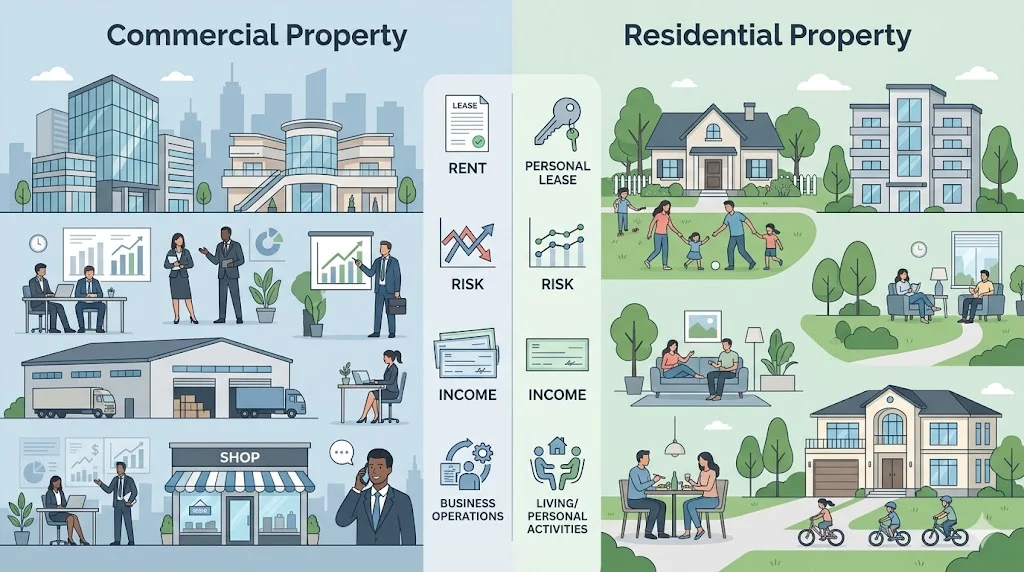
Commercial vs residential refers to the classification of property based on its purpose of use. Commercial properties are used for business activities such as offices, shops, and warehouses, while residential properties are designed for people to live in, such as houses, apartments, and flats. The main difference lies in usage, regulations, financing, and taxation.
Choosing between commercial vs residential property can have a major impact on your money, lifestyle, and long-term plans. At first, the difference may seem simple. One is for businesses, and the other is mainly for living. But real estate decisions go much deeper than that.
Commercial properties can include offices, shops, warehouses, and retail spaces. Residential properties include houses, apartments, condos, and other homes. Each type has different costs, rules, risks, financing options, and income potential.
Understanding these differences can help investors make smarter decisions. It can also help buyers, tenants, landlords, and developers avoid costly mistakes.
In this guide, we will compare commercial vs residential property in simple terms. You will learn how they differ, their advantages and disadvantages, investment potential, rental income, taxes, financing, maintenance, risks, and which option may be better for different situations
Quick Answer: Commercial vs Residential Overview
Commercial vs residential properties differ mainly in purpose and usage.
Commercial properties are used for business activities like offices, retail shops, hotels, and warehouses. They are designed to generate income through business operations or rent from companies.
Residential properties are used for living purposes. These include houses, apartments, villas, and dormitories.
In short:
- Commercial = Business use
- Residential = Living use
Definition of Commercial vs Residential Property
What is Commercial Property?
Commercial property refers to real estate used for business or income-generating activities. It includes spaces where companies operate, sell goods, or provide services.
Examples include:
- Office buildings
- Shopping malls
- Retail stores
- Warehouses
- Hotels
- Industrial units
Commercial vs residential property differs mainly because commercial spaces are focused on profit generation.
What is Residential Property?
Residential property refers to buildings designed for people to live in. These properties provide shelter, comfort, and personal space.
Examples include:
- Houses
- Apartments
- Condominiums
- Villas
- Townhouses
In commercial vs residential comparison, residential properties focus on lifestyle and living needs rather than business income.
Key Differences Between Commercial vs Residential
Purpose of Use
Commercial vs residential properties differ in purpose:
- Commercial: Business and profit generation
- Residential: Living and personal use
Ownership and Tenancy
- Commercial leases are longer and more complex
- Residential leases are shorter and simpler
Financing
- Commercial loans have higher interest rates
- Residential loans are easier to get
Income Potential
- Commercial properties often generate higher rental income
- Residential properties provide stable but lower returns
Risk Level
- Commercial: Higher risk, higher reward
- Residential: Lower risk, stable returns
Comparison Table: Commercial vs Residential
| Feature | Commercial Property | Residential Property |
| Purpose | Business use | Living use |
| Examples | Offices, shops | Houses, apartments |
| Income | High rental yield | Moderate income |
| Risk | High | Low |
| Loan type | Strict conditions | Easy approval |
| Lease duration | Long-term | Short-term |
| Maintenance | Tenant responsibility often | Owner responsibility |
| Market demand | Business-driven | Population-driven |
Advantages and Disadvantages of Commercial vs Residential
Advantages of Commercial Property
Commercial vs residential investments show that commercial properties offer:
- Higher rental income
- Long-term lease agreements
- Business-oriented tenants
- Potential for high capital appreciation
- Lower vacancy rates in prime locations
Disadvantages of Commercial Property
- High initial investment
- Complex legal documentation
- Market sensitivity to economic changes
- Higher maintenance costs in some cases
Advantages of Residential Property
- Stable demand
- Easier to buy and sell
- Simple legal structure
- Suitable for first-time buyers
- Emotional value (home ownership)
Disadvantages of Residential Property
- Lower rental income
- Slower appreciation in some markets
- Maintenance burden on owners
- Tenant turnover can be frequent
Real-World Examples of Commercial vs Residential
Commercial Examples
A shopping mall in a city center is a commercial property. It earns money through rent from shops, restaurants, and entertainment outlets.
A corporate office building in a business district is another example. Companies rent spaces to operate their businesses.
Residential Examples
A family living in a 3-bedroom house is a residential setup.
An apartment complex where individuals rent flats for living is also residential property.
How Commercial vs Residential Properties Generate Income
Commercial Income Sources
- Rent from businesses
- Service charges
- Parking fees
- Lease agreements
Residential Income Sources
- Monthly rent from tenants
- Property appreciation
- Vacation rentals (in some cases)
Regional and Global Usage of Commercial vs Residential
In Developed Countries
In countries with strong economies, commercial vs residential investment is highly structured.
- Commercial properties are managed by corporations
- Residential properties are often regulated for housing stability
In Developing Countries
- Residential demand is higher due to population growth
- Commercial growth is linked to urban development
Urban vs Rural Areas
- Urban areas: High commercial activity
- Rural areas: Mostly residential properties
Common Mistakes in Understanding Commercial vs Residential
Mistake 1: Thinking They Are the Same
Many beginners assume all properties work the same way. In reality, commercial vs residential properties follow different laws and financial systems.
Mistake 2: Ignoring Risk Levels
Investors often underestimate the risk in commercial properties.
Mistake 3: Choosing Based Only on Price
Low price does not always mean better investment.
Mistake 4: Not Understanding Lease Terms
Commercial leases are long and binding compared to residential agreements.
Mistake 5: Overlooking Maintenance Costs
Commercial properties may require specialized maintenance.
Exercises with Answers
Exercise 1
Question: Which property type is used for business activities?
A) Residential
B) Commercial
C) Agricultural
Answer: B) Commercial
Exercise 2
Question: A family living in an apartment is an example of:
Answer: Residential property
Exercise 3
Question: Which has higher rental income potential in commercial vs residential comparison?
Answer: Commercial property
Exercise 4
Question: True or False: Residential properties are riskier than commercial properties.
Answer: False
Exercise 5
Question: Give one example of each:
- Commercial:
- Residential:
Answer:
- Commercial: Shopping mall
- Residential: House
Related Concepts and Comparisons
Commercial vs Residential vs Industrial
- Commercial: Business use
- Residential: Living use
- Industrial: Manufacturing and production
Freehold vs Leasehold
Ownership type also affects commercial vs residential investment decisions.
Rental Yield Comparison
Commercial properties often offer higher rental yield compared to residential ones.
FAQs
What is the main difference between commercial vs residential property?
Commercial properties are used for business, while residential properties are used for living purposes.
Which is more profitable, commercial vs residential?
Commercial properties usually generate higher income, but they also carry higher risk.
Is residential property safer than commercial property?
Yes, residential properties are generally considered safer due to stable demand.
Can I live in a commercial property?
In most cases, no. Commercial vs residential zoning laws restrict usage.
Which is easier to finance, commercial or residential?
Residential properties are easier to finance with lower interest rates.
Do commercial properties appreciate faster?
They can, especially in strong business locations, but it depends on market conditions.
What are examples of residential properties?
Houses, apartments, and villas are common residential properties.
What are examples of commercial properties?
Offices, malls, and retail stores are commercial properties.
Which requires more maintenance, commercial or residential?
Commercial properties often require more complex maintenance.
Is commercial vs residential investment good for beginners?
Beginners usually start with residential due to lower risk and simpler management.
Conclusion
Understanding commercial vs residential property is essential for making smart real estate decisions. Both types serve different purposes and offer unique benefits.
Commercial properties are best for high income and long-term investment growth, but they come with higher risk and complexity. Residential properties are more stable, easier to manage, and ideal for beginners or personal use.
Before investing, always consider your budget, risk tolerance, location, and long-term goals. A clear understanding of commercial vs residential differences can help you avoid mistakes and choose the right path in real estate.
Whether you are buying a home or investing in business property, knowledge is your strongest tool for success.
Discover more Articles:
- Mustang vs Camaro: Key Differences Explained Clearly For 2026
- Memrise vs Duolingo Comparison Guide 2026: Which Language App Is Better for You?

Kevin Brooks is a grammar specialist at GramBrix.com, dedicated to helping readers understand language rules with clarity and confidence. He simplifies complex grammar concepts through practical examples and easy explanations.