
Last Updated on August 4, 2026
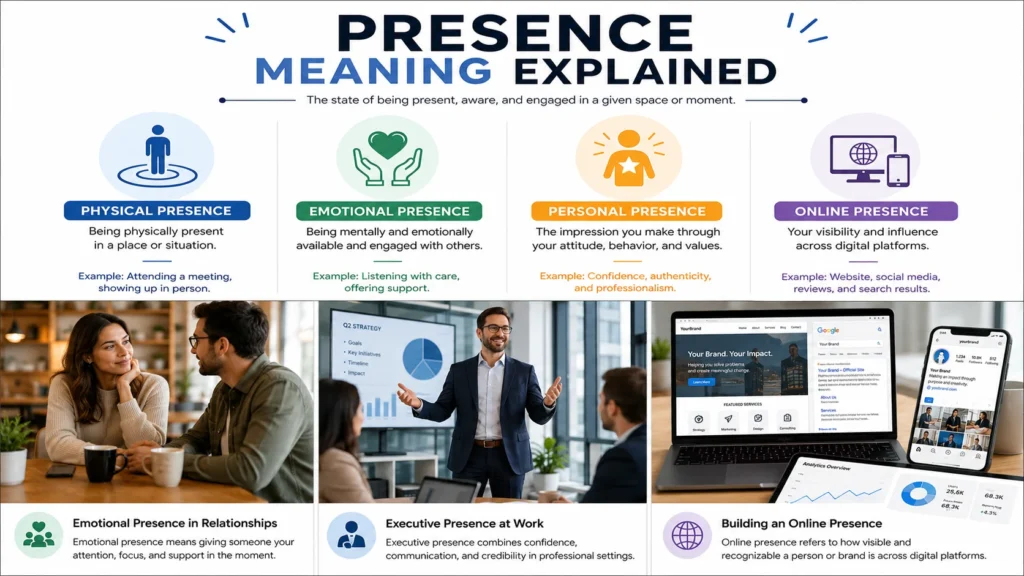
Presence meaning refers to the state of being present, noticeable, or felt in a place, situation, conversation, or relationship. It can describe physical presence (being somewhere in person), personal presence (the impact someone has), or emotional presence (giving someone your full attention and energy).
If you searched for presence meaning, you probably want more than a one-line dictionary definition. You may have seen the word in a sentence like “her presence filled the room,” “your presence is required,” or “he has a strong online presence,” and wondered what it actually means in real life.
The meaning of presence depends on the context, but generally, presence refers to the state of being somewhere, being noticed, or having an influence on people around you. In simple terms, the meaning for presence is being physically, mentally, or emotionally present.
The word presence is common in everyday English, but its meaning changes slightly depending on how it is used. Sometimes it simply means being physically there. In other situations, it describes a person’s confidence, influence, attentiveness, or emotional connection with others.
For example:
- Your presence meaning in an invitation usually refers to your attendance.
- Strong presence meaning often refers to a person’s confidence, influence, or ability to attract attention.
- Constant presence meaning describes someone or something that is consistently there over time.
- Emotional presence meaning refers to being mentally and emotionally available, especially during conversations or relationships.
Many people also search for presence meaning in relationship because the term has a special meaning in personal connections. In relationships, presence is more than physical proximity. It means being emotionally available, attentive, supportive, and fully engaged with your partner. A person can be physically present but emotionally absent, which is why emotional presence is often considered essential for healthy relationships.
You may also encounter searches such as p r e s e n c e meaning, which simply refers to the same word spelled out letter by letter, or presence meaning in relationship in Tagalog, where users are looking for relationship-focused explanations in another language.
According to standard English dictionaries and communication experts, presence can refer to:
- Physical attendance
- Personal influence or charisma
- Emotional attentiveness
- Professional impact
- Digital or online visibility
This guide explains presence meaning in plain US English, with examples, platform-specific usage, related phrases, common misunderstandings, reply ideas, and FAQs. By the end, you’ll know exactly what presence means in conversation, writing, social media, school, work, and relationships.
Quick Answer Box
| Element | Meaning of “Presence” |
| Basic meaning | The state of being present, nearby, noticeable, or actively there |
| Common contexts | Physical attendance, emotional attentiveness, confidence, influence, spiritual feeling, online visibility |
| Used for | People, events, meetings, rooms, brands, leaders, relationships, social media, performance |
| Tone | Neutral, formal, warm, emotional, professional, or poetic depending on context |
| Example | “Her presence made everyone feel calmer.” |
| Online/business use | “Brand presence” or “online presence” means visibility and recognition across platforms |
| Relationship use | “Be more present” means give attention, focus, and emotional availability |
| Workplace use | “Your presence is required” means you need to attend or show up |
What Does Presence Mean?
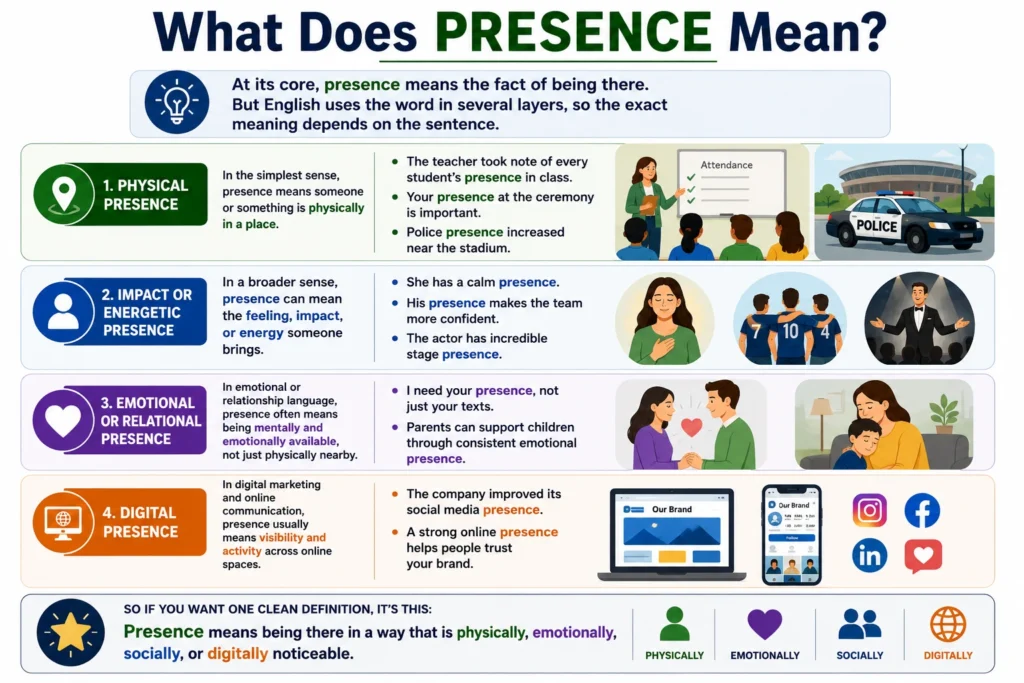
At its core, presence means the fact of being there. But English uses the word in several layers, so the exact meaning depends on the sentence.
In the simplest sense, presence means someone or something is physically in a place.
- The teacher took note of every student’s presence in class.
- Your presence at the ceremony is important.
- Police presence increased near the stadium.
In a broader sense, presence can mean the feeling, impact, or energy someone brings.
- She has a calm presence.
- His presence makes the team more confident.
- The actor has incredible stage presence.
In emotional or relationship language, presence often means being mentally and emotionally available, not just physically nearby.
- I need your presence, not just your texts.
- Parents can support children through consistent emotional presence.
In digital marketing and online communication, presence usually means visibility and activity across online spaces.
- The company improved its social media presence.
- A strong online presence helps people trust your brand.
So if you want one clean definition, it’s this:
Presence means being there in a way that is physically, emotionally, socially, or digitally noticeable.
Full Definition of Presence
A full definition of presence includes several connected meanings:
- Physical presence – being in a place in person
- Personal presence – the effect, aura, or influence someone has
- Emotional presence – giving attention, care, and focus to another person or moment
- Professional presence – appearing confident, credible, and engaged in work or leadership settings
- Online presence – how visible, active, and recognizable someone or something is on the internet
- Symbolic or spiritual presence – the sense that a person, memory, or force is felt even if not physically visible
That is why the same word appears in school notices, relationship advice, leadership training, public speaking, social media strategy, and even spiritual writing.
Context and Usage of Presence
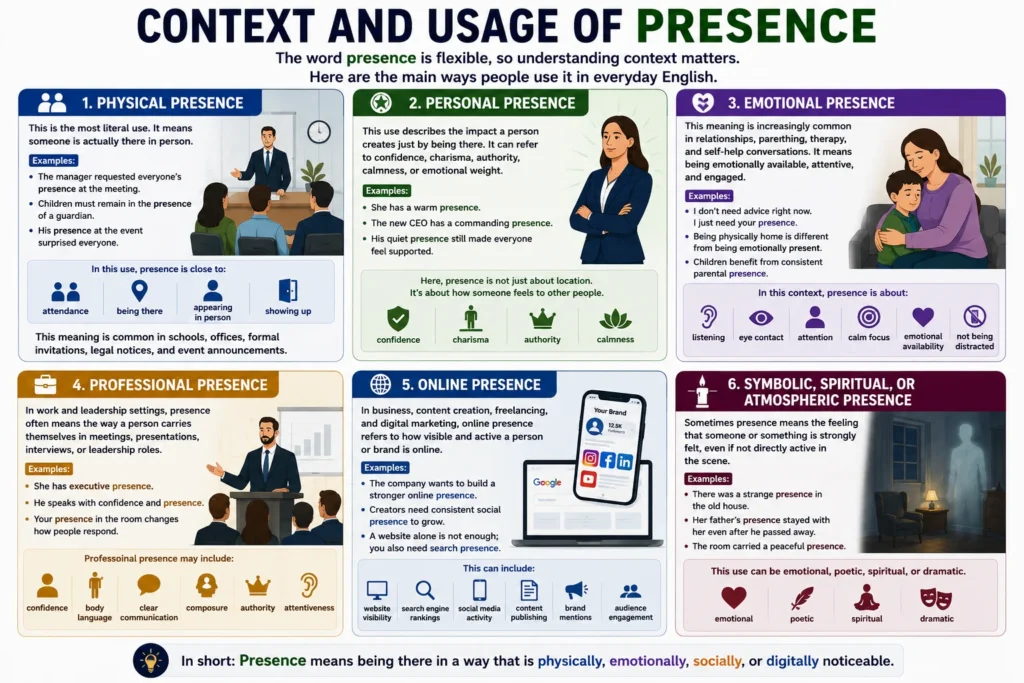
The word presence is flexible, so understanding context matters. Here are the main ways people use it in everyday English.
Physical Presence
This is the most literal use. It means someone is actually there in person.
Examples:
- The manager requested everyone’s presence at the meeting.
- Children must remain in the presence of a guardian.
- His presence at the event surprised everyone.
In this use, presence is close to:
- attendance
- being there
- appearing in person
- showing up
This meaning is common in schools, offices, formal invitations, legal notices, and event announcements.
Personal Presence
This use describes the impact a person creates just by being there. It can refer to confidence, charisma, authority, calmness, or emotional weight.
Examples:
- She has a warm presence.
- The new CEO has a commanding presence.
- His quiet presence still made everyone feel supported.
Here, presence is not just about location. It’s about how someone feels to other people.
Emotional Presence
This meaning is increasingly common in relationships, parenting, therapy, and selfhelp conversations. It means being emotionally available, attentive, and engaged.
Examples:
- I don’t need advice right now. I just need your presence.
- Being physically home is different from being emotionally present.
- Children benefit from consistent parental presence.
In this context, presence is about:
- listening
- eye contact
- attention
- calm focus
- emotional availability
- not being distracted
Professional Presence
In work and leadership settings, presence often means the way a person carries themselves in meetings, presentations, interviews, or leadership roles.
Examples:
- She has executive presence.
- He speaks with confidence and presence.
- Your presence in the room changes how people respond.
Professional presence may include:
- confidence
- body language
- clear communication
- composure
- authority
- attentiveness
Online Presence
In business, content creation, freelancing, and digital marketing, online presence refers to how visible and active a person or brand is online.
Examples:
- The company wants to build a stronger online presence.
- Creators need consistent social presence to grow.
- A website alone is not enough; you also need search presence.
This can include:
- website visibility
- search engine rankings
- social media activity
- content publishing
- brand mentions
- audience engagement
Symbolic, Spiritual, or Atmospheric Presence
Sometimes presence means the feeling that someone or something is strongly felt, even if not directly active in the scene.
Examples:
- There was a strange presence in the old house.
- Her father’s presence stayed with her even after he passed away.
- The room carried a peaceful presence.
This use can be emotional, poetic, spiritual, or dramatic.
Presence Meaning in Different Sentence Types
To fully understand presence meaning, it helps to see how the word changes based on the sentence.
“Your Presence Is Required”
This is formal and means you need to attend or you are expected to be there in person.
Example:
- Your presence is required at the staff meeting tomorrow at 10 AM.
Meaning:
- attendance is expected
- not optional
- often used in formal notices or invitations
“She Has a Strong Presence”
This means she has noticeable impact, confidence, or charisma.
Example:
- Even when she says very little, she has a strong presence.
Meaning:
- people notice her
- she influences the atmosphere
- she may appear confident, calm, powerful, or elegant
“Be Present” or “Be More Present”
This means pay attention fully and engage emotionally or mentally in the moment.
Example:
- Put your phone down and be present during dinner.
Meaning:
- focus on the current moment
- stop being distracted
- give someone real attention
“Online Presence”
This means how visible and active a person, business, or brand is online.
Example:
- The bakery improved its online presence through local SEO and Instagram.
Meaning:
- more people can find the bakery online
- the bakery is active and visible across digital channels
“In the Presence of”
This means near someone, with someone there, or under someone’s observation.
Example:
- Please don’t use that language in the presence of children.
Meaning:
- while children are around
- while they can hear or observe
Real Life Examples of Presence Meaning
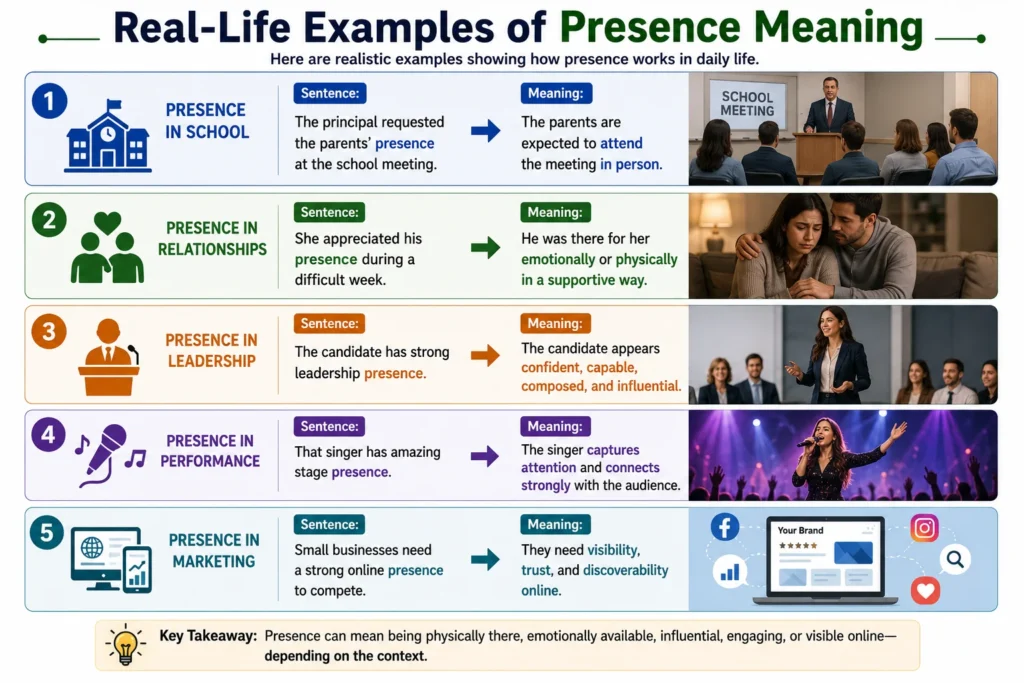
Here are realistic examples showing how presence works in daily life.
Example 1: Presence in School
Sentence: The principal requested the parents’ presence at the school meeting.
Meaning: The parents are expected to attend the meeting in person.
Example 2: Presence in Relationships
Sentence: She appreciated his presence during a difficult week.
Meaning: He was there for her emotionally or physically in a supportive way.
Example 3: Presence in Leadership
Sentence: The candidate has strong leadership presence.
Meaning: The candidate appears confident, capable, composed, and influential.
Example 4: Presence in Performance
Sentence: That singer has amazing stage presence.
Meaning: The singer captures attention and connects strongly with the audience.
Example 5: Presence in Marketing
Sentence: Small businesses need a strong online presence to compete.
Meaning: They need visibility, trust, and discoverability online.
Five Conversation Examples Using Presence
Below are natural conversation examples so you can see how presence works in real speech.
Conversation Example 1: Relationship Context
A: I feel like you’re here, but not really here.
B: What do you mean?
A: I mean I need your presence, not just you sitting next to me scrolling on your phone.
Meaning: “Presence” here means emotional attention and engagement.
Conversation Example 2: Work Context
Manager: We’re meeting with the client at 2 PM, and your presence is required.
Employee: Got it. I’ll be there.
Meaning: “Presence is required” means attendance is necessary.
Conversation Example 3: Personality / Aura Context
A: Why does everyone listen when Maya speaks?
B: She just has that presence. People trust her.
Meaning: Presence means strong personal impact, confidence, or authority.
Conversation Example 4: Parenting Context
A: What helped your son through that rough year?
B: Honestly, just trying to be present every day and really listen.
Meaning: “Be present” means emotionally available and attentive.
Conversation Example 5: Business / Social Media Context
A: Why is that small brand growing so fast?
B: Their online presence is strong. They post consistently, rank in search, and engage with customers.
Meaning: Presence means visibility and activity across digital platforms.
PlatformSpecific Meaning of Presence
The word presence is not a trendy Gen Z slang term like rizz or mid, but it still appears across digital platforms in different ways. The meaning changes depending on whether people are talking about branding, communication, identity, or emotional behavior online.
Presence on Instagram
On Instagram, presence usually refers to a person’s or brand’s visual visibility and identity.
Examples:
- She has a strong Instagram presence.
- The brand needs a more polished presence on Instagram.
This can include:
- posting regularly
- having a recognizable style
- getting engagement
- showing up in followers’ feeds
- building a memorable identity
If someone says a creator has “good presence” on Instagram, they often mean the person is noticeable, consistent, visually strong, and easy to remember.
Presence on TikTok
On TikTok, presence often means how strongly someone shows up in the feed culture of the app. It can involve personality, camera confidence, and consistency.
Examples:
- He has great camera presence on TikTok.
- That business has no TikTok presence yet.
Possible meanings:
- good oncamera energy
- confidence and personality
- visible content strategy
- active account growth
- audience familiarity
Presence on LinkedIn
On LinkedIn, presence usually sounds more professional. It often means credibility, visibility, and professional branding.
Examples:
- You should build a stronger LinkedIn presence.
- Her leadership presence comes through in her posts and interviews.
This can refer to:
- posting useful insights
- showing expertise
- having a complete profile
- networking visibly
- appearing credible in your industry
Presence on X or Threads
On fastmoving textbased platforms like X or Threads, presence often means being active in public conversation.
Examples:
- The company’s social presence improved after they started replying to users.
- He has a strong political presence online.
Here, presence may involve:
- regular posting
- audience interaction
- influence in a niche
- recognizable opinions or commentary
Presence on Zoom or Video Meetings
In remote work, people often talk about virtual presence or meeting presence.
Examples:
- She has great executive presence even on Zoom.
- Try to improve your presence during remote presentations.
This can mean:
- speaking clearly
- maintaining attention
- eye contact with the camera
- calm body language
- confidence and engagement
Presence in Messaging Apps Like WhatsApp
In WhatsApp or private messaging, presence is less about branding and more about availability and attention.
Examples:
- I know you’re online, but I miss your actual presence.
- Even over chat, she has a comforting presence.
Here, presence can be emotional:
- responsive energy
- thoughtful replies
- attentiveness
- warmth in communication
Alternative Meanings of Presence
The word presence can also take on more specific meanings depending on the field or context.
Presence in Public Speaking
In public speaking, presence means the ability to hold attention and project confidence.
This includes:
- posture
- pacing
- voice control
- eye contact
- confidence
- connection with the audience
Presence in Acting or Performance
Actors, singers, dancers, and performers are often praised for stage presence.
This means:
- they attract attention
- they feel alive on stage
- they emotionally connect with the audience
- they dominate the performance space in a memorable way
Presence in Meditation or Mindfulness
In mindfulness language, presence means full awareness of the current moment.
Examples:
- Meditation helps build presence.
- Presence means noticing the moment without rushing past it.
Presence in Spiritual Writing
In spiritual or religious language, presence can refer to:
- the felt closeness of God
- a sacred atmosphere
- a spiritual force
- the emotional sense that someone’s spirit or memory is near
Presence in Security or Authority Contexts
You may hear:
- police presence
- military presence
- security presence
This means an authority group is visibly present in an area.
Example:
- There was increased police presence downtown after the event.
Related Terms and NLP Variations of Presence
If you are trying to understand presence meaning, it helps to know the related words and semantic variations that often appear in search results or conversations.
Words Related to Physical Presence
- attendance
- appearance
- being there
- availability
- participation
- inperson attendance
Words Related to Emotional Presence
- attentiveness
- mindfulness
- focus
- support
- emotional availability
- connection
- grounded attention
Words Related to Personal Presence
- charisma
- aura
- confidence
- gravitas
- influence
- authority
- magnetism
- command
Words Related to Online Presence
- visibility
- digital footprint
- social media visibility
- brand awareness
- discoverability
- audience reach
- search visibility
Common Phrases With Presence
- physical presence
- strong presence
- executive presence
- online presence
- social presence
- commanding presence
- stage presence
- be present
- in the presence of
- presence of mind
Presence vs Similar Words
A lot of confusion around presence meaning comes from similar words. Here’s how presence compares.
Presence vs Attendance
Attendance usually means simply showing up.
Presence can mean attendance, but it can also mean influence, energy, attention, or visibility.
- Attendance = you came to class.
- Presence = you came, or your energy/impact was felt.
Presence vs Attention
Attention is what you focus on.
Presence is a fuller state of being engaged and mentally there.
- Attention can be momentary.
- Presence suggests a deeper quality of focus and involvement.
Presence vs Aura
Aura is often more mystical, emotional, or vibebased.
Presence is broader and more practical. It can be formal, emotional, professional, or digital.
Presence vs Visibility
Visibility usually refers to being seen.
Presence includes visibility, but also consistency, influence, and felt impact.
For example:
- A brand can be visible online.
- A brand with strong presence is visible, recognizable, active, and memorable.
Presence vs Charisma
Charisma usually means personal charm that attracts people.
Presence can include charisma, but it also includes calmness, authority, stillness, emotional support, and credibility.
Someone can have strong presence without being flashy or loud.
How to Respond When Someone Uses the Word Presence
If someone says “presence” in conversation, your reply depends on the context. Here are common situations and natural responses.
If Someone Says “Your Presence Is Required”
This is formal and usually means you need to attend.
Possible replies:
- Understood. I’ll be there.
- Thanks for the headsup. I’ll attend.
- Noted. I’ll make sure to be present.
If Someone Says “I Need Your Presence”
This is more emotional and usually means they want real attention or support.
Possible replies:
- I’m here. Tell me what you need.
- You have my full attention.
- I understand. I’ll put everything aside and be with you.
- Thanks for telling me. I want to show up better for you.
If Someone Says “You Have a Strong Presence”
This is usually a compliment.
Possible replies:
- Thank you, I appreciate that.
- That means a lot.
- Thanks, I’m glad I could bring something positive to the room.
If Someone Says “You Need a Stronger Online Presence”
This is usually advice about visibility or branding.
Possible replies:
- That makes sense. Where do you think I should start?
- Do you mean social media, SEO, or overall branding?
- I agree. I need to be more consistent online.
If Someone Says “Be More Present”
This usually means stop being distracted and engage more fully.
Possible replies:
- You’re right. I’ve been mentally elsewhere.
- I hear you. I’ll work on being more present.
- Thanks for saying it clearly. I want to do better.
Misinterpretations of Presence
Because presence has multiple meanings, people sometimes misunderstand it. Here are the most common mistakes.
Misinterpretation 1: Thinking Presence Only Means Physical Attendance
This is the biggest mistake. Presence does not always mean “showing up in person.”
Sometimes it means:
- emotional support
- confidence
- influence
- online visibility
- spiritual or atmospheric feeling
Misinterpretation 2: Confusing Presence With Popularity
A person can have strong presence without being famous, loud, or highly social.
Presence can be:
- calm
- quiet
- grounding
- authoritative
- emotionally steady
Misinterpretation 3: Assuming “Be Present” Means “Just Sit There”
Not really. “Be present” usually means:
- listen actively
- stop multitasking
- give real attention
- engage with the current moment
Misinterpretation 4: Treating Online Presence as Just Posting More
A strong online presence is not only about volume. It also involves:
- consistency
- quality
- clarity of identity
- discoverability
- trust
- engagement
Misinterpretation 5: Assuming Presence Is Always Positive
Not necessarily. A sentence like “there was a threatening presence in the room” uses presence in a negative way. Presence simply means someone or something is strongly felt or noticeable.
When Not to Use the Word Presence
Although presence is useful, there are times when a simpler word works better.
Don’t Use It When You Just Mean “Attendance” in Plain Casual Writing
If you are writing something very simple, “attendance” may be clearer than “presence.”
- Formal: Your presence is requested.
- Plain: Please attend the meeting.
Don’t Use It to Sound Overly Dramatic Without a Reason
If you say “his presence changed the atmosphere of the grocery store” in a casual situation, it may sound exaggerated unless you really mean it.
Don’t Use It Vaguely in Business Writing
If you say “we need more presence,” people may not know whether you mean:
- social media presence
- market presence
- leadership presence
- inperson attendance
- customer visibility
Be specific when possible.
Usage Tips for Using Presence Correctly
If you want to use presence naturally, these tips help.
Use “Presence” for More Than Just Being There
Choose presence when you want to suggest:
- impact
- attention
- emotional weight
- influence
- visibility
- support
Add a Descriptive Word for Clarity
These combinations sound natural:
- strong presence
- calm presence
- commanding presence
- reassuring presence
- online presence
- executive presence
- physical presence
- social presence
Match the Tone to the Situation
Formal
- Your presence is requested at the annual dinner.
Emotional
- I value your presence when life feels heavy.
Professional
- She brings strong executive presence to client meetings.
Digital
- The startup needs a stronger online presence before launch.
Use “Be Present” for Mindfulness or Relationships
This phrase is especially common when talking about:
- parenting
- relationships
- therapy
- coaching
- mindfulness
- worklife balance
Examples:
- Be present with your family.
- Try to be present during the conversation.
- I’m learning to be present instead of constantly rushing ahead.
Common Phrases and What They Mean
Here are some of the most common phrases built around presence.
Strong Presence
Means someone is noticeable, influential, confident, or memorable.
Commanding Presence
Means someone naturally projects authority and attention.
Calm Presence
Means someone makes others feel steady, safe, or relaxed.
Stage Presence
Means a performer captures the audience’s attention powerfully.
Executive Presence
Means someone appears credible, composed, and leaderlike in professional settings.
Online Presence
Means visibility and activity on the internet across websites, search engines, and social platforms.
Presence of Mind
This is a specific phrase meaning the ability to stay calm and think clearly in a difficult moment.
Example:
- She had the presence of mind to call 911 immediately.
In the Presence of
Means someone is nearby or observing.
Example:
- Please be respectful in the presence of guests.
RealWorld Scenarios Where Presence Matters
To understand presence meaning deeply, it helps to see where it matters in real life.
In Relationships
Presence matters when someone needs:
- attention
- listening
- emotional safety
- support during stress
- quality time without distraction
A partner may say “I miss your presence” even if you talk every day. That usually means they miss your emotional availability, not just your messages.
In Parenting
Children often respond strongly to parental presence. This doesn’t only mean being physically in the house. It also means:
- listening
- noticing emotional changes
- being patient
- showing consistent care
In Leadership
Leaders with strong presence often create trust before they even finish speaking. Their presence may come from:
- calm confidence
- clarity
- body language
- decisiveness
- emotional steadiness
In Branding and Marketing
A brand’s presence affects whether people remember it, trust it, and find it online. Presence in this sense is built through:
- website quality
- SEO visibility
- social proof
- consistent messaging
- audience engagement
In Public Speaking
Presence determines whether the audience feels connected to the speaker. It’s not just what you say. It’s how you carry yourself, pause, look at people, and hold the room.
FAQs
What is the simple meaning of presence?
The simple meaning of presence is the state of being there or being felt. It can refer to physical attendance, emotional attentiveness, personal impact, or online visibility depending on context.
What does “your presence is required” mean?
It means you are expected to attend or you need to be there in person. It is a formal phrase often used in work, school, or event settings.
What does “be present” mean?
“Be present” means focus on the current moment and give real attention to what is happening. In relationships, it often means being emotionally available instead of distracted.
What does “strong presence” mean?
A strong presence means someone has noticeable impact, confidence, influence, or charisma. It can also mean they make others feel calm, attentive, or affected by their energy.
What is online presence?
Online presence refers to how visible, active, and recognizable a person, business, or brand is on the internet. It can include websites, search results, social media, reviews, and digital content.
Is presence the same as attendance?
Not always. Attendance mainly means showing up. Presence can mean showing up, but it can also mean emotional support, personal impact, confidence, or online visibility.
What does “in the presence of” mean?
It means near someone, with someone there, or while someone is around and able to see or hear.
Example:
- Don’t use that language in the presence of children.
What does “presence of mind” mean?
Presence of mind means staying calm and thinking clearly in a difficult or sudden situation.
Example:
- He had the presence of mind to turn off the gas.
Can presence be emotional?
Yes. Emotional presence means being mentally and emotionally available for someone. It often involves listening, attention, empathy, and not being distracted.
Is presence a positive word?
Usually yes, but not always. It can be positive in phrases like warm presence or strong presence, but it can also be neutral or negative in sentences like police presence or a threatening presence.
Conclusion
The full presence meaning goes far beyond simply “being there.” It can describe physical attendance, personal impact, emotional attentiveness, professional confidence, digital visibility, or even a felt atmosphere in a room. That’s why the word appears in so many different situations from school notices and workplace emails to relationship conversations, public speaking, mindfulness advice, and social media strategy.
If you see presence in a sentence, the easiest way to understand it is to ask one question:
Does this sentence mean being physically there, emotionally available, personally impactful, or visibly active online?
That one check usually makes the meaning clear.
In everyday US English:
- “Your presence is required” = you need to attend
- “Be present” = focus and engage in the moment
- “She has strong presence” = she has impact, confidence, or influence
- “Online presence” = visibility and recognition across digital platforms
So if you wanted the clearest possible answer to presence meaning, here it is:
Presence means being there in a way that is noticed, felt, or actively engaged—physically, emotionally, socially, professionally, or digitally.

Kevin Brooks is a grammar specialist at GramBrix.com, dedicated to helping readers understand language rules with clarity and confidence. He simplifies complex grammar concepts through practical examples and easy explanations.