Last Updated on July 10, 2026
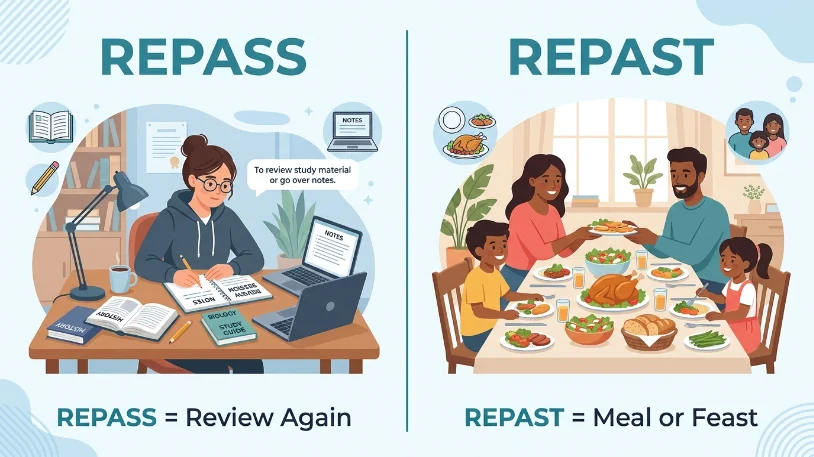
Many people confuse repass and repast because the words look similar, but they have very different meanings. Repast is a common English word that means a meal or food, while repass is a less common word that can mean to pass again or review something. In most writing situations, if you are talking about eating or a meal, repast is the correct choice.
English contains many words that look alike but mean completely different things. One example is repass or repast. These two words differ by only one letter, yet they have separate meanings and uses.
Many students, writers, and English learners accidentally use one when they mean the other. This mistake often happens because both words are uncommon in everyday conversation. When reading books, academic texts, or older literature, you may come across these terms and wonder which one is correct.
Understanding the difference between repass and repast helps improve your vocabulary and prevents writing errors. It also allows you to communicate more clearly in professional, academic, and creative writing.
In this guide, we’ll explain the meaning of each word, show real examples, compare their usage, discuss common mistakes, and help you remember which word belongs in different situations.
What Does Repass Mean?
Definition of Repass
The word repass is a verb. It generally means:
- To pass again
- To go over something again
- To review or reconsider
- To travel through a place another time
Although it is a valid English word, it is rarely used in modern everyday speech.
Examples of Repass in Sentences
- The teacher asked students to repass the lesson before the exam.
- We had to repass the same route because of road construction.
- She decided to repass the information to make sure nothing was missed.
Where Repass Is Commonly Used
You may find repass in:
- Academic writing
- Historical texts
- Formal literature
- Legal documents
- Older English works
In modern English, words like “review,” “revisit,” or “go over again” are often preferred.
What Does Repast Mean?
Definition of Repast
The word repast is a noun that means:
- A meal
- Food served during a meal
- A feast or dining experience
Repast has been part of English for centuries and is more common than repass.
Examples of Repast in Sentences
- The family enjoyed a large repast after the wedding ceremony.
- Guests were invited to share a repast together.
- The travelers stopped for a simple repast before continuing their journey.
Where Repast Is Commonly Used
Repast frequently appears in:
- Literature
- Hospitality writing
- Historical documents
- Religious texts
- Formal dining descriptions
Repass or Repast: Quick Comparison
| Feature | Repass | Repast |
| Part of Speech | Verb | Noun |
| Main Meaning | Pass again or review | Meal or food |
| Modern Usage | Rare | Occasional |
| Common Context | Reviewing, repeating | Dining, meals |
| Example | Repass the lesson | Enjoy a repast |
How to Remember the Difference
Memory Trick for Repass
Think of the word pass inside repass.
Repass = pass again.
Example:
- Repass the route.
- Repass the notes.
- Repass the information.
Memory Trick for Repast
Think of the word feast.
Repast sounds similar to feast.
Repast = meal or food.
Example:
- Wedding repast.
- Family repast.
- Evening repast.
Why People Confuse Repass and Repast
Similar Spelling
The words differ by only one letter.
- Repass
- Repast
When reading quickly, many people overlook the difference.
Similar Pronunciation
Both words sound somewhat alike, especially for non-native speakers.
Lack of Familiarity
Neither word appears frequently in everyday conversation, which makes confusion more likely.
Real World Examples
Example in Education
Incorrect:
- Please repast your notes before the test.
Correct:
- Please repass your notes before the test.
The sentence refers to reviewing information, not eating food.
Example in Hospitality
Incorrect:
- Guests enjoyed a repass after the ceremony.
Correct:
- Guests enjoyed a repast after the ceremony.
The sentence refers to a meal.
Example in Literature
Writers often use repast to create a formal or elegant tone when describing dining scenes.
Example:
“The king invited his guests to a magnificent repast.”
Repass vs Repast in Modern English
Which Word Is More Common Today?
Repast is generally more recognizable because it appears in books, articles, and ceremonial language.
Repass is much less common and has largely been replaced by simpler alternatives.
Modern Alternatives to Repass
Instead of repass, writers often use:
- Review
- Revisit
- Repeat
- Go over
- Examine again
Modern Alternatives to Repast
Instead of repast, writers often use:
- Meal
- Food
- Dinner
- Lunch
- Feast
Common Mistakes and Corrections
Mistake: Using Repass for a Meal
Incorrect:
- We enjoyed a repass after the wedding.
Correct:
- We enjoyed a repast after the wedding.
Mistake: Using Repast for Reviewing Information
Incorrect:
- Students should repast their notes.
Correct:
- Students should repass their notes.
Mistake: Assuming Both Words Mean the Same Thing
Incorrect assumption:
- Repass and repast are interchangeable.
Correct understanding:
- They have completely different meanings.
Exercises with Answers
Exercise 1
Choose the correct word.
The guests gathered for a wonderful _____ after the ceremony.
Answer: Repast
Exercise 2
Choose the correct word.
Students should _____ the chapter before tomorrow’s test.
Answer: Repass
Exercise 3
Choose the correct word.
The travelers stopped for a quick _____.
Answer: Repast
Exercise 4
Choose the correct word.
We had to _____ the same road because of traffic.
Answer: Repass
Exercise 5
Which word means a meal?
Answer: Repast
Related Words and Concepts
Feast
A large and special meal.
Banquet
A formal meal with many guests.
Review
To study something again.
Revisit
To return to something for further examination.
Refresh
To renew knowledge or memory of something.
These related terms often appear in the same contexts as repass and repast.
Frequently Asked Questions
Is repass a real word?
Yes. Repass is a legitimate English word that means to pass again or review something.
Is repast a real word?
Yes. Repast is a noun that refers to a meal or food.
Which is more common: repass or repast?
Repast is generally more recognizable and appears more often in modern writing.
Does repast mean dinner?
Yes. Repast can refer to dinner, lunch, breakfast, or any meal.
Can repass mean review?
Yes. Repass can mean reviewing or going over something again.
Why do people confuse repass and repast?
Their spelling and pronunciation are very similar, causing frequent mistakes.
Is repast an old-fashioned word?
It can sound formal or literary, but it is still understood in modern English.
Can I use repass in academic writing?
Yes, although words like review or revisit are usually more common today.
What is a wedding repast?
A wedding repast is the meal served to guests after a wedding ceremony.
How can I remember repass or repast correctly?
Remember that repass contains “pass” and means to pass again. Repast is related to meals and feasts.
Conclusion
Understanding the difference between repass or repast is easier once you know the basic meanings. Repass is a verb that means to pass again, review, or revisit something. Repast is a noun that refers to a meal or food.
Although these words look nearly identical, they belong in completely different contexts. If you’re talking about studying notes, reviewing information, or repeating a route, repass is the correct word. If you’re talking about dining, eating, or sharing food, repast is the right choice.
For most modern writing, simpler alternatives such as “review” and “meal” are often preferred. However, knowing these traditional words can improve your vocabulary and help you understand literature, formal writing, and historical texts more confidently.
When in doubt, remember one simple rule: repass means pass again, while repast means a meal.

Victoria Lane is a grammar-focused writer at GramBrix.com, passionate about helping readers master the rules of language. She provides clear explanations and practical examples that make writing more accurate, polished and confident.