
Last Updated on July 26, 2026
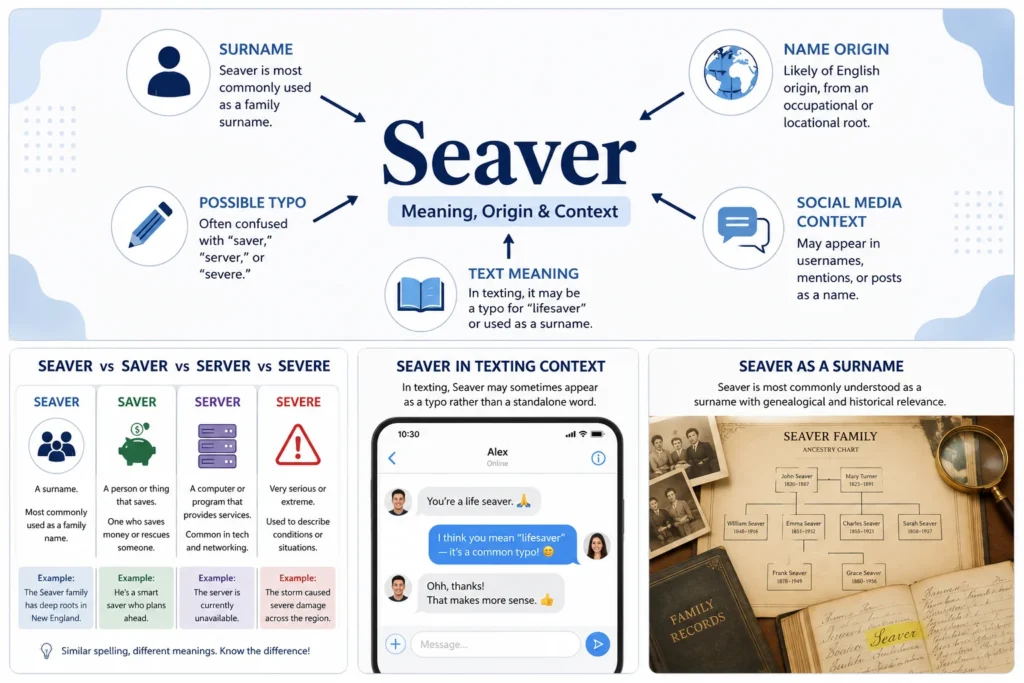
Seaver is most commonly used as a surname or family name, but people searching for “seaver meaning” may also be looking for a typo, a rare word variation, or the meaning of the name in a specific context. In most cases, Seaver refers to a last name of English origin, not a common slang word or modern texting term.
If you have searched for the Seaver meaning, you are probably trying to understand whether Seaver is a real word, a surname with historical origins, or a term with a hidden meaning in online conversations. This confusion is understandable because Seaver is not a common dictionary word in everyday American English, so its meaning depends largely on the context in which it appears.
The Seaver meaning is most commonly connected to it being a surname or family name. If you’re asking what does Seaver mean, the answer usually relates to its use as a proper noun rather than a traditional English vocabulary word. In many cases, Seaver may refer to a person’s last name, a historical family name, a username, a brand identity, or a specific reference rather than having a single universal definition.
Understanding the Seaver definition requires looking at the situation where the word appears. Unlike ordinary English words, names often carry meanings based on language history, genealogy, regional usage, and family traditions. Learning to define Seaver accurately means considering whether it appears in a family record, social media profile, school document, online username, business name, or casual conversation.
In some online contexts, people may also search for Seaver meaning in text or wonder whether it has a slang interpretation. However, the word does not have a widely recognized slang meaning in modern internet communication. In certain situations, it may simply be a typo, variation, or mistaken spelling of a more familiar word such as severe, server, saver, or seafarer.
Quick Answer Box
| Element | Answer |
| Primary meaning of Seaver | Most commonly a surname / family name |
| Word type | Proper noun in most cases |
| Common use | Personal name, genealogy, historical records, usernames, social profiles |
| Slang meaning? | No widely recognized mainstream slang meaning in US English |
| Can it be a typo? | Yes, sometimes for saver, server, or severe |
| Tone | Neutral; usually informational or identitybased |
| Where you might see it | Social media usernames, family trees, public records, school or business names |
| Best interpretation strategy | Look at the context: is it a name, a misspelling, or a label? |
| Example | “Tom Seaver was a famous baseball player” → here Seaver is a surname |
What Does Seaver Mean?
At its core, Seaver usually refers to a proper name, especially a surname. It is not a widely used modern slang term like “rizz,” “cap,” or “mid,” and it does not have a common universal texting definition in the way acronyms such as “IMO” or “TBH” do.
So if you ask, “What does Seaver mean?”, the most accurate short answer is this:
Seaver is most often a last name or family name rather than a standard vocabulary word.
That said, search intent around seaver meaning often falls into multiple categories. People may be looking for:
- the origin and meaning of the surname Seaver
- whether Seaver is a first name or last name
- whether Seaver has a biblical, historical, or symbolic meaning
- whether it is a misspelling of another word
- whether it means something on TikTok, Snapchat, or texting
- whether it appears in a quote, username, caption, or genealogy record
Because of that, the meaning is not just about one dictionary definition. It’s about identifying the role of the word in context.
Full Definition of Seaver
A fuller definition of Seaver looks like this:
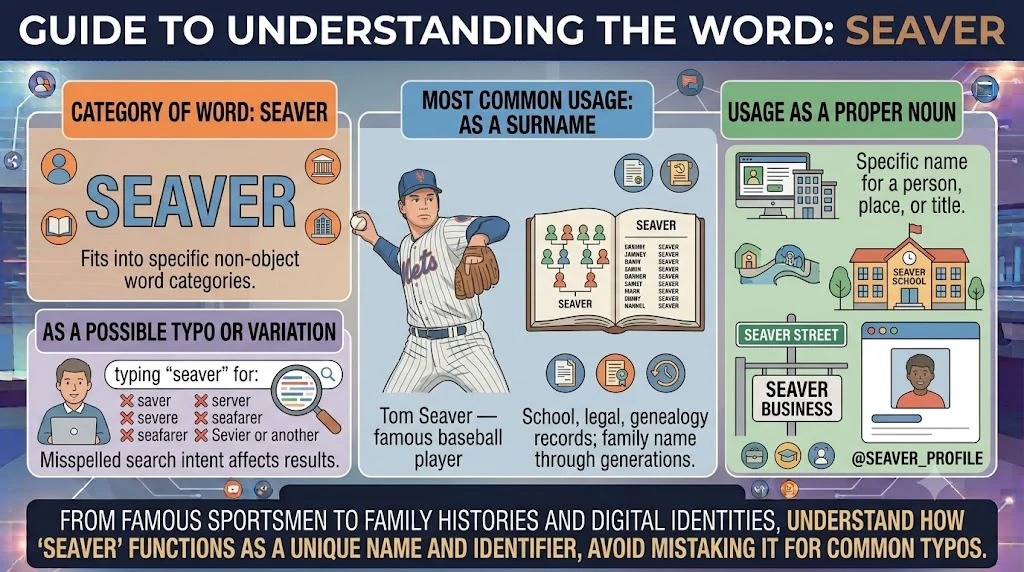
Seaver is generally a surname of English origin found in family histories, public records, sports references, and personal identities. It can also appear as a proper noun in names of people, schools, streets, businesses, or online profiles. In everyday English, it is not usually used as a common noun, verb, adjective, or internet slang term.
What category of word is Seaver?
In most realworld usage, Seaver fits into one of these categories:
As a surname
This is the most common use. For example:
- Tom Seaver — the famous baseball player
- a person listed in school, legal, or genealogy records
- a family name passed through generations
As a proper noun
A proper noun is a specific name for a person, place, or title. So Seaver may appear in:
- social media handles
- school alumni lists
- property records
- memorial pages
- local business names
- ancestry documents
As a possible type or variation
Sometimes people type Seaver when they actually mean:
- saver
- server
- severe
- seafarer
- Sevier or another surname/place name
This matters because search results for “seaver meaning” can sometimes mix real surname meaning with misspelled word intent.
Keyword Intent Analysis: What People Usually Mean When They Search “Seaver Meaning”
The keyword seaver meaning is a mixedintent query, but the dominant intent is definition and identity clarification.
Primary search intent
The primary intent is usually:
- “What does the word or name Seaver mean?”
- “Is Seaver a real name?”
- “What is the origin of Seaver?”
This is mostly informational intent.
Secondary search intent
A secondary layer often includes:
- pronunciation and name origin
- whether Seaver has a family crest, symbolic meaning, or historical root
- whether it’s used in messages or social media
- whether it’s a misspelling of another word
Hidden intent behind the search
There’s also a contextual or emotional layer. Many people search a term like this because they saw it in one of these situations:
- in a family tree
- in a message or username
- in a sports reference
- in a baby naming discussion
- in an obituary or ancestry record
- in a school assignment or online profile
In other words, they are not just asking, “What’s the definition?” They’re really asking:
- “What does this mean in the place where I found it?”
- “Is this a person’s name or an actual word?”
- “Am I misunderstanding what I saw?”
That’s why context matters so much for seaver meaning.
The Name Origin of Seaver
When Seaver appears as a surname, it is generally treated as a family name of English origin, though surname histories can vary depending on spelling, region, and migration patterns.
Possible surname background
Like many old surnames, Seaver may have developed from:
- an older occupational or descriptive family name
- a regional spelling shift over time
- a shortened or altered form of another surname
- migrationrelated spelling standardization in England or the United States
Surname meanings are not always as fixed as modern dictionary definitions. A family name can evolve across centuries, and the exact meaning may depend on which family line you’re tracing.
Why surname meanings can be tricky
People often want a surname meaning to work like a modern word definition, but names don’t always behave that way. For example:
- one spelling can have multiple historical roots
- immigration records may alter spelling
- pronunciation may stay the same while spelling changes
- families in different states or countries may share a similar name but have different ancestry paths
So if you’re researching Seaver as a family name, the best interpretation is usually:
Seaver is a surname with historical and genealogical significance rather than a modern everyday vocabulary word.
Is Seaver a First Name or Last Name?
In the US, Seaver is far more likely to be used as a last name than a first name.
Most common usage
You’ll most often see it in formats like:
- John Seaver
- Emily Seaver
- Robert Seaver
- The Seaver family
- Seaver genealogy records
Can Seaver be a first name?
Technically, almost any surname can be used as a first name in modern naming culture. In the US especially, some families use surnames as first names for style, legacy, or family tribute reasons. So Seaver could be used as a first name, but that is not the standard or most recognized use.
Best answer
If someone asks:
“Is Seaver a first name or last name?”
The best answer is:
Seaver is primarily a surname / last name, though it could occasionally be used as a given name in modern naming style.
Is Seaver a Slang Word?
No—Seaver is not a widely recognized mainstream slang word in American English.
That’s important because many meaningbased searches today are really slang searches. People are used to looking up terms that pop up on:
- TikTok
- Snapchat
- Discord
- YouTube comments
- text messages
- gaming chats
But Seaver does not currently function as a standard internet slang term in the way words like these do:
- sus
- rizz
- ate
- bet
- slay
- delulu
- fr
- no cap
So if you saw Seaver in a message and thought it might be slang, the safer assumption is:
- it’s a name
- it’s a username
- it’s a nickname
- it’s a misspelling
- it’s a contextspecific label rather than a universal slang word
Context and Usage: How Seaver Is Actually Used
The meaning of Seaver changes depending on where you saw it. Here are the most common contexts.
Seaver as a Person’s Last Name
This is the most straightforward use.
Example:
- “My teacher’s last name is Seaver.”
- “I found the Seaver family in the census records.”
- “Tom Seaver was one of the greatest pitchers in baseball.”
In these examples, Seaver has no hidden slang meaning. It’s simply a surname.
What it implies in context
If someone says “Seaver” in this way, it usually implies:
- identity
- family connection
- historical reference
- sports or public figure reference
- a proper name in a formal or personal setting
Seaver in Genealogy and Family History
A lot of people search surname meanings because they’re building a family tree or looking through old documents. In genealogy spaces, Seaver would typically be treated as a family surname.
Examples:
- “I’m researching the Seaver line from New England.”
- “My greatgrandmother’s maiden name was Seaver.”
- “There are multiple Seaver branches in the family records.”
In this setting, the question “What does Seaver mean?” often really means:
- Where did the family name come from?
- Is it English, Scottish, or something else?
- Has the spelling changed over time?
- Does the name have a symbolic meaning?
Seaver in Sports and Pop Culture
One reason many Americans recognize the name Seaver is because of Tom Seaver, the legendary baseball pitcher. That can shape search behavior too.
If someone sees “Seaver” in a sports article, documentary, or trivia post, the meaning is likely tied to the surname of a notable person, not a word definition.
Example:
- “Seaver struck out 10 in that game.”
- “The documentary covered Seaver’s legacy.”
- “He was compared to Seaver in terms of command and consistency.”
Here, Seaver functions as a reference to a person, especially in sports writing.
Seaver in Usernames and Online Profiles
Online, Seaver may appear in usernames, gamer tags, brand handles, or social profiles. In those cases, the word may not have a dictionary meaning at all.
Examples:
- @seaver.media
- SeaverDesigns
- seaver_92
- TheSeaverHouse
In a username, Seaver could mean:
- the person’s real surname
- a family name used for branding
- a tribute to someone with the surname
- a custom alias with personal meaning
That’s why context matters. A profile handle is not automatically slang.
Seaver as a Possible Misspelling
One of the biggest edge cases with seaver meaning is that the person searching may have encountered a typo. If the surrounding sentence looks odd, the intended word may be something else.
Common words people confuse with Seaver
Saver
This is probably the closest commonword match.
Saver means someone or something that saves, preserves, or helps reduce cost.
Examples:
- “Money saver”
- “Screen saver”
- “Time saver”
If someone wrote:
- “That hack is a total seaver”
they may have meant:
- “That hack is a total saver”
Server
This is another likely confusion, especially in tech, gaming, or restaurant settings.
Examples:
- “The server is down.”
- “Ask your server for the check.”
- “We switched to a private server.”
A typo from server to seaver can happen fast, especially on mobile.
Severe
This is less likely but still possible.
Examples:
- “severe weather”
- “severe pain”
- “severe reaction”
If someone typed “seaver storm warning,” it may simply be a misspelling.
Seafarer or a related rare word
In rare cases, people may be searching for a poetic, historical, or literary word and accidentally land on Seaver due to spelling confusion.
Real Life Examples of Seaver Meaning in Sentences
Here are practical examples showing how the meaning changes depending on context.
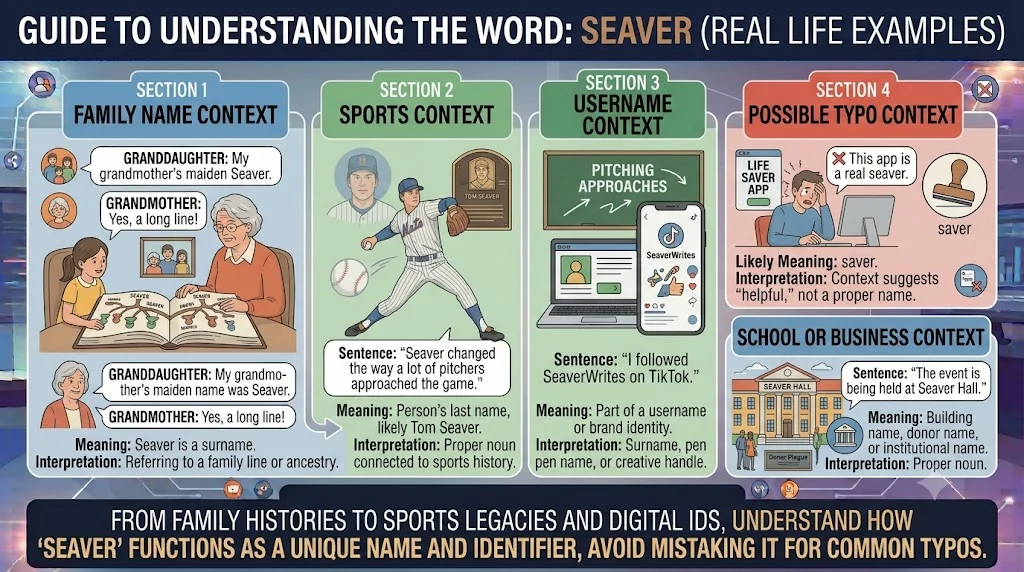
Example 1: Family name context
Sentence: “My grandmother’s maiden name was Seaver.”
Meaning: Seaver is a surname.
Interpretation: The speaker is referring to a family line or ancestry, not slang.
Example 2: Sports context
Sentence: “Seaver changed the way a lot of pitchers approached the game.”
Meaning: Seaver is a person’s last name, likely referring to Tom Seaver.
Interpretation: It’s a proper noun connected to sports history.
Example 3: Username context
Sentence: “I followed SeaverWrites on TikTok.”
Meaning: Seaver is part of a username or personal brand identity.
Interpretation: It may be a surname, pen name, or creative handle.
Example 4: Possible typo context
Sentence: “This app is a real seaver.”
Likely meaning: The intended word may be saver.
Interpretation: The context suggests “helpful” or “timesaving,” not a proper name.
Example 5: School or business context
Sentence: “The event is being held at Seaver Hall.”
Meaning: Seaver is likely part of a building name, donor name, or institutional name.
Interpretation: It still functions as a proper noun.
5 Conversation Examples With Natural Chat Style
Below are realistic examples of how someone might encounter Seaver in conversation or online.
Conversation Example 1: Family history chat
Person A:
“I found the name Seaver in my greatgrandfather’s records. Do you know what it means?”
Person B:
“It’s most likely a surname, not a slang word. You’d probably want to look at family origin records or genealogy sources.”
Meaning: surname / ancestry context
Conversation Example 2: Sports discussion
Person A:
“Who’s Seaver? My dad keeps bringing him up in baseball debates.”
Person B:
“He probably means Tom Seaver. He was one of the most respected pitchers ever.”
Meaning: notable surname tied to a public figure
Conversation Example 3: Confused text message
Person A:
“My friend texted, ‘You’re a seaver.’ Is that a real word?”
Person B:
“They probably meant saver, like ‘you saved me’ or ‘you helped a lot.’”
Meaning: likely typo, not a formal meaning of Seaver
Conversation Example 4: Social profile context
Person A:
“I saw ‘Seaver Studio’ on Instagram. Is Seaver a word?”
Person B:
“Could be the owner’s last name or a brand name. It doesn’t necessarily mean anything slangwise.”
Meaning: identity / branding usage
Conversation Example 5: School or campus setting
Person A:
“The orientation map says Seaver Hall. What does Seaver mean there?”
Person B:
“It’s probably named after a person or family, not a vocabulary word.”
Meaning: place name based on surname
PlatformSpecific Meaning of Seaver
Even though Seaver is not a standard slang term, people still encounter it on different platforms. Here’s how to interpret it depending on where it appears.
Seaver Meaning on TikTok
On TikTok, Seaver is most likely one of these:
- part of a username
- a creator’s surname
- a brand identity
- a niche reference in a fandom, family account, or sports edit
- a typo in captions or comments
How to read it on TikTok
If you see:
- “Seaver posted again”
- “I found Seaver edits”
- “follow SeaverArt”
then Seaver is probably a name, not a coded internet term.
TikTok interpretation tip
Check:
- the profile name
- hashtags
- caption wording
- whether the term refers to a person, account, or fandom
Seaver Meaning on Snapchat
On Snapchat, people often use shortened names, nicknames, or private references. So Seaver could be:
- a contact name
- a display name
- a friend’s surname
- a private joke
- a typo
If someone sends “Seaver” on Snapchat
You’d want to ask:
- Are they naming a person?
- Are they referring to a saved contact?
- Did they mean saver?
Because Snapchat context is casual, typos are very common.
Seaver Meaning on Instagram
On Instagram, Seaver often appears in:
- usernames
- page titles
- photography brands
- family accounts
- design portfolios
- alumni or memorial pages
Example:
- seaverphotos
- the.seaver.home
- seavercollective
Again, this points more toward identity or branding than slang meaning.
Seaver Meaning in Texting
In text messages, Seaver is usually interpreted in one of two ways:
As a name
Example:
- “Seaver said he’ll be there at 7.”
Here it’s clearly a person’s name.
As a typo for saver
Example:
- “You’re a life seaver.”
This almost certainly means:
- “You’re a lifesaver.”
That’s one of the most important realworld interpretations because lifesaver is such a common phrase, and seaver can show up accidentally in rushed texting.
Seaver Meaning on Reddit, Discord, and Forums
In forums and chat communities, Seaver can be:
- a username
- a surname reference
- a fandom or gaming alias
- a mistaken spelling
If you’re trying to decode it in a thread, ask these questions:
- Is it capitalized like a name?
- Is it used where a person would normally be referenced?
- Does the sentence make more sense if it were saver or server?
- Is it attached to a handle, account, or channel name?
Those clues usually solve the meaning fast.
Alternative Meanings and Interpretations of Seaver
To fully cover the topic, it helps to separate confirmed common uses from possible interpretations.
Meaning 1: A surname or family name
This is the most common and reliable meaning.
Meaning 2: A proper noun in schools, buildings, or organizations
A hall, scholarship, family foundation, or school building may carry the name Seaver.
Meaning 3: A username, alias, or brand name
Especially online.
Meaning 4: A typo for another word
Most often:
- saver
- server
- severe
Meaning 5: A search error or phonetic confusion
Sometimes the user is looking for another name or word entirely but types Seaver because it sounds close.
Related Terms and NLP Variations
If someone is searching seaver meaning, they may also be looking for related terms or variants. These semantic neighbors matter because they often appear in search suggestions or user confusion.
Closely related search variations
Seaver name meaning
This suggests surnameorigin intent.
Seaver surname origin
This is genealogyfocused and usually tied to family history.
Is Seaver a word?
This is a direct vocabulary clarification query.
Seaver definition
This suggests the user expects a dictionarystyle answer.
What does Seaver mean in text?
This suggests texting/slang confusion.
Seaver vs saver
This suggests typo clarification.
Seaver pronunciation
This often appears when users have seen the name written but not spoken.
Similarlooking or similarsounding words
Saver
A person or thing that saves time, money, effort, or resources.
Server
A computer system, a waiter/waitress role, or a game host system.
Severe
Serious, harsh, intense, or strict.
Sevier
A different surname or place name that may be confused in spelling.
Seafarer
A sailor or traveler by sea; semantically different but visually close enough to create confusion in searches.
Emotional Meaning and Social Interpretation
Sometimes people don’t want the literal definition. They want the social meaning of what they saw. Here’s how that works with Seaver.
If someone uses Seaver as a name
The emotional meaning is usually neutral. It’s just identity.
If someone accidentally types Seaver instead of saver
The emotional tone can actually be positive.
Example:
- “You’re a lifesaver” → warm, grateful, appreciative
- typo version: “You’re a life seaver” → same intended emotional meaning
So in texting, Seaver can sometimes inherit the emotional meaning of saver if the message clearly points that way.
If Seaver appears in a memorial, building, or dedication
The social meaning may imply respect, legacy, or family significance.
How to Respond if Someone Uses Seaver
If someone sends or posts Seaver, your response depends on the context.
If Seaver is clearly a surname
You can respond normally.
Examples:
- “Oh, is that a family name?”
- “Are you talking about Tom Seaver?”
- “Is Seaver your last name?”
If Seaver looks like a typo for saver
A gentle response works best.
Examples:
- “Do you mean saver?”
- “If you mean lifesaver, then thank you 😄”
- “I think autocorrect got you there lol”
If Seaver appears in a username or brand
You usually don’t need to “translate” it at all. Just treat it as a name.
Examples:
- “Is Seaver your surname or brand name?”
- “Cool handle—does Seaver mean something personal to you?”
If you genuinely can’t tell what it means
Ask directly but casually.
Examples:
- “Do you mean Seaver as a name?”
- “Is that a typo or a reference?”
- “What does Seaver mean in your context?”
That’s often the cleanest move, especially in texting or online chat where context is thin.
Misinterpretations of Seaver
Because the term is uncommon as a standalone word, it gets misread a lot. Here are the most common mistakes.
Mistake 1: Assuming it’s slang
People see an unfamiliar word online and assume it’s TikTok slang. In this case, that’s usually not correct.
Mistake 2: Assuming it has one fixed dictionary meaning
It usually doesn’t function like a regular dictionary word. It’s more often a name.
Mistake 3: Ignoring capitalization
If you see Seaver with a capital S, that strongly suggests a proper noun.
Compare:
- Seaver → likely a name
- saver → common English noun
Mistake 4: Not checking surrounding words
The sentence often reveals the answer immediately.
- “Seaver Hall” → proper name
- “Tom Seaver” → surname
- “you’re a seaver” → likely typo for saver
Mistake 5: Treating every odd spelling as intentional
Sometimes it’s just autocorrect, rushed typing, or voicetotext failure. No deep hidden meaning required.
When NOT to Use Seaver
If you mean one of the following common English words, don’t use Seaver unless it is actually a name:
Don’t use Seaver when you mean “saver”
Wrong:
- “This app is a huge seaver.”
Better:
- “This app is a huge time saver.”
Don’t use Seaver when you mean “lifesaver”
Wrong:
- “You’re a life seaver.”
Better:
- “You’re a lifesaver.”
Don’t use Seaver when you mean “server”
Wrong:
- “The seaver is offline.”
Better:
- “The server is offline.”
Don’t use Seaver as fake slang unless your audience already gets the joke
Because it’s not a standard slang term, using it casually can create confusion rather than personality.
Usage Tips for Understanding Seaver Correctly
If you’re trying to decode Seaver fast, use this framework.
Tip 1: Check capitalization
Capital S usually means a name.
Tip 2: Look at the sentence role
Ask whether it’s being used like a person, place, or common word.
Namestyle pattern
- “Seaver called me.”
- “I know a Seaver.”
- “That’s Seaver Hall.”
Wordstyle pattern
- “You’re a seaver.”
- “That tool is a seaver.”
The second group is much more likely to be a typo.
Tip 3: Check the platform
On social media, it may be a handle. In a family record, it’s probably a surname. In a text message, it may be a typo.
Tip 4: Look for nearby clues
Words like these help:
- Mr., Mrs., Dr., Coach → likely surname
- Hall, House, Center, Foundation → likely proper noun
- life, money, time before Seaverlike wording → likely meant saver
Tip 5: Don’t force slang where none exists
Not every unusual word is a coded Gen Z term. Sometimes it’s just a name, fr.
Seaver vs Saver: The Difference
This is one of the most useful comparisons because it solves a lot of confusion.
| Word | Meaning | Common Use |
| Seaver | Usually a surname or proper noun | Names, records, buildings, identities |
| Saver | Someone or something that saves | money saver, time saver, lifesaver |
Example comparison
- “Tom Seaver played baseball.” → surname
- “This budgeting app is a money saver.” → common noun
Seaver vs Server: The Difference
| Word | Meaning | Common Use |
| Seaver | Usually a name | personal name, building, surname |
| Server | tech system or restaurant worker | websites, gaming, restaurants |
Example comparison
- “Seaver gave the speech.” → likely a person
- “The server crashed again.” → tech meaning
Seaver vs Severe: The Difference
| Word | Meaning | Common Use |
| Seaver | usually a proper name | surname, title, identity |
| Severe | serious, intense, harsh | weather, pain, damage, rules |
Example comparison
- “Seaver was listed on the program.” → proper noun
- “The storm was severe.” → adjective
FAQs
What does Seaver mean exactly?
In most cases, Seaver is a surname or family name, not a common English slang word.
Is Seaver a real word?
It is real as a name, especially a surname. It is not commonly used as an everyday vocabulary word in modern American English.
Is Seaver a last name?
Yes. Seaver is primarily used as a last name / surname.
Does Seaver have a slang meaning?
No widely recognized mainstream slang meaning exists for Seaver in US English.
What does Seaver mean in a text message?
It depends on context. It could be:
- a person’s surname
- a username
- a typo for saver, server, or another word
Is Seaver a typo for lifesaver?
Sometimes, yes. If someone texts “you’re a life seaver,” they almost certainly mean lifesaver.
What does Seaver mean on TikTok?
Usually it’s a username, surname, or brandlike identity, not a standard TikTok slang term.
Is Seaver a first name?
It can be used that way occasionally, but it is much more commonly a last name.
How do I know if Seaver is a name or a typo?
Check:
- capitalization
- sentence context
- whether it fits as a person’s name
- whether saver or server makes more sense in the sentence
Why are people searching for seaver meaning?
Usually because they saw it in:
- a family record
- a social profile
- a sports reference
- a text message
- a building or organization name
- a possible typo and want clarification
Conclusion
The simplest and most accurate answer to seaver meaning is this:
Seaver is most commonly a surname or proper name, not a standard slang term or everyday dictionary word.
If you saw Seaver in a family tree, school record, sports article, memorial, or username, it’s probably functioning as a name. If you saw it in a casual text like “you’re a seaver” or “that app is a seaver,” it’s probably a misspelling of saver or another similar word.
So the best way to understand Seaver is not to ask for one rigid definition. Instead, ask:
- Is this a name?
- Is this a typo?
- Is this a username or brand label?
- What does the sentence around it suggest?
That contextfirst approach gives you the right meaning almost every time.

Justin Powell is a writer at GramBrix.com who focuses on grammar, clarity and effective communication, helping readers strengthen their language skills.