Last Updated on August 4, 2026
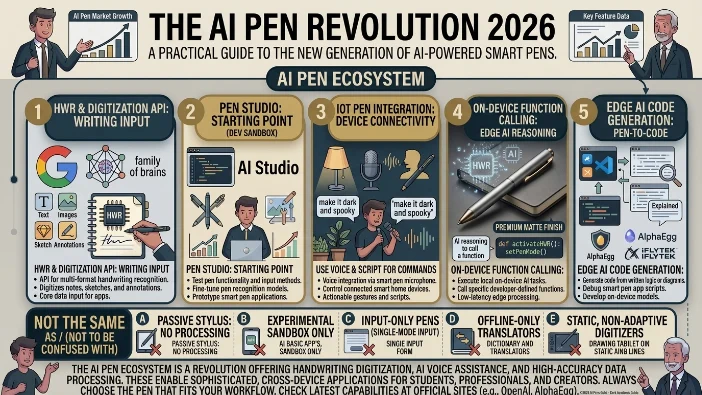
An AI pen is a smart writing device that combines artificial intelligence with traditional handwriting or scanning to boost productivity, learning, and note taking. These devices fall into three main categories: AI scanning pens that use OCR to read and translate printed text, AI digital pens that convert handwriting to text with voice recording and Bluetooth sync, and screenless AI pens like OpenAI’s upcoming 2026 hardware that processes voice and handwriting without any display. The global digital pen market hit $904 million in 2025 and is projected to reach $2.36 billion by 2034. Top models include the AlphaEgg SmartPen D1 Ultra for students, the iFLYTEK SmartPen P20 Plus for language learning, and the One Smart AI Pen with ChatGPT 4.0 Mini integration. Handwriting recognition accuracy now exceeds 95% with deep learning systems. AI pens serve students, professionals, researchers, and anyone seeking to reduce screen dependency while capturing ideas naturally.
You don’t need another screen in your life. The endless notifications, the glowing rectangles demanding your attention, the constant battle against digital distraction it’s exhausting just thinking about it.
But what if your most powerful AI tool looked nothing like a smartphone or a tablet? What if it looked like a pen?
OpenAI is about to answer that question. In 2026, the company is launching its first hardware product: a screenless AI pen. Codename Gumdrop. A minimalist metal stylus weighing only 10 to 15 grams. No screen, no camera, no operating system interface.
This isn’t a gimmick. It’s a statement.
AI is finally escaping the screen and returning to the physical world. And it’s happening through the most natural human gestures we have: writing, speaking, and taking notes by hand.
The global digital pen market hit $904.2 million in 2025, and it’s projected to reach $2.36 billion by 2034—a 10.91% annual growth rate. North America owns 38% of that market, driven by strong adoption in education and business.
So what’s really going on with AI pens? Let’s explore everything you need to know about this emerging category, from OpenAI’s bold bet to the practical tools already in your hands.
What Exactly Is an AI Pen?
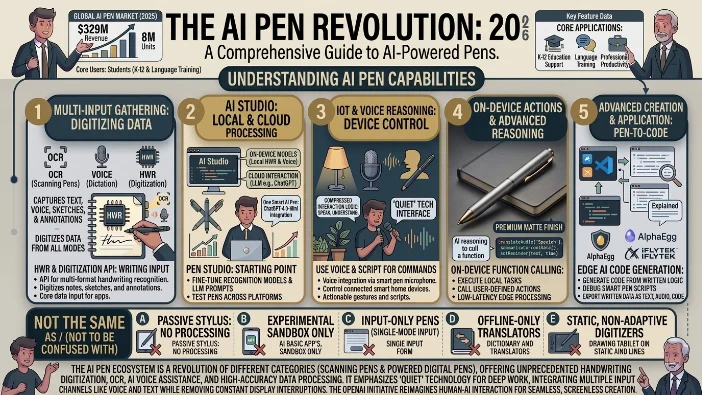
Before we dive deep, let’s clear up some confusion. “AI pen” covers several different categories right now.
AI scanning pens are portable learning devices that use OCR (optical character recognition) to scan printed text. They combine text-to-speech, translation engines, and storage modules to read text aloud, translate languages, and capture notes in real time. The global market for these hit $329 million in 2025, with roughly 8 million units sold at an average price of $40. Students make up the core user base, driving demand in K-12 education and language training.
AI-powered digital pens are the next generation. They feature voice dictation, multilingual audio recording, and handwriting-to-text conversion. Many now integrate Bluetooth and AI tools like ChatGPT for seamless note-taking. For instance, the One Smart AI Pen launched on Kickstarter in March 2025 with ChatGPT-4.0-Mini integration, voice dictation, and audio recording in 52 languages.
OpenAI’s screenless pen is something else entirely. It’s a hardware gamble that reimagines human-AI interaction from the ground up.
The Rise of Screenless AI: Why a Pen?
OpenAI’s decision to build a pen is fascinating because it goes against everything we’ve been taught about “smart” devices.
For twenty years, the tech industry assumed smart meant screens. Bigger screens. Brighter screens. More interactive screens. From feature phones to smartphones to tablets to smartwatches, every piece of smart hardware eventually circled back to one center: the display.
The screen wasn’t just an output window. It was the user’s control panel, feedback loop, and reality check. Smart means having a screen” became the industry’s default design anchor.
OpenAI just threw that anchor overboard.
Why This Matters Now
The timing makes sense. Digital tools that constantly demand attention reduce deep concentration by 20% to 30% among knowledge workers. We’re drowning in interruptions.
According to an MIT Media Lab survey, more than 65% of users now want “quiet” technologies—tools that add value without imposing constant demands. The AI pen answers that call.
The pen is a socially neutral interface. It’s an age-old extension of human thought, accompanying reflection and creation without ever imposing itself. People accept pens without justification. No learning curve, no onboarding tutorial, no permission requests.
OpenAI’s $6.5 Billion Bet
Here’s the backstory. In May 2025, OpenAI acquired io, an AI hardware startup co-founded by Jony Ive, for approximately $6.5 billion in an all-stock transaction. This was OpenAI’s largest acquisition ever. It brought 55 top hardware, manufacturing, and industrial design experts into the fold.
Jony Ive is the legendary designer behind the iPod, iPhone, iMac, and MacBook Air. He knows how to create objects people genuinely want to hold.
The pen’s design philosophy is radical. No screen, no camera, no traditional operating system interface. Writing isn’t even the core function—handwriting recognition is just one input channel. The pen doesn’t try to replace your phone or computer. It deliberately avoids the “display” dimension entirely.
Its interaction logic is compressed to the extreme: you speak, it understands. You don’t look, it’s still working. The AI pen is always available when you need it and disappears when you don’t.
How AI Pens Actually Work (The Technology Behind the Magic)
AI pens pack sophisticated technology into tiny packages. Here’s what makes them tick.
Hardware Components
| Component | Function |
|---|---|
| CMOS image sensors | Capture text and handwriting images for scanning |
| MCUs/AI chips | Process data on-device for speed and privacy |
| Memory | Store text, audio, and configuration data |
| Microphones/speakers | Enable voice recording and audio feedback |
| IMU (Inertial Measurement Unit) | Track pen motion for handwriting reconstruction |
| Bluetooth | Connect to phones, tablets, and computers |
Handwriting Recognition Accuracy
The technology has improved dramatically. A 2025 IEEE study on cursive handwriting reconstruction using sensorized ink pens achieved character recognition rates of 59.49% with reconstruction algorithms, compared to 81.02% with scanned paper. Those numbers sound modest, but they’re improving fast.
Modern deep learning-based HTR systems combine Convolutional Neural Networks (CNN) for spatial feature extraction, Recurrent Neural Networks (RNN) with Long Short-Term Memory (LSTM) for sequence modeling, and Connectionist Temporal Classification (CTC) for sequence alignment. These hybrid approaches achieve recognition accuracy of 95.6% on benchmark datasets like IAM.
Some systems go even further. Motion-only handwriting recognition using LSTM models achieved 90.46% test accuracy in one 2024 study. That means the pen can recognize your handwriting purely from movement data—no screen, no camera, just sensors.
Handwriting Recognition Accuracy Table
| Study | Device Type | Accuracy |
|---|---|---|
| Hasan et al. (2024) | Tablet + digital pen | 98.31% |
| Rahim et al. (2024) | Tablet + digital pen | 94.62% |
| Çifçi and Tekin (2024) | Image-capturing device | 98.77% |
| Li et al. (2024) | Image-capturing device | 98.50% |
| Khoh et al. (2023) | Microsoft Kinect | 97.43% |
| Deep Learning HTR (2025) | Offline recognition | 95.60% |
| Motion-based LSTM (2024) | IMU smart pen | 90.46% |
| SIP Reconstruction (2025) | Sensorized ink pen | 59.49% |
AI Pen Applications: Who Uses These Things and Why
AI pens aren’t just cool gadgets. They serve real purposes across education, business, research, and personal productivity.
For Students and Education
The educational market is massive. A 2026 Red Dot Design Award winner, the AlphaEgg SmartPen D1, targets younger learners with integrated HD camera scanning, translation, and voice interaction. It features high recognition accuracy and lightweight design for extended use without hand fatigue.
The iFLYTEK SmartPen P20 Plus, another Red Dot winner, uses AI to help students aged ten and up learn languages in age-appropriate contexts. It includes a scanning head, touch module, OLED screen with blue light filter, grammar analysis, and correction features.
Why handwriting matters for learning: A Princeton University study demonstrated that handwriting promotes 25% greater information retention compared to digital note-taking. The physical act of forming letters and words creates stronger neural pathways.
AI pens add to this:
- Automatic lecture summarization
- Study guide generation from handwritten notes
- Searchable handwritten content
- Grammar checking and pronunciation feedback
- Real-time translation of scanned text
For Business Professionals and Knowledge Workers
The knowledge worker market is equally compelling. AI-powered digital pens reduce reliance on screens for everyday tasks, enabling seamless note-taking in meetings.
Key business use cases:
- Meeting notes: Capture handwritten notes, record audio, and get AI-generated summaries with action items
- Brainstorming: Sketch ideas and let AI expand bullet points into structured plans
- Document annotation: Mark up reports and contracts with handwriting that converts to searchable text
- Transcription: Record meetings and receive full transcriptions automatically
For Researchers and Academics
OpenAI’s acquisition of io and development of the AI pen aligns with their broader “OpenAI for Science” initiative. The company also released Prism in 2026, an LLM-powered tool embedded in LaTeX editors for writing scientific papers. Over 1.3 million scientists submit more than 8 million queries weekly to ChatGPT on advanced math and science topics.
The AI pen captures initial ideas. Prism develops them into polished papers. Together, they create a complete workflow from thought to publication.
For Language Learning and Accessibility
AI scanning pens have found a natural home in language education. The best models offer:
- Built-in dictionaries from Oxford and other authoritative sources
- OCR accuracy for printed text
- Real-time translation with natural language processing
- Text-to-speech for pronunciation practice
- Color camera support for textbooks and illustrations
OpenAI’s Screenless Pen: The Details
Let’s dive deeper into what OpenAI is actually building.
Specs and Features
| Feature | Detail |
|---|---|
| Codename | Gumdrop |
| Weight | 10-15 grams |
| Design | Metal fountain pen aesthetic |
| Screen | None |
| Camera | None |
| Operating System | None |
| Input Methods | Handwriting, voice |
| Core Function | Passive data collection and contextual AI processing |
| AI Integration | ChatGPT synchronization |
| Release Year | 2026 |
The Design Philosophy
The pen represents a fundamental shift in how we think about AI interaction. Instead of intervening in real-time, the AI observes, records, understands, and then acts afterward.
Think about that for a second.
Traditional AI assistants interrupt constantly. They suggest, correct, and prompt you in the moment. This may seem helpful, but it actually fragments your concentration. Studies show that digital interruptions reduce deep work capacity by 20-30%.
OpenAI’s pen flips the script. The AI doesn’t interrupt. It waits. Later, it structures, summarizes, connects, and transforms your raw material into something more valuable.
This delayed timing marks a major departure from AI approaches centered on immediacy and constant engagement.
What It Actually Does
Handwriting input: Write naturally on paper. The pen captures your handwriting and converts it to digital text through built-in motion sensors and AI processing.
Voice input: Speak your notes. The pen records and transcribes voice, adding audio to your digital notes.
AI processing: Send your notes to ChatGPT for summarization, expansion, connection to other ideas, and question answering.
Context awareness: The AI understands context what you’re writing about, who you’re with, what you referenced before.
Privacy: A local AI model processes data directly on the device for speed and privacy.
The Strategy Behind the Hardware
OpenAI’s API and ChatGPT Plus subscriptions continue growing, but growth has naturally slowed. Hardware creates a new revenue stream and a closed ecosystem: hardware plus services plus subscriptions that lock users in.
The pen avoids direct competition with Apple or Google on smartphones. Instead, it creates a new category: a third device you carry alongside your phone and laptop.
The Privacy Question Nobody’s Answering
AI pens capture deeply personal data: your handwriting, your voice, your ideas, your private conversations. This raises serious concerns.
According to the OECD, 68% of users worry about the implicit collection of cognitive and contextual data from AI-enabled devices.
Privacy Challenges
- Handwriting as biometric data: Handwriting is almost as unique as fingerprints. AI pens that capture handwriting patterns create a biometric profile of you.
- Audio recording: Recording conversations, even for note-taking, opens questions about consent and surveillance.
- Contextual inference: AI can infer more from your notes than you explicitly write—topics, relationships, interests, health concerns.
- Third-party data sharing: What happens to your data when it syncs to the cloud?
What AI Pen Manufacturers Must Address
| Requirement | Why It Matters |
|---|---|
| Local processing | Process as much data on-device as possible |
| End-to-end encryption | Protect data in transit |
| User control | Let users delete data, opt out of collection, and see what’s stored |
| Transparency | Clearly explain what data is collected and why |
| No unauthorized sharing | Never sell or share user data without explicit consent |
OpenAI will need to demonstrate strict adherence to these best practices. The company’s reputation depends on it.
AI Pen Market: The Numbers
Global Digital Pen Market
| Metric | Value |
|---|---|
| 2025 Market Size | $904.2 million |
| 2034 Forecast | $2.36 billion |
| CAGR (2026-2034) | 10.91% |
| North America Share (2025) | 38% |
AI Smart Scanning Pens
| Metric | Value |
|---|---|
| 2025 Market Size | $329 million |
| 2032 Forecast | $465 million |
| CAGR | 5.4% |
| 2025 Sales Volume | ~8 million units |
| Average Price (2025) | ~$40/unit |
| Industry Gross Margin (2025) | ~30% |
Key Players
The AI scanning pens market features companies like C-Pen, Scanmarker, Lenovo, HampoTech, and iFLYTEK. The Chinese market is particularly strong, with brands like AlphaEgg, iFLYTEK, and Youdao dominating the K-12 education segment.
Popular AI Pens in 2026
AlphaEgg SmartPen D1 Ultra
Primary keyword: Best AI pen for students
Core strengths:
- Scans textbooks and illustrations with color recognition
- Built-in AI voice Q&A for all subjects
- Real-world example: Translates “He knocked over the glasses” to “他撞到了玻璃杯” instead of the generic “打翻了眼镜”
- Uses the same technology as China’s high school and college entrance exams for oral assessment
- Offers phoneme-level pronunciation instruction (corrects mouth shape and airflow for sounds like /p/)
- Features both high school entrance exam grading technology and the iFLYTEK Spark large language model for essay feedback
iFLYTEK SmartPen P20 Plus
Primary keyword: AI smart pen
Core strengths:
- Designed for learners aged ten and above
- One-handed operation with scanning head and touch module
- Smart algorithm adjusts scan angle automatically
- OLED screen with blue light filter
- Integrated grammar analysis and correction
Youdao AI Answer Pen Space X
Primary keyword: AI digital pen
Core strengths:
- Based on NetEase’s “Ziyue” educational large language model
- Cooperates with DeepSeek-R1 for multi-round interactive Q&A
- 3.6cm wide pen head for scanning long text passages and diagrams
- 4.4-inch OLED HD screen
- 78 million word vocabulary
- Supports scanning in 100 languages and simultaneous translation in 28 languages
One Smart AI Pen
Primary keyword: AI note-taking pen
Core strengths:
- Launched on Kickstarter March 2025
- Combines microphone, Bluetooth, and AI features
- Voice dictation and audio recording in 52+ languages
- Integrates ChatGPT-4.0-Mini
- Writing mode converts handwriting to digital text
The Future of Screenless AI

The AI pen might seem niche. But it’s part of a broader movement: AI that works in the background, not the foreground.
What Comes Next
Passive AI: Instead of interrupting, AI will work quietly in the background. It will observe, understand, and act only when relevant.
Context-aware computing: AI will understand your context—where you are, what you’re doing, what you need—without asking.
Screenless proliferation: More devices will abandon screens. Voice-first and gesture-first interfaces will grow.
Cognitive enhancement: The best AI will enhance human cognition rather than replace it. Researcher Diyi Yang from Stanford notes that future AI interfaces must preserve cognitive autonomy rather than dilute it.
The Challenge
The screenless AI market faces hurdles. Users need to trust these devices. The learning curve for a pen is minimal (everyone knows how to write), but the mental shift from screen-centric to screenless interaction is real.
Accuracy matters. Reconstructing handwriting from motion data is harder than scanning printed text. The technology is improving, but occasional errors frustrate users.
What OpenAI Must Prove
As the 36Kr analysis puts it: “Ultimately, the future of screenless AI lies not in showy skills but in restraint: restraining the obsession with universality, over-designing the hardware form, and the grand narrative of replacing mobile phones”.
The pen isn’t about replacing your phone. It’s about giving you a choice. A screenless alternative for specific tasks. A quiet companion that supports thought rather than interrupting it.
Should You Buy an AI Pen?
That depends on who you are.
Buy an AI Pen If You Are:
A student: The learning benefits are real. Handwriting helps retention by 25% compared to typing. AI features like automatic summarization and study guide generation save hours. The best educational AI pens (AlphaEgg, iFLYTEK, Youdao) offer exam-grade pronunciation assessment and grammar correction.
A knowledge worker: Meeting notes, brainstorming sessions, document annotation—AI pens make all of this easier. The ability to record audio and get AI-generated summaries is genuinely transformative.
A researcher or writer: Capturing ideas the moment they appear and having AI help structure, expand, and connect them is powerful. The combination of handwriting’s cognitive benefits and AI’s processing power is compelling.
Someone who wants less screen time: If you’re tired of endless notifications and constant digital distractions, a screenless AI pen offers genuine relief.
Skip It If You Are:
A casual user: Your phone already does most of this, even if it’s more distracting. The AI pen is a luxury item for people who want to think without screens getting in the way.
Someone who rarely handwrites: If you’re comfortable typing everything, the physical act of writing won’t feel natural.
Budget-conscious: Prices range from $40 for basic scanning pens to several hundred dollars for premium models.
The Bottom Line
The global digital pen market is growing at nearly 11% annually. AI scanning pens alone sold 8 million units in 2025. This isn’t a fad. It’s a genuine shift in how people interact with information.
OpenAI’s screenless pen is the most ambitious move in this space. If it succeeds, expect copycats. If it fails, the industry will retreat to screens. Either way, the experiment is fascinating to watch.
The real question isn’t whether AI pens work. It’s whether people want to write again. Whether the cognitive benefits of handwriting are worth the trade-off. Whether quiet, respectful AI is better than constant, interruptive AI.
Sam Altman, OpenAI’s CEO, put it this way: “I think more powerfully—and with 100% probability—there’s going to be 10,000 advances that wouldn’t have happened or wouldn’t have happened as quickly, and AI will have been a contributor to that. It won’t be this shining beacon—it will just be an incremental, compounding acceleration.”
The AI pen embodies that philosophy. It’s not a shiny beacon. It’s a quiet assistant that compounds your thinking. And that might be the most revolutionary thing of all.
FAQs
What exactly is an AI pen and how does it work?
An AI pen is a smart writing device that uses artificial intelligence to capture, process, and enhance your handwritten notes, voice recordings, or scanned text. It works through a combination of hardware sensors (like IMUs for motion tracking, microphones for audio, or CMOS image sensors for scanning) and AI algorithms that perform optical character recognition (OCR), natural language processing, and handwriting recognition. Some AI pens process data locally for privacy, while others sync to cloud-based AI models like ChatGPT for advanced features like summarization, translation, and contextual analysis.
What’s the difference between an AI scanning pen and an AI digital pen?
AI scanning pens are portable devices that use OCR technology to scan printed text from books, documents, or screens. They typically read text aloud, translate languages, and store scanned content for later review. Think of them as learning tools for students and language learners. The global market for these reached $329 million in 2025 with roughly 8 million units sold at around $40 each.
AI digital pens are more advanced. They convert your handwriting to digital text, record voice notes, integrate with AI assistants like ChatGPT, and sync via Bluetooth to your phone or computer. They’re designed for knowledge workers, researchers, and professionals who want to capture ideas naturally without typing. The One Smart AI Pen, for example, combines dictation, audio recording in 52 languages, and ChatGPT-4.0-Mini integration.
Can an AI pen really understand my handwriting?
Yes, with impressive accuracy. Modern handwriting recognition systems using deep learning achieve recognition rates of 95.6% on benchmark datasets like IAM. Tablet-based systems using digital pens have hit 98.31% accuracy in recent studies.
That said, accuracy depends on the device. Motion-only systems that reconstruct handwriting purely from IMU sensors achieve around 90.46% accuracy—good but not perfect. Your handwriting style, writing speed, and paper texture all affect results. The best advice? Write clearly and test the pen’s recognition capabilities before relying on it for critical work.
Is OpenAI actually making an AI pen and when is it coming out?
Yes, OpenAI is launching a screenless AI pen in 2026. Codenamed Gumdrop, it’s their first hardware product and represents a major strategic bet. The company acquired Jony Ive’s hardware startup io for approximately $6.5 billion in May 2025, bringing 55 top designers and engineers into the fold.
The pen has no screen, no camera, and no operating system interface. It weighs only 10 to 15 grams and features a minimalist metal fountain pen aesthetic. You write on paper or speak your notes, and the device captures everything through motion sensors and microphones. It processes data locally for privacy and syncs with ChatGPT for advanced summarization, question answering, and idea expansion.
How much does an AI pen cost and where can I buy one?
Prices vary widely by category and features.
| Type | Price Range | Examples |
|---|---|---|
| Basic AI scanning pens | $30-$60 | C-Pen, basic Scanmarker models |
| Premium scanning pens | $80-$150 | iFLYTEK P20 Plus, Youdao Space X |
| AI digital pens | $100-$300 | One Smart AI Pen, Lumipen |
| OpenAI screenless pen | TBA (2026) | Not yet available |
You can buy AI scanning pens from Amazon, Best Buy, and specialized educational retailers. Digital pens often launch through Kickstarter or direct-to-consumer websites. OpenAI’s pen will be available through their website and select retail partners when it launches in 2026.
Who benefits most from using an AI pen?
Students and language learners gain the most. Handwriting boosts information retention by 25% compared to typing, and AI features like translation, grammar correction, pronunciation feedback, and automatic summarization supercharge learning. The AlphaEgg SmartPen D1 Ultra uses China’s high school entrance exam technology to assess oral skills at the phoneme level.
Knowledge workers and professionals use AI pens for meeting notes, brainstorming, and document annotation. Recording audio and getting AI-generated summaries with action items saves hours each week.
Researchers and writers benefit from capturing ideas immediately and having AI help structure, expand, and connect thoughts. OpenAI’s pen syncs with their Prism scientific writing tool, creating a complete workflow from notebook to publication.
Is my data safe with an AI pen? What about privacy?
Privacy is a significant concern. According to the OECD, 68% of users worry about the implicit collection of cognitive and contextual data from AI-enabled devices. Handwriting is almost as unique as fingerprints, so your writing patterns create a biometric profile.
Here’s what to look for in a privacy-conscious AI pen:
| Feature | Why It Matters |
|---|---|
| Local processing | Data stays on the device, never leaves your control |
| End-to-end encryption | Protects data during transmission |
| User data control | Let you delete data and opt out of collection |
| Clear privacy policy | No hidden data sharing with third parties |
OpenAI emphasizes local processing for their screenless pen. Always read privacy policies carefully before buying any smart writing device.
Can an AI pen replace my laptop or smartphone?
No, and that’s by design. AI pens are companion devices, not replacements. They excel at capturing ideas, taking notes, and recording thoughts in natural settings where screens are intrusive or impractical. You won’t write a full report, send an email, or browse the web with an AI pen.
Instead, think of it as a bridge between analog thinking and digital productivity. You write in your notebook. The pen captures your ideas. The AI processes, organizes, and enhances them. Later, you access everything on your computer or phone when you need to create polished output.
The goal isn’t to replace your devices—it’s to reduce your dependency on them during the creative and thinking phases of your work. Less screen time, more focus, and better ideas. That’s the real promise of the AI pen.
Conclusion
The AI pen isn’t just another gadget it’s a quiet rebellion against the screen saturated world we’ve built.
For twenty years, we’ve been told that smarter means more screen. And honestly? It’s exhausting. Our deep work capacity has dropped 20% to 30% because we can’t focus for more than a few minutes without something beeping at us.
The AI pen offers something different. It’s a tool that works with your natural habits rather than against them. You write. You speak. The AI listens in the background, waits patiently, and only acts when you need it.
The numbers tell a compelling story. The global digital pen market grew to $904.2 million in 2025, with North America holding 38% of that share. AI scanning pens alone sold roughly 8 million units at an average price of $40. This isn’t a niche curiosity it’s a genuine shift in how people interact with information.
Students benefit most directly. Handwriting already boosts retention by 25% compared to typing. Add AI-powered summarization, study guides, grammar correction, and real-time translation, and you’ve got a learning supertool. Products like the AlphaEgg SmartPen D1 Ultra and iFLYTEK SmartPen P20 Plus are already delivering exam-grade assessment and phoneme-level pronunciation instruction.
Knowledge workers are next. Imagine capturing meeting notes, recording audio, and getting AI-generated summaries with action items—all without touching a keyboard or staring at another screen. That’s the promise of AI digital pens, and it’s already here with devices like the One Smart AI Pen integrating ChatGPT-4.0-Mini.
OpenAI’s screenless pen represents the boldest bet in this space. Jony Ive’s design team is building something that deliberately avoids screens, cameras, and operating systems. It’s a metal fountain pen aesthetic, weighing only 10 to 15 grams, that captures handwriting and voice and processes everything locally for privacy. No distractions. No demands. Just quiet intelligence that compounds your thinking.
Of course, challenges remain. Privacy concerns are real handwriting is almost as unique as fingerprints, and 68% of users worry about implicit data collection. Recognition accuracy still varies, with motion only systems hitting around 90% compared to 95%+ for image based systems. And not everyone wants to handwrite again.
But if Sam Altman’s vision holds true, the future of AI isn’t about flashy features and constant engagement. It’s about restraint. Quiet tools that don’t demand attention but deliver value when you need it. The AI pen is a step toward that future a small, elegant device that might just help us think more clearly in a world that never stops buzzing.
So whether you’re a student drowning in lecture notes, a professional buried in meeting recordings, or just someone who misses the feel of pen on paper, an AI pen might be worth your attention. The market says they’re here to stay. The technology says they’re getting better every year. And the philosophy behind them says something important: sometimes the smartest tool is the one that knows when to stay quiet.

Victoria Lane is a grammar-focused writer at GramBrix.com, passionate about helping readers master the rules of language. She provides clear explanations and practical examples that make writing more accurate, polished and confident.