
Last Updated on July 6, 2026
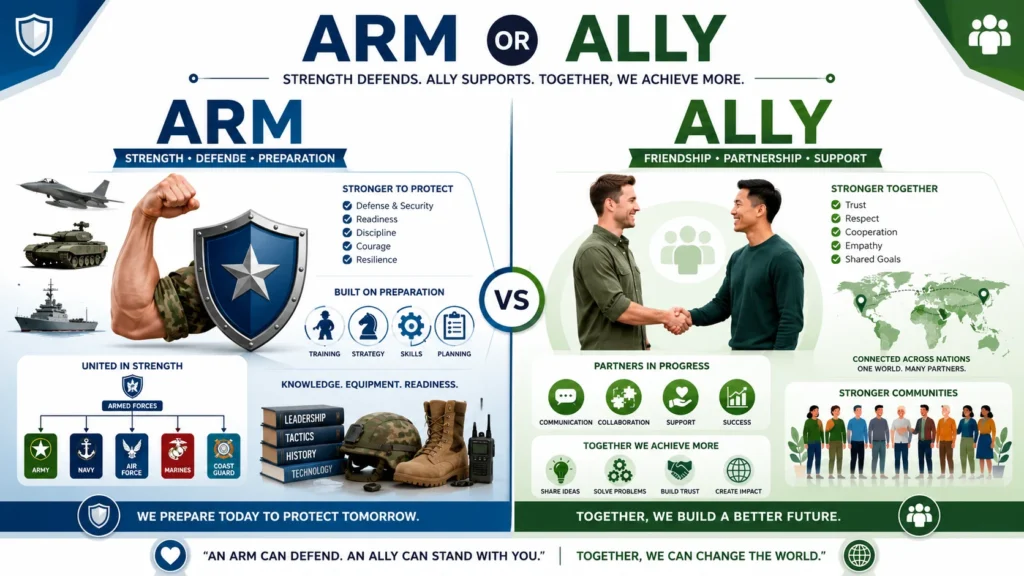
Arm and ally are two very different English words. Arm usually refers to a body part or a weapon, while ally refers to a friend, supporter, or partner who provides help and cooperation. Understanding the difference between arm or ally helps you avoid common vocabulary mistakes in writing and conversation.
English has many words that sound somewhat similar or appear in similar contexts but have completely different meanings. One such pair is arm and ally. Although these words are not commonly confused because of pronunciation, learners sometimes use them incorrectly when discussing support, defense, military topics, partnerships, or relationships.
Knowing when to use arm and when to use ally is important for clear communication. A small mistake can completely change the meaning of a sentence. For example, saying a country is an “arm” of another nation is very different from saying it is an “ally.”
This guide explains the meaning, usage, examples, advantages, disadvantages, common mistakes, and practical exercises related to arm or ally. Whether you are a student, writer, business professional, or English learner, this article will help you understand the difference clearly and use both words with confidence.
Quick Answer
The difference between arm and ally is simple:
| Word | Meaning | Part of Speech |
|---|---|---|
| Arm | A body part, a weapon, or to equip with weapons | Noun or Verb |
| Ally | A friend, supporter, partner, or cooperating nation | Noun or Verb |
Examples
Arm
- He injured his arm while playing football.
- The soldiers carried an arm for protection.
- The government decided to arm the troops.
Ally
- Canada is a close ally of the United States.
- She became an ally of environmental groups.
- Several companies allied together to complete the project.
In short:
- Arm = weapon, body part, or equip with weapons
- Ally = supporter, friend, or partner
Understanding the Word Arm
Definition of Arm
The word arm has multiple meanings depending on context.
As a noun, it can refer to:
- The upper limb of the human body
- A weapon
- A branch or division of an organization
As a verb, it means:
- To provide weapons
- To prepare someone for action
Arm as a Body Part
This is the most common meaning.
Examples:
- My arm hurts after lifting heavy boxes.
- She waved her arm to get attention.
- The child broke his arm during the game.
Arm as a Weapon
In military and legal contexts, arm often means a weapon.
Examples:
- The law regulates the possession of arms.
- Citizens were prohibited from carrying arms.
Arm as a Verb
Examples:
- The nation decided to arm its military forces.
- The guards were armed with rifles.
- Education can arm people with knowledge.
Notice that “arm” can also be used figuratively.
Example:
- Experience armed her with confidence.
Understanding the Word Ally
Definition of Ally
An ally is a person, group, organization, or country that supports another.
The relationship is usually based on cooperation, shared goals, or mutual benefit.
Ally as a Noun
Examples:
- He became a strong ally in the campaign.
- The company found an ally in local investors.
- The country relies on its allies during conflicts.
Ally as a Verb
The verb form means to join forces.
Examples:
- Several businesses allied together.
- The nations allied against a common threat.
- Environmental groups allied with scientists.
Characteristics of an Ally
An ally often:
- Provides support
- Shares interests
- Works toward common goals
- Offers protection or assistance
- Maintains cooperation
Arm or Ally: Comparison Table
| Feature | Arm | Ally |
|---|---|---|
| Primary Meaning | Body part or weapon | Supporter or partner |
| Part of Speech | Noun and verb | Noun and verb |
| Military Use | Weapon or equip with weapons | Friendly nation |
| Business Use | Rare | Common |
| Human Relationship | Not usually | Common |
| Cooperation Meaning | No | Yes |
| Support Meaning | Indirect | Direct |
| Example | Arm the soldiers | Ally with partners |
Origins of Arm and Ally
Origin of Arm
The word arm comes from Latin arma, meaning weapons or military equipment.
Over time, it also became associated with the human limb because it is used to wield weapons and tools.
Origin of Ally
The word ally comes from Old French alier, meaning to unite or combine.
Its root emphasizes partnership and cooperation.
This historical difference explains why the meanings remain distinct today.
Real World Examples of Arm
In Healthcare
- The doctor examined the patient’s arm.
- She injured her left arm.
In Sports
- The pitcher has a strong throwing arm.
- He strained his arm during practice.
In Military Contexts
- The nation chose to arm its forces.
- The soldiers carried modern arms.
In Business and Education
- Training can arm employees with valuable skills.
- Research arms companies with useful data.
Real World Examples of Ally
International Relations
Countries often rely on allies.
Examples:
- The United Kingdom is a long standing ally of many Western nations.
- Military allies cooperate during crises.
Business
- The startup found an ally in a major investor.
- Strategic allies can increase market reach.
Social Causes
- Community leaders became allies of education reform.
- Many organizations act as allies for human rights.
Personal Relationships
- A true friend can be a strong ally.
- Parents are often allies of their children.
Advantages and Disadvantages of Being an Ally
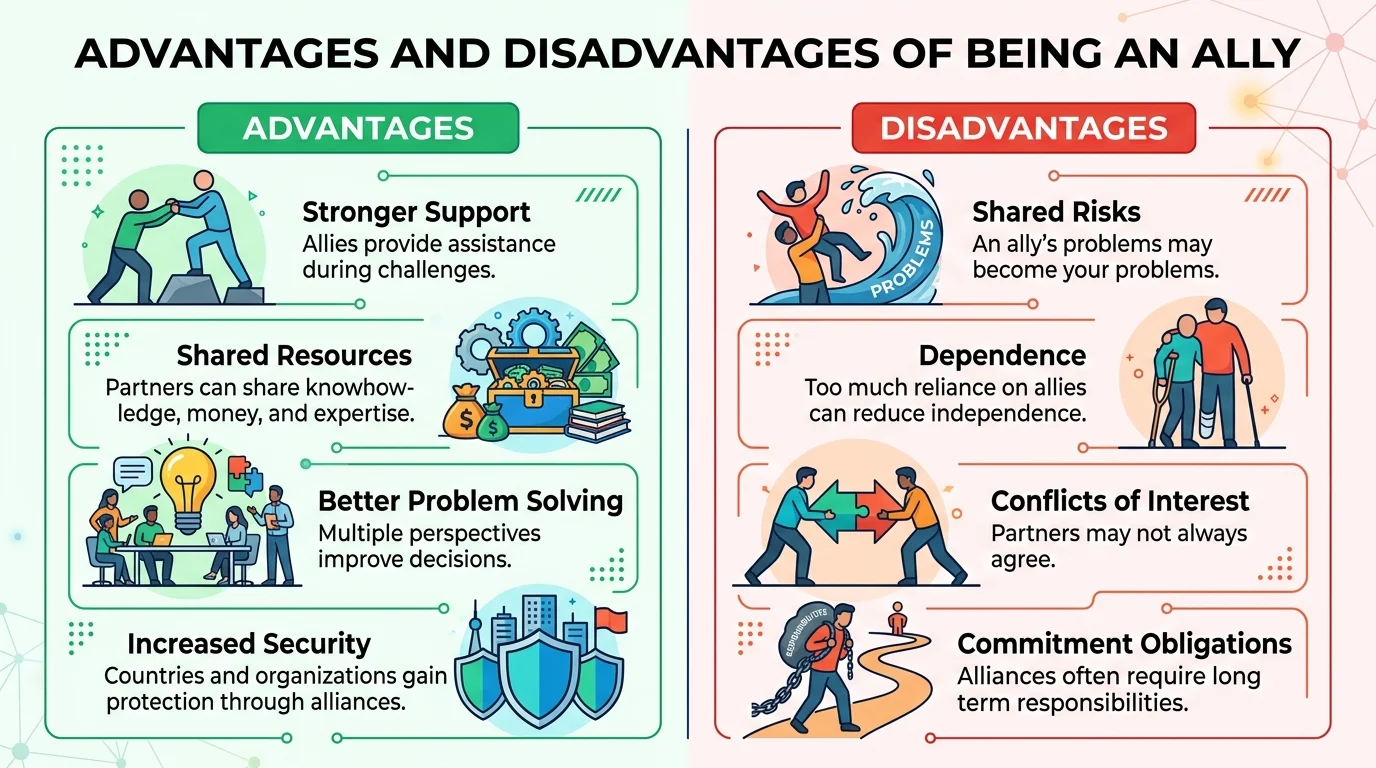
Advantages
Stronger Support
Allies provide assistance during challenges.
Shared Resources
Partners can share knowledge, money, and expertise.
Better Problem Solving
Multiple perspectives improve decisions.
Increased Security
Countries and organizations gain protection through alliances.
Disadvantages
Shared Risks
An ally’s problems may become your problems.
Dependence
Too much reliance on allies can reduce independence.
Conflicts of Interest
Partners may not always agree.
Commitment Obligations
Alliances often require long term responsibilities.
Advantages and Disadvantages of Arming
Advantages
- Improved security
- Better defense capability
- Increased preparedness
- Enhanced protection
Disadvantages
- Higher costs
- Potential escalation of conflict
- Increased risk of misuse
- Greater responsibility
Arm or Ally in International Politics
The distinction becomes especially important in global affairs.
Arm
When discussing nations, arm usually means supplying weapons.
Example:
- The government decided to arm its military.
Ally
An ally is a friendly nation working toward common objectives.
Example:
- The country remains a key ally in the region.
Example Comparison
Incorrect:
- Germany is an arm of France.
Correct:
- Germany is an ally of France.
The second sentence expresses cooperation, while the first changes the meaning completely.
Arm or Ally in Business
Arm
In business, arm often refers to a branch or division.
Examples:
- The research arm of the company released a report.
- The marketing arm handles advertising.
Ally
In business, an ally is a partner.
Examples:
- The startup found an ally in a technology company.
- Strategic allies help expand operations.
Arm or Ally in Social Movements
Arm
Used metaphorically.
Example:
- Education can arm people with knowledge.
Ally
Used literally.
Example:
- Community members became allies of the movement.
In social causes, ally is much more common.
Regional and Global Usage
United States
Both words are frequently used.
Examples:
- Right to bear arms
- International allies
United Kingdom
The meanings remain the same.
Examples:
- Armed forces
- Political allies
Canada
Common in government, education, and media.
Examples:
- Armed personnel
- Allied nations
Australia
Both words are widely understood and used in identical ways.
Global English
English speakers around the world use these meanings consistently.
Unlike some vocabulary differences between American and British English, arm and ally have largely universal meanings.
Common Mistakes with Arm or Ally
Mistake 1
Incorrect:
- She became my arm during the project.
Correct:
- She became my ally during the project.
Mistake 2
Incorrect:
- The country allied the soldiers.
Correct:
- The country armed the soldiers.
Mistake 3
Incorrect:
- The weapon was a strong ally.
Correct:
- The weapon was a useful arm.
Mistake 4
Incorrect:
- The company’s ally department released a report.
Correct:
- The company’s research arm released a report.
Mistake 5
Incorrect:
- We need more arms in the partnership.
Correct:
- We need more allies in the partnership.
Memory Trick for Arm or Ally
A simple way to remember the difference:
Arm
Think of:
- Arm = body part
- Arm = weapon
- Arm = equip
Ally
Think of:
- Ally = assistance
- Ally = friend
- Ally = partner
A useful phrase:
An ally helps you. An arm equips you.
Related Concepts and Comparisons
Friend vs Ally
| Friend | Ally |
|---|---|
| Personal relationship | Goal oriented support |
| Emotional connection | Strategic cooperation |
| Informal | Often formal |
Partner vs Ally
| Partner | Ally |
|---|---|
| Shared ownership | Shared support |
| Business focus | Broader cooperation |
| Equal involvement | Can vary |
Arm vs Weapon
| Arm | Weapon |
|---|---|
| Broader term | Specific object |
| Can be a verb | Usually a noun |
| Includes military usage | Refers directly to tools of combat |
Ally vs Supporter
| Ally | Supporter |
|---|---|
| Active cooperation | May simply agree |
| Often strategic | Can be passive |
| Mutual goals | Not always mutual |
Exercises with Answers
Exercise 1
Choose the correct word.
- The nation decided to _____ its military.
- She became an important _____ in the campaign.
- I injured my _____ while exercising.
- The companies decided to _____ together.
- The research _____ published a study.
Answers
- arm
- ally
- arm
- ally
- arm
Exercise 2
Fill in the blanks.
- A close friend can be an excellent _____.
- The government chose to _____ the forces.
- The company’s legal _____ handled the issue.
- Several nations became military _____.
- He broke his _____ during the match.
Answers
- ally
- arm
- arm
- allies
- arm
Exercise 3
Identify the mistake.
- The company’s ally released a financial report.
- We need more arms to support the project.
- The nation armed its soldiers.
- Canada is a valuable ally.
Answers
- Should be arm
- Should be allies
- Correct
- Correct
Advanced Usage Notes
Arm as a Metaphor
English frequently uses arm figuratively.
Examples:
- Arm yourself with knowledge.
- Arm yourself with patience.
- Arm yourself with facts.
No weapons are involved.
The meaning is “prepare yourself.”
Ally as a Modern Social Term
Today, ally is often used in discussions about inclusion and social support.
Examples:
- Workplace allies encourage fairness.
- Community allies help vulnerable groups.
- Educational allies support student success.
In these contexts, ally means someone who actively supports others.
FAQs
What is the difference between arm or ally?
An arm is a body part, weapon, or means of preparation, while an ally is a supporter, partner, or friend.
Can arm and ally be used interchangeably?
No. They have completely different meanings and should not be substituted for one another.
Is ally a noun or a verb?
It can be both. As a noun, it means a supporter. As a verb, it means to join forces.
Can arm be used as a verb?
Yes. To arm means to provide weapons or prepare someone with resources or knowledge.
What does military ally mean?
A military ally is a nation that cooperates with another country for defense or strategic goals.
What does arm yourself with knowledge mean?
It means to prepare yourself by learning useful information.
What is an ally in business?
An ally in business is a partner, supporter, or organization that helps achieve common goals.
Can a person be an ally?
Yes. Friends, coworkers, leaders, and community members can all be allies.
What is the plural of ally?
The plural form is allies.
When should I use arm instead of ally?
Use arm when referring to a body part, a weapon, preparation, or a division of an organization. Use ally when referring to support, cooperation, or partnership.
Conclusion
Understanding the difference between arm or ally is essential for accurate English communication. Although these words may appear in similar discussions involving defense, support, organizations, or international relations, their meanings are very different.
Arm refers to a body part, a weapon, a branch of an organization, or the act of equipping someone with tools, resources, or weapons. Ally, on the other hand, refers to a supporter, friend, partner, or cooperating nation working toward shared goals.
The easiest way to remember the distinction is that an ally helps you, while an arm equips you. Whether you are writing about politics, business, education, military affairs, or everyday life, choosing the correct word improves clarity and professionalism.
When in doubt, ask yourself a simple question: Are you talking about support and cooperation? Use ally. Are you talking about a weapon, body part, preparation, or organizational branch? Use arm. Following this rule will help you avoid mistakes and communicate with confidence.

Victoria Lane is a grammar-focused writer at GramBrix.com, passionate about helping readers master the rules of language. She provides clear explanations and practical examples that make writing more accurate, polished and confident.