Last Updated on July 5, 2026
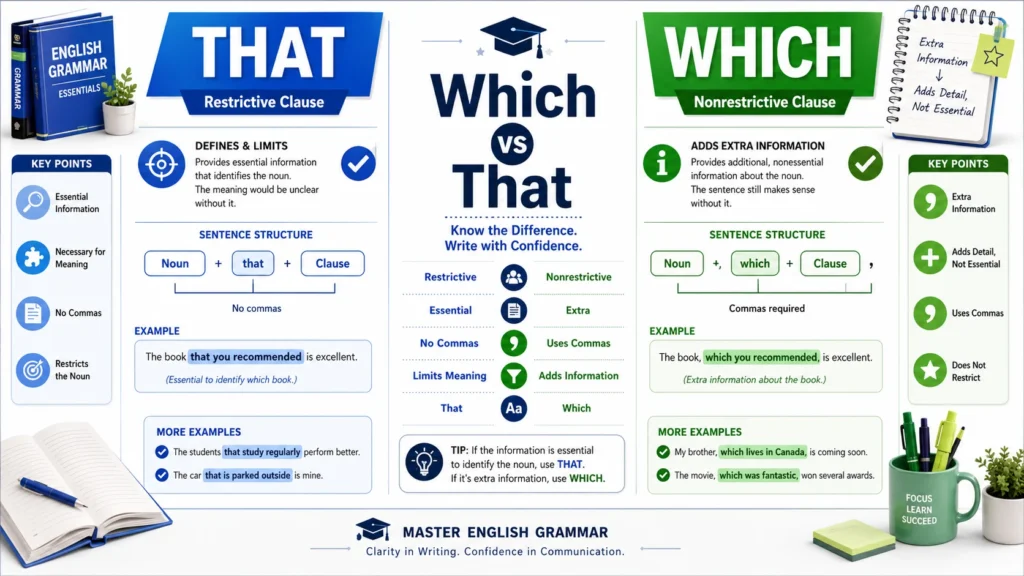
Which or that are relative pronouns used to introduce clauses in a sentence. In formal grammar, that is used for essential information that defines the noun, while which is used for extra information that can be removed without changing the sentence’s core meaning. Understanding the difference helps improve clarity, punctuation, and professional writing.
Many English learners and even native speakers struggle with which or that. At first glance, both words seem to do the same job. They connect ideas and provide more information about a person, thing, or object. Because they often appear in similar sentences, people frequently use them interchangeably.
However, there is an important difference between which and that, especially in formal writing. Choosing the correct word can make your writing clearer, more professional, and easier to understand. It can also help you avoid punctuation mistakes and improve grammar accuracy.
Imagine giving directions to someone. Some details are necessary, while others are simply extra information. The same idea applies to which or that. One introduces information that is essential. The other introduces information that is additional.
Whether you are writing emails, academic papers, business reports, blog posts, or everyday messages, understanding the difference between which or that can significantly improve your communication skills. This guide explains the rules, provides examples, highlights common mistakes, and includes practice exercises to help you master this important grammar topic.
Quick Answer
The simplest rule is:
| Use | Purpose | Example |
|---|---|---|
| That | Essential information | The car that is parked outside belongs to John. |
| Which | Extra information | The car, which is parked outside, belongs to John. |
In American English:
- That usually introduces a restrictive clause.
- Which usually introduces a nonrestrictive clause.
A restrictive clause is necessary to identify the noun.
A nonrestrictive clause adds extra information.
What Are Relative Pronouns?
Before understanding which or that, it helps to know what a relative pronoun is.
A relative pronoun connects a clause to a noun.
Common relative pronouns include:
- Who
- Whom
- Whose
- Which
- That
Example:
- The book that I bought is excellent.
- The book, which I bought yesterday, is excellent.
In both sentences, the pronoun introduces additional information about the book.
Understanding “That”
Definition of That
That introduces information that is essential to the meaning of the sentence.
Without the clause, the sentence would lose important information.
Examples of That
- The laptop that I purchased last week is fast.
- Students that study regularly often achieve better results.
- The movie that won the award was impressive.
In each example, the clause identifies exactly which noun is being discussed.
Why That Is Important
Consider this sentence:
- The cookies that contain nuts are on the top shelf.
This means only the nut-containing cookies are on the top shelf.
Without the clause:
- The cookies are on the top shelf.
The meaning becomes less specific.
Therefore, the clause is essential.
Understanding “Which”
Definition of Which
Which introduces information that is extra or nonessential.
The sentence still makes sense if the clause is removed.
Examples of Which
- My laptop, which I bought last week, is very fast.
- Paris, which is famous for its culture, attracts millions of tourists.
- The meeting, which lasted three hours, was productive.
The information provides additional detail but is not required to identify the noun.
Why Which Is Important
Consider this sentence:
- My car, which is blue, needs repairs.
Even without the clause:
- My car needs repairs.
The main meaning remains unchanged.
Restrictive vs Nonrestrictive Clauses
The distinction between restrictive and nonrestrictive clauses is the key to understanding which or that.
Restrictive Clause
A restrictive clause identifies a specific noun.
Example:
- The employees that completed the training received certificates.
Only certain employees completed the training.
The clause is essential.
Nonrestrictive Clause
A nonrestrictive clause adds extra information.
Example:
- The employees, which had already completed similar courses, adapted quickly.
The clause provides additional details.
The sentence remains understandable without it.
Comparison Table
| Feature | That Clause | Which Clause |
|---|---|---|
| Essential information | Yes | No |
| Can be removed | No | Yes |
| Uses commas | No | Yes |
| Common in formal American English | Yes | Yes |
| Identifies noun | Yes | Usually no |
Which or That in American English
American style guides strongly support a distinction between which and that.
Examples:
Correct:
- The report that contains financial data is confidential.
- The report, which contains financial data, was published yesterday.
The first sentence identifies a specific report.
The second sentence assumes the report is already known and adds extra information.
Many editors follow this rule because it reduces ambiguity.
Which or That in British English
British English is more flexible.
Writers sometimes use which in restrictive clauses.
Example:
- The house which stands near the river is beautiful.
This is generally acceptable in British English.
However, many British writers still follow the restrictive and nonrestrictive distinction because it improves clarity.
Why Commas Matter
Commas often determine whether which or that should be used.
Without Commas
- The employees that arrived early received bonuses.
Only some employees received bonuses.
With Commas
- The employees, which arrived early, received bonuses.
This sentence sounds awkward because “which” normally refers to things rather than people.
A better version:
- The employees, who arrived early, received bonuses.
Key Rule
If commas surround the clause, which is often appropriate.
If no commas appear, that is usually appropriate.
Real World Examples of Which or That
Business Writing
- The proposal that addresses customer concerns was approved.
- The proposal, which was submitted yesterday, was approved.
Academic Writing
- The research that focuses on climate change gained attention.
- The research, which was published in 2025, gained attention.
Technology
- The software that prevents malware should be updated.
- The software, which was released last month, has new features.
Everyday Conversation
- The jacket that you borrowed is in my closet.
- My jacket, which you borrowed last week, is in my closet.
Which or That in Professional Writing
Professional writers often prefer precise grammar.
Using that for essential information and which for extra information creates:
- Better readability
- Greater clarity
- Stronger sentence structure
- Fewer misunderstandings
Editors frequently recommend this approach.
Advantages and Disadvantages
Advantages of Using That Correctly
- Clear identification of nouns
- Less ambiguity
- Preferred in many style guides
- Improves precision
Disadvantages of Overusing That
- Can make sentences feel repetitive
- Sometimes unnecessary in casual writing
Advantages of Using Which Correctly
- Adds useful details
- Creates smoother sentence flow
- Supports descriptive writing
Disadvantages of Misusing Which
- Can confuse readers
- May create grammatical ambiguity
- Often requires punctuation knowledge
Common Mistakes with Which or That
Using Which Without Commas
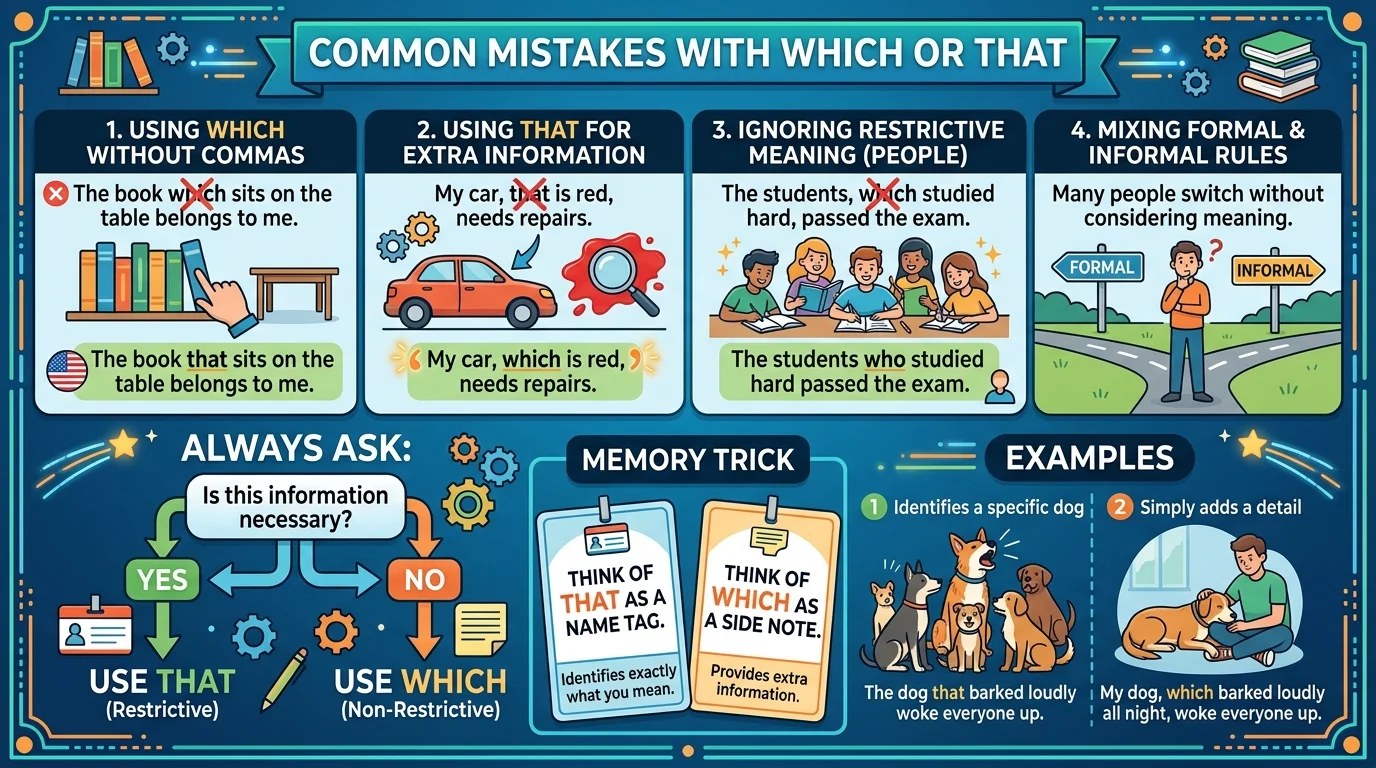
Incorrect:
- The book which sits on the table belongs to me.
Preferred American English:
- The book that sits on the table belongs to me.
Using That for Extra Information
Incorrect:
- My car, that is red, needs repairs.
Correct:
- My car, which is red, needs repairs.
Ignoring Restrictive Meaning
Incorrect:
- The students, which studied hard, passed the exam.
Correct:
- The students who studied hard passed the exam.
Mixing Formal and Informal Rules
Many people switch between the two forms without considering meaning.
Always ask:
“Is this information necessary?”
If yes, use that.
If no, use which.
Easy Memory Trick
Think of that as a name tag.
It identifies exactly what you mean.
Think of which as a side note.
It provides extra information.
Example:
- The dog that barked loudly woke everyone up.
- My dog, which barked loudly all night, woke everyone up.
The first identifies a specific dog.
The second simply adds a detail.
Which or That in Different Types of Writing
Academic Writing
Formal grammar is important.
Example:
- The theory that explains the phenomenon remains widely accepted.
Business Reports
Precision matters.
Example:
- The department that handles customer complaints will review the issue.
Journalism
Writers often follow strict style guides.
Example:
- The policy that affects small businesses was introduced Monday.
Blog Writing
Rules may be relaxed, but clarity remains important.
Example:
- The article that discusses SEO strategies received thousands of views.
Related Concepts and Comparisons
Which vs Who
Use who for people.
- The teacher who helped me was kind.
Use which for things.
- The computer which crashed yesterday has been repaired.
Which vs What
Which implies choice from known options.
- Which color do you prefer?
What is more open-ended.
- What color do you prefer?
That vs Who
For people:
- The person who called earlier left a message.
Informally:
- The person that called earlier left a message.
Both may be acceptable, but who is often preferred.
Which vs Whose
Which refers to things.
Whose indicates possession.
- The company whose profits increased expanded rapidly.
Advanced Grammar Considerations
Omitting That
Sometimes that can be omitted.
Example:
- The book that I bought is excellent.
- The book I bought is excellent.
Both are correct.
When Which Cannot Replace That
In restrictive clauses, many formal style guides prefer that.
Example:
- The software that solves the problem is expensive.
Using which may sound less precise in American English.
Formal Editing Standards
Many editors use this process:
- Identify the clause.
- Determine whether it is essential.
- Use that if essential.
- Use which if nonessential.
- Add commas around nonessential clauses.
Practice Exercises
Exercise 1
Choose which or that.
- The house _____ has a red roof is mine.
- My house, _____ has a red roof, is easy to find.
- The book _____ explains grammar is helpful.
- The museum, _____ opened in 1920, attracts tourists.
- The phone _____ I bought yesterday is expensive.
Answers
- that
- which
- that
- which
- that
Exercise 2
Correct the sentence.
- My car, that is blue, needs washing.
- The report which contains the budget is confidential.
- The laptop, that I bought last week, works perfectly.
- The policy which affects all employees was updated.
- The building, that was constructed in 1900, remains famous.
Answers
- My car, which is blue, needs washing.
- The report that contains the budget is confidential.
- The laptop, which I bought last week, works perfectly.
- The policy that affects all employees was updated.
- The building, which was constructed in 1900, remains famous.
Exercise 3
Identify the Clause Type
| Sentence | Restrictive or Nonrestrictive |
|---|---|
| The car that needs repairs is mine. | Restrictive |
| My car, which needs repairs, is mine. | Nonrestrictive |
| The employee that won the award is absent. | Restrictive |
| The employee, which won the award, is absent. | Incorrect usage |
| The software that prevents viruses is useful. | Restrictive |
FAQs
Which or that: what is the main difference?
That introduces essential information. Which introduces extra information that can usually be removed without changing the main meaning.
Can I use which instead of that?
In British English, sometimes yes. In formal American English, that is preferred for restrictive clauses.
Do I need commas with which?
Usually yes. Nonrestrictive clauses introduced by which are typically surrounded by commas.
Can that and which be interchangeable?
Sometimes in casual writing. However, following the restrictive versus nonrestrictive rule improves clarity.
Which or that in academic writing?
Most academic writers use that for essential clauses and which for nonessential clauses.
Why do editors prefer that?
Editors value precision. Using that for restrictive clauses reduces ambiguity.
Can which refer to people?
Generally no. Use who or whom for people.
Can I omit that in a sentence?
Often yes. For example, “The book I bought” is acceptable instead of “The book that I bought.”
Which or that in British English?
British English is more flexible and may allow which in restrictive clauses, though many writers still prefer the distinction.
How can I remember which or that easily?
Remember: that identifies, while which adds information. Think of that as essential and which as extra.
Conclusion
Understanding which or that is one of the most useful grammar skills in English. Although both words introduce relative clauses, they serve different purposes. That is generally used for essential information that identifies a noun, while which is used for additional information that can be removed without changing the sentence’s core meaning.
The key to mastering this topic is understanding the difference between restrictive and nonrestrictive clauses. If the information is necessary, choose that. If it is extra information, choose which and use commas appropriately. This simple rule improves clarity, professionalism, and readability.
Whether you are writing business emails, academic papers, website content, reports, or everyday messages, using which or that correctly helps readers understand exactly what you mean. Practice with real examples, review common mistakes, and pay attention to punctuation. Over time, the distinction will become natural, making your writing more polished and effective.

Kevin Brooks is a grammar specialist at GramBrix.com, dedicated to helping readers understand language rules with clarity and confidence. He simplifies complex grammar concepts through practical examples and easy explanations.