
Last Updated on July 17, 2026
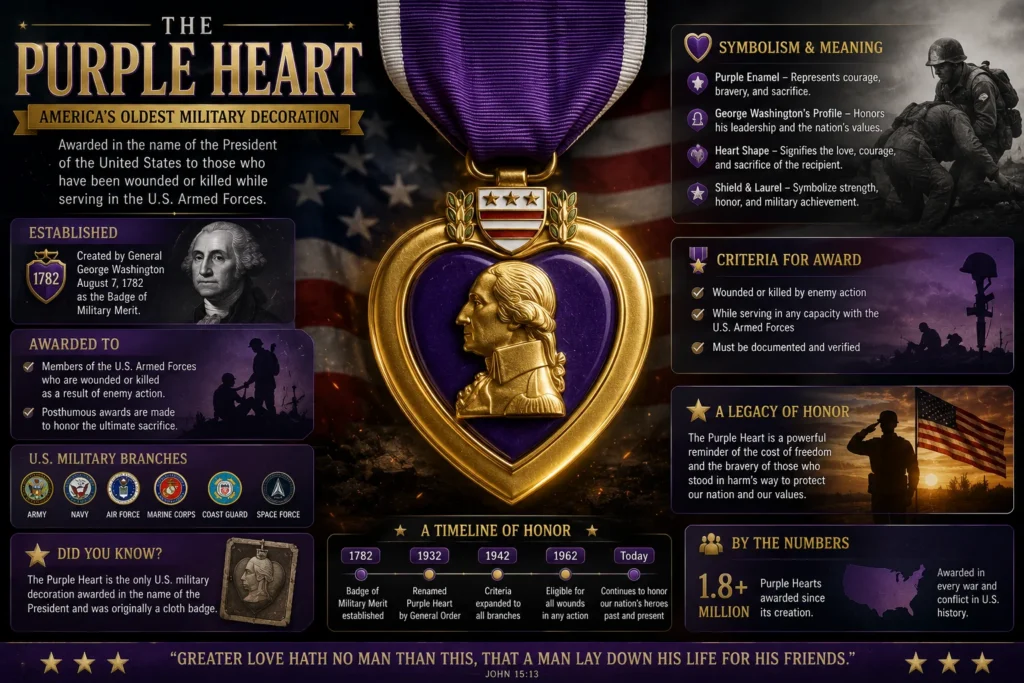
The Purple Heart is a United States military decoration awarded to service members who are wounded, injured, or killed as a result of enemy action while serving in the U.S. Armed Forces. It symbolizes sacrifice, courage, duty, and service to the nation.
The phrase Purple Heart meaning often sparks curiosity among people who see the medal mentioned in military stories, news reports, historical documentaries, or veterans’ conversations. Unlike many military awards that recognize achievement or leadership, the Purple Heart honors something deeply personal: sacrifice.
For generations, Americans have viewed the Purple Heart as one of the nation’s most respected military decorations. It recognizes service members who suffered wounds or lost their lives while defending their country. Therefore, the medal carries powerful emotional significance for military families, veterans, and citizens alike.
In this comprehensive guide, you’ll learn the complete Purple Heart meaning, its history, eligibility rules, symbolism, military importance, cultural impact, common misconceptions, modern usage, and much more.
Quick Answer Box
| Category | Details |
|---|---|
| Meaning | Military award for those wounded or killed in combat |
| Origin | Established by George Washington in 1782 |
| Primary Context | U.S. military honors |
| Symbolism | Sacrifice, bravery, service, patriotism |
| Awarded To | Service members injured or killed by enemy action |
| Common Usage | Military recognition, historical discussions, veteran communities |
| Tone | Respectful, honorable, solemn |
| Example | “My grandfather received a Purple Heart during World War II.” |
What Does It Mean?
The Purple Heart is a prestigious U.S. military medal awarded to members of the Armed Forces who are wounded, injured, or killed as a direct result of enemy action.
Unlike medals awarded for exceptional performance or leadership, the Purple Heart specifically recognizes physical sacrifice suffered in military service.
In simple terms, receiving a Purple Heart means a service member paid a personal price while defending the United States.
Key elements of the Purple Heart meaning include:
- Combat-related injury
- Enemy-caused wounds
- Military sacrifice
- National service
- Honor and recognition
- Courage under hostile conditions
Because of these factors, many Americans consider the Purple Heart one of the most emotionally significant military decorations.
Full Definition
The official meaning of the Purple Heart centers on recognizing military personnel who:
- Were wounded by enemy action
- Were injured due to hostile forces
- Died in combat
- Died from wounds received during combat
- Suffered qualifying combat-related injuries
The award applies to members of:
- U.S. Army
- U.S. Navy
- U.S. Marine Corps
- U.S. Air Force
- U.S. Coast Guard
- U.S. Space Force
Furthermore, the Purple Heart differs from achievement-based medals because eligibility depends on injury or death resulting from hostile action rather than personal accomplishment alone.
Why Is It Called the Purple Heart?
The medal features a purple heart-shaped design. The color purple historically symbolizes courage, honor, dignity, and sacrifice.
Meanwhile, the heart shape represents devotion, commitment, and personal sacrifice for one’s nation.
Together, these elements create one of the most recognizable symbols in American military history.
What Does Receiving a Purple Heart Signify?
Receiving a Purple Heart signifies:
- A willingness to serve despite danger
- Personal sacrifice for national defense
- Endurance through hardship
- Recognition by the nation
- Permanent acknowledgment of service-related suffering
Therefore, many veterans view the award not as a badge of achievement but as evidence of sacrifice.
Context and Usage
The term “Purple Heart” appears in various contexts throughout American society.
Military Context
This remains the most common usage.
Examples:
- “She received a Purple Heart after being wounded in Afghanistan.”
- “The soldier earned two Purple Hearts during his military career.”
Historical Context
Historians frequently discuss Purple Heart recipients when covering wars.
Examples include:
- World War II
- Korean War
- Vietnam War
- Gulf War
- Iraq War
- Afghanistan War
Veteran Communities
Veterans often mention the Purple Heart when discussing military experiences, recovery, or service.
News and Media
Journalists regularly reference Purple Heart recipients in stories involving military service, heroism, or remembrance ceremonies.
Educational Context
Teachers and museums often explain the Purple Heart while discussing American military history.
Real-Life Examples
Conversation Example 1
Person A: Was your grandfather in the military?
Person B: Yes. He served during World War II and received a Purple Heart after being wounded in France.
Conversation Example 2
Person A: Why is that medal so important?
Person B: Because the Purple Heart recognizes soldiers who were injured or killed by enemy forces.
Conversation Example 3
Student: What does a Purple Heart mean?
Teacher: It means the service member suffered wounds during combat and received official recognition from the U.S. military.
Conversation Example 4
Reporter: The veteran displayed several military medals.
Veteran: The Purple Heart means the most to me because it represents sacrifice.
Conversation Example 5
Friend: I saw a Purple Heart license plate.
Veteran: Those plates are often issued to Purple Heart recipients as recognition of their service.
Platform-Specific Meaning
Although the Purple Heart is primarily a military term, discussions occur across many digital platforms.
On Facebook, users often post Purple Heart stories during:
- Memorial Day
- Veterans Day
- Military appreciation events
- Family remembrance posts
Example:
“My father received a Purple Heart during the Vietnam War. We honor his service today.”
Instagram posts commonly feature:
- Medal photographs
- Veteran tributes
- Historical images
- Military memorials
The Purple Heart usually symbolizes honor and remembrance.
X (Formerly Twitter)
Users often discuss Purple Heart recipients during military commemorations and national events.
YouTube
Military history channels frequently explain:
- Purple Heart history
- Medal eligibility
- Recipient stories
- Battlefield accounts
TikTok
Creators often share educational videos explaining military awards, including the Purple Heart.
Many videos focus on:
- Historical facts
- Veteran interviews
- Military traditions
- Award significance
Military and history communities frequently discuss:
- Purple Heart qualifications
- Personal experiences
- Historical recipient stories
- Military culture
The History of the Purple Heart
Understanding the Purple Heart meaning requires understanding its fascinating history.
George Washington’s Original Badge
The Purple Heart traces its roots to 1782.
General George Washington created the Badge of Military Merit during the American Revolutionary War.
At the time, military honors were often reserved for officers. Washington wanted enlisted soldiers to receive recognition as well.
This decision was revolutionary because it acknowledged ordinary service members.
Revival in the 20th Century
Although the original award disappeared for many years, military leaders revived the concept in 1932.
The modern Purple Heart was established on the 200th anniversary of George Washington’s birth.
Since then, it has remained a permanent military decoration.
Purple Hearts Through American Wars
The award has recognized sacrifice in:
- World War I
- World War II
- Korean War
- Vietnam War
- Persian Gulf War
- Iraq War
- Afghanistan War
- Other military operations
As a result, millions of Americans recognize the Purple Heart as a symbol of military sacrifice.
Symbolism Behind the Purple Heart
The Purple Heart contains several symbolic elements.
Purple Color
Purple traditionally represents:
- Courage
- Nobility
- Honor
- Dignity
- Respect
Heart Shape
The heart symbolizes:
- Commitment
- Loyalty
- Devotion
- Personal sacrifice
George Washington’s Image
The medal features George Washington, connecting recipients to the nation’s founding principles.
Gold Elements
The gold details represent excellence, service, and national gratitude.
Together, these design elements create a powerful symbol of military sacrifice.
Alternative Meanings
While the Purple Heart primarily refers to the military medal, the phrase occasionally appears in broader cultural contexts.
Symbol of Sacrifice
Some people use “Purple Heart” metaphorically to describe personal sacrifice.
Example:
“He deserves a Purple Heart for dealing with that project.”
However, many veterans discourage casual usage because the award carries significant military meaning.
Charity and Veteran Organizations
Several organizations use the Purple Heart name to support veterans and military families.
Cultural References
Books, films, and television programs often reference Purple Hearts when portraying military service.
Nevertheless, the primary meaning remains the military decoration.
Related Terms and NLP Variations
People searching for Purple Heart meaning often look for related terms.
Military Award Synonyms
- Military medal
- Combat decoration
- Service award
- Combat injury medal
- Military honor
Related Military Decorations
- Medal of Honor
- Silver Star
- Bronze Star
- Distinguished Service Cross
- Navy Cross
- Air Force Cross
Related Search Queries
- What is a Purple Heart?
- Purple Heart definition
- Purple Heart military award
- Purple Heart eligibility
- Purple Heart symbolism
- Purple Heart history
- Purple Heart recipient meaning
- Purple Heart significance
Associated Concepts
- Patriotism
- Military service
- Combat injury
- Veteran recognition
- National defense
- Heroism
- Sacrifice
How to Respond or Reply
Sometimes people hear someone mention a Purple Heart and wonder how to respond appropriately.
If Someone Says They Received a Purple Heart
Respectful responses include:
- “Thank you for your service.”
- “I appreciate your sacrifice.”
- “That’s a tremendous honor.”
- “Thank you for what you’ve done for our country.”
If Discussing a Family Member
Examples:
- “Your family must be proud.”
- “That’s an important part of your family’s history.”
- “What an incredible legacy.”
If Reading About a Recipient
Appropriate reactions include:
- Respect
- Gratitude
- Recognition
- Reflection
Because the Purple Heart relates to injury or death, responses should remain respectful and sincere.
Misinterpretations
Several misconceptions surround the Purple Heart.
Misconception 1: It Is Given for Bravery Alone
Not exactly.
A service member can act bravely without receiving a Purple Heart.
The award specifically requires qualifying wounds or death resulting from enemy action.
Misconception 2: Every Combat Veteran Receives One
False.
Many combat veterans never receive a Purple Heart because they were not wounded by enemy action.
Misconception 3: It Is the Highest Military Award
Incorrect.
The Medal of Honor ranks above the Purple Heart in military precedence.
Misconception 4: Only Army Soldiers Receive It
False.
All branches of the U.S. Armed Forces may award the Purple Heart.
Misconception 5: Any Injury Qualifies
Incorrect.
The injury must meet specific military criteria and connect directly to hostile action.
When Not to Use It
Although the Purple Heart appears in casual conversations, some situations require caution.
Avoid Trivial Comparisons
For example:
- “I deserve a Purple Heart after shopping all day.”
Many people view such statements as disrespectful.
Avoid Mocking References
Because the award recognizes sacrifice and injury, jokes can appear insensitive.
Avoid Political Misuse
The Purple Heart should not become a tool for minimizing the experiences of recipients.
Avoid Incorrect Assumptions
Never assume someone received a Purple Heart simply because they served in combat.
Usage Tips
Use Respectful Language
When discussing Purple Heart recipients, maintain a respectful tone.
Understand the Context
Recognize that every Purple Heart represents a real injury or loss.
Learn Basic Eligibility Rules
This knowledge helps avoid misunderstandings.
Use Accurate Terminology
Say:
- Purple Heart recipient
- Purple Heart medal
- Purple Heart award
Avoid vague or inaccurate descriptions.
Recognize Its Emotional Weight
For many families, the Purple Heart represents painful memories as well as honor.
Therefore, sensitivity matters.
Purple Heart in Modern American Culture
The Purple Heart remains highly respected in modern society.
Veterans’ organizations, schools, museums, and government institutions continue to educate Americans about its significance.
Meanwhile, many cities earn recognition as “Purple Heart Cities” to honor military service members.
In addition, sports teams, nonprofits, and community groups frequently hold ceremonies recognizing recipients.
As a result, the Purple Heart remains an enduring symbol of sacrifice and patriotism.
Purple Heart vs. Other Military Awards
Purple Heart vs. Medal of Honor
Purple Heart:
- Awarded for wounds or death
- Focuses on sacrifice
Medal of Honor:
- Awarded for extraordinary heroism
- Highest U.S. military decoration
Purple Heart vs. Bronze Star
Purple Heart:
- Requires combat-related injury
Bronze Star:
- Recognizes achievement or heroic service
Purple Heart vs. Silver Star
Purple Heart:
- Centers on wounds received
Silver Star:
- Recognizes gallantry in action
These distinctions help explain why the Purple Heart occupies a unique place among military decorations.
FAQs
What is the Purple Heart meaning?
The Purple Heart is a U.S. military decoration awarded to service members wounded, injured, or killed because of enemy action.
Why is the Purple Heart important?
It recognizes personal sacrifice and honors those who suffered injuries while serving their country.
Who can receive a Purple Heart?
Eligible members of the U.S. Armed Forces who meet combat injury requirements can receive the award.
Is the Purple Heart awarded after death?
Yes. The military may award the Purple Heart posthumously to service members killed by enemy action.
Does every wounded soldier receive a Purple Heart?
If the injury meets official eligibility standards and results from hostile action, the service member may qualify.
Can civilians receive a Purple Heart?
Generally, no. The award is reserved for members of the U.S. Armed Forces.
What does the purple color symbolize?
Purple traditionally symbolizes honor, courage, dignity, and sacrifice.
Is the Purple Heart still awarded today?
Yes. The U.S. military continues awarding the Purple Heart to qualifying service members.
What war had the most Purple Heart recipients?
World War II produced one of the largest numbers of Purple Heart recipients due to the scale of combat operations.
What should you say to a Purple Heart recipient?
A respectful acknowledgment such as “Thank you for your service” or “Thank you for your sacrifice” is generally appropriate.
Conclusion
The Purple Heart meaning extends far beyond a military medal. It represents sacrifice, courage, resilience, and service to the United States. Unlike awards based solely on achievement, the Purple Heart recognizes the personal cost of defending a nation.
Its history reaches back to George Washington, while its legacy continues through every generation of American service members. Whether encountered in military history, family stories, veteran communities, or national ceremonies, the Purple Heart remains one of the most respected symbols of honor in the United States.
Above all, the Purple Heart serves as a lasting reminder that freedom often comes at a personal cost. Therefore, every recipient’s story reflects dedication, sacrifice, and commitment to something larger than themselves.

Kevin Brooks is a grammar specialist at GramBrix.com, dedicated to helping readers understand language rules with clarity and confidence. He simplifies complex grammar concepts through practical examples and easy explanations.