Last Updated on July 6, 2026
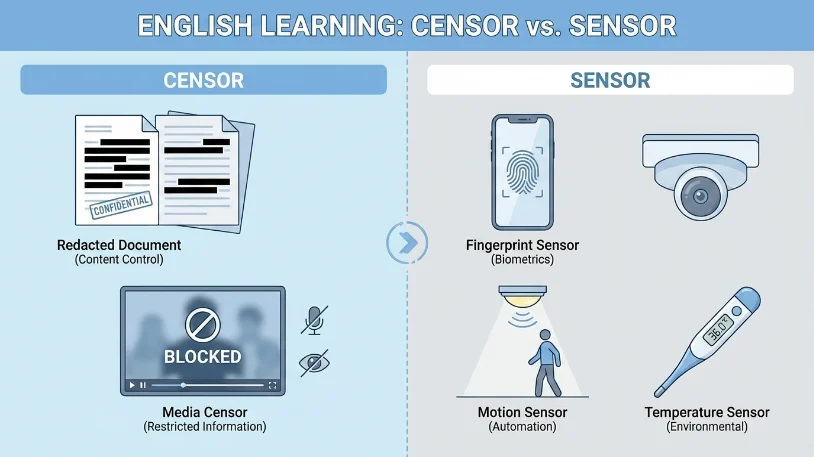
“Censor” and “sensor” may sound similar, but they have completely different meanings. A censor blocks, removes, or controls information, while a sensor detects changes like light, heat, motion, or pressure in devices and machines.
English has many words that sound alike but mean very different things. “Censor” and “sensor” are a perfect example. People often confuse them because they are pronounced almost the same. But using the wrong one can completely change the meaning of a sentence.
Imagine writing, “The phone has a powerful censor.” That sounds strange because phones use sensors, not censors. On the other hand, governments or media companies may censor content, not sensor it.
This confusion is common among students, writers, bloggers, and even professionals. The good news is that the difference is actually simple once you understand it.
In this guide, you’ll learn the meaning of censor or sensor in plain English. We’ll cover definitions, examples, comparisons, mistakes people make, and practical exercises to help you remember the correct word every time.
Quick Answer / Overview
Here’s the simplest way to remember the difference:
| Word | Meaning | Example |
|---|---|---|
| Censor | To block or remove information | The movie was censored |
| Sensor | A device that detects something | The phone sensor stopped working |
Easy Memory Trick
- Censor = control content
- Sensor = detect signals
What Does “Censor” Mean?
The word “censor” is connected to controlling information.
A censor can:
- Remove content
- Hide information
- Block speech
- Restrict media
It is often related to:
- Governments
- Social media
- TV channels
- Schools
- News organizations
Simple Example
A TV station may censor bad language during a live show.
That means they remove or mute certain words.
Common Uses of Censor
- Censor a movie
- Censor online content
- Censor political speech
- Self-censorship
“Censor” as a Noun
A censor can also be a person or organization that controls information.
Example:
The government censor removed parts of the article.
What Does “Sensor” Mean?
A sensor is a device that detects changes in the environment.
Sensors are used in:
- Smartphones
- Cars
- Cameras
- Smart homes
- Medical equipment
They collect information and send signals.
Examples of Sensors
- Temperature sensor
- Motion sensor
- Fingerprint sensor
- Light sensor
- Smoke sensor
Simple Example
Your phone screen becomes brighter outside because the light sensor detects sunlight.
Censor vs Sensor: Main Differences
| Feature | Censor | Sensor |
|---|---|---|
| Type | Person, action, or system | Electronic device |
| Purpose | Control information | Detect changes |
| Used In | Media, politics, internet | Technology, science |
| Related To | Speech and content | Signals and data |
| Example | Censoring a film | Motion sensor in lights |
Why People Confuse Censor or Sensor
There are two main reasons.
Similar Pronunciation
Both words sound almost identical in everyday speech.
Similar Spelling
Only one letter changes:
- Censor
- Sensor
That small difference causes many writing mistakes.
Real-World Examples
Example of “Censor”
A social media platform removes violent videos.
This is censorship.
The company is censoring harmful content.
Example of “Sensor”
An automatic door opens when someone walks near it.
That happens because of a motion sensor.
Example in Smartphones
Modern phones use many sensors:
- Face recognition sensor
- Fingerprint sensor
- Gyroscope sensor
But phones do not use censors.
Advantages and Disadvantages
Advantages of Censorship
Sometimes censorship is used to:
- Protect children
- Stop harmful content
- Prevent violence
- Reduce hate speech
Disadvantages of Censorship
Too much censorship can:
- Limit free speech
- Hide important truths
- Control public opinion
Advantages of Sensors
Sensors make technology smarter and safer.
Benefits include:
- Automation
- Better security
- Energy saving
- Accurate measurements
Disadvantages of Sensors
Sensors can:
- Fail over time
- Give wrong readings
- Increase device cost
Regional and Global Usage
Use of “Censor” Around the World
Different countries handle censorship differently.
Some governments heavily censor:
- News
- Social media
- Movies
- Political discussions
Other countries allow more freedom of speech.
Use of “Sensor” Worldwide
Sensors are now everywhere globally.
They are used in:
- Smart cities
- Hospitals
- Airports
- Cars
- Factories
Modern technology depends heavily on sensors.
Common Mistakes and Corrections
Mistake 1
❌ The car censor is broken.
✔ The car sensor is broken.
Reason:
Cars use electronic devices called sensors.
Mistake 2
❌ The government sensor the news.
✔ The government censors the news.
Reason:
Censor relates to controlling information.
Mistake 3
❌ My phone has a face censor.
✔ My phone has a face sensor.
Mistake 4
❌ The movie was sensored.
✔ The movie was censored.
Easy Memory Tricks
Trick for “Censor”
Think:
Censor = Control
Both start with “C”.
Trick for “Sensor”
Think:
Sensor = Signal
Both start with “S”.
Related Concepts and Comparisons
Censorship vs Free Speech
Censorship limits communication.
Free speech allows open expression.
This debate is common in politics and media.
Sensor vs Detector
A detector finds something specific.
A sensor continuously measures changes.
Example:
- Smoke detector
- Temperature sensor
Human Senses vs Sensors
Human senses:
- Sight
- Hearing
- Touch
Machine sensors:
- Light sensor
- Pressure sensor
- Heat sensor
Sensors work like electronic senses.
Exercises With Answers
Exercise 1
Choose the correct word:
The airport uses heat ______ to detect temperature.
Answer:
Sensor
Exercise 2
The TV channel decided to ______ violent scenes.
Answer:
Censor
Exercise 3
Which word relates to technology?
Answer:
Sensor
Exercise 4
Which word relates to controlling media?
Answer:
Censor
Exercise 5
Correct the sentence:
“My phone censor stopped working.”
Correct Answer:
“My phone sensor stopped working.”
FAQs
What is the difference between censor or sensor?
A censor controls or removes information, while a sensor detects physical changes like light, heat, or motion.
Is a camera using a censor or sensor?
A camera uses an image sensor to capture light and create photos.
What does censor mean in media?
In media, censor means blocking or removing content considered inappropriate or sensitive.
Why do people confuse censor or sensor?
People confuse them because the words sound similar and differ by only one letter.
What are examples of sensors?
Examples include motion sensors, temperature sensors, light sensors, and fingerprint sensors.
Can governments censor the internet?
Yes, some governments censor websites, social media, and online information.
What is a motion sensor?
A motion sensor detects movement and is commonly used in lights, alarms, and security systems.
How can I remember censor vs sensor?
Remember:
- Censor = control content
- Sensor = detect signals
Is censorship always bad?
Not always. Some censorship is used to block harmful or dangerous material, but excessive censorship can limit freedom.
Do smartphones use sensors?
Yes. Smartphones use many sensors, including fingerprint, light, and motion sensors.
Conclusion
Understanding the difference between censor or sensor is easier than it first seems. Even though the words sound alike, their meanings are completely different.
A censor controls information. It is linked to media, speech, and content restrictions. A sensor, however, is a device used in technology to detect changes like movement, temperature, or light.
The easiest way to avoid mistakes is to connect each word with a simple idea:
- Censor = control
- Sensor = signals
Once you remember that, the confusion becomes much smaller.
Whether you are writing an email, article, school assignment, or social media post, using the correct word makes your writing clearer and more professional.
Small language mistakes happen to everyone, but learning the difference between words like censor and sensor can improve both your communication and confidence.

Kevin Brooks is a grammar specialist at GramBrix.com, dedicated to helping readers understand language rules with clarity and confidence. He simplifies complex grammar concepts through practical examples and easy explanations.