Last Updated on July 5, 2026
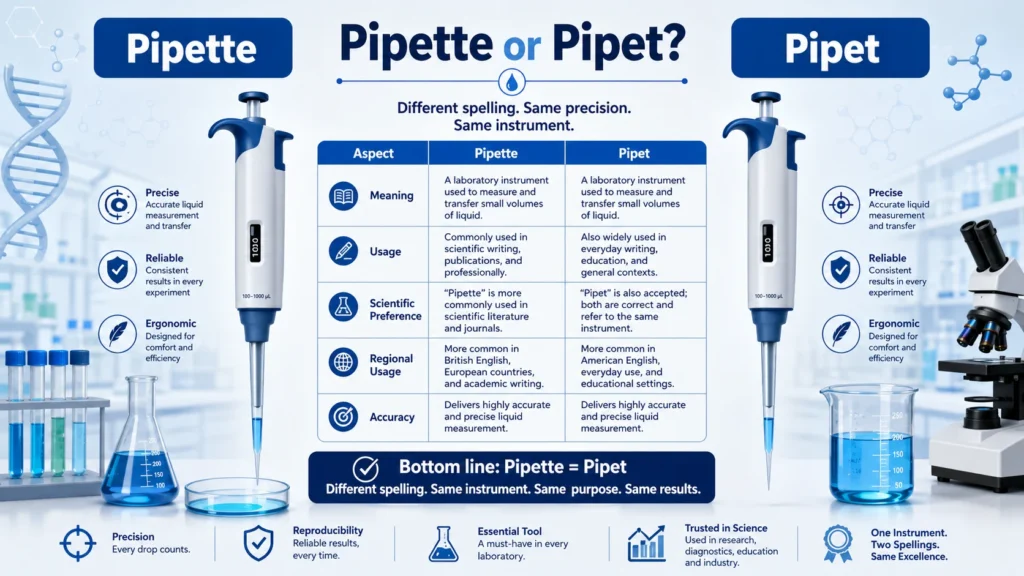
Pipette and pipet refer to the same laboratory tool used to measure and transfer precise amounts of liquid. The difference is mainly regional and stylistic: pipette is the internationally preferred spelling and is more common in scientific literature, while pipet is an accepted alternative, especially in some American laboratory contexts.
If you work in a laboratory, study science, or read research papers, you may have seen both pipette and pipet. This often leads to a simple question: Which spelling is correct?
The answer can be surprising. Both words are correct. They describe the same tool used to transfer or measure liquids with accuracy. Yet many people wonder why two spellings exist and whether one should be used instead of the other.
The confusion appears in laboratory manuals, academic articles, product catalogs, and classroom materials. A student may learn one spelling in school and later encounter another in a scientific journal. This can create uncertainty, especially for beginners.
Understanding the difference between pipette or pipet is important because scientific writing values consistency and clarity. Whether you are writing a lab report, purchasing laboratory equipment, or studying biology and chemistry, knowing the preferred usage can help you communicate more effectively.
This guide explains everything from basic definitions to advanced laboratory applications. You will learn the history, advantages, disadvantages, regional preferences, common mistakes, and practical examples related to pipette and pipet.
Quick Answer
| Term | Meaning | Preferred Usage |
|---|---|---|
| Pipette | Laboratory tool used to transfer or measure liquids | International standard and most common spelling |
| Pipet | Same laboratory tool | Alternative spelling, mainly used in some American contexts |
Short Answer
There is no functional difference between a pipette and a pipet. Both terms refer to the same instrument. The spelling pipette is more widely used in scientific publications, educational materials, and laboratory documentation worldwide.
What Is a Pipette or Pipet?
A pipette is a laboratory instrument designed to move a measured volume of liquid from one container to another.
Scientists use pipettes every day in:
- Chemistry laboratories
- Biology laboratories
- Medical testing facilities
- Pharmaceutical companies
- Research institutions
- Universities
- Environmental testing centers
The main purpose of a pipette is precision. Many experiments require exact liquid measurements. Even a small error can affect results.
Simple Analogy
Think of a pipette as a highly accurate drinking straw. Instead of sipping liquid, it carefully measures and transfers a specific amount.
For example:
- A chef measures ingredients with measuring spoons.
- A scientist measures liquids with a pipette.
The scientific version simply requires much greater accuracy.
The Origin of Pipette and Pipet
The word pipette comes from the French word pipette, meaning a small tube.
Over time, English-speaking scientists adopted the term. As scientific language evolved, some American publications shortened the spelling to pipet.
Today:
- Pipette remains the traditional spelling.
- Pipet remains an accepted simplified spelling.
Most international standards organizations and scientific journals prefer pipette.
Why Are There Two Spellings?
Many English words have multiple accepted spellings.
Examples include:
| Version 1 | Version 2 |
|---|---|
| Catalog | Catalogue |
| Program | Programme |
| Gray | Grey |
| Pipet | Pipette |
The existence of two spellings does not change the meaning.
The variation developed through:
- Regional preferences
- Historical usage
- Publishing standards
- Educational traditions
Definition of Pipette
A pipette is a calibrated laboratory instrument used to accurately measure and transfer liquid volumes.
Key Characteristics
- High precision
- Controlled liquid transfer
- Available in many sizes
- Essential for laboratory work
Common Volume Ranges
| Pipette Type | Typical Volume |
|---|---|
| Micropipette | 0.1 µL to 1000 µL |
| Serological Pipette | 1 mL to 100 mL |
| Volumetric Pipette | Fixed volume |
| Transfer Pipette | Variable use |
Types of Pipettes
Understanding pipette types helps explain why these tools are so important.
Volumetric Pipette
A volumetric pipette delivers one exact volume.
Features:
- Extremely accurate
- Common in analytical chemistry
- Used for standard solutions
Example:
A 25 mL volumetric pipette delivers exactly 25 mL.
Graduated Pipette
Graduated pipettes have measurement markings.
Benefits:
- Flexible volume selection
- Easy to read
- Common in teaching labs
Serological Pipette
Serological pipettes transfer larger liquid volumes.
Common uses:
- Cell culture work
- Biological research
- Medical laboratories
Micropipette
Micropipettes handle very small liquid volumes.
Applications:
- DNA analysis
- PCR testing
- Molecular biology
- Biotechnology
Micropipettes are among the most common laboratory tools today.
Transfer Pipette
Transfer pipettes are simple tools for moving liquids.
Characteristics:
- Inexpensive
- Easy to use
- Often disposable
Pipette vs Pipet Comparison
Detailed Comparison Table
| Feature | Pipette | Pipet |
|---|---|---|
| Meaning | Liquid measuring tool | Same liquid measuring tool |
| Accuracy | Same | Same |
| Function | Same | Same |
| Laboratory Use | Same | Same |
| Scientific Acceptance | Very common | Accepted |
| International Usage | Preferred | Less common |
| Educational Materials | Common | Less common |
| Journal Publications | Preferred | Occasionally used |
Main Takeaway
The difference is spelling only. The instrument itself remains identical.
How a Pipette Works
A pipette works by creating pressure differences that allow liquid to enter and leave the instrument.
Basic Steps
- Set desired volume.
- Press plunger.
- Place tip into liquid.
- Release plunger slowly.
- Liquid enters the tip.
- Move to destination container.
- Dispense liquid.
This process ensures precise measurements.
Advantages of Using a Pipette
Pipettes offer many benefits in scientific work.
High Accuracy
Scientists can measure tiny amounts of liquid precisely.
Better Reproducibility
Experiments can be repeated with consistent results.
Reduced Waste
Accurate measurements prevent excess chemical use.
Faster Workflow
Modern pipettes improve laboratory efficiency.
Improved Safety
Controlled liquid handling reduces spills and exposure.
Disadvantages of Using a Pipette
Although useful, pipettes have limitations.
Calibration Requirements
Pipettes must be calibrated regularly.
User Error
Incorrect technique can affect accuracy.
Maintenance Costs
High-quality pipettes require maintenance.
Potential Contamination
Improper handling may contaminate samples.
Fragility
Some precision pipettes can be damaged if dropped.
Real World Examples of Pipette Usage
Medical Laboratories
Technicians use micropipettes to prepare blood samples.
Pharmaceutical Research
Scientists measure chemicals for drug development.
University Chemistry Labs
Students learn solution preparation with pipettes.
Environmental Testing
Researchers analyze water samples using precise liquid measurements.
Biotechnology Companies
Pipettes assist in genetic testing and molecular research.
Pipette Use in Chemistry
Chemists depend on precise measurements.
Examples include:
- Preparing standard solutions
- Conducting titrations
- Mixing reagents
- Analyzing samples
Even a tiny measurement error can influence experimental results.
Pipette Use in Biology
Biologists frequently work with microscopic quantities.
Applications include:
- DNA extraction
- RNA analysis
- Cell culture preparation
- Protein studies
Micropipettes are especially important in molecular biology.
Pipette Use in Medicine
Healthcare laboratories use pipettes for:
- Blood testing
- Diagnostic procedures
- Disease detection
- Vaccine research
Accurate liquid transfer contributes to reliable test outcomes.
Regional and Global Usage
One of the biggest topics in the pipette or pipet debate is regional preference.
International Usage
Most countries use pipette.
This includes:
- United Kingdom
- Canada
- Australia
- India
- European countries
- International research organizations
United States Usage
Both spellings appear.
However:
- Pipette is increasingly common.
- Pipet still appears in some manuals and laboratory documents.
Scientific Journals
Most modern journals favor pipette because it aligns with international terminology.
Which Spelling Should You Use?
For Academic Writing
Use pipette.
Reasons:
- Most widely recognized
- Accepted globally
- Preferred by journals
For Laboratory Documentation
Follow your institution’s style guide.
For General Communication
Choose pipette because readers are more likely to recognize it.
Common Mistakes When Using Pipette or Pipet
Assuming They Are Different Tools
Incorrect:
“Pipette and pipet are different instruments.”
Correct:
“They are different spellings for the same instrument.”
Mixing Spellings in One Document
Incorrect:
“The pipette was calibrated. Each pipet was inspected.”
Correct:
Use one spelling consistently.
Using Informal Terminology
Incorrect:
“Dropper”
Correct:
“Pipette” when referring to a calibrated scientific instrument.
Ignoring Calibration
A pipette’s accuracy depends on proper calibration.
Pipette Accuracy and Precision
Many people confuse accuracy and precision.
Accuracy
How close a measurement is to the true value.
Precision
How consistent repeated measurements are.
Example
A pipette may dispense:
- 100.0 µL
- 100.1 µL
- 99.9 µL
These measurements are both accurate and precise.
Choosing the Right Pipette
Different tasks require different pipettes.
| Task | Recommended Pipette |
|---|---|
| DNA analysis | Micropipette |
| Solution preparation | Volumetric pipette |
| Cell culture | Serological pipette |
| Basic liquid transfer | Transfer pipette |
| Analytical chemistry | Volumetric pipette |
Selecting the proper instrument improves results.
Pipette Maintenance Tips
Proper maintenance extends lifespan.
Clean Regularly
Remove residue and contamination.
Calibrate Frequently
Verify measurement accuracy.
Store Correctly
Keep pipettes upright when possible.
Use Correct Tips
Matching tips improve performance.
Avoid Dropping
Precision instruments can lose calibration after impact.
Related Concepts and Comparisons
Pipette vs Dropper
| Feature | Pipette | Dropper |
|---|---|---|
| Accuracy | High | Low |
| Calibration | Yes | Usually No |
| Scientific Use | Extensive | Limited |
| Precision | High | Low |
Pipette vs Burette
| Feature | Pipette | Burette |
|---|---|---|
| Purpose | Transfer liquid | Deliver measured liquid gradually |
| Precision | High | High |
| Titration Use | Limited | Primary use |
Pipette vs Syringe
| Feature | Pipette | Syringe |
|---|---|---|
| Laboratory Use | Common | Common |
| Needle Required | No | Often |
| Precision | High | Moderate to High |
The Role of Pipettes in Modern Science
Modern research would be difficult without pipettes.
They support:
- Genomics
- Biotechnology
- Pharmaceutical development
- Clinical diagnostics
- Environmental science
- Food safety testing
Many scientific breakthroughs depend on precise liquid handling.
Exercises With Answers
Exercise 1
Which spelling is internationally preferred?
A. Pipet
B. Pipette
Answer: B. Pipette
Exercise 2
True or False:
Pipette and pipet are different laboratory instruments.
Answer: False
Exercise 3
Which pipette is commonly used for DNA analysis?
A. Micropipette
B. Transfer pipette
C. Dropper
Answer: A. Micropipette
Exercise 4
Fill in the blank:
A _________ transfers measured liquid volumes in a laboratory.
Answer: Pipette (or Pipet)
Exercise 5
Which statement is correct?
A. Pipet and pipette have different functions.
B. Pipette is usually preferred in scientific publications.
Answer: B
FAQs
Is pipette or pipet correct?
Both are correct. Pipette is the more common and internationally preferred spelling.
What is the difference between pipette and pipet?
There is no functional difference. The distinction is only spelling.
Why do some laboratories use pipet instead of pipette?
Some American institutions historically adopted the shorter spelling pipet.
Which spelling should I use in a research paper?
Use pipette unless your journal or institution specifies otherwise.
Are pipette and pipet pronounced differently?
No. Both are generally pronounced the same way.
Is pipette the scientific standard?
Yes. Pipette is the dominant spelling in modern scientific literature worldwide.
Can I use pipet in laboratory reports?
Yes, if your organization accepts it. Consistency is important.
What does a pipette do?
A pipette measures and transfers precise amounts of liquid for scientific work.
What is a micropipette?
A micropipette is a specialized pipette designed to measure very small liquid volumes, usually in microliters.
Which spelling is more common on laboratory equipment?
Most manufacturers and scientific suppliers use pipette more frequently than pipet.
Should students learn pipette or pipet?
Students should generally learn pipette because it is the spelling most often encountered in textbooks and journals.
Conclusion
The debate over pipette or pipet is much simpler than many people expect. Both terms refer to the same laboratory instrument used to measure and transfer liquids accurately. The difference lies only in spelling, not in design, function, precision, or scientific purpose.
In modern scientific communication, pipette has become the dominant spelling. It appears most often in textbooks, research papers, laboratory manuals, product catalogs, and international standards. While pipet remains an accepted alternative, particularly in some American contexts, it is far less common globally.
For students, researchers, laboratory technicians, and science writers, the best approach is usually to use pipette and remain consistent throughout a document. Consistency improves professionalism and avoids confusion.
Whether you are performing DNA analysis, preparing chemical solutions, conducting medical tests, or learning laboratory skills for the first time, understanding the terminology helps you communicate more effectively. The key takeaway is simple: both words are correct, but pipette is the spelling most people will recognize and expect in modern scientific writing.

Justin Powell is a writer at GramBrix.com who focuses on grammar, clarity and effective communication, helping readers strengthen their language skills.