
Last Updated on July 13, 2026
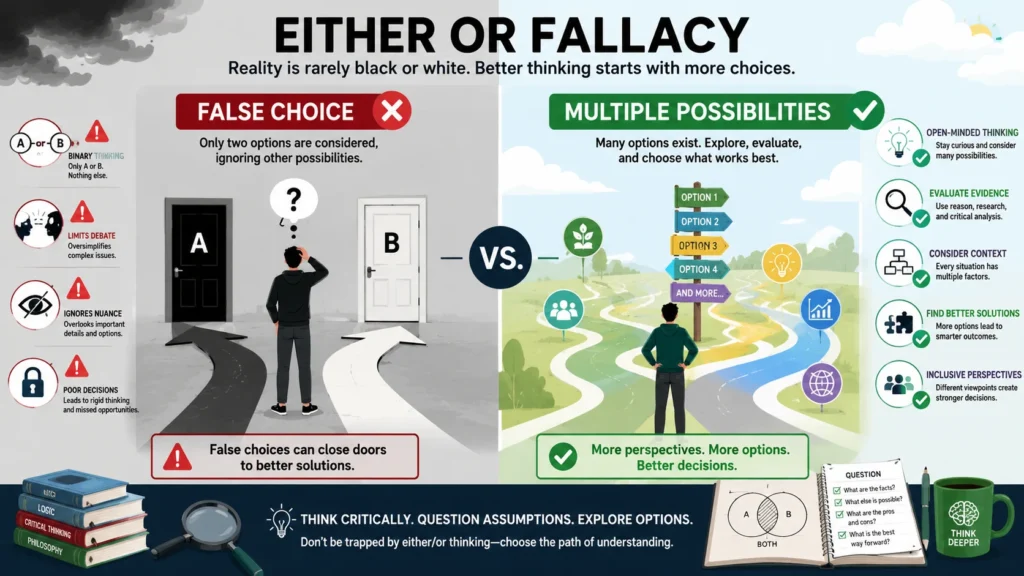
The either or fallacy is a logical error that presents only two options when more possibilities exist. It oversimplifies complex issues and can lead people to make poor decisions by ignoring alternative solutions. Understanding the either or fallacy helps improve critical thinking, communication, and problem solving.
The either or fallacy is one of the most common mistakes in reasoning. People use it in conversations, politics, advertising, social media debates, and even everyday decision making. The fallacy occurs when someone claims there are only two possible choices, even though other options exist.
At first, the argument may sound convincing. Humans often prefer simple answers. When faced with a difficult problem, it feels easier to choose between two clear options. However, many real world situations are more complex than that.
Imagine someone says, “You are either with us or against us.” At first glance, it seems logical. Yet there may be many other positions. A person could be neutral, undecided, partially supportive, or supportive of some ideas but not others.
Learning about the either or fallacy helps people think more carefully. It teaches us to look for hidden alternatives and avoid being trapped by false choices. Whether you are a student, writer, business professional, or everyday reader, understanding this fallacy can improve your reasoning skills and help you make better decisions.
Quick Answer
The either or fallacy is a logical fallacy that falsely limits a situation to only two choices when additional possibilities exist.
Simple Formula
Option A or Option B
Reality: Option A, Option B, Option C, Option D, or a combination of several options.
Example
Fallacious statement:
“You either go to college or you will fail in life.”
Why it is wrong:
Many successful people follow other paths such as vocational training, entrepreneurship, apprenticeships, or self education.
What Is the Either or Fallacy?
The either or fallacy occurs when an argument presents only two alternatives and ignores other reasonable possibilities.
It is also known as:
- False dilemma
- False dichotomy
- Black and white thinking
- Bifurcation fallacy
All of these terms describe the same basic error in reasoning.
Simple Definition
An either or fallacy is the mistake of assuming there are only two choices when there are actually more.
Key Characteristics
The either or fallacy usually includes:
- Only two options are presented
- Other possibilities are ignored
- The issue is oversimplified
- The audience is pressured to choose one side
- Complex situations are reduced to simple categories
Understanding the Logic Behind the Either or Fallacy
To understand this fallacy, consider the following statement:
Either we ban all social media or society will collapse.
This argument assumes only two outcomes:
| Presented Choices | Missing Possibilities |
|---|---|
| Ban social media | Better regulations |
| Society collapses | Improved education |
| Total restriction | Responsible use |
| Complete removal | Parental controls |
The speaker ignores many practical solutions between the two extremes.
This is why the argument is considered logically weak.
Why People Use the Either or Fallacy
People may use this fallacy intentionally or unintentionally.
Simplifying Complex Issues
Many topics are complicated. Reducing them to two options makes them easier to discuss.
Example:
“Either we increase taxes or the economy will fail.”
Economic policy is far more complex than that.
Persuasion
Some speakers use false dilemmas to influence opinions.
When only two choices are presented, one option may appear much more attractive.
Emotional Appeals
The either or fallacy often relies on fear.
Example:
“Either support this policy or public safety will disappear.”
Fear can push people toward a preferred choice.
Lack of Information
Sometimes people simply do not realize additional options exist.
They may honestly believe only two choices are available.
Types of Either or Fallacies
Political False Dilemmas
Political discussions often contain either or fallacies.
Example:
“Either you support this law or you do not care about citizens.”
Reality is more nuanced.
A person may care deeply about citizens while disagreeing with the law.
Personal False Dilemmas
Example:
“Either you love me or you hate me.”
Human relationships contain many emotions and perspectives.
Business False Dilemmas
Example:
“Either we cut jobs or the company will go bankrupt.”
Other solutions may include restructuring, innovation, or cost reduction elsewhere.
Educational False Dilemmas
Example:
“Either get straight A grades or your future is ruined.”
Success depends on many factors beyond grades.
Real World Examples of the Either or Fallacy
Example in Politics
Statement:
“Either we spend more on defense or the country becomes unsafe.”
Possible alternatives:
- Strategic alliances
- Better technology
- Efficient spending
- Diplomacy
Example in Health
Statement:
“Either follow this diet perfectly or you will never lose weight.”
Reality:
Healthy progress often comes through gradual improvements.
Example in Education
Statement:
“Either attend university or remain unsuccessful.”
Reality:
Many careers do not require a university degree.
Example in Parenting
Statement:
“Either my child obeys every rule or they are becoming irresponsible.”
Reality:
Children can learn through discussion and guidance.
Example in Business
Statement:
“Either work overtime every weekend or lose your job.”
Reality:
There may be scheduling changes, delegation, or productivity improvements.
Either or Fallacy in Advertising
Advertisers sometimes use false dilemmas to influence consumers.
Example
“Either buy our security software or leave your computer vulnerable.”
This ignores alternatives such as:
- Competitor products
- Free solutions
- Built in protections
- Different security strategies
Why It Works
Consumers often prefer simple decisions.
Presenting only two options reduces critical thinking.
Either or Fallacy in Social Media
Social media platforms encourage quick opinions and short responses.
As a result, false dilemmas appear frequently.
Examples:
- “Either you support this trend or you are out of touch.”
- “Either agree with me or you are uninformed.”
- “Either this movie is perfect or it is terrible.”
These statements ignore middle positions.
Advantages and Disadvantages of Recognizing the Either or Fallacy
Advantages
| Benefit | Explanation |
|---|---|
| Better critical thinking | Encourages deeper analysis |
| Improved decisions | Reveals overlooked options |
| Stronger arguments | Helps avoid weak reasoning |
| Greater open mindedness | Encourages consideration of alternatives |
| Better communication | Leads to balanced discussions |
Disadvantages
| Challenge | Explanation |
|---|---|
| More complex decisions | Additional options require more analysis |
| Slower decision making | Evaluating alternatives takes time |
| Information overload | Too many possibilities can confuse people |
Despite these challenges, avoiding the either or fallacy generally leads to better outcomes.
Regional and Global Usage
The either or fallacy appears worldwide because it is rooted in human thinking patterns.
In Western Countries
Political debates often use false dilemmas involving:
- Freedom versus security
- Taxes versus growth
- Tradition versus change
In Business Environments
Companies around the world may present choices such as:
- Profit versus employee welfare
- Cost reduction versus quality
In reality, balanced solutions often exist.
In Educational Systems
Students everywhere may hear statements like:
“Either become a top student or fail.”
This ignores many pathways to success.
Common Signs of an Either or Fallacy
Watch for phrases such as:
- Either this or that
- You are with us or against us
- There are only two choices
- One way or the other
- No middle ground
- All or nothing
- Black or white
These phrases do not automatically indicate a fallacy, but they often signal one.
Common Mistakes When Identifying the Either or Fallacy
Assuming Every Two Option Choice Is Fallacious
Not all either or statements are false.
Example:
“Either the light is on or it is off.”
This is logically valid because only two states exist.
Ignoring Genuine Constraints
Sometimes only two options truly exist.
Example:
“Either the exam is passed or failed.”
This is not an either or fallacy.
Confusing It With Personal Preference
A person can prefer one option over another without committing a fallacy.
The problem arises when additional possibilities are wrongly excluded.
How to Avoid the Either or Fallacy
Ask What Is Missing
Whenever two choices are presented, ask:
“What other options might exist?”
Look for Middle Ground
Many issues are not extreme.
Balanced solutions often provide better outcomes.
Gather More Information
Additional research often reveals overlooked possibilities.
Challenge Assumptions
Ask:
- Why only these two choices?
- Who benefits from this framing?
- What alternatives are being ignored?
Related Concepts and Comparisons
Either or Fallacy vs Straw Man Fallacy
| Either or Fallacy | Straw Man Fallacy |
|---|---|
| Limits choices to two options | Misrepresents an opponent’s argument |
| Creates a false dilemma | Creates a distorted version of a position |
| Ignores alternatives | Attacks a weaker argument |
Either or Fallacy vs Slippery Slope
| Either or Fallacy | Slippery Slope |
|---|---|
| Claims only two options exist | Claims one action leads to extreme consequences |
| Focuses on choices | Focuses on outcomes |
Either or Fallacy vs Hasty Generalization
| Either or Fallacy | Hasty Generalization |
|---|---|
| Restricts available choices | Draws conclusions from limited evidence |
| Concerns alternatives | Concerns evidence quality |
Psychological Reasons Behind the Either or Fallacy
Humans often prefer simple mental shortcuts.
Psychologists sometimes call this binary thinking.
Reasons include:
- Reduced mental effort
- Desire for certainty
- Emotional comfort
- Social group identity
- Fear of ambiguity
Recognizing these tendencies helps people think more objectively.
Famous Examples of Either or Fallacy
Political Speeches
Many historical speeches have used phrases such as:
“You are either with us or against us.”
These statements create artificial divisions.
Corporate Messaging
Some companies suggest:
“Either adopt our solution or face failure.”
Competitors and alternative methods may exist.
Public Debates
Discussions about technology, education, health, and economics often contain false dilemmas.
Exercises With Answers
Exercise 1
Statement:
“Either you become a doctor or your career will not matter.”
Is this an either or fallacy?
Answer: Yes.
Many valuable careers exist besides medicine.
Exercise 2
Statement:
“Either the switch is on or off.”
Is this an either or fallacy?
Answer: No.
Only two states exist.
Exercise 3
Statement:
“Either we raise prices or the business closes.”
Is this necessarily an either or fallacy?
Answer: Often yes.
Other options may include reducing costs, improving efficiency, or finding new revenue.
Exercise 4
Statement:
“Either you agree with every policy or you are disloyal.”
Is this an either or fallacy?
Answer: Yes.
People can support an organization while disagreeing with some policies.
Exercise 5
Statement:
“Either it is raining or it is not raining.”
Is this an either or fallacy?
Answer: No.
The statement reflects a true logical distinction.
Practice Quiz
Identify whether each statement contains an either or fallacy.
| Statement | Fallacy? |
|---|---|
| Either buy this product or remain unhappy | Yes |
| Either the door is open or closed | No |
| Either attend college or fail in life | Yes |
| Either support every idea or leave the group | Yes |
| Either the battery is charged or discharged | No |
Answers
- Yes
- No
- Yes
- Yes
- No
How Teachers Use the Either or Fallacy as a Learning Tool
Teachers often use examples of false dilemmas to help students:
- Improve reasoning skills
- Analyze arguments
- Detect manipulation
- Strengthen debate abilities
- Evaluate evidence
Critical thinking courses frequently include the either or fallacy because it appears so often in everyday communication.
FAQs
What is the either or fallacy?
The either or fallacy is a logical error that presents only two options while ignoring other possible alternatives.
Is the either or fallacy the same as a false dilemma?
Yes. False dilemma and false dichotomy are common names for the either or fallacy.
Why is the either or fallacy misleading?
It oversimplifies complex situations and hides other reasonable choices.
Can an either or statement be valid?
Yes. If only two possibilities truly exist, the statement is not an either or fallacy.
How can I identify an either or fallacy?
Look for arguments that force a choice between two options and ask whether additional alternatives exist.
Where is the either or fallacy commonly used?
It often appears in politics, advertising, business, social media, education, and personal relationships.
Why do people use the either or fallacy?
Some use it intentionally to persuade others, while some use it because they overlook alternative possibilities.
What is an example of an either or fallacy in advertising?
“Either buy our product or continue suffering from the problem.” This ignores competing products and other solutions.
How does the either or fallacy affect decision making?
It can lead people to ignore better alternatives and make choices based on incomplete information.
How can I avoid committing an either or fallacy?
Consider additional possibilities, seek evidence, and avoid assuming that only two options exist.
Conclusion
The either or fallacy is one of the most common logical fallacies in everyday life. It occurs when a person presents only two choices even though other alternatives are available. This type of reasoning can appear convincing because it simplifies complicated issues, but it often leads to poor decisions and weak arguments.
Recognizing the either or fallacy is an important critical thinking skill. Whether you encounter it in politics, business, education, advertising, or personal conversations, learning to spot false dilemmas helps you evaluate information more accurately. Instead of accepting forced choices, ask what options might be missing and whether the situation is truly limited to only two outcomes.
The best approach is to stay curious, gather evidence, and explore multiple perspectives. Most real world problems have more than two solutions. By avoiding black and white thinking and considering a wider range of possibilities, you can make smarter decisions, build stronger arguments, and become a more effective communicator.

Kevin Brooks is a grammar specialist at GramBrix.com, dedicated to helping readers understand language rules with clarity and confidence. He simplifies complex grammar concepts through practical examples and easy explanations.