Last Updated on June 14, 2026
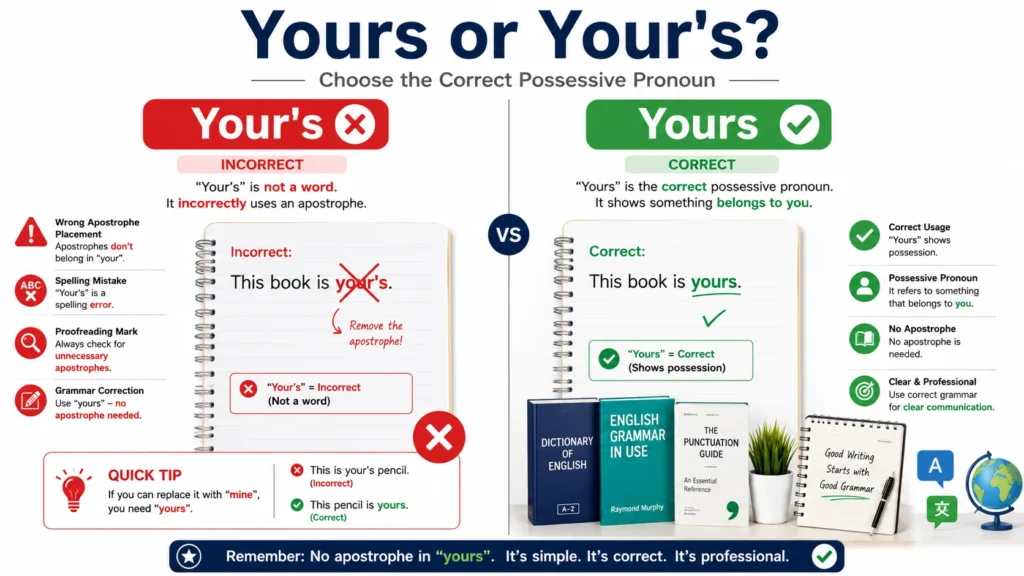
“Yours” is the correct possessive pronoun used to show ownership, while “your’s” is incorrect in standard English. If you want to say something belongs to someone, use yours without an apostrophe. Understanding the difference between yours or your’s helps improve grammar, writing, and communication.
Many English learners and native speakers get confused about yours or your’s. At first glance, both words seem possible. After all, many English words use apostrophes. This often leads people to think that your’s must be correct.
The truth is simple. Yours is the correct word. Your’s is not considered correct in standard English grammar.
This mistake appears in emails, social media posts, text messages, school assignments, and even business communication. While it may seem like a small error, using the wrong form can affect how professional your writing looks.
Learning the difference between yours or your’s is important because possessive pronouns follow special grammar rules. Once you understand those rules, you will rarely make this mistake again.
This guide explains everything you need to know about yours or your’s, including definitions, examples, common mistakes, regional usage, exercises, FAQs, and practical writing tips.
Quick Answer
| Word | Correct? | Meaning |
|---|---|---|
| Yours | Yes | Belonging to you |
| Your’s | No | Incorrect spelling |
Short Rule
Use yours when showing ownership.
✅ This book is yours.
❌ This book is your’s.
If you remember only one thing from this article, remember this:
Yours never needs an apostrophe.
Understanding the Difference Between Yours or Your’s
The confusion usually comes from apostrophes.
People learn that apostrophes often show possession.
Examples:
- John’s car
- Sarah’s notebook
- The dog’s toy
Because of these examples, many writers assume that ownership always requires an apostrophe.
However, possessive pronouns work differently.
Words like:
- mine
- yours
- his
- hers
- ours
- theirs
already show possession. They do not need apostrophes.
Therefore:
✅ The house is yours.
❌ The house is your’s.
The apostrophe is unnecessary because yours is already possessive.
What Does Yours Mean?
Yours is a possessive pronoun.
A possessive pronoun replaces a noun and shows ownership.
Examples
- This jacket is yours.
- The decision is yours.
- That seat is yours.
- The responsibility is yours.
In each example, yours indicates ownership without repeating the noun.
Instead of saying:
- This jacket belongs to you.
You can simply say:
- This jacket is yours.
The meaning stays the same.
Why Your’s Is Incorrect
The word your’s does not exist in standard English grammar.
Many writers mistakenly create it because they think possession requires an apostrophe.
However, possessive pronouns never use apostrophes.
Compare these examples:
| Possessive Adjective | Possessive Pronoun |
|---|---|
| My | Mine |
| Your | Yours |
| Her | Hers |
| Our | Ours |
| Their | Theirs |
Notice something important.
None of the possessive pronouns contain apostrophes.
Therefore:
- mine ✔
- yours ✔
- hers ✔
- ours ✔
- theirs ✔
Adding an apostrophe creates an incorrect form.
Definition of Your
To understand yours, you must first understand your.
Your is a possessive adjective.
It comes before a noun.
Examples
- Your car is outside.
- Your phone is ringing.
- Your bag is on the table.
- Your dog is friendly.
In these sentences, your modifies a noun.
Formula
Your + Noun
Examples:
- Your house
- Your computer
- Your idea
- Your project
Definition of Yours
Yours is a possessive pronoun.
It replaces the noun completely.
Formula
Yours = Belonging to You
Examples:
- The house is yours.
- The computer is yours.
- The idea is yours.
- The project is yours.
Notice that no noun follows yours.
Your vs Yours
This comparison causes confusion for many learners.
| Word | Type | Followed by a Noun? |
|---|---|---|
| Your | Possessive adjective | Yes |
| Yours | Possessive pronoun | No |
Examples
Using Your
- Your book is new.
- Your room is clean.
- Your laptop is fast.
Using Yours
- The book is yours.
- The room is yours.
- The laptop is yours.
Real World Examples of Yours
Let’s look at practical situations.
At School
Teacher:
“Whose notebook is this?”
Student:
“It is yours.”
At Work
Manager:
“Who owns this report?”
Employee:
“The final version is yours.”
At Home
Parent:
“Which bedroom belongs to you?”
Child:
“The blue room is yours.”
Online Shopping
Customer:
“Is this package mine?”
Delivery person:
“Yes, it is yours.”
Comparison Table: Yours or Your’s
| Situation | Correct Form |
|---|---|
| This pen belongs to you | Yours |
| The choice belongs to you | Yours |
| The responsibility belongs to you | Yours |
| Ownership statement | Yours |
| Possessive pronoun | Yours |
| Standard English writing | Yours |
| Formal writing | Yours |
| Academic writing | Yours |
Your’s is never correct in these situations.
Advantages of Using Yours Correctly
Using yours correctly offers several benefits.
Better Grammar
Correct grammar improves writing quality.
Professional Communication
Employers notice grammar mistakes.
Using correct language creates a positive impression.
Better Academic Performance
Students receive higher marks when grammar is accurate.
Clear Communication
Readers understand your meaning immediately.
Greater Confidence
Knowing grammar rules helps you write confidently.
Disadvantages of Using Your’s
Using your’s can create problems.
Looks Unprofessional
Readers may view the mistake negatively.
Reduces Credibility
Grammar errors can affect trust.
Creates Confusion
Some readers may pause to understand what you mean.
Common Editing Issue
Editors often need to correct this mistake.
How Possessive Pronouns Work
Possessive pronouns replace nouns.
Examples include:
| Pronoun | Possessive Pronoun |
|---|---|
| I | Mine |
| You | Yours |
| He | His |
| She | Hers |
| We | Ours |
| They | Theirs |
Examples
- The red car is mine.
- The blue car is yours.
- The green car is hers.
- The white car is ours.
Each pronoun shows ownership.
No apostrophes are needed.
Why Apostrophes Cause Confusion
Apostrophes have two major jobs.
Showing Possession
Examples:
- John’s phone
- Emma’s notebook
- The cat’s bed
Showing Contractions
Examples:
- It’s = It is
- Don’t = Do not
- Can’t = Cannot
Because apostrophes are used in these situations, many writers incorrectly add one to yours.
However, possessive pronouns are exceptions.
Similar Words That Follow the Same Rule
The same grammar rule applies to other possessive pronouns.
Correct Forms
- Mine
- Yours
- His
- Hers
- Ours
- Theirs
Incorrect Forms
- Mine’s
- Your’s
- Her’s
- Our’s
- Their’s
These incorrect versions appear online but are not accepted in standard English.
Regional and Global Usage
One interesting fact about yours or your’s is that the rule remains the same worldwide.
Whether you use:
- American English
- British English
- Canadian English
- Australian English
- New Zealand English
- South African English
the correct form is always yours.
American English
✅ This seat is yours.
British English
✅ This seat is yours.
Australian English
✅ This seat is yours.
The grammar rule does not change by region.
Formal Writing Examples
Business Email
Correct:
“Please review the document. The final decision is yours.”
Incorrect:
“Please review the document. The final decision is your’s.”
Cover Letter
Correct:
“The opportunity to lead the project is yours.”
Report
Correct:
“The responsibility for approval is yours.”
Informal Writing Examples
Text Message
Correct:
“The charger is yours.”
Social Media
Correct:
“This achievement is yours.”
Chat Message
Correct:
“The account is yours now.”
Common Mistakes With Yours
Using an Apostrophe
Incorrect:
- The bike is your’s.
Correct:
- The bike is yours.
Adding a Noun After Yours
Incorrect:
- Yours car is outside.
Correct:
- Your car is outside.
Or:
- The car is yours.
Mixing Up Your and Yours
Incorrect:
- This phone is your.
Correct:
- This phone is yours.
Memory Trick to Remember the Rule
A simple trick can help.
Look at these words:
- mine
- yours
- hers
- ours
- theirs
None use apostrophes.
Since all possessive pronouns follow the same pattern, yours should not have one either.
Another easy reminder:
If mine has no apostrophe, yours doesn’t need one either.
Related Concepts and Comparisons
Yours vs You’re
These words sound similar but mean different things.
| Word | Meaning |
|---|---|
| Yours | Belonging to you |
| You’re | You are |
Examples:
- This bag is yours.
- You’re carrying the bag.
Yours vs Your
| Word | Function |
|---|---|
| Your | Possessive adjective |
| Yours | Possessive pronoun |
Examples:
- Your book is on the desk.
- The book is yours.
Yours vs Mine
Both are possessive pronouns.
Examples:
- The blue bicycle is mine.
- The red bicycle is yours.
Advanced Understanding of Possessive Pronouns
Grammar experts classify yours as an independent possessive pronoun.
This means it can stand alone.
Example:
- The decision is yours.
The word functions independently without needing another noun.
By contrast, your depends on a noun.
Example:
- Your decision matters.
This distinction explains why the two words are not interchangeable.
Common Sentences Using Yours
Here are examples from everyday English.
- The victory is yours.
- The prize is yours.
- The room is yours.
- The credit is yours.
- The opportunity is yours.
- The future is yours.
- The choice is yours.
- The success is yours.
- The ticket is yours.
- The package is yours.
These are all correct.
Exercises With Answers
Exercise 1
Choose the correct option.
- The umbrella is (yours / your’s).
- This desk is (yours / your’s).
- The final decision is (yours / your’s).
- That notebook is (yours / your’s).
- The responsibility is (yours / your’s).
Answers
- Yours
- Yours
- Yours
- Yours
- Yours
Exercise 2
Correct the mistakes.
- The laptop is your’s.
- The jacket is your’s.
- This opportunity is your’s.
- The car is your’s.
- The seat is your’s.
Answers
- The laptop is yours.
- The jacket is yours.
- This opportunity is yours.
- The car is yours.
- The seat is yours.
Exercise 3
Fill in the blanks.
- This pen is ______.
- Is this notebook ______?
- The prize is ______.
- The choice is ______.
- That package is ______.
Answers
- yours
- yours
- yours
- yours
- yours
Practice Quiz
Choose the correct sentence.
Question 1
A. The bike is your’s.
B. The bike is yours.
Answer: B
Question 2
A. Your car is parked outside.
B. Yours car is parked outside.
Answer: A
Question 3
A. The decision is yours.
B. The decision is your’s.
Answer: A
Question 4
A. Is this phone yours?
B. Is this phone your’s?
Answer: A
Question 5
A. The success is yours.
B. The success is your’s.
Answer: A
FAQs
Is yours or your’s correct?
Yours is correct. Your’s is incorrect in standard English grammar.
Why doesn’t yours have an apostrophe?
Because yours is already a possessive pronoun. Possessive pronouns do not use apostrophes.
Can I ever use your’s in a sentence?
No. Standard English does not recognize your’s as a correct word.
What is the difference between your and yours?
Your comes before a noun, while yours replaces the noun entirely.
Is yours a possessive pronoun?
Yes. Yours is a possessive pronoun that shows ownership.
How do I remember yours or your’s?
Remember that possessive pronouns like mine, hers, ours, and yours never use apostrophes.
Is yours correct in formal writing?
Yes. Yours is correct in academic, professional, and business writing.
Do British and American English use different rules for yours?
No. Both varieties use yours and reject your’s.
Can yours appear at the end of a sentence?
Yes. Example: “The decision is yours.”
What are examples of sentences with yours?
Examples include:
- The prize is yours.
- The house is yours.
- This seat is yours.
- The opportunity is yours.
Conclusion
The debate over yours or your’s is actually very simple once you understand the grammar rule. Yours is the correct possessive pronoun, and your’s is incorrect in standard English. The confusion usually happens because many people associate apostrophes with possession. However, possessive pronouns already express ownership and do not require apostrophes.
A useful way to remember the rule is to compare yours with other possessive pronouns such as mine, hers, ours, and theirs. None of these words use apostrophes, and neither should yours. Whether you are writing an email, a school paper, a report, or a social media post, choosing yours helps your writing appear polished and professional.
When in doubt, ask yourself whether the word means “belonging to you.” If it does, the correct choice is almost always yours. Practice using the examples and exercises in this guide, and this common grammar mistake will quickly become a thing of the past.

Kevin Brooks is a grammar specialist at GramBrix.com, dedicated to helping readers understand language rules with clarity and confidence. He simplifies complex grammar concepts through practical examples and easy explanations.