
Last Updated on August 4, 2026
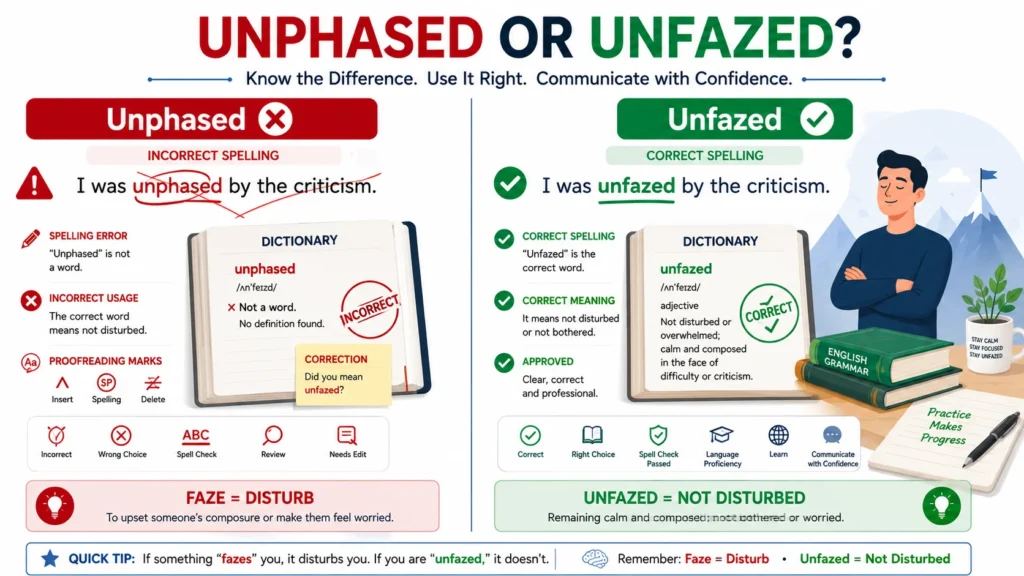
Unfazed is the correct word in standard English and means not disturbed, worried, or affected by something. Unphased is usually considered a misspelling of unfazed, although many people mistakenly use it because it sounds similar to the word phase. If you are writing professionally, use unfazed.
Many English words sound alike but have different meanings. Some words are confused so often that people begin to wonder if both versions are correct. One common example is unphased or unfazed.
You may have seen someone write, “She was unphased by the criticism,” while another person writes, “She was unfazed by the criticism.” At first glance, both seem reasonable. They sound almost identical when spoken. Because of this, many writers search for unphased meaning or unfazed meaning and assume both spellings are acceptable.
However, there is an important difference. In standard English, unfazed is the correct word, while unphased is generally considered a misspelling when people intend to describe someone who remains calm, unaffected, or unbothered.
If you’re looking for the meaning of unfazed, the word unfazed means not disturbed, worried, confused, or affected by something difficult, surprising, or stressful. The same definition applies when people search for meaning unfazed.
For example:
- She remained unfazed by the criticism.
- He seemed unfazed by the unexpected changes.
Many people also search for phrases such as not fazed meaning, I am not fazed meaning, or I’m not fazed meaning. In these expressions, not fazed means remaining calm, confident, or unaffected despite challenges, pressure, or criticism.
The confusion often arises because people hear the phrase and spell it as not phased meaning or I’m not phased meaning. While these versions are common online, they are usually spelling errors when the intended meaning is “unaffected” or “unbothered.”
Similarly, searches for meaning of unphased typically stem from the widespread misspelling of unfazed. In most everyday, academic, professional, and business writing, unfazed is the accepted and recommended spelling.
According to major English dictionaries and style guides, unfazed originated from the verb faze, which means to disturb, unsettle, or disconcert someone. Therefore, unfazed literally means “not disturbed” or “not affected.”
Understanding the difference between unphased and unfazed can improve your writing, prevent embarrassing mistakes, and help you communicate more clearly. Whether you are writing emails, academic papers, social media posts, blog articles, or business reports, using the correct spelling demonstrates attention to detail and language accuracy.
This guide explains:
- Unfazed meaning
- Why unphased meaning is usually a misspelling
- The difference between unphased and unfazed
- Real-world usage examples
- Common mistakes
- Grammar and spelling tips
- Practice exercises with answers
By the end, you’ll know exactly which word to use, why it is correct, and how to avoid one of the most common spelling mistakes in modern English.
Quick Answer
| Term | Correct? | Meaning |
|---|---|---|
| Unfazed | Yes | Not disturbed, worried, surprised, or affected |
| Unphased | Usually No | Common misspelling of unfazed |
Short Answer
If you are choosing between unphased or unfazed, use unfazed.
Example:
✅ She remained unfazed by the negative comments.
❌ She remained unphased by the negative comments.
Understanding the Difference Between Unphased and Unfazed
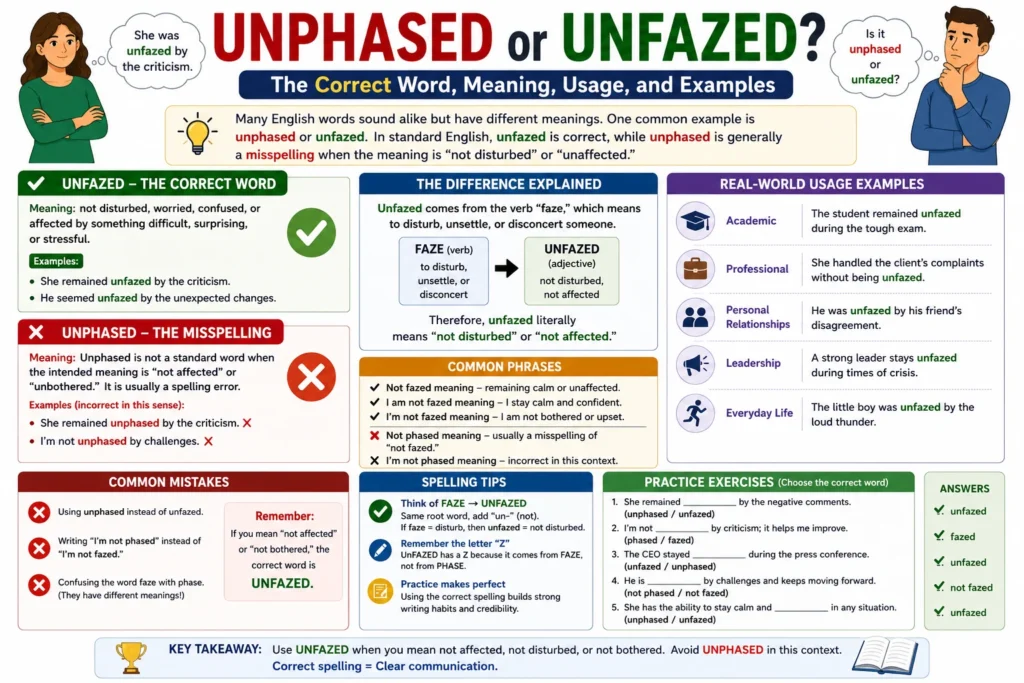
The confusion comes from pronunciation.
When spoken quickly, unfazed sounds similar to unphased. Because English contains many words related to phases, such as:
- Phase one
- Phase out
- Phase shift
- Development phase
Many writers incorrectly assume that “unphased” is the logical opposite.
In reality, unfazed comes from the verb faze, not phase.
The Key Rule
- Faze means to disturb, upset, or bother someone.
- Unfazed means not disturbed or bothered.
Therefore:
Unfazed = Not bothered
This simple rule solves most confusion.
What Does Unfazed Mean?
Definition
Unfazed is an adjective that describes a person who remains calm despite difficulties, surprises, criticism, pressure, or challenges.
Dictionary Style Definition
Unfazed:
- Not disturbed
- Not worried
- Not affected emotionally
- Calm under pressure
Examples
- The athlete was unfazed by the loud crowd.
- She remained unfazed after receiving criticism.
- He seemed unfazed by the unexpected delay.
- The manager stayed unfazed during the crisis.
- They were unfazed by the bad weather.
In each example, the person remains calm and unaffected.
What Does Faze Mean?
To understand unfazed, you first need to understand faze.
Definition of Faze
Faze means:
- To disturb
- To upset
- To bother
- To unsettle
Examples
- The criticism did not faze her.
- The difficult questions failed to faze the candidate.
- Nothing seems to faze him.
Relationship Between Faze and Unfazed
| Word | Meaning |
|---|---|
| Faze | To disturb |
| Unfazed | Not disturbed |
Think of it this way:
If something cannot faze you, you are unfazed.
What Does Unphased Mean?
Is Unphased a Real Word?
This is where things become interesting.
The word unphased technically exists in very limited contexts.
It can literally mean:
- Not divided into phases
- Not arranged into stages
However, this usage is rare and highly specialized.
For example, engineers or scientists may occasionally use the term when discussing systems, signals, or phased operations.
Example of Technical Usage
- The equipment remained unphased during testing.
Even in technical writing, this usage is uncommon.
Everyday English
When people write:
- He was unphased by criticism.
- She looked unphased by the news.
They almost always mean unfazed.
Why People Confuse Unphased and Unfazed
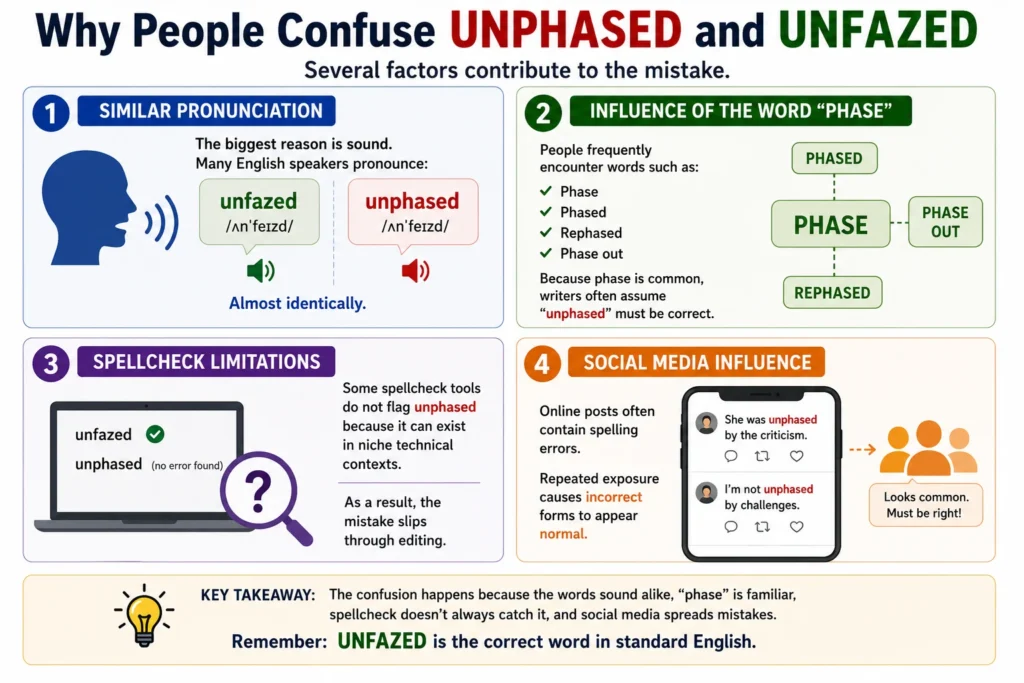
Several factors contribute to the mistake.
Similar Pronunciation
The biggest reason is sound.
Many English speakers pronounce:
- Unfazed
- Unphased
Almost identically.
Influence of the Word Phase
People frequently encounter words such as:
- Phase
- Phased
- Rephased
- Phase out
Because phase is common, writers often assume “unphased” must be correct.
Spellcheck Limitations
Some spellcheck tools do not flag unphased because it can exist in niche technical contexts.
As a result, the mistake slips through editing.
Social Media Influence
Online posts often contain spelling errors. Repeated exposure causes incorrect forms to appear normal.
Origins of the Word Unfazed
Historical Background
The word faze entered English in the nineteenth century.
Its exact origin remains somewhat uncertain, but it developed the meaning:
- To disturb
- To unsettle
- To disconcert
Over time, the adjective unfazed emerged to describe people who remained calm despite challenges.
Evolution of Usage
Modern English increasingly uses unfazed in:
- Journalism
- Business writing
- Sports reporting
- Academic writing
- Everyday conversation
Examples:
- The team was unfazed by the pressure.
- Investors appeared unfazed by market volatility.
- The politician remained unfazed during questioning.
Unphased or Unfazed in Everyday Situations
Workplace Communication
Correct:
- The CEO remained unfazed during the meeting.
Incorrect:
- The CEO remained unphased during the meeting.
School and University Writing
Correct:
- The researcher appeared unfazed by criticism.
Incorrect:
- The researcher appeared unphased by criticism.
Social Media
Correct:
- I’m completely unfazed by the rumors.
Incorrect:
- I’m completely unphased by the rumors.
Sports
Correct:
- The goalkeeper stayed unfazed after conceding an early goal.
Incorrect:
- The goalkeeper stayed unphased after conceding an early goal.
Comparison Table: Unphased vs Unfazed
| Feature | Unfazed | Unphased |
|---|---|---|
| Standard English | Yes | Usually No |
| Means not bothered | Yes | No |
| Common in writing | Yes | Rare |
| Accepted in professional writing | Yes | No |
| Frequently confused | Yes | Yes |
| Recommended usage | Yes | No |
Advantages and Disadvantages
Advantages of Using Unfazed
Correct Grammar
Using unfazed demonstrates strong language skills.
Professional Appearance
Readers trust writing that uses correct vocabulary.
Clear Meaning
There is no confusion about your intended message.
Widely Accepted
Unfazed is recognized by dictionaries and style guides.
Disadvantages of Using Unphased Incorrectly
Appears Unprofessional
Readers may view it as a spelling error.
Can Reduce Credibility
Mistakes affect the authority of your writing.
May Confuse Readers
Some readers may pause to interpret the meaning.
Can Hurt Academic Writing
Teachers and editors may mark it as incorrect.
Real World Examples
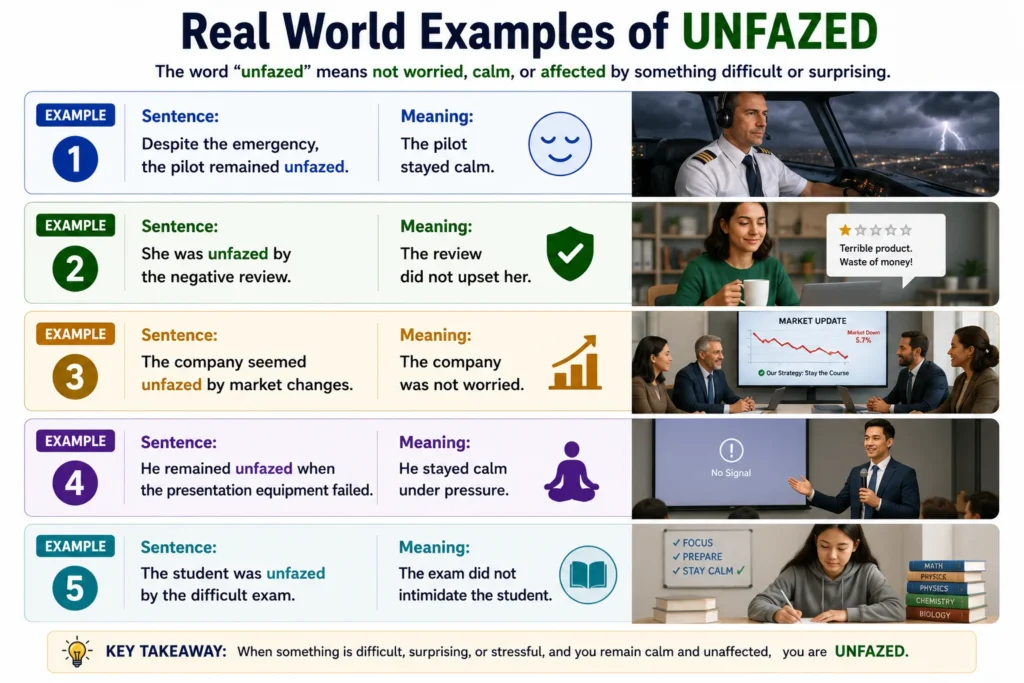
Example One
Sentence:
- Despite the emergency, the pilot remained unfazed.
Meaning:
The pilot stayed calm.
Example Two
Sentence:
- She was unfazed by the negative review.
Meaning:
The review did not upset her.
Example Three
Sentence:
- The company seemed unfazed by market changes.
Meaning:
The company was not worried.
Example Four
Sentence:
- He remained unfazed when the presentation equipment failed.
Meaning:
He stayed calm under pressure.
Example Five
Sentence:
- The student was unfazed by the difficult exam.
Meaning:
The exam did not intimidate the student.
Regional and Global Usage
American English
American English overwhelmingly prefers unfazed.
Examples appear frequently in:
- Newspapers
- Magazines
- Business reports
- Sports journalism
British English
British English also uses unfazed as the standard spelling.
Examples can be found in:
- News articles
- Academic publications
- Government documents
Canadian English
Canadian writers use unfazed.
Australian English
Australian English also follows the same convention.
Global English
Across major English-speaking regions:
✅ Unfazed
❌ Unphased
The preference is remarkably consistent.
Common Mistakes and Corrections
Mistake One
❌ She was unphased by the criticism.
✅ She was unfazed by the criticism.
Mistake Two
❌ The athlete looked unphased.
✅ The athlete looked unfazed.
Mistake Three
❌ He seemed unphased by the challenge.
✅ He seemed unfazed by the challenge.
Mistake Four
❌ Investors remained unphased.
✅ Investors remained unfazed.
Mistake Five
❌ I am unphased by their comments.
✅ I am unfazed by their comments.
Memory Trick to Remember the Correct Word
A simple memory trick can help.
Think About the Root Word
Unfazed comes from faze.
Ask yourself:
“Was the person bothered?”
If the answer is no, use unfazed.
Simple Formula
Faze = Disturb
Unfazed = Not disturbed
This formula works every time.
Related Words and Synonyms
Synonyms of Unfazed
- Calm
- Composed
- Relaxed
- Unbothered
- Cool
- Collected
- Steady
- Unshaken
- Untroubled
- Confident
Example
Original:
- She remained unfazed.
Alternative:
- She remained calm.
- She remained composed.
- She remained unshaken.
Unfazed in Professional Writing
Professional writers often choose unfazed because it conveys resilience and confidence.
Business Example
- The leadership team remained unfazed during economic uncertainty.
Journalism Example
- The candidate appeared unfazed by aggressive questioning.
Academic Example
- Participants remained unfazed throughout the experiment.
Sports Example
- The champion stayed unfazed despite the pressure.
Unfazed in Literature and Media
Authors often use unfazed to describe strong characters.
Examples include:
- Heroes facing danger
- Leaders handling crises
- Athletes under pressure
- Detectives solving mysteries
The word instantly communicates emotional control.
Related Comparisons
- Unfazed vs Unbothered
| Unfazed | Unbothered |
|---|---|
| Not disturbed | Not concerned |
| Often used under pressure | More casual |
| Formal and informal | Mostly informal |
- Unfazed vs Calm
| Unfazed | Calm |
|---|---|
| Not affected by events | General emotional state |
| Reaction based | State based |
- Unfazed vs Unshaken
| Unfazed | Unshaken |
|---|---|
| Not bothered | Not weakened emotionally |
| Common in conversation | Slightly more formal |
Exercises With Answers
Exercise One
Choose the correct word.
- She remained _____ during the interview.
- The athlete looked _____ after the mistake.
- Investors were _____ by the market decline.
Answers
- Unfazed
- Unfazed
- Unfazed
Exercise Two
Find the mistake.
- He was unphased by the criticism.
- She remained unphased during the debate.
- The manager seemed unphased.
Answers
- Unfazed
- Unfazed
- Unfazed
Exercise Three
Fill in the blanks.
- Nothing could _____ him.
- She stayed _____ despite the pressure.
- The team remained _____ throughout the match.
Answers
- Faze
- Unfazed
- Unfazed
Exercise Four
Correct the sentence.
- I am unphased by online comments.
- They were unphased during the crisis.
- The speaker remained unphased.
Correct Versions
- I am unfazed by online comments.
- They were unfazed during the crisis.
- The speaker remained unfazed.
Advanced Understanding of Unphased or Unfazed
Experienced writers know that language evolves. Some spelling errors become accepted over time.
However, major dictionaries and style guides still treat unfazed as the correct word for describing someone who is not disturbed.
While unphased occasionally appears online, it is generally viewed as a spelling mistake rather than an accepted alternative.
For professional communication, there is little reason to risk confusion.
Using unfazed ensures clarity and correctness.
FAQs
Is unfazed the correct spelling?
Yes. Unfazed is the correct spelling when you mean someone is not bothered, disturbed, or worried.
Is unphased a real word?
In rare technical contexts, yes. However, in everyday writing, it is usually a misspelling of unfazed.
Why do people write unphased instead of unfazed?
Because the two words sound very similar when spoken, many writers mistakenly connect the term to the word phase.
Should I use unphased or unfazed in professional writing?
Always use unfazed unless you are discussing a specialized technical meaning related to phases.
Can spellcheck miss the error unphased?
Yes. Some spellcheck systems may not flag it because the word can exist in limited technical contexts.
What does unfazed mean?
It means not disturbed, not worried, not upset, or not affected by a situation.
How do I remember unfazed or unphased?
Remember that unfazed comes from the verb faze, which means to disturb.
Is unfazed formal or informal?
It works in both formal and informal writing. It is common in journalism, business, academic writing, and everyday speech.
Can I say someone was unfazed by criticism?
Yes. That is one of the most common uses of the word.
Is unphased becoming accepted English?
Not currently. Most dictionaries, editors, teachers, and style guides still recommend unfazed.
Conclusion
The debate over unphased or unfazed is easier to solve than many people think. In standard English, unfazed is the correct word when describing someone who remains calm, confident, or unaffected by a challenge, criticism, surprise, or difficult situation. It comes from the verb faze, which means to disturb or upset someone.
Although unphased occasionally appears online and may have limited technical uses, it is generally considered a misspelling in everyday writing. Using it in emails, reports, essays, articles, or professional communication can make your writing appear less polished.
A helpful memory trick is simple: If something does not faze you, you are unfazed. Keeping that connection in mind will help you choose the correct spelling every time.
For students, professionals, content creators, and business writers, the safest and most accurate choice is always unfazed. Using the correct word improves clarity, strengthens credibility, and ensures your message is understood exactly as intended.

Justin Powell is a writer at GramBrix.com who focuses on grammar, clarity and effective communication, helping readers strengthen their language skills.