Last Updated on August 4, 2026
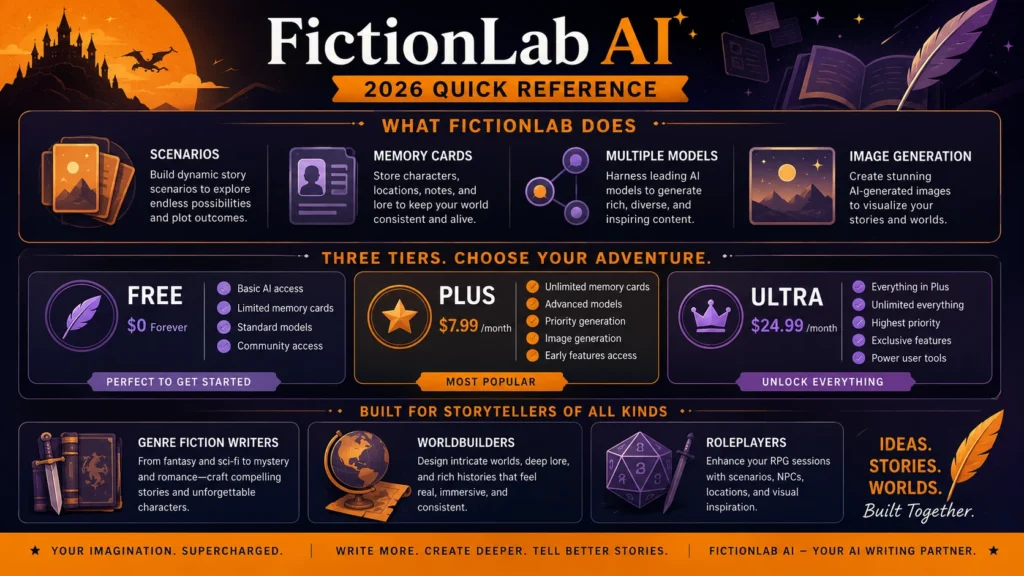
FictionLab AI is a story-first AI roleplay platform designed for long-form narrative creation and worldbuilding. Unlike Character AI, which focuses on casual chat, FictionLab uses Memory Cards and Story Cards to maintain character consistency across sessions. The platform launched in May 2025 and has over 2,500 ratings with a 4.2 star average on Google Play. It offers three tiers: Free (70B models, 32K context, 100 memory cards), Plus ($7.99/month, 685B models, 131K context, 500 memory cards), and Ultra ($24.99/month, reasoning models, in-chat image generation, interactive lore maps). Key models include Ophelia (free, narrative depth), Oracle (Plus, balanced creativity), Glendora V4 (Plus, emotional depth), and Eclipse (Ultra, frontier reasoning). FictionLab is uncensored by default with no ID verification required. It excels at genre fiction writing, scene work, and iterative drafting but struggles with long continuity management, logical consistency for complex plots, and voice differentiation over extended works. It’s best used as a “scene doctor” guided by a human outline rather than a full automation tool.
What Is FictionLab AI?
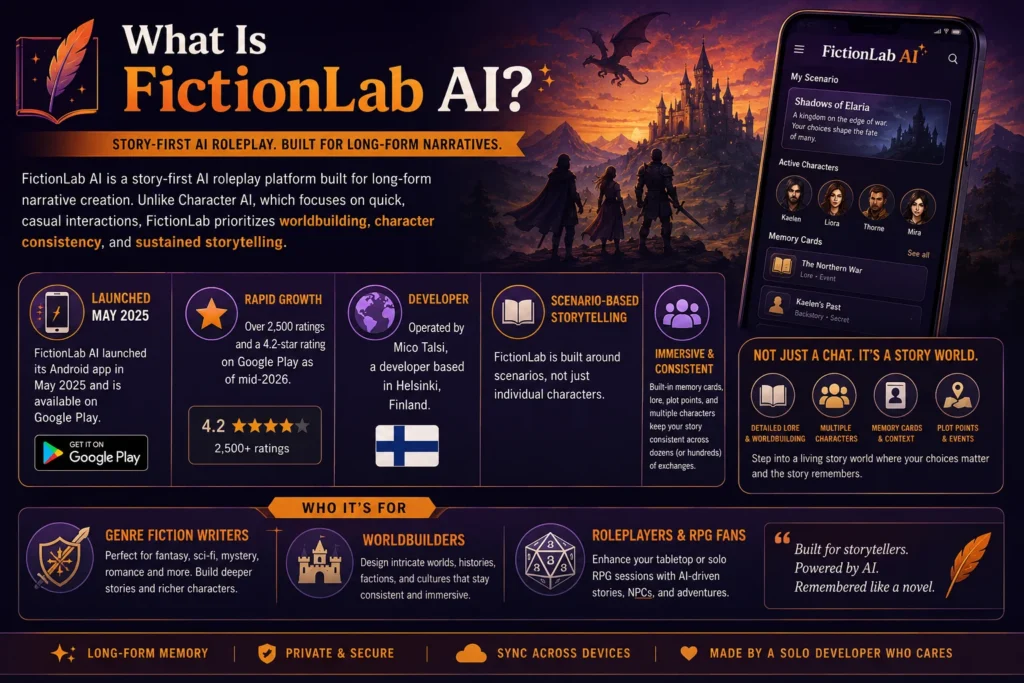
FictionLab AI is a story-first AI roleplay platform built for long-form narrative creation. Unlike Character AI, which focuses on quick, casual interactions, FictionLab prioritizes worldbuilding, character consistency, and sustained storytelling .
The platform launched its Android app in May 2025 and has seen rapid growth, with over 2,500 ratings and a 4.2-star rating on Google Play as of mid-2026 . It’s operated by Mico Talsi, a developer based in Helsinki, Finland .
Key distinction: FictionLab is built around “scenarios” rather than individual characters. You don’t just chat with a bot; you step into a story world with lore, multiple characters, memory cards, and plot points designed to stay consistent over dozens of exchanges .
What Makes FictionLab Different?
Story-First Architecture
Most AI roleplay platforms treat conversations as isolated exchanges. FictionLab treats them as narrative arcs. When you create or join a scenario, you’re entering a world with defined rules, tone, and characters that persist across sessions .
Here’s what that looks like in practice:
- Scenarios function like interactive story modules with lore, character descriptions, and custom instructions
- Personas let you define your character’s identity and backstory
- Memory Cards anchor important plot details so the AI doesn’t forget them
- Story Cards work like lorebooks, injecting world-building context dynamically
Uncensored by Default
Unlike Character AI’s strict content filters, FictionLab positions itself as a storytelling platform with minimal restrictions . No ID verification is required to access mature content. The community scenarios skew toward fantasy, sci-fi, and romance rather than explicit content specifically, but the platform doesn’t block creative exploration.
FictionLab Models: What You’re Actually Getting
FictionLab runs multiple proprietary models, each tuned for different writing needs.
Free Tier Models
| Model | Strengths | Best For |
|---|---|---|
| Ophelia (~70B) | Narrative depth, strong memory, consistency across long scenes | Epic fantasy, multi-character arcs, detailed worldbuilding |
| Wraith | Fast responses, lighter memory overhead | Quick dialogue exchanges, casual roleplay |
Ophelia is the standout free model. In testing, a multi-character fantasy storyline with shifting locations held together across 30+ messages . Details introduced early stayed accurate far longer than lighter models manage. The weakness: Ophelia narrates action scenes slowly. A fight sequence becomes three paragraphs of footwork when the scene needs momentum.
FictionLab+ Models ($7.99/month)
| Model | Strengths | Best For |
|---|---|---|
| Oracle | Creativity, memory, natural responses | Most narrative styles, balanced performance |
| Glendora V4 | Instruction following, creativity, emotional depth | Emotionally rich scenes, character-driven stories |
| Solara | Personalized responses, active development | Experimental writing |
| Quasar | Limited-time mystery model | Exploration and testing |
One reviewer noted that Glendora tends toward repetitive one-line breaks and excessive formatting, while Oracle delivers stronger prose but occasionally ends responses with forced “Option A or Option B” choices .
FictionLab Ultra Models ($24.99/month)
| Model | Strengths | Best For |
|---|---|---|
| Eclipse | Frontier ensemble with strong reasoning, deep memory | Long epics, multi-character scenes |
| Paragon | Built on DeepSeek V4 Pro, thoughtful, warm | Tactical roleplays, intricate plotting |
| Lumina | Built on Xiaomi MiMo V2.5 Pro, prose specialist | Richly described scenes, atmospheric writing |
These Ultra-tier models launched on May 24, 2026, targeting power users who want the absolute best experience .
FictionLab Pricing Tiers (2026)
| Feature | Free Tier | FictionLab+ ($7.99/mo) | FictionLab Ultra ($24.99/mo) |
|---|---|---|---|
| AI Context Window | 32K | 131K | 131K+ |
| AI Parameter Count | 70B | 685B | 685B |
| Thinking Models | No | No | Yes |
| Models Available | 3 | 7+1 limited | 10+1 limited |
| Response Priority | Normal | Priority | High Priority |
| Lore Pieces Combined Length | 100,000 | 250,000 | 400,000 |
| Memory Cards | 100 (500 chars each) | 500 (1,000 chars each) | 500 (1,000 chars each) |
| Image Generation Credits | 20 | 200 | 400 |
| In-Chat Image Generation | No | No | Yes |
| Dynamic Lore Engine | No | No | Yes |
| Interactive Lore Maps | No | No | Yes |
| Custom Chat Backgrounds | No | Yes | Yes |
Pricing note: FictionLab+ is reportedly the cheapest premium tier among major AI roleplay platforms . The Ultra tier was introduced on May 24, 2026, through version 1.6.5 .
Memory System: How FictionLab Keeps Stories Consistent
Memory Cards
Memory Cards are FictionLab’s core innovation. Instead of relying on a context window that forgets older events, you can pin specific facts, relationships, and plot points that remain anchored across every session .
How they work:
- You create a Memory Card manually or let the AI suggest one
- Each card holds a specific fact (e.g., “Ethan is secretly a prince in exile”)
- The AI references these cards consistently across all exchanges
- Free users get 100 cards; Plus users get 500
Users consistently praise this feature for eliminating the “who are you again?” problem that plagues long conversations on other platforms .
Story Cards (Lore Engine)
Story Cards function like a lorebook. You add world-building information, characters, and locations, then assign trigger words. When those words appear in your chat, the AI automatically pulls the relevant lore into context .
The Librarian is the engine behind this system. It picks up plot points and details much more reliably than previous versions and brings the right lore into the scene when it actually matters.
Interactive Lore Maps (Ultra Only)
Ultra subscribers get a visual map of their story’s memory. Memories and lore appear as nodes connected by lines, so you can actually see how your world ties together . You can sort, snap to grid, and see your total message count.
Slash Commands: Real-Time Control
FictionLab offers slash commands that give you active control over your session without leaving the chat :
/ooc– Switch to out-of-character mid-scene for meta instructions/pov– Shift narrative perspective on the fly/memory-cards– Review and add memory anchors/imagine– Ultra-only image generation within the chat
These aren’t cosmetic. They give writers active control that neither Character AI nor Janitor AI offers natively .
Image Generation
FictionLab includes an image generator with multiple styles and models. NSFW content is permitted .
Credit breakdown:
| Tier | Monthly Image Credits |
|---|---|
| Free | 20 |
| FictionLab+ | 200 |
| FictionLab Ultra | 400 |
The “Quick Create” and “Quick Create Pro” image models were introduced in February 2026 . Ultra subscribers can generate images directly in-chat using the /imagine command .
FictionLab vs Character AI vs Janitor AI
| Category | Character AI | Janitor AI | FictionLab |
|---|---|---|---|
| Best For | Quick interactions, community discovery | Deep customization, power users | Long-form storytelling, worldbuilding |
| Content Freedom | SFW only, strict filters | Unrestricted with ID verification | Uncensored by default, no ID |
| Memory Quality | Good (Chat Memories pins) | Good (Lorebook injection) | Excellent (Memory Cards) |
| Character Depth | Basic | Up to 3,200 tokens | Story Cards + Personas |
| Context Window | ~4K | Varies by external model | Up to 131K |
| Free Tier Value | Good (ads injected) | Good (plus prompt limits) | Excellent (no ads, full models) |
| Mobile Experience | Excellent | Poor | Good |
Source: AI Insights comparison , Robo Rhythms review
Real User Feedback: The Good and The Bad
What Users Love
“Memory is fine for free and the text is precise and detailed.” – Google Play reviewer
“FictionLab is the best-kept secret in the alternatives space… the memory system works differently from most competitors. Instead of a context window that forgets older events, FictionLab uses memory cards that you define yourself. The character references these cards consistently across every session.” – Robo Rhythms review
“It’s weirdly good at thinking like a director. If you say ‘make this feel like a tense bottle episode in a single room,’ it tends to add little physical beats, glances, props, etc. General chat models often just add more dialog. FictionLab actually moves bodies around the space in a way that’s closer to how fiction writers think.” – EyeFi forum user
“Mantiene la ESCENCIA y hace que todo sea más épico.” – Spanish Google Play reviewer, praising character consistency
What Users Hate
Search functionality is frequently broken or unavailable – Users report being unable to search or discover new scenarios
Slow response times and lag degrade the experience – As the platform scales, server delays appear
Premium models are often overloaded or unavailable even for paying users
The AI sometimes uses your own character and says words you never wanted to say
No character export as of early 2026 – Characters built here stay here. If you’re planning a portable library, know this before investing time
Voice sameness over distance – Across several chapters, sentence rhythm starts to feel similar and minor characters’ voices converge
The UI is confusing and visually “noisy” – A reviewer described it as “not really pleasing to my eyes” with orange colors making it feel cluttered
Limitations That Bite in Daily Use
“Authorial Intent” Is Fragile
Even more than other tools, FictionLab sometimes silently optimizes for what it thinks “good fiction” looks like, instead of what you asked. If you want a flat, emotionally numb narrator, it may secretly add emotional growth because “that’s what proper arcs look like” .
Subtlety and Negative Space
It struggles with scenes where the main point is what characters don’t say. Long silences, subtexty dialogue, and implied history get spelled out. You can partially fix this with repeated reminders, but it’s fighting its own training .
Logical Brittleness
Complex mysteries, rigorous political setups, and hard-science plots still require human-level planning. It can help brainstorm clues, but you must enforce cause/effect and timelines yourself .
Prose “Texture” Over Time
A chapter looks fine. Five chapters later, there’s a repetitive rhythm to paragraphs and sentence structure. You don’t catch it in a single pass, but it builds up, so you still need your own ear in revision .
Voice Drift Per Character
It can keep overall style fairly consistent, but having 4–5 distinct character voices over a long work is still your job. It’s OK at “snarky one, stoic one, anxious one” on a scene level, but in a 60k project they gradually blur .
“Turn It Into Great Prose” Button Does Not Exist
If your base scene is structurally flat, FictionLab will decorate it, not fix it. It adds interiority, stronger verbs, punchier dialogue, but rarely introduces the one big structural change that makes the scene actually work .
Who FictionLab Is For
Use FictionLab if you:
- Write genre fiction (romance, fantasy, mystery, horror)
- Want an AI that “thinks in scenes” instead of essays
- Like working with an assistant that pitches variations and branches
- Are comfortable being the showrunner: you maintain the bible, the arcs, the deeper themes
- Need to maintain character consistency across long sessions
- Want creative freedom without ID verification
Skip FictionLab if you:
- Want a “write my whole book” machine
- Need strict logical consistency for puzzle plots
- Write nonfiction, essays, or blog posts
- Prefer a polished, intuitive UI out of the box
- Need character export or portability
- Require guaranteed premium model availability
Frequently Asked Questions
Is FictionLab AI free?
Yes. The free tier includes 32K context, 70B parameter models, 100 memory cards, 20 image credits, and no ads. Three models are available: Ophelia, Wraith, and one additional free model.
How much does FictionLab+ cost?
FictionLab+ costs $7.99 per month. The Ultra tier costs $24.99 per month. There is no yearly subscription option.
What models does FictionLab offer?
Free tier models include Ophelia (~70B) and Wraith. Plus models include Oracle, Glendora V4, Solara, and Quasar. Ultra models include Eclipse, Paragon, and Lumina.
Is FictionLab AI uncensored?
FictionLab positions itself as a storytelling platform with minimal content restrictions. No ID verification is required for mature content. Community scenarios skew toward fantasy, sci-fi, and romance rather than explicit content specifically.
Can I use FictionLab for commercial projects?
FictionLab doesn’t explicitly restrict commercial use, but the platform is designed for personal creative writing. If you plan to publish commercial fiction, you should review the Terms of Service carefully.
Does FictionLab have an app?
Yes. FictionLab launched its Android app in May 2025. It’s available on Google Play with over 2,500 ratings and a 4.2-star average as of mid-2026 . There is no confirmed iOS app as of early 2026.
How does FictionLab compare to Character AI?
FictionLab is built for long-form storytelling with superior memory features. Character AI is built for quick interactions with a larger community library . Character AI has strict content filters; FictionLab is uncensored by default. Character AI has excellent mobile experience; FictionLab’s app is good but still improving.
Conclusion
FictionLab AI makes a compelling promise: a platform built for writers, not just casual chatters. Its Memory Cards and Story Cards genuinely solve the “who are you again?” problem that plagues most AI roleplay platforms after a dozen exchanges . The free tier is remarkably generous full models, no ads, and real creative control without forcing you to pull out your wallet.
But FictionLab isn’t for everyone. The same story-first architecture that makes it powerful for long-form narratives can feel clunky if you just want quick character interactions. The UI divides opinion , and the lack of character export means your creations are locked into FictionLab’s ecosystem . Voice drift, logical brittleness, and a tendency to “fix” your creative intent mean you’re still the showrunner .
Here’s our honest recommendation: If you’re a genre fiction writer (fantasy, romance, sci-fi, thriller) who wants an AI that “thinks in scenes” and helps you iterate on problem areas, FictionLab is arguably the best tool available right now. Start with the free tier, test Ophelia with a multi-scene story, and see if the memory system works for your workflow. If you find yourself hitting the 100 memory card limit, FictionLab+ at $7.99/month offers exceptional value—it’s the cheapest premium tier among major platforms . Only upgrade to Ultra if you’re producing professional-grade content and need reasoning models or in-chat image generation.
If you’re a casual roleplayer, just want quick character interactions, or need strict logical consistency for complex plots, look elsewhere. Character AI still wins on community discovery, and Janitor AI offers deeper character customization . But for sustained storytelling that actually remembers what happened twenty messages ago, FictionLab is the platform to beat in 2026.

Victoria Lane is a grammar-focused writer at GramBrix.com, passionate about helping readers master the rules of language. She provides clear explanations and practical examples that make writing more accurate, polished and confident.