Last Updated on August 1, 2026
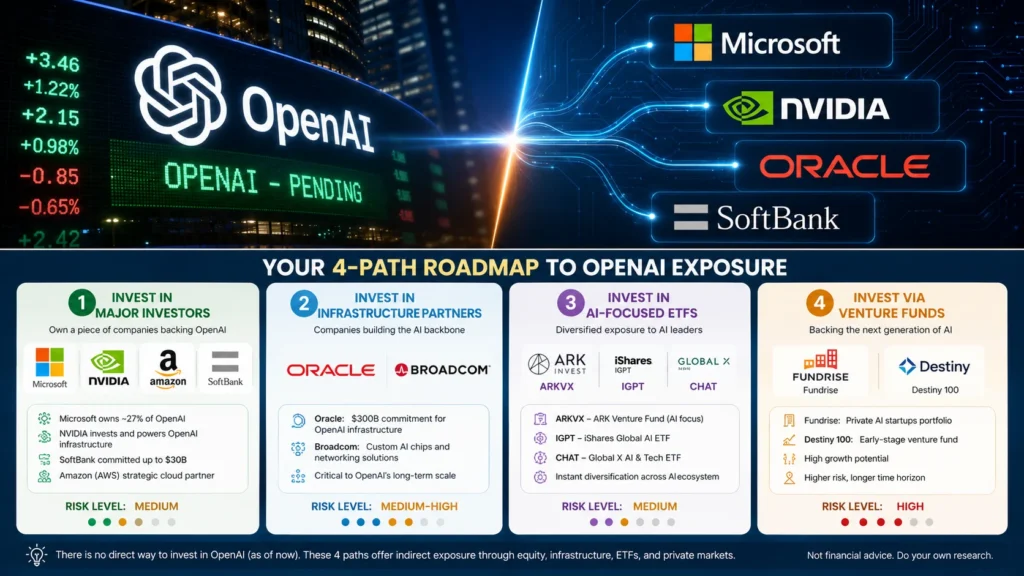
No OpenAI remains a private company with no ticker symbol. But a confidential S-1 filing on June 8, 2026 signals the IPO is coming, possibly in 2027 at a $1 trillion valuation. While retail investors can’t buy shares directly yet, there are four proven ways to gain exposure: invest in major stakeholders like Microsoft (27% stake), infrastructure partners like Oracle or Broadcom, AI-focused ETFs, or venture capital funds with minimums as low as $10. OpenAI expects to lose $14 billion in 2026, so weigh the risks carefully before jumping in.
OpenAI, the brains behind ChatGPT, filed a confidential S-1 with the SEC on June 8, 2026. That’s the first formal step toward going public. But here’s the kicker: the company’s own CFO has admitted the IPO might not happen for a while. Why? Because Sam Altman reportedly wants a $1 trillion valuation, and he’s willing to wait for it.
That leaves millions of retail investors in a frustrating spot. You can’t buy OpenAI stock on Robinhood. There’s no ticker symbol to search. The only people holding shares right now are employees, founders, and deep-pocketed institutions like Microsoft, SoftBank, and Nvidia.
But that doesn’t mean you’re locked out entirely.
This guide breaks down everything you need to know: the real IPO timeline, the restructuring story that made it possible, who owns what, and most importantly four concrete strategies to invest in OpenAI’s success before the ticker even exists. We’ll also explore the risks you can’t afford to ignore, from massive cash burn to fierce competition from Anthropic and Google.
If you’re serious about getting exposure to the most valuable AI company on the planet, keep reading. The window is open you just need to know which door to walk through.
Let me know if you want this expanded into a full blog post or adjusted for a different tone or audience.
Can You Buy OpenAI Stock Right Now?
Let’s cut through the noise immediately.
No OpenAI stock is not publicly available for purchase as of July 2026.
The company behind ChatGPT remains private. There is no ticker symbol to search for on Robinhood. You can’t buy shares through Fidelity, Vanguard, or any standard brokerage account. The only people holding OpenAI equity today are founders, employees, and a select group of institutional investors .
But here’s where it gets interesting.
OpenAI filed a confidential S-1 with the SEC on June 8, 2026 the first formal step toward an IPO . The company even acknowledged the filing publicly with a remarkably candid statement:
“We expect it to leak so we’re just announcing it. We have not decided on timing yet; it may be a while because there are things we want to do that are likely easier as a private company.”
So the IPO door is open. The question isn’t if anymore it’s when and how you can position yourself before that day arrives.
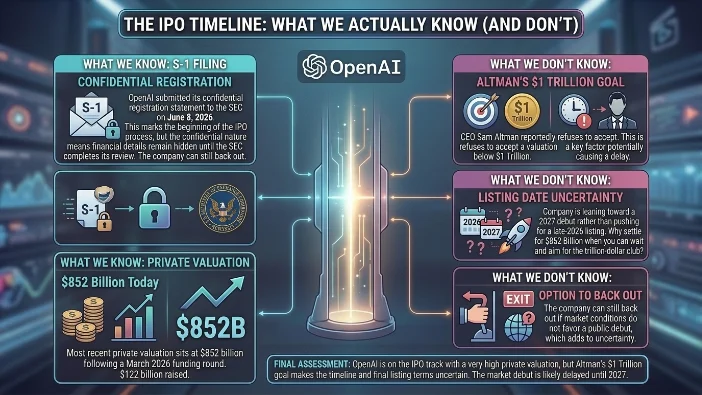
The IPO Timeline: What We Actually Know (and Don’t)
The story keeps evolving, so let’s pin down the facts.
The S-1 Filing: June 8, 2026
OpenAI submitted its confidential registration statement to the SEC on June 8 . This marks the beginning of the IPO process, but the confidential nature means financial details remain hidden until the SEC completes its review. The company can still back out if conditions don’t favor a public debut .
The Valuation Question: $852 Billion Today, $1 Trillion Tomorrow?
According to multiple sources, OpenAI’s most recent private valuation sits at $852 billion following a March 2026 funding round that raised $122 billion . But CEO Sam Altman reportedly wants more much more.
The New York Times reported that Altman has refused to accept a valuation below $1 trillion for the IPO . This explains why the company is leaning toward a 2027 debut rather than pushing for a late-2026 listing. Why settle for $852 billion when you can wait and aim for the trillion-dollar club?
The IPO Readiness Signal
OpenAI’s CFO Sarah Friar told the Associated Press that the company is already “acting with the good hygiene of a public company,” measuring revenue and reporting in ways that align with SEC requirements . This suggests the internal machinery is greased and ready the delay is strategic, not operational.
Key IPO Facts at a Glance
| Metric | Current Status |
|---|---|
| SEC Filing | Confidential S-1 submitted June 8, 2026 |
| Current Valuation | $852 billion (private markets) |
| Target IPO Valuation | $1 trillion+ |
| Likely IPO Date | 2027 (leaning, not confirmed) |
| Underwriters | Goldman Sachs, Morgan Stanley (reported) |
| Ticker Symbol | Not yet announced |
Why OpenAI Couldn’t Go Public Before Now
The path to an IPO wasn’t straightforward OpenAI had to completely overhaul its identity first.
The Nonprofit Origin Story
OpenAI launched in 2015 as a nonprofit research lab dedicated to developing artificial general intelligence “for the common good” . Elon Musk, Sam Altman, and several other tech heavyweights founded it with zero profit motive.
Going public under that structure was impossible. You can’t sell shares of a nonprofit to Wall Street.
The Restructuring: October 2025
In October 2025, OpenAI converted itself into a Public Benefit Corporation (PBC) . This hybrid model allows the company to pursue profit while maintaining social responsibility commitments. The nonprofit arm still exists as the OpenAI Foundation, retaining roughly 26% control .
This restructuring removed the final barrier to an IPO. The PBC structure gives OpenAI the flexibility to raise public capital without abandoning its original mission entirely.
The Legal Battle with Elon Musk
One more obstacle cleared: In May 2026, a federal jury dismissed Elon Musk’s lawsuit against OpenAI. Musk had sued seeking to oust Altman and unwind the for-profit conversion. The judge ruled Musk filed his lawsuit too late .
With that distraction gone, the IPO path became even clearer.
The Ownership Breakdown: Who Already Holds OpenAI Stock?
Before the IPO, OpenAI’s equity is concentrated among a handful of major players :
Microsoft: The 800-Pound Gorilla (27% Stake)
Microsoft invested roughly $13 billion into OpenAI between 2019 and 2023. Following the restructuring, Microsoft’s stake settled at approximately 27% of the company on an as-converted diluted basis .
The value of that stake? Based on the $852 billion private valuation, it’s worth about $230 billion . If OpenAI lists at $1 trillion, that 27% stake would be worth roughly $270 billion almost 10% of Microsoft’s entire $2.9 trillion market cap .
But the Microsoft relationship goes far beyond equity:
- Revenue share: Microsoft receives 20% of OpenAI’s revenue through 2030, capped at $38 billion total
- Azure commitment: OpenAI committed to spending $250 billion on Azure cloud services through 2032
- IP rights: Microsoft retains exclusive rights to OpenAI’s technology through 2032
SoftBank: The New Heavy Hitter (13% Stake)
SoftBank’s 13% stake came through the latest funding rounds. The Japanese investment giant has already booked $45 billion in unrealized gains from its OpenAI position .
Amazon: The Strategic Partner
Amazon holds $15 billion in preferred stock with a commitment to invest another $35 billion as part of a collaboration with AWS .
Nvidia: The Hardware Tie-In
Nvidia invested $30 billion in OpenAI, but it’s not just about equity OpenAI has committed to purchasing hardware from Nvidia as part of the deal .
The Foundation
The nonprofit OpenAI Foundation retains 26% control .
The Rest
Current and former employees plus other investors hold the remaining 47% .
How to Invest in OpenAI Before the IPO: 4 Proven Strategies
You can’t buy OpenAI directly. But you can build a portfolio that rides its coattails. Here’s how.
Strategy 1: Buy the Major Investors
This is the simplest approach buy the publicly traded companies that already own OpenAI shares.
Microsoft (NASDAQ: MSFT)
Microsoft offers the most direct equity exposure among public companies . The 27% stake is massive by any measure. Plus, Microsoft’s Azure revenue grew 40% year-over-year in Q1 2026, and the company generated $82.9 billion in revenue (up 18%) .
The stock is down nearly 20% in 2026 and trades about 30% below its 52-week high around 20 times forward earnings . That’s a discount compared to its historic premium during the AI boom .
Risk: The OpenAI stake is still just one piece of a much larger business. You’re buying Microsoft’s entire $2.9 trillion operation, not just its OpenAI exposure .
Nvidia (NASDAQ: NVDA)
Nvidia isn’t just an OpenAI investor it’s the hardware backbone of the entire AI industry. Nvidia’s data center revenue is exploding, hitting record levels in fiscal Q1 2027 with 85% year-over-year growth .
Risk: Nvidia’s massive growth is already priced in. The stock trades at a premium, and any slowdown in AI infrastructure spending could hit hard.
Amazon (NASDAQ: AMZN)
Amazon’s $15 billion preferred stake plus $35 billion commitment gives it meaningful exposure. And AWS remains a cloud computing powerhouse .
Risk: The OpenAI stake is a rounding error relative to Amazon’s overall value.
SoftBank (OTC: SFTBY)
SoftBank owns 13% of OpenAI and has already booked $45 billion in unrealized gains .
Risk: OTC trading and concentration risk SoftBank is heavily leveraged across multiple tech bets.
Strategy 2: Invest in Infrastructure Partners
This strategy targets the companies building the pipes that OpenAI depends on regardless of which AI company ultimately wins.
Oracle (NYSE: ORCL)
OpenAI committed $300 billion to Oracle for compute capacity over five years starting in 2027 . Oracle’s remaining performance obligations surged 359% to $455 billion.
Risk: Oracle is taking on significant debt to fund its capacity buildout.
Broadcom (NASDAQ: AVGO)
Broadcom signed a deal to deploy 10 gigawatts of custom AI accelerators for OpenAI between 2026 and 2029. Estimated total cost: $350 billion to $500 billion . AI semiconductor revenue hit $8.2 billion in Q1 2026 double the previous year.
Risk: Broadcom’s diversification means only part of its business ties to OpenAI directly.
Strategy 3: Invest in AI-Focused Funds
Several closed-end funds and ETFs hold private OpenAI shares or provide concentrated AI exposure .
Ark Venture Fund (ARKVX)
Cathie Wood’s Ark Invest manages this actively managed interval fund. OpenAI makes up about 8.5% of the portfolio . Total assets: just over $1 billion.
Pros: More concentrated OpenAI exposure than buying Microsoft or Nvidia.
Cons: Active management fees and interval fund structure with redemption limitations.
Destiny 100 (DXYZ)
A closed-end fund that acquires economic interests in private tech companies. OpenAI accounts for about 5.8% of its holdings .
Cons: Closed-end funds often trade below net asset value, and the expense ratio is significant.
Robinhood Venture Fund I (RVI)
This fund launched in March 2026, focusing on AI and fintech companies. OpenAI is one of its largest holdings, with $75 million invested .
Cons: Expense ratio of 3.13% (reduced to 2.13% through August 2026) and typical closed-end fund volatility .
AI-Focused ETFs for Broader Exposure
| ETF | Ticker | Focus |
|---|---|---|
| Invesco AI and Next Gen Software | IGPT | Generative AI stocks |
| Roundhill Generative AI & Technology | CHAT | First generative AI ETF |
| iShares Future AI & Tech | ARTY | ~50 AI-related stocks |
| Global X Robotics & AI | BOTZ | Robotics and automation |
| ARK Innovation ETF | ARKK | Holds $175M in OpenAI (2.6% of portfolio) |
Strategy 4: Invest in Venture Capital Funds (Non-Accredited)
For retail investors who don’t qualify as accredited, the Fundrise Innovation Fund offers OpenAI exposure with a minimum investment of just $10 .
Pros: Low barrier to entry, includes OpenAI alongside other private companies.
Cons: Less transparency and liquidity than public stocks.
OpenAI’s Financial Reality: The Good, the Bad, and the Expensive
Before you rush into any “OpenAI play,” understand the numbers.
Revenue: Growing Fast
- Annualized revenue run rate: $10 billion as of June 2025 (doubled from $5.5 billion in December 2024)
- Projected 2026 revenue: $24-30 billion
- Projected 2030 revenue target: Nearly $200 billion
Profitability: Nowhere in Sight
Here’s the sobering part: OpenAI is expected to lose approximately $14 billion in 2026 . The company is burning cash at an unprecedented rate to fund:
- Model training (costs can exceed $4 billion per generation)
- Infrastructure buildout
- Talent acquisition
- Compute costs estimated at over $100 billion annually
The company has raised more than $180 billion since its founding in 2015 . Yet profitability remains a distant goal.
The Risk of Dilution
Because OpenAI will likely continue raising private capital before the IPO, Microsoft’s 27% stake could be diluted further . The 27% figure already reflects dilution from recent funding rounds early investors have seen their percentage shrink over time.
The Competition Problem: OpenAI Is Losing Ground
Here’s a truth many AI enthusiasts don’t want to hear: OpenAI’s dominance is slipping.
Analysts at Emarketer have noted that OpenAI appears to be losing its strong early leads with consumers and businesses to Google (Gemini) and Anthropic (Claude) .
The Competitor Snapshot
| Company | Valuation | Status |
|---|---|---|
| OpenAI | $852 billion | Filed for IPO (2027 target) |
| Anthropic | $965 billion | Filed for IPO |
| SpaceX | $1.77 trillion | IPO completed June 2026 |
Anthropic is already profitable (or close to it) the company told investors it expects to turn a profit in the first half of 2026 . OpenAI hasn’t made similar claims.
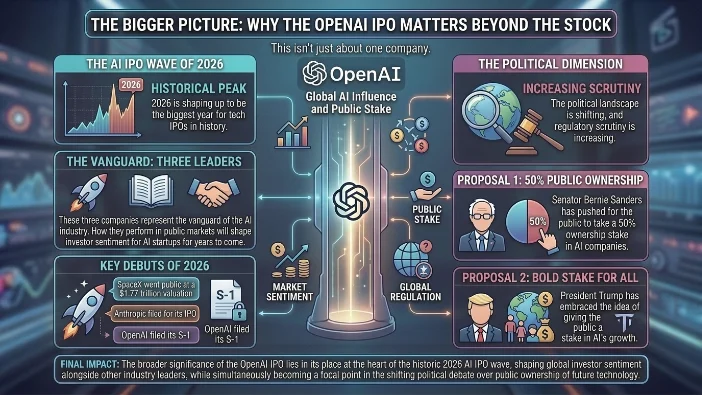
The Bigger Picture: Why the Open AI IPO Matters Beyond the Stock
This isn’t just about one company.
The AI IPO Wave of 2026
2026 is shaping up to be the biggest year for tech IPOs in history .
- SpaceX went public at a $1.77 trillion valuation
- Anthropic filed for its IPO
- OpenAI filed its S-1
These three companies represent the vanguard of the AI industry. How they perform in public markets will shape investor sentiment for AI startups for years to come.
The Political Dimension
Senator Bernie Sanders has pushed for the public to take a 50% ownership stake in AI companies . President Trump has embraced the idea of giving the public a stake in AI’s growth . The political landscape is shifting, and regulatory scrutiny is increasing.
FAQs
Can I buy OpenAI stock on Robinhood right now?
No. OpenAI has no ticker symbol and is not publicly traded .
When will OpenAI go public?
Likely 2027, though the company hasn’t confirmed a date. The S-1 filing gives them flexibility .
What is the OpenAI stock ticker?
Not yet announced. No ticker symbol has been assigned .
Is OpenAI profitable?
No. The company expects to lose approximately $14 billion in 2026 .
What’s the best way to invest in OpenAI indirectly?
Microsoft offers the most direct equity exposure among public companies .
What is OpenAI valued at?
$852 billion in private markets as of March 2026. The IPO may target a $1 trillion valuation .
Disclaimer: This article is for informational and educational purposes only. It does not constitute financial advice. Always do your own research and consult a qualified financial advisor before making investment decisions.
Conclusion
Wait for the direct IPO if:
- You want pure-play OpenAI exposure without dilution from other business lines
- You’re patient enough to wait until 2027 (or longer)
- You want to avoid the complexity of closed-end funds and secondary markets
Buy indirect exposure now if:
- You believe the AI megatrend is real and want immediate exposure
- You’re comfortable with the added layer of company-specific and market-specific risk
- You see long-term value in infrastructure plays regardless of OpenAI’s individual outcome
The Motley Fool’s take: Microsoft offers the “most stable way to gain exposure,” while Nvidia provides a play on the broader AI infrastructure demand .

Kevin Brooks is a grammar specialist at GramBrix.com, dedicated to helping readers understand language rules with clarity and confidence. He simplifies complex grammar concepts through practical examples and easy explanations.