
Last Updated on July 15, 2026
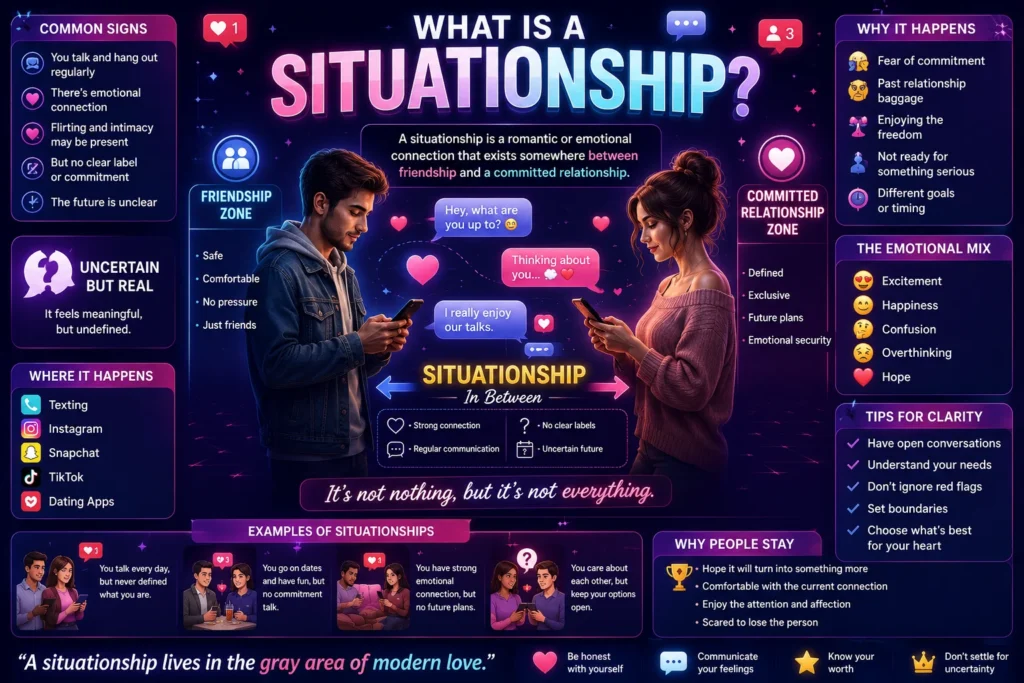
A situationship is a romantic or emotional connection that exists between friendship and a committed relationship. People in a situationship often spend time together, communicate regularly, and share intimacy, but they have not clearly defined the relationship or committed to each other.
Modern dating has created new terms to describe relationship dynamics, and one of the most popular is situationship. If you’ve seen someone say, “We’re not dating, but we’re not just friends either,” they may be describing a situationship.
The term has become common on social media, dating apps, podcasts, and everyday conversations. Moreover, many people search for the situationship meaning because the concept can feel confusing. Unlike traditional relationships, situationships often lack clear labels, expectations, or long-term commitments.
Some people enjoy the flexibility of a situationship. Others find it emotionally exhausting because the boundaries remain unclear. Therefore, understanding what a situationship is can help you recognize one, navigate it more effectively, and decide whether it aligns with your goals.
In this comprehensive guide, you’ll learn the exact situationship meaning, common signs, emotional dynamics, platform-specific usage, real-life examples, misunderstandings, and practical advice for handling these modern relationship situations.
Quick Answer Box
| Element | Explanation |
|---|---|
| Meaning | An undefined romantic relationship without clear commitment |
| Context | Dating, relationships, modern romance |
| Usage | Describing unclear romantic connections |
| Common Platforms | TikTok, Instagram, Snapchat, dating apps, X, Reddit |
| Example | “We’ve been talking for months, but we’re still in a situationship.” |
| Tone | Casual, emotional, relationship-focused |
What Does It Mean?
The situationship meaning refers to a romantic or emotionally involved connection that lacks a clearly defined relationship status.
A situationship typically includes some characteristics of a relationship, such as:
- Frequent communication
- Emotional connection
- Physical intimacy
- Regular time together
- Mutual attraction
However, it usually lacks:
- Official commitment
- Clear labels
- Exclusive expectations
- Long-term planning
- Relationship certainty
As a result, people often describe a situationship as existing somewhere between casual dating and a committed relationship.
Full Definition
A situationship is an informal romantic arrangement where two people share emotional, romantic, or physical involvement without clearly defining the relationship.
The word combines:
- Situation
- Relationship
Together, they create situationship, meaning a relationship-like situation without the structure of an official relationship.
Although situationships vary, most share several common characteristics:
- Undefined status
- Mixed signals
- Emotional attachment
- Limited commitment
- Ongoing uncertainty
Therefore, the defining feature is not the level of affection but the lack of clarity.
Context & Usage
People use the term situationship in many dating and social contexts.
Modern Dating Culture
Dating culture has changed significantly in recent years.
People now meet through:
- Dating apps
- Social media
- Online communities
- Mutual connections
Consequently, relationship labels sometimes develop more slowly than before.
A situationship often emerges when two people enjoy each other’s company but avoid discussing commitment.
Emotional Context
Many situationships involve genuine feelings.
For example, two people may:
- Text daily
- Go on dates
- Share personal experiences
- Support each other emotionally
However, they may never officially define the relationship.
This emotional ambiguity often creates confusion.
Social Context
Friends frequently ask:
- “Are you dating?”
- “Is that your boyfriend?”
- “Is that your girlfriend?”
When neither person has a clear answer, a situationship may exist.
Communication Context
The term appears frequently in:
- Text messages
- Relationship discussions
- Dating podcasts
- Social media videos
- Advice columns
Moreover, younger generations often use it to describe complex romantic situations.
Real-Life Examples
Understanding real scenarios makes the situationship meaning easier to recognize.
Conversation Example 1
Friend 1: Are you two officially together?
Friend 2: Not really.
Friend 1: Then what’s going on?
Friend 2: Honestly, it’s a situationship.
Conversation Example 2
Person A: Do you see other people?
Person B: We never talked about exclusivity.
Person A: Sounds like a situationship.
Conversation Example 3
Friend: How long have you been talking?
Person: Almost eight months.
Friend: And you’re still not dating?
Person: Exactly.
Conversation Example 4
Person A: We text every day.
Person B: Are you in a relationship?
Person A: No. That’s the problem.
Conversation Example 5
Friend: Why are you stressed?
Person: I like them, but I don’t know where we stand.
Friend: That sounds like situationship anxiety.
Platform-Specific Meaning
The situationship meaning remains generally consistent across platforms. However, discussions often emphasize different aspects.
TikTok
TikTok popularized the term through dating content.
Common topics include:
- Situationship red flags
- Situationship stories
- Emotional confusion
- Dating advice
Many creators discuss how situationships affect mental health and self-esteem.
Instagram often showcases situationships through:
- Relationship memes
- Story posts
- Dating quotes
- Advice graphics
People frequently share relatable content about unclear romantic dynamics.
Snapchat
On Snapchat, situationships often involve:
- Daily streaks
- Consistent communication
- Flirting
- Emotional attachment
However, users may still avoid defining the relationship.
Dating Apps
Situationships commonly begin on:
- Tinder
- Bumble
- Hinge
- OkCupid
Sometimes people continue dating casually without discussing commitment.
Relationship forums often contain questions such as:
- “Am I in a situationship?”
- “How do I leave a situationship?”
- “Can a situationship become a relationship?”
Therefore, Reddit discussions frequently explore real-life experiences.
X (Formerly Twitter)
Users often joke about situationships through:
- Memes
- Viral posts
- Relationship humor
The term has become part of internet culture.
Alternative Meanings
Although situationship usually refers to dating, people occasionally use it more broadly.
Romantic Situationship
This is the most common meaning.
Two people share emotional or romantic involvement without commitment.
Emotional Situationship
Sometimes physical intimacy is absent.
Instead, the connection remains emotionally intense yet undefined.
Long-Distance Situationship
Two people maintain regular communication.
However, they never establish a committed relationship.
On-and-Off Situationship
Some situationships cycle repeatedly between closeness and distance.
This pattern often creates emotional instability.
Related Terms / NLP Variations
Many users searching for situationship meaning also search related relationship terminology.
Similar Terms
- Talking stage
- Casual dating
- Friends with benefits
- Romantic connection
- Undefined relationship
- Gray-area relationship
Related Dating Terms
- Breadcrumbing
- Ghosting
- Love bombing
- Benching
- Orbiting
- Soft launching
These terms frequently appear in modern dating discussions.
Synonyms
Depending on context:
- Undefined relationship
- Casual romantic connection
- Unofficial relationship
- Relationship without labels
- Ambiguous romance
Opposite Terms
- Committed relationship
- Marriage
- Exclusive partnership
- Official relationship
These involve clear expectations and mutual commitment.
How to Respond or Reply
If someone says they’re in a situationship, your response depends on the context.
Supportive Response
You can say:
- How do you feel about it?
- Are you happy with the arrangement?
- What do you want from the relationship?
These questions encourage self-reflection.
Clarifying Response
If someone describes a confusing situation, ask:
- Have you discussed expectations?
- Do both people want the same thing?
- Have you defined boundaries?
Clear communication often reveals important answers.
Honest Self-Reflection
If you’re personally in a situationship, consider asking yourself:
- Am I getting what I need?
- Are my expectations realistic?
- Do we want the same future?
These questions help create clarity.
Misinterpretations
Many people misunderstand situationships.
Mistake 1: Every Casual Relationship Is a Situationship
Not necessarily.
Casual relationships can still include clear communication and agreed expectations.
Situationships typically involve uncertainty.
Mistake 2: Situationships Are Always Toxic
This is false.
Some people genuinely prefer flexibility and enjoy the arrangement.
Problems usually arise when expectations differ.
Mistake 3: Situationships Never Become Relationships
Many situationships eventually evolve into committed partnerships.
However, others remain undefined for extended periods.
Mistake 4: Only Young People Have Situationships
Adults of all ages experience them.
Although social media popularized the term, the dynamic existed long before the label.
When NOT to Use It
Situationship is not appropriate in every circumstance.
Clearly Defined Relationships
If both people have agreed to commitment, exclusivity, and labels, the connection is a relationship, not a situationship.
Pure Friendship
Friendships without romantic interest do not qualify.
Professional Relationships
Workplace connections should not be described as situationships unless a romantic dynamic exists.
Family Relationships
The term applies to romantic contexts rather than family dynamics.
Usage Tips
Tip 1: Focus on Relationship Clarity
The defining feature is uncertainty.
Without ambiguity, the term may not fit.
Tip 2: Consider Mutual Understanding
Sometimes one person sees a situationship while the other believes they’re dating.
Therefore, communication matters.
Tip 3: Avoid Assumptions
Every situationship differs.
Some involve deep emotions. Others remain casual.
Tip 4: Pay Attention to Expectations
Relationship satisfaction often depends on whether expectations align.
Tip 5: Discuss Boundaries
Healthy communication reduces confusion.
Even in a situationship, boundaries and expectations remain important.
FAQs
What is a situationship in simple terms?
A situationship is a romantic connection without a clearly defined relationship status.
Is a situationship the same as dating?
Not exactly. Dating can lead to a situationship, but situationships usually lack commitment and labels.
Can a situationship become a relationship?
Yes. Many situationships eventually become committed relationships after open communication.
Why do people stay in situationships?
Some enjoy flexibility. Others hope the connection will develop into something more serious.
Are situationships healthy?
They can be healthy if both people understand and accept the arrangement. Problems often arise when expectations differ.
How long does a situationship last?
There is no fixed timeline. Some last weeks, while others continue for months or even years.
What are the signs of a situationship?
Common signs include emotional closeness, regular communication, physical intimacy, and a lack of relationship labels.
Is a situationship exclusive?
Not necessarily. Unless both people agree on exclusivity, assumptions can lead to misunderstandings.
Why do situationships hurt emotionally?
Uncertainty often creates anxiety, especially when one person wants more commitment than the other.
How do you end a situationship?
Communicate honestly, express your needs, and establish clear boundaries moving forward.
Conclusion
The situationship meaning centers on one key idea: a romantic connection that lacks clear definition and commitment. Unlike traditional relationships, situationships often exist in a gray area where emotional intimacy, attraction, and regular communication occur without official labels or long-term agreements.
For some people, this flexibility feels comfortable. However, for others, the uncertainty creates frustration, confusion, and emotional stress. Therefore, understanding what a situationship is can help you recognize relationship patterns, communicate your expectations, and make informed decisions about your romantic life.
Ultimately, the healthiest approach involves honest communication. Whether a situationship develops into a committed relationship or naturally ends, clarity helps both people understand where they stand and what they truly want.

Kevin Brooks is a grammar specialist at GramBrix.com, dedicated to helping readers understand language rules with clarity and confidence. He simplifies complex grammar concepts through practical examples and easy explanations.