Last Updated on July 30, 2026
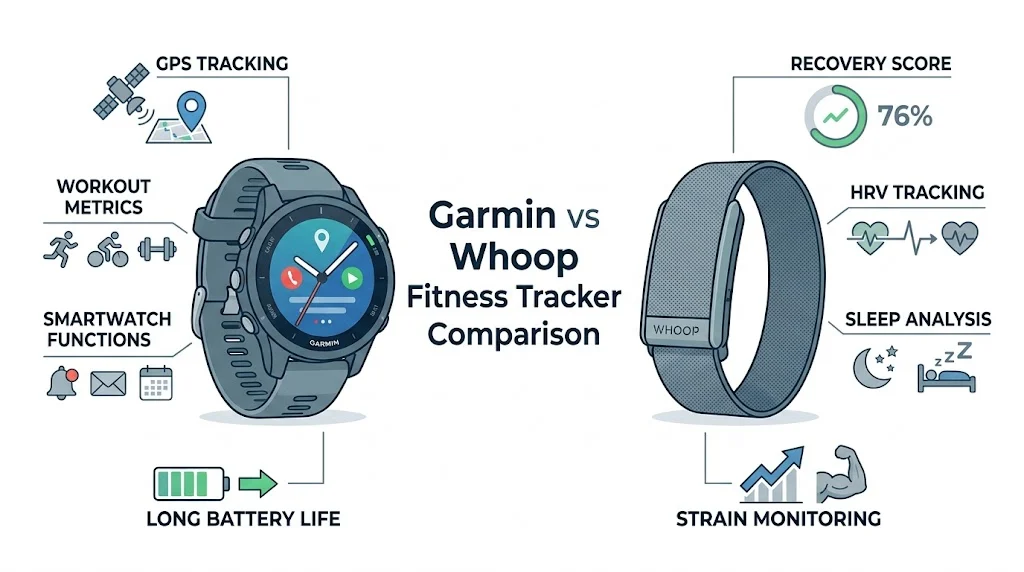
Garmin vs Whoop compares two popular fitness trackers for athletes and health-focused users. Garmin offers GPS, workouts, and smartwatch features, while Whoop specializes in recovery, strain, and sleep tracking via a subscription model. Choose Garmin for a full smartwatch experience, or Whoop for deep performance and recovery insights.
You’re training harder than ever. Your workouts are consistent. Your nutrition is on point. You’re getting enough sleep. Yet your performance has stalled. Is your training plan failing—or are you simply missing the data your body is trying to give you?
For many athletes and fitness enthusiasts, the problem isn’t effort—it’s insight. Modern performance isn’t measured by steps taken or calories burned alone. Today’s sports science shows that factors like heart rate variability (HRV), sleep quality, recovery, training load, and physiological readiness play a major role in determining how well your body adapts to exercise. Without tracking these metrics, even the most disciplined training routine can produce inconsistent results.
This is where the comparison between Garmin vs WHOOP becomes important. Both platforms are trusted by endurance athletes, coaches, and fitness professionals, but they approach performance tracking from two very different philosophies.
Garmin is built as a complete multi-sport ecosystem. Its smartwatches combine GPS accuracy, advanced training metrics, HRV tracking, heart rate monitoring, navigation, and sport-specific analytics into a single wearable. It’s designed for runners, cyclists, swimmers, triathletes, hikers, and anyone who wants detailed performance data alongside everyday smartwatch features.
WHOOP, on the other hand, takes a recovery-first approach. Instead of focusing on notifications or GPS navigation, it continuously monitors your body’s physiological signals to measure sleep quality, daily strain, recovery, and readiness to train. Rather than asking “How hard did you work today?” WHOOP focuses on a more valuable question: “Is your body actually ready to perform at its best today?”
The distinction is more than a product feature—it’s a difference in training philosophy. Garmin emphasizes performance measurement and structured training, while WHOOP prioritizes recovery optimization and evidence-based training decisions. Neither approach is universally better; the right choice depends on your goals, sport, coaching style, and how you prefer to use data.
In this comprehensive guide, we’ll compare Garmin vs WHOOP across accuracy, health metrics, recovery tracking, training insights, battery life, pricing, and real-world athlete experiences. Drawing on exercise science principles, performance tracking concepts, and practical use cases, you’ll gain a clear understanding of which ecosystem best supports your fitness goals, training style, and budget.
Quick Answer: Garmin vs Whoop
| Feature | Garmin | Whoop |
|---|---|---|
| Device Type | Smartwatch | Screenless fitness band |
| Main Focus | GPS tracking and sports metrics | Recovery and strain monitoring |
| Display | Full watch screen | No screen |
| Battery | 7–30 days depending on model | About 4–5 days |
| Subscription | Usually none | Required monthly subscription |
| Sports Tracking | Very advanced | Basic |
| Sleep Tracking | Good | Extremely detailed |
| Recovery Insights | Moderate | Core feature |
| Best For | Runners, cyclists, outdoor athletes | Performance optimization and recovery |
Simple Summary
- Choose Garmin if you want a powerful sports smartwatch with GPS and training tools.
- Choose Whoop if you want deep recovery insights and strain management for performance optimization.
What Is Garmin?
Garmin is a global technology company known for GPS navigation devices, smartwatches, and sports wearables.
Garmin watches are designed for athletes, outdoor explorers, and people who want detailed fitness tracking with smartwatch capabilities.
Popular Garmin watch series include:
- Garmin Fenix Series
- Garmin Forerunner Series
- Garmin Venu Series
- Garmin Instinct
Key Garmin Features
Garmin watches include many tools for training and health monitoring:
Fitness Tracking
- Running metrics
- Cycling metrics
- Swimming tracking
- VO2 Max estimates
- Training load
Health Monitoring
- Heart rate
- Stress levels
- Sleep tracking
- Body Battery energy score
- Blood oxygen monitoring
Smartwatch Functions
- Phone notifications
- Music storage
- GPS navigation
- Contactless payments
- Apps and widgets
Garmin is widely used by:
- Runners
- Triathletes
- Cyclists
- Hikers
- Adventure athletes
What Is Whoop?
WHOOP is a fitness technology company focused on performance optimization and recovery tracking.
Instead of a smartwatch, Whoop uses a screenless fitness band that continuously collects data.
All insights appear in the Whoop mobile app.
Core Whoop Metrics
Whoop focuses on three main pillars:
Strain
Measures how hard your body worked during the day.
Recovery
Analyzes readiness for training based on sleep, heart rate variability, and resting heart rate.
Sleep
Provides deep analysis of sleep cycles and sleep debt.
Whoop Sensors Track
- Heart rate
- Heart rate variability (HRV)
- Respiratory rate
- Skin temperature
- Sleep stages
- Activity strain
Unlike Garmin, Whoop does not show data on the device itself.
Everything happens in the app.
Garmin vs Whoop: Key Differences Explained
Hardware Design
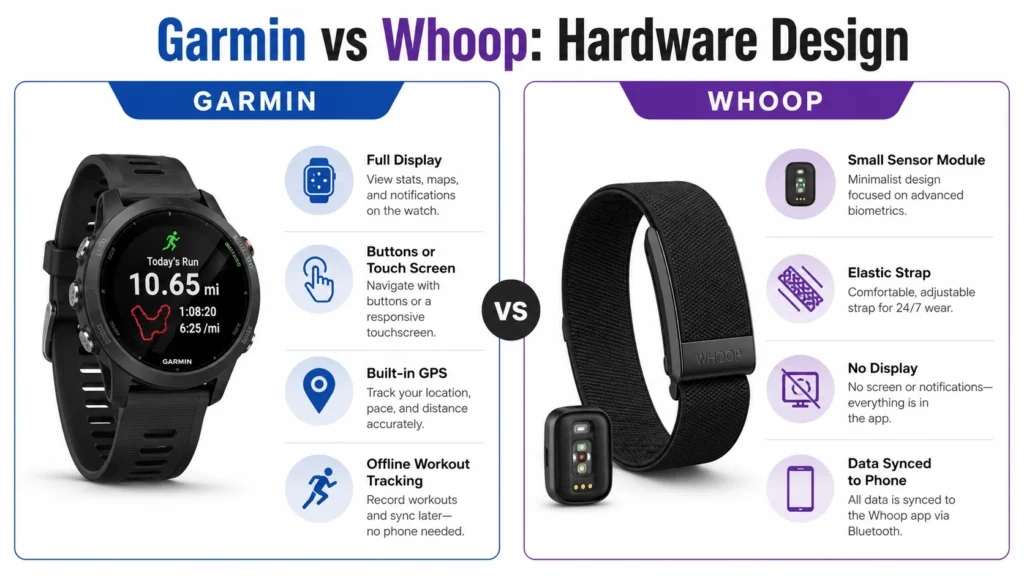
Garmin watches look like traditional smartwatches.
They include:
- Full display
- Buttons or touch screens
- Built in GPS
- Offline workout tracking
Whoop devices are simpler.
They include:
- Small sensor module
- Elastic strap
- No display
- Data synced to phone
| Feature | Garmin | Whoop |
|---|---|---|
| Display | Yes | No |
| Buttons | Yes | No |
| Standalone tracking | Yes | Limited |
| Wear style | Watch | Band |
Data Focus
Garmin emphasizes activity tracking.
Examples include:
- Distance
- Pace
- Elevation
- Training load
- VO2 max
Whoop emphasizes recovery science.
Examples include:
- HRV
- Recovery score
- Sleep performance
- Daily strain targets
Cost Structure
Garmin devices require one-time purchase.
Whoop uses a subscription model.
| Cost Type | Garmin | Whoop |
|---|---|---|
| Upfront device | Yes | Usually included |
| Monthly fee | No | Yes |
| Long term cost | Lower | Higher |
Many users dislike Whoop’s subscription cost.
Data Depth
Whoop often provides deeper physiological analysis.
Examples include:
- HRV based recovery
- Sleep debt calculations
- Daily coaching suggestions
Garmin provides:
- Good health data
- Strong activity tracking
- Performance analytics
But recovery guidance is usually less detailed.
Advantages of Garmin
Versatility
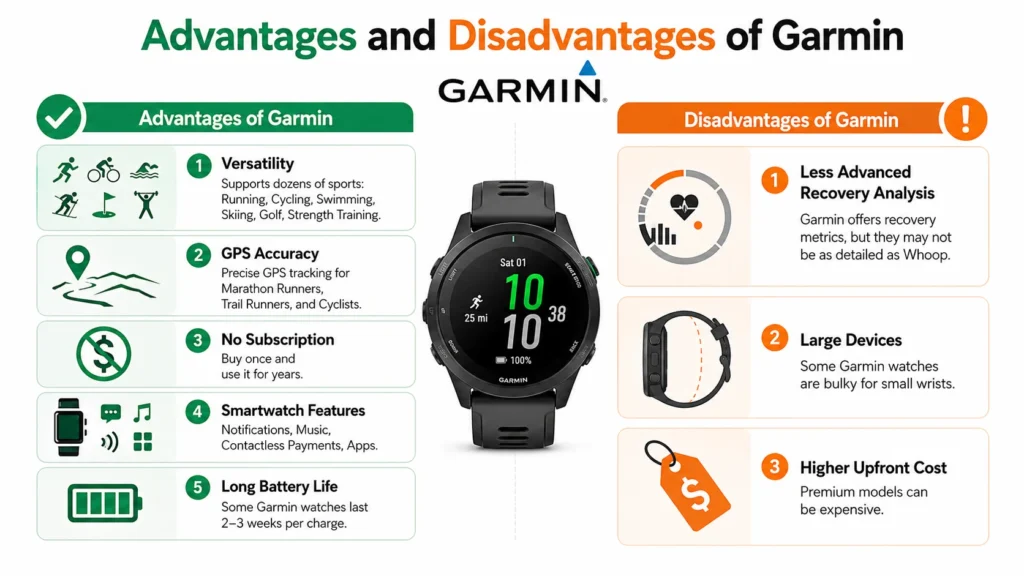
Garmin devices support dozens of sports:
- Running
- Cycling
- Swimming
- Skiing
- Golf
- Strength training
GPS Accuracy
Garmin is famous for precise GPS tracking.
This is essential for:
- Marathon runners
- Trail runners
- Cyclists
No Subscription
You buy the watch once and use it for years.
Smartwatch Features
Garmin devices offer:
- Notifications
- Music
- Contactless payments
- Apps
Long Battery Life
Some Garmin watches last 2–3 weeks per charge.
Disadvantages of Garmin
Less Advanced Recovery Analysis
Garmin offers recovery metrics, but they may not be as detailed as Whoop.
Large Devices
Some Garmin watches are bulky for small wrists.
Higher Upfront Cost
Premium models can be expensive.
Advantages of Whoop
Best Recovery Tracking
Whoop is known for industry leading recovery analytics.
It uses:
- Heart rate variability
- Resting heart rate
- Sleep quality
Sleep Optimization
The app shows:
- Sleep debt
- Sleep consistency
- Recommended bedtime
Continuous Wear
You can wear Whoop 24 hours a day, including during charging.
Coaching Insights
Whoop gives daily recommendations like:
- Train hard today
- Focus on recovery
- Sleep earlier tonight
Disadvantages of Whoop
Monthly Subscription
Users must pay every month.
No Screen
You must open the phone app to see data.
Limited Workout Tracking
Whoop is weaker for detailed sport metrics.
No GPS
Outdoor activity tracking depends on phone GPS.
Real World Examples
Example 1: Marathon Runner
A runner training for a marathon needs:
- Pace tracking
- Distance accuracy
- Heart rate zones
Garmin is the better choice.
Example 2: Professional Athlete
A professional athlete wants:
- Recovery monitoring
- HRV analysis
- Sleep tracking
Whoop may be more useful.
Example 3: Casual Fitness User
A casual user might prefer Garmin because:
- It tracks workouts
- It works as a watch
- No subscription is required.
Garmin vs Whoop for Different Users
| User Type | Best Choice |
|---|---|
| Runner | Garmin |
| Cyclist | Garmin |
| Triathlete | Garmin |
| Biohacker | Whoop |
| Sleep optimization | Whoop |
| Recovery focused athletes | Whoop |
| Outdoor adventurers | Garmin |
Regional and Global Usage
Both Garmin and Whoop are used worldwide.
Garmin has stronger presence in:
- Outdoor sports
- Endurance athletics
- Navigation technology
Whoop is popular among:
- Professional athletes
- Sports teams
- Fitness influencers
- Biohacking communities
Many elite athletes use Whoop to monitor recovery.
Common Mistakes When Comparing Garmin vs Whoop
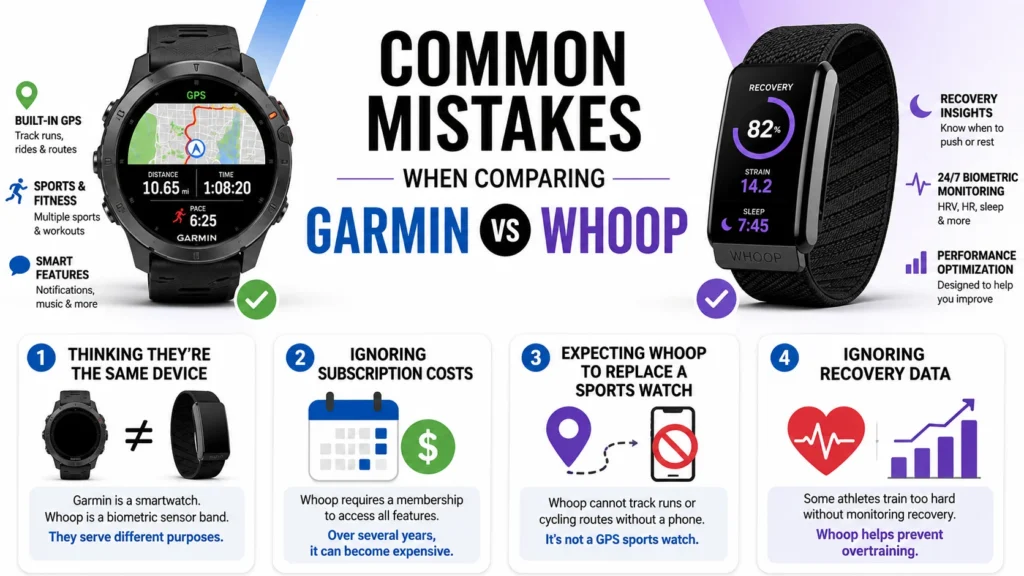
Mistake 1: Thinking They Are the Same Device
Garmin is a smartwatch.
Whoop is a biometric sensor band.
They serve different purposes.
Mistake 2: Ignoring Subscription Costs
Over several years, Whoop can become expensive.
Mistake 3: Expecting Whoop to Replace a Sports Watch
Whoop cannot track runs or cycling routes without a phone.
Mistake 4: Ignoring Recovery Data
Some athletes train too hard without monitoring recovery.
Whoop helps prevent overtraining.
Practical Exercises
Exercise 1
A cyclist wants GPS route tracking and cadence analysis.
Which device is better?
Answer: Garmin
Exercise 2
An athlete wants deep sleep and recovery insights.
Which device is better?
Answer: Whoop
Exercise 3
A user wants smartwatch features and workout tracking without a subscription.
Which device should they choose?
Answer: Garmin
Related Comparisons
Many people also compare Garmin and Whoop with other wearables such as:
- Fitbit
- Apple
- Apple Watch
- Oura
Each device focuses on different strengths.
For example:
| Device | Strength |
|---|---|
| Apple Watch | Smartwatch ecosystem |
| Fitbit | Health tracking |
| Oura Ring | Sleep tracking |
| Garmin | Sports performance |
| Whoop | Recovery analytics |
FAQs
Is Garmin better than Whoop for running?
Yes. Garmin watches provide advanced running metrics like pace, cadence, and GPS mapping, making them better for runners than Whoop.
Can Whoop replace a Garmin watch?
Not completely. Whoop focuses on recovery and strain, but it lacks GPS tracking, workout screens, and smartwatch features found in Garmin devices.
Is Whoop more accurate than Garmin?
For recovery metrics such as heart rate variability and sleep analysis, Whoop may provide deeper insights. However, Garmin is more accurate for GPS and activity tracking.
Do professional athletes use Whoop?
Yes. Many professional athletes use Whoop to track recovery, strain, and sleep performance.
Is Garmin cheaper than Whoop long term?
Yes. Garmin requires a one time purchase, while Whoop requires a monthly subscription that increases long term cost.
Which device is better for sleep tracking?
Whoop usually provides more detailed sleep analytics and coaching recommendations.
Does Garmin track recovery like Whoop?
Garmin offers recovery features like Body Battery and training readiness, but they are generally less detailed than Whoop recovery insights.
Can you wear Whoop during sports?
Yes. Whoop is designed for continuous wear and works during workouts, sleep, and daily activities.
Is Garmin good for strength training?
Yes. Many Garmin watches track strength workouts and repetitions.
Should beginners choose Garmin or Whoop?
Most beginners benefit more from Garmin because it offers activity tracking, smartwatch features, and no subscription cost.
Conclusion
Choosing between Garmin vs Whoop depends on what type of fitness insights you need.
Garmin devices are powerful multi sport smartwatches. They offer excellent GPS accuracy, workout tracking, and smartwatch features. Runners, cyclists, hikers, and endurance athletes often prefer Garmin because it provides detailed training data and reliable navigation tools.
Whoop takes a different approach. It focuses on recovery science and performance optimization. Its strength lies in heart rate variability analysis, sleep tracking, and daily strain management. Athletes who prioritize recovery, biohacking, and long term performance improvements may benefit more from Whoop.
In simple terms:
- Choose Garmin if you want a sports watch with GPS, workouts, and smartwatch functions.
- Choose Whoop if you want deep recovery insights and coaching for training readiness.
Many serious athletes even use both devices together, combining Garmin activity tracking with Whoop recovery analytics.
The best choice is the one that fits your training goals, budget, and lifestyle.

Kevin Brooks is a grammar specialist at GramBrix.com, dedicated to helping readers understand language rules with clarity and confidence. He simplifies complex grammar concepts through practical examples and easy explanations.