
Last Updated on July 5, 2026
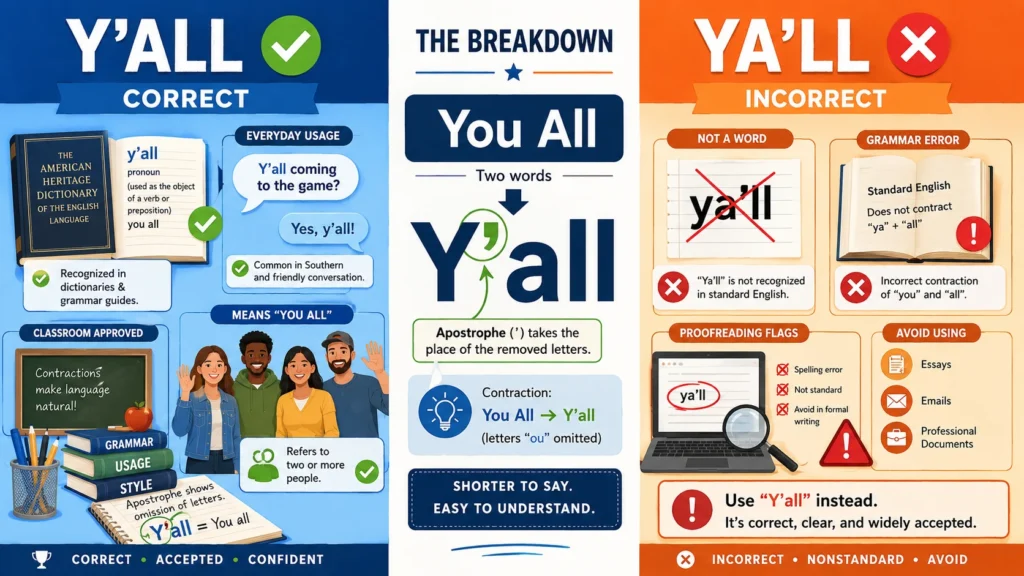
Y’all is the correct contraction of “you all.” The apostrophe replaces the missing letters in you, making y’all the standard and widely accepted spelling. Ya’ll is generally considered a misspelling and is not recognized in standard English writing.
Many English learners and native speakers alike wonder whether they should write y’all or ya’ll. The two spellings look similar, but only one is considered correct in standard English.
This confusion happens because contractions can be tricky. When people hear the word spoken aloud, they often guess where the apostrophe belongs. As a result, some writers use ya’ll, believing it follows the same pattern as other contractions. However, grammar rules tell a different story.
The term y’all is especially common in everyday speech across parts of the United States. It has also become popular worldwide through social media, television, music, and online communication. Because it is used so often, knowing the correct spelling is important for both casual and professional writing.
In this guide, you will learn the difference between y’all and ya’ll, understand why one spelling is correct, see real-world examples, discover common mistakes, practice with exercises, and gain confidence using the expression correctly.
Quick Answer
| Word | Correct? | Meaning |
|---|---|---|
| Y’all | ✅ Yes | Contraction of “you all” |
| Ya’ll | ❌ No | Misspelling of y’all |
Correct: Y’all are welcome to join us.
Incorrect: Ya’ll are welcome to join us.
The correct form is y’all because it comes from the phrase you all.
What Does Y’all Mean?
Y’all is a contraction of you all.
It is used when speaking to or about a group of people.
Examples
- Y’all look great today.
- Are y’all ready for dinner?
- I hope y’all enjoy the trip.
- Y’all should arrive before noon.
Think of y’all as the plural version of you.
In modern English, the word you can refer to one person or many people. This sometimes creates confusion. The word y’all helps clarify that the speaker is addressing more than one person.
Simple Analogy
Imagine a teacher entering a classroom.
Instead of saying:
“Are you ready?”
The teacher might say:
“Are y’all ready?”
This makes it clear that the teacher is speaking to the entire class.
Why Is Y’all Correct?
To understand why y’all is correct, look at the original phrase:
You all
When creating a contraction, the apostrophe replaces omitted letters.
Breakdown
| Full Phrase | Contraction |
|---|---|
| You all | Y’all |
The apostrophe replaces the letters ou from you.
Therefore:
You all → Y’all
This follows the standard rules of English contractions.
Similar Examples
| Full Form | Contraction |
|---|---|
| Do not | Don’t |
| Cannot | Can’t |
| I am | I’m |
| We are | We’re |
| You all | Y’all |
Because the apostrophe marks missing letters, y’all is grammatically correct.
Why Is Ya’ll Incorrect?
The spelling ya’ll places the apostrophe incorrectly.
If we analyze it:
Ya’ll
This would suggest the original phrase was something like:
Ya all
However, standard English does not use ya all as the phrase being contracted.
Since the contraction comes from you all, the apostrophe belongs after the letter Y.
Incorrect Logic
| Incorrect Form | Problem |
|---|---|
| Ya’ll | Does not correctly represent “you all” |
Because of this, dictionaries, style guides, and grammar experts consider ya’ll a misspelling.
The History of Y’all
Many people associate y’all with the Southern United States.
The expression developed as a practical way to address groups of people.
Historical Background
Linguists believe the phrase became popular in the American South during the nineteenth century.
Over time, it evolved from:
You all
to
Y’all
The word gained acceptance because it solved a grammatical problem. English lacked a clear plural version of you, so speakers created one naturally.
Today, y’all appears in:
- Conversations
- Literature
- Social media
- Advertising
- Television shows
- Business communication
Regional Usage of Y’all
Southern United States
This is where y’all is most strongly associated.
Examples:
- Y’all come back soon.
- How are y’all doing?
Other Parts of the United States
The word is increasingly common nationwide.
Many younger speakers use it regardless of location.
International Usage
People around the world now recognize y’all through:
- Movies
- TV shows
- Social media
- Online communities
As a result, the word has become more mainstream.
Y’all vs Other Plural Forms of You
Different English-speaking regions use different ways to indicate multiple people.
| Expression | Region |
|---|---|
| Y’all | Southern United States |
| You guys | United States |
| You lot | United Kingdom |
| Youse | Ireland, Australia, parts of North America |
| Yinz | Western Pennsylvania |
| You all | Standard English |
Each serves a similar purpose.
Examples
Y’all
- Are y’all ready?
You guys
- Are you guys ready?
You lot
- Are you lot ready?
All communicate the same basic idea.
Advantages and Disadvantages of Using Y’all
Advantages
Inclusive
Y’all refers to a group without focusing on gender.
Example:
- Welcome, y’all.
Clear
It immediately signals that multiple people are being addressed.
Friendly
The word often creates a warm and conversational tone.
Efficient
One short word replaces two words.
Disadvantages
Informal Tone
Some formal documents may prefer you all instead.
Regional Association
Some readers still associate it strongly with Southern American speech.
Possible Misunderstanding
People unfamiliar with the term may find it unusual.
Real World Examples of Y’all
In Everyday Conversation
- Y’all should try this restaurant.
- Have y’all seen the new movie?
- I hope y’all have a great weekend.
In Customer Service
- Thank y’all for choosing our company.
- We appreciate y’all’s support.
In Social Media
- Hope y’all are having a great day.
- Love seeing y’all’s comments.
In Education
- Can y’all submit your assignments by Friday?
- Are y’all ready for the quiz?
Is Y’all Accepted in Professional Writing?
The answer depends on the context.
Appropriate Situations
- Marketing content
- Brand messaging
- Informal emails
- Social media posts
- Community outreach
Less Appropriate Situations
- Academic research papers
- Formal legal documents
- Highly technical reports
In formal settings, many writers choose you all instead.
Common Mistakes with Y’all
Using Ya’ll
❌ Ya’ll need to finish the project.
✅ Y’all need to finish the project.
Using Yall Without an Apostrophe
❌ Yall are welcome.
✅ Y’all are welcome.
Confusing Singular and Plural Usage
❌ Y’all referring to one person in a context where plurality matters.
✅ Use y’all for groups.
Double Plural Forms
Some speakers say:
- All y’all
This is common in some dialects but may sound unusual in standard writing.
Y’all in Grammar
Subject
- Y’all are amazing.
Object
- I invited y’all.
Possessive Form
- Is this y’all’s car?
Possessive Example
- I appreciate y’all’s effort.
Although possessive forms vary slightly by style preference, y’all’s is commonly used.
Comparison Table: Y’all vs Ya’ll
| Feature | Y’all | Ya’ll |
|---|---|---|
| Correct spelling | Yes | No |
| Recognized by dictionaries | Yes | No |
| Means “you all” | Yes | No |
| Accepted in writing | Yes | Usually no |
| Common usage | Very common | Rare |
| Grammatically correct | Yes | No |
Related Concepts and Comparisons
Y’all vs You All
| Y’all | You All |
|---|---|
| Contraction | Full phrase |
| Informal | Neutral |
| Shorter | Longer |
Examples:
- Y’all are invited.
- You all are invited.
Both are correct.
Y’all vs You Guys
| Y’all | You Guys |
|---|---|
| Gender neutral | Can sound gender specific |
| Common in the South | Common nationwide |
Many people prefer y’all because it is inclusive.
Y’all vs Everyone
| Y’all | Everyone |
|---|---|
| Direct address | Group reference |
| Second person | Third person |
Example:
- Y’all need to listen.
- Everyone needs to listen.
When Should You Use Y’all?
Use y’all when:
- Speaking to multiple people.
- Writing conversationally.
- Creating friendly content.
- Posting on social media.
- Communicating with audiences that understand the term.
Avoid it when:
- Writing highly formal documents.
- Following strict academic style rules.
Examples in Different Situations
Family
- Are y’all coming to dinner?
Workplace
- Can y’all review the proposal?
School
- Y’all did a great job on the project.
Online Community
- Thank y’all for your feedback.
Business Marketing
- We appreciate y’all’s loyalty.
Exercises: Choose the Correct Form
Exercise 1
Which sentence is correct?
A. Ya’ll are invited.
B. Y’all are invited.
Answer: B
Exercise 2
Which spelling represents “you all”?
A. Y’all
B. Ya’ll
Answer: A
Exercise 3
Choose the correct sentence.
A. Yall are welcome.
B. Y’all are welcome.
Answer: B
Exercise 4
Which is grammatically correct?
A. Ya’ll enjoy the show.
B. Y’all enjoy the show.
Answer: B
Exercise 5
Fill in the blank:
_____ should arrive by 9 a.m.
Answer: Y’all
Advanced Practice
Correct the errors.
Sentence 1
Ya’ll have done great work.
Correct Version:
Y’all have done great work.
Sentence 2
Yall need to finish the assignment.
Correct Version:
Y’all need to finish the assignment.
Sentence 3
Ya’ll’s project looks excellent.
Correct Version:
Y’all’s project looks excellent.
Why the Confusion Continues
Several factors keep the confusion alive.
Pronunciation
Both spellings sound identical when spoken.
Informal Communication
Text messages and social media often encourage creative spelling.
Apostrophe Placement
Many writers are unsure where contractions place apostrophes.
Lack of Grammar Knowledge
Some people have never learned the word’s origin from you all.
Once you understand the contraction, remembering the correct spelling becomes much easier.
Style Guide Recommendations
Most dictionaries and writing authorities recognize y’all.
Common guidance includes:
- Use y’all when writing informally.
- Avoid ya’ll.
- Use you all in highly formal contexts if preferred.
The key rule remains simple:
Y’all is correct. Ya’ll is incorrect.
FAQs
Is y’all or ya’ll correct?
Y’all is correct because it is the contraction of you all. Ya’ll is considered a misspelling.
Why is ya’ll wrong?
The apostrophe is placed incorrectly. The contraction comes from you all, not ya all.
Can I use y’all in professional writing?
Yes, in friendly and conversational communication. Formal academic or legal writing may prefer you all.
Is y’all a real word?
Yes. Dictionaries recognize y’all as a legitimate English word and contraction.
Does y’all mean one person or many people?
It usually refers to multiple people.
Is y’all only used in the Southern United States?
No. While it originated there, people across the United States and around the world now use it.
How do you make y’all possessive?
The common possessive form is y’all’s.
Example: I appreciate y’all’s help.
Can y’all be used in emails?
Yes. Many businesses and individuals use y’all in friendly email communication.
Should I write yall without an apostrophe?
No. The apostrophe is necessary because y’all is a contraction.
What is the difference between y’all and you all?
Y’all is the contracted form, while you all is the full phrase. Both mean the same thing.
Conclusion
The debate between y’all or ya’ll has a simple answer: y’all is the correct spelling, and ya’ll is incorrect. The word y’all comes directly from the phrase you all, with the apostrophe replacing omitted letters from you. Because of this grammatical structure, dictionaries and style guides consistently recognize y’all as the proper form.
Understanding this difference can improve both your writing and your confidence. Whether you are sending emails, posting on social media, creating content, or having everyday conversations, using y’all correctly helps you communicate clearly and professionally.
Remember these key points:
- Y’all = Correct
- Ya’ll = Incorrect
- Y’all means “you all”
- The apostrophe belongs after the Y
- Y’all is widely accepted in informal and conversational English
When in doubt, think of the original phrase you all. That simple reminder will help you choose the correct spelling every time.

Justin Powell is a writer at GramBrix.com who focuses on grammar, clarity and effective communication, helping readers strengthen their language skills.