Last Updated on June 24, 2026
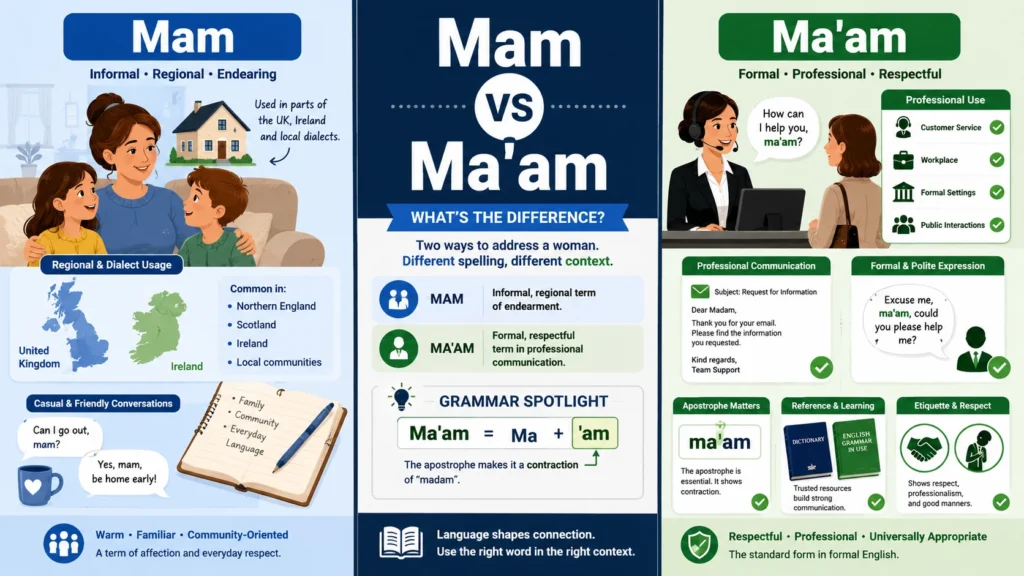
Ma’am is the standard and correct contraction of “madam” and is widely used as a polite form of address for women. Mam is a regional spelling commonly used in parts of the United Kingdom, Ireland, and some local dialects, but it is generally not considered the standard form in formal English writing.
Many English learners and native speakers wonder whether they should write mam or ma’am. At first glance, the two words look very similar. They are both used when speaking to or about a woman respectfully. However, they are not always interchangeable.
The confusion often happens because people hear the words in conversation and spell them the way they sound. In some regions, people say “mam” naturally, while in others, “ma’am” is the standard form. This difference can lead to mistakes in emails, business communication, school assignments, and everyday writing.
Understanding the difference between mam or ma’am helps you communicate more professionally and avoid grammar errors. It also allows you to recognize regional language differences and use the most appropriate term for your audience.
In this guide, you will learn the meanings of both words, their origins, where they are commonly used, common mistakes to avoid, real-world examples, regional differences, and practical exercises to improve your understanding.
Quick Answer
If you are writing standard English, especially in professional or formal situations, use ma’am.
| Word | Meaning | Standard English? | Common Usage |
|---|---|---|---|
| Mam | Informal or regional term for mother or a respectful female address | Limited | UK regional dialects, Ireland, Northern England, Wales |
| Ma’am | Contraction of “madam” | Yes | Formal and polite address in American English and many other English-speaking regions |
Short rule: When in doubt, choose ma’am.
Understanding Mam or Ma’am
Although these words sound alike in many accents, they have different histories and uses.
What Does Mam Mean?
Mam is primarily a regional word.
In several parts of the United Kingdom and Ireland, people use “mam” to mean:
- Mother
- Mom
- Mum
Examples:
- My mam is coming over for dinner.
- I called my mam yesterday.
- Her mam works at the hospital.
In some local dialects, “mam” may also be used as a respectful way to address a woman.
Examples:
- Thank you, mam.
- Excuse me, mam.
However, this usage is regional rather than standard.
What Does Ma’am Mean?
Ma’am is a contraction of madam.
It is a formal and polite title used when speaking directly to a woman.
Examples:
- Yes, ma’am.
- Thank you, ma’am.
- How may I help you, ma’am?
The apostrophe replaces omitted letters from “madam.”
Think of it like these contractions:
| Full Word | Contraction |
|---|---|
| Cannot | Can’t |
| Do not | Don’t |
| Madam | Ma’am |
Because it is a recognized contraction, ma’am is considered the correct spelling in formal English.
Origin of Mam and Ma’am
Understanding the history of these words makes the distinction easier.
Origin of Ma’am
The word ma’am comes from madam, which entered English from French.
Historically, “madam” was used to show respect to women of high social standing.
Over time, speakers shortened “madam” to “ma’am” in everyday speech.
Today, it remains a common polite form of address.
Origin of Mam
The word mam developed as a regional variation of words meaning “mother.
It became especially common in:
- Northern England
- Wales
- Ireland
- Parts of Scotland
Many families still use “mam” as their everyday word for mother.
Mam or Ma’am: Main Differences
| Feature | Mam | Ma’am |
|---|---|---|
| Meaning | Mother or regional respectful address | Polite form of address for a woman |
| Origin | Regional dialect word | Contraction of madam |
| Formal Writing | Usually no | Yes |
| Business Communication | Rarely used | Commonly used |
| Standard English | Limited | Yes |
| Common Regions | UK, Ireland, Wales | United States and international English |
When to Use Mam
Referring to Your Mother
In many regions, “mam” simply means mother.
Examples:
- My mam taught me how to cook.
- I visited my mam last weekend.
- Her mam lives nearby.
Regional Speech
Some communities naturally use “mam” when addressing women.
Example:
- Thank you, mam, for your help.
Even though this may be acceptable locally, it may appear incorrect in international business or academic writing.
When to Use Ma’am
Customer Service
Many service workers use “ma’am” to show respect.
Examples:
- How may I assist you, ma’am?
- Your order is ready, ma’am.
Professional Communication
Examples:
- Yes, ma’am, I will complete the report.
- Thank you for your feedback, ma’am.
Military and Government Settings
In many countries, especially the United States, “ma’am” is common in official communication.
Examples:
- Yes, ma’am.
- No, ma’am.
Why the Apostrophe Matters
The apostrophe in ma’am is not optional.
It indicates that letters have been removed from the original word “madam.”
Without the apostrophe, the word changes to “mam,” which has a different meaning and usage.
Compare:
| Word | Correct Usage |
|---|---|
| Mam | My mam is a teacher. |
| Ma’am | Thank you, ma’am. |
A helpful memory trick:
Ma’am = Madam shortened
The apostrophe reminds you that letters are missing.
Advantages and Disadvantages of Each Form
Mam
Advantages
- Common in regional speech
- Natural in local communities
- Widely understood as “mother” in some countries
Disadvantages
- Can appear incorrect in formal writing
- May confuse international readers
- Not universally accepted as a respectful title
Ma’am
Advantages
- Grammatically correct in standard English
- Professional and respectful
- Widely recognized internationally
- Suitable for business communication
Disadvantages
- Some people feel it sounds overly formal
- Can make younger women feel older in certain cultures
Real World Examples of Mam or Ma’am
Example 1: Email to a Customer
Correct:
- Dear Ma’am,
- Thank you for contacting us.
Incorrect:
- Dear Mam,
- Thank you for contacting us.
Example 2: Talking About Your Mother
Correct:
- My mam loves gardening.
Less Appropriate:
- My ma’am loves gardening.
Example 3: Customer Service Interaction
Customer: Where is the checkout?
Employee: Right this way, ma’am.
Example 4: Family Conversation
- My mam makes the best soup.
- My mam taught me to ride a bicycle.
Regional and Global Usage
Language varies across countries.
United States
People overwhelmingly use ma’am as a respectful title.
Examples:
- Yes, ma’am.
- No, ma’am.
England
Usage depends on the region.
Many people use:
- Mum
- Mam
to refer to their mother.
Ireland
“Mam” is extremely common for mother.
Examples:
- My mam is visiting tomorrow.
- I spoke to my mam today.
Wales
“Mam” is often used instead of “mum.”
Australia and New Zealand
“Mum” is more common than “mam,” while “ma’am” appears mostly in formal contexts.
Mam or Ma’am in Professional Writing
When writing:
- Emails
- Cover letters
- Reports
- Customer service messages
- Academic documents
Use ma’am when addressing a woman respectfully.
Examples:
- Thank you, ma’am.
- Excuse me, ma’am.
- Good morning, ma’am.
Avoid using mam unless referring to someone’s mother in a regional context.
Common Mistakes
Using Mam Instead of Ma’am
Incorrect:
- Thank you, mam.
Correct:
- Thank you, ma’am.
Forgetting the Apostrophe
Incorrect:
- Thank you, maam.
Correct:
- Thank you, ma’am.
Using Ma’am for Mother
Incorrect:
- My ma’am is visiting today.
Correct:
- My mam is visiting today. (regional)
- My mom is visiting today.
- My mum is visiting today.
Assuming Both Are Always Interchangeable
They are not.
Context determines which word is appropriate.
Comparison With Similar Words
| Word | Meaning |
|---|---|
| Ma’am | Respectful title for a woman |
| Madam | Formal title for a woman |
| Miss | Unmarried woman |
| Mrs. | Married woman |
| Ms. | Woman regardless of marital status |
| Mum | Mother |
| Mom | Mother |
| Mam | Regional word for mother |
Practical Tips for Remembering the Difference
Remember the Source Word
Ma’am comes from madam.
If you mean “madam,” use ma’am.
Think About the Audience
Professional audience?
Use ma’am.
Talking about your mother in Ireland or Northern England?
Mam may be correct.
Check for an Apostrophe
If addressing a woman respectfully, the apostrophe usually belongs there.
Exercises With Answers
Exercise 1
Choose the correct word.
- Thank you, _____.
- My _____ is a nurse.
- Excuse me, _____, you dropped your wallet.
- I called my _____ yesterday.
- Yes, _____, I understand.
Answers
- ma’am
- mam
- ma’am
- mam
- ma’am
Exercise 2
Correct the sentence.
- Thank you mam for your help.
- My ma’am lives in Dublin.
- Yes mam, I understand.
Answers
- Thank you, ma’am, for your help.
- My mam lives in Dublin.
- Yes, ma’am, I understand.
Exercise 3
Identify the correct usage.
A. My mam made dinner.
B. My ma’am made dinner.
Answer:
A is correct in regions where “mam” means mother.
Related Concepts and Comparisons
Mam vs Mum
Both often mean mother.
Regional preference determines which is used.
Examples:
- My mam is here.
- My mum is here.
Mam vs Mom
Mom is primarily American English.
Mam is more common in parts of the UK and Ireland.
Ma’am vs Madam
Both are respectful.
Madam is more formal.
Examples:
- Good morning, Madam.
- Good morning, Ma’am.
Ma’am vs Miss
Miss often refers to a younger woman.
Ma’am is generally used regardless of age when showing respect.
FAQs
Is mam or ma’am correct?
Both can be correct depending on context. “Ma’am” is the standard respectful title, while “mam” is often a regional word for mother.
Should I write mam or ma’am in an email?
Use ma’am in professional emails and formal communication.
Why does ma’am have an apostrophe?
The apostrophe shows that letters were removed from the word “madam.”
Is mam a real word?
Yes. It is a legitimate regional word commonly meaning mother in parts of the UK and Ireland.
Can mam and ma’am be used interchangeably?
Not always. Their meanings and contexts are different.
Which spelling is more common in American English?
Ma’am is far more common in American English.
Is it rude to say ma’am?
Usually no. It is generally considered respectful and polite.
How do I remember mam or ma’am?
If the word comes from “madam,” use ma’am. If referring to your mother in a regional dialect, use mam.
Is ma’am formal or informal?
Ma’am is generally polite and moderately formal.
What is the difference between mam, mom, and mum?
All three can mean mother. The preferred spelling depends on regional English usage.
Conclusion
The distinction between mam or ma’am is simple once you understand their meanings and origins. Ma’am is the standard contraction of madam and is the preferred choice when respectfully addressing a woman in formal, professional, or customer service situations. It is widely accepted across standard English and is especially common in American English.
Mam, on the other hand, is primarily a regional term used in parts of the United Kingdom, Ireland, Wales, and nearby areas. Most often, it means mother, although some dialects also use it as a respectful form of address.
When writing business emails, academic papers, professional messages, or formal correspondence, choose ma’am. When talking about your mother in regions where the term is common, mam may be the natural and correct choice.
The easiest rule to remember is this: if you can replace the word with madam, use ma’am. If you mean mother, use mam where regional usage supports it. Following this guideline will help you communicate clearly, professionally, and confidently.

Justin Powell is a writer at GramBrix.com who focuses on grammar, clarity and effective communication, helping readers strengthen their language skills.