Last Updated on August 21, 2026
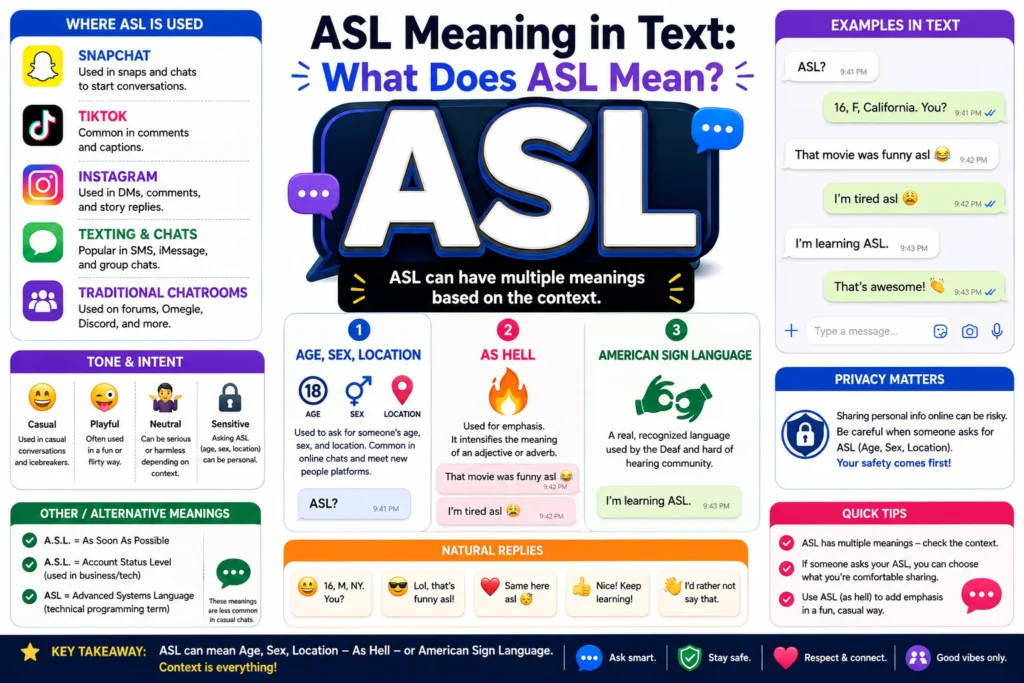
ASL in text usually means “age, sex, location,” a casual way to ask personal details. On social media, it can also mean “as hell” when it intensifies an adjective. Context, punctuation, and surrounding words most often determine the intended meaning.
asl meaning in text usually depends on the conversation around the acronym. Most often, ASL means “age, sex, location.” People used this short form in online chatrooms to ask someone for basic personal details. However, modern social media has added another common interpretation: “as hell.”
For example, someone might ask, “ASL?” during an introduction. They may want to know your age, gender or sex, and where you live. In another conversation, someone might write, “That movie was funny asl.” Here, the phrase means “funny as hell.”
Therefore, the same three letters can carry very different meanings. Context matters more than capitalization. The words surrounding ASL usually reveal the intended sense.
This guide explains the asl meaning in text across texting, Snapchat, TikTok, Instagram, and everyday online conversations. It also covers tone, examples, alternative meanings, misunderstandings, and natural ways to respond.
Quick Answer: What Does ASL Usually Mean?
| Meaning | Context | Primary Platforms | Example | Tone |
|---|---|---|---|---|
| Age, sex, location | Meeting someone online | Chatrooms, texting, social media | “ASL?” | Direct, casual |
| As hell | Intensifying an adjective | TikTok, Instagram, texting | “Tired asl” | Casual, emphatic |
| American Sign Language | Language or accessibility discussion | General web, education, social media | “I’m learning ASL.” | Neutral |
| Context dependent | Technical or organization specific use | Various | Depends on topic | Varies |
What Does asl meaning in text Mean?
The most traditional interpretation of asl meaning in text is “age, sex, location.” It became associated with online chat culture, where people wanted a quick way to learn basic information about another person.
The acronym saves time. Instead of typing three separate questions, someone could simply type “ASL?” and wait for a response.
For example:
“Hey, ASL?”
A typical answer might look like:
“22, female, Texas.”
However, modern internet slang has changed the way people use ASL. On platforms such as TikTok and Instagram, lowercase asl often means “as hell.”
Consider this example:
“That test was hard asl.”
The speaker is not asking for someone’s age or location. Instead, they are emphasizing how difficult the test was.
The same pattern appears with many adjectives:
| Phrase | Meaning |
|---|---|
| “Funny asl” | Very funny |
| “Cold asl” | Extremely cold |
| “Tired asl” | Extremely tired |
| “Busy asl” | Extremely busy |
| “Cute asl” | Very cute |
| “Fast asl” | Extremely fast |
The second interpretation has become especially visible in casual social media language. Therefore, readers should not automatically assume that every use refers to “age, sex, location.”
Where Did the Acronym Come From?
ASL became popular in early internet chat environments. Online users often communicated with abbreviations because typing was slower and conversations moved quickly.
“Age, sex, location” worked well as a compact introduction question. It allowed strangers to exchange basic demographic information without typing a complete sentence.
The phrase later appeared in instant messaging, forums, and other online communities.
Its history also explains why older internet users may interpret “ASL?” differently from younger social media users. Language changes as platforms change.
Why Does Context Matter So Much?
Context is the strongest clue.
If someone writes:
“ASL?”
They probably mean “age, sex, location?”
If someone writes:
“I’m exhausted asl.”
They almost certainly mean “exhausted as hell.”
The grammatical position also helps. When ASL appears directly after an adjective, “as hell” usually makes more sense.
When ASL appears alone as a question, “age, sex, location” becomes more likely.
Contextual Dynamics and Nuances
Understanding asl meaning in text requires more than memorizing one definition. You also need to consider the relationship between the speakers, the platform, punctuation, and sentence structure.
ASL as an Introduction Question
The classic use appears when two strangers begin talking.
For example:
“Hey, you seem cool. ASL?”
The person may be asking for your age, sex, and location.
However, this question can feel outdated today. Many users prefer more specific and respectful questions.
Instead of asking:
“ASL?”
Someone might say:
“How old are you, and where are you from?”
That wording feels clearer and less abrupt.
ASL as an Intensifier
The newer interpretation works differently.
In phrases such as:
“That dog is cute asl.”
The speaker uses ASL as an intensifier. It adds emphasis to “cute.”
The meaning is roughly:
“That dog is extremely cute.”
This usage is highly informal. It belongs mainly to casual online communication.
Capitalization Changes the Visual Impression
Capitalization can provide a small clue.
ASL often resembles the older “age, sex, location” acronym or American Sign Language.
asl often appears as “as hell” in casual social media posts.
However, capitalization is not a reliable rule. People frequently type everything in lowercase, especially on mobile devices.
Therefore, never rely on capitalization alone.
The Relationship Between Speakers Matters
A message from a stranger deserves more caution than a message from a close friend.
If a stranger sends:
“ASL?”
You can decide whether you want to share personal information.
If a friend sends:
“That was embarrassing asl 😂”
The intended meaning is obvious from the sentence.
Consequently, social context can be just as important as grammar.
Real Life Conversation Examples Using asl meaning in text
These examples show how the same acronym can function differently.
Example 1: Traditional Chat Introduction
Person A: Hey, what’s up?
Person B: Not much. You?
Person A: Just chilling. ASL?
Person B: I’m 21, male, and from Florida.
Here, ASL means “age, sex, location.”
The question appears by itself. It functions as a request for personal information.
Example 2: TikTok Style
Person A: Did you see that new video?
Person B: Yeah 😭 That ending was wild asl.
Person A: Fr, I wasn’t expecting it.
Here, “wild asl” means extremely wild or very wild.
The phrase “as hell” fits naturally after the adjective.
Example 3: Texting With a Friend
Person A: How was the gym?
Person B: Packed asl today.
Person A: Glad I stayed home 😂
Here, the speaker means the gym was extremely crowded.
The acronym acts as an informal intensifier.
Example 4: Ambiguous Context
Person A: ASL?
Person B: What do you mean?
Person A: Age, sex, location.
Person B: Ohhh. I’m 24, female, California.
This example shows why short acronyms can create confusion. The recipient may not know which definition the sender intended.
Example 5: A More Modern Introduction
Person A: Hey! Where are you from?
Person B: Chicago. You?
Person A: Atlanta. How old are you?
Person B: 23.
This conversation avoids the traditional abbreviation completely.
It also sounds more natural in many modern social settings.
Platform Specific Breakdown
Different platforms encourage different slang habits. Therefore, asl meaning in text can shift depending on where you see it.
How It Is Used on Snapchat
Snapchat conversations often use highly compressed language. Users commonly rely on abbreviations, emojis, and short phrases.
If someone sends:
“ASL?”
They may be using the traditional meaning.
However, if a friend sends:
“That filter is ugly asl 😭”
The meaning is clearly “ugly as hell.”
Snapchat also encourages quick replies. As a result, users may leave out words that would normally make the meaning obvious.
Look at the difference:
| Snapchat Message | Likely Meaning |
|---|---|
| “ASL?” | Age, sex, location |
| “Cute asl” | Very cute |
| “You tired asl?” | Very tired |
| “Where you from?” | Direct location question |
The relationship between the users also matters. A stranger asking for age and location deserves more caution than a friend using ASL as an intensifier.
The Role of asl meaning in text on TikTok
TikTok has helped spread many forms of compressed internet language. Lowercase slang appears frequently in comments, captions, and direct messages.
A TikTok comment might say:
“This transition is clean asl.”
Here, ASL means “as hell.”
The phrase intensifies “clean.”
Another comment might read:
“Bro is fast asl 💀”
Again, the intended meaning is “extremely fast.”
The platform context makes this interpretation much more likely than “age, sex, location.”
However, TikTok does not eliminate the older meaning. Someone could still use “ASL?” while talking to a stranger.
Therefore, the surrounding sentence remains the best clue.
Instagram and Texting Dynamics
Instagram comments and direct messages use slang in much the same way as TikTok.
For example:
“Your outfit is fire asl.”
The speaker means the outfit is extremely good.
A direct message might instead say:
“ASL? We’ve never talked before.”
That version likely uses the traditional meaning.
Texting follows the same pattern. Friends often use lowercase abbreviations to make messages faster and more expressive.
For example:
“I’m hungry asl.”
This means:
“I’m extremely hungry.”
Meanwhile:
“ASL?”
usually signals a personal introduction question.
Alternative Meanings and NLP Variations
The phrase has more than one possible interpretation. NLP systems, search engines, and human readers must use context to distinguish them.
American Sign Language
ASL also commonly stands for American Sign Language, a complete natural language used by many Deaf and hard of hearing people in the United States and parts of Canada.
For example:
“I’m taking an ASL class.”
Here, the meaning has nothing to do with internet slang.
This interpretation becomes especially likely when the surrounding words mention:
• Deaf culture
• Signing
• Interpreters
• Accessibility
• Fingerspelling
• ASL classes
• Deaf education
The sentence structure usually makes the distinction clear.
“As Hell”
The slang interpretation appears after an adjective or descriptive phrase.
Examples include:
| Expression | Plain English |
|---|---|
| “Hot asl” | Extremely hot |
| “Loud asl” | Extremely loud |
| “Funny asl” | Very funny |
| “Awkward asl” | Extremely awkward |
| “Hungry asl” | Very hungry |
This construction is informal and can include profanity by implication. Therefore, it may not suit professional communication.
Age, Sex, Location
The traditional chatroom interpretation remains recognizable.
The letters represent:
A = Age
S = Sex
L = Location
Modern users may choose different wording because “sex” can feel too personal or ambiguous in casual introductions.
A clearer alternative might be:
“How old are you, and where are you from?”
That approach gives the recipient more control over what they share.
Contextual NLP Signals
A language model can distinguish the meanings by examining nearby words.
For example:
“ASL class starts Monday.”
The model should recognize American Sign Language.
Meanwhile:
“That game was boring asl.”
The grammatical pattern strongly indicates “as hell.”
Finally:
“ASL?”
The standalone question strongly suggests the traditional chat abbreviation.
This is a useful example of contextual disambiguation, where meaning comes from the words surrounding an ambiguous term.
Misinterpretations: When NOT to Use asl meaning in text
Knowing asl meaning in text is useful, but using the abbreviation incorrectly can create awkward conversations.
Avoid It in Professional Messages
Do not use slang like “funny asl” in a formal email, job application, academic paper, or professional report.
Instead, write:
“Extremely funny.”
Or:
“Very humorous.”
Professional communication benefits from clarity.
Avoid Asking Strangers for Sensitive Details
The traditional “age, sex, location” question asks for personal information.
Some people may not want to share their age, gender, or location with someone they have just met online.
A safer approach is to let people volunteer information.
For example:
“Where are you from?”
is more specific than:
“ASL?”
You can also avoid asking for a precise location. A state, region, or general area may provide enough context.
Avoid Assuming Every “ASL” Means the Same Thing
This is the biggest mistake.
If you see:
“That was amazing asl.”
Do not interpret it as “age, sex, location.”
The adjective “amazing” provides a strong grammatical clue.
Similarly, if someone says:
“I’m learning ASL.”
The topic probably concerns American Sign Language.
Therefore, meaning depends on syntax, context, and conversation history.
Avoid Using It When Clarity Matters
Acronyms are efficient, but they can create ambiguity.
If your message could be misunderstood, spell it out.
For example:
“How old are you, and where are you from?”
is clearer than:
“ASL?”
This matters especially when talking with someone unfamiliar with internet slang.
How to Respond in Chat Comfortably
Your response should depend on the intended meaning.
When Someone Means Age, Sex, Location
You do not have to answer every part.
You could say:
“I’m 22 and from Texas.”
Or:
“I’m 22. I’d rather not share my exact location.”
That response protects your privacy while keeping the conversation friendly.
You can also ask why they want to know:
“Can I ask why?”
There is nothing rude about setting boundaries online.
When ASL Means “As Hell”
Usually, no special response is necessary.
If someone writes:
“That was funny asl.”
You could answer:
“Right? 😂”
Or:
“Seriously!”
You can simply continue the conversation naturally.
When You Are Unsure
Clarification is the easiest solution.
Try:
“Do you mean age, sex, location?”
Or:
“Do you mean ‘as hell’?”
This takes only a few seconds and prevents misunderstandings.
When Someone Means American Sign Language
Respond according to the topic.
For example:
“Are you learning ASL?”
could receive:
“Yeah, I just started taking classes.”
The surrounding topic should make the meaning clear.
FAQs
What is the asl meaning in text?
The traditional meaning is “age, sex, location.” In modern social media slang, however, lowercase “asl” often means “as hell.” The sentence determines which interpretation fits.
Does asl mean “as hell”?
Yes. In casual online slang, “asl” can mean “as hell.” It usually follows an adjective, such as “tired asl,” “funny asl,” or “cold asl.”
What does ASL mean when someone asks “ASL?”
When someone sends only “ASL?” they may mean “age, sex, location?” This usage comes from older internet chat culture. However, you can ask for clarification if the context is unclear.
What does ASL mean on TikTok?
On TikTok, “asl” commonly works as an intensifier meaning “as hell.” For example, “that song is good asl” means the speaker thinks the song is extremely good.
Is ASL a rude word?
Not inherently. The meaning determines the tone. “ASL?” is casual, while “funny asl” is slang that includes an implied profanity. Neither is automatically offensive, but both are informal.
Is it safe to answer an ASL question from a stranger?
You should decide what information you feel comfortable sharing. You do not need to provide your exact location, age, or other personal details. A general answer or polite refusal is completely acceptable.
Why do people say “tired asl”?
People use the phrase to emphasize an adjective. “Tired asl” means extremely tired or very tired. It is common in casual texting and social media conversations.
Does ASL always mean American Sign Language?
No. ASL has several meanings. It can refer to American Sign Language, “age, sex, location,” or “as hell.” The surrounding words normally reveal the intended meaning.
Can I use ASL in a professional email?
It is better to avoid slang abbreviations in professional communication. Write the intended phrase clearly instead. Formal writing should prioritize precision over compressed internet language.
How can I tell which meaning someone intended?
Look at the grammar and context. A standalone “ASL?” often means “age, sex, location.” An adjective followed by “asl” usually means “as hell.” Discussions about signing usually indicate American Sign Language.
Conclusion
The story behind asl meaning in text shows how quickly digital language can evolve.
Originally, ASL became well known as “age, sex, location.” It offered online users a quick introduction question during the early days of internet chat.
Today, the same letters can mean “as hell.” Social platforms have helped this version spread through captions, comments, direct messages, and casual texting.
ASL also remains a common abbreviation for American Sign Language, which makes context essential.
The easiest way to understand the term is to examine how it appears in a sentence.
If someone writes:
“ASL?”
They may be asking for age, sex, and location.
If someone writes:
“That was wild asl.”
They probably mean “wild as hell.”
If someone writes:
“I’m studying ASL.”
They are almost certainly discussing American Sign Language.
Therefore, asl meaning in text cannot be determined from the three letters alone. Grammar, platform, conversation history, and tone all provide important clues.
When you are unsure, simply ask what the sender means. That small clarification can prevent an unnecessary misunderstanding.
Most importantly, remember that internet slang is flexible. Meanings change across generations, communities, and platforms. Understanding that flexibility helps you read online conversations more accurately and communicate with greater confidence.

Justin Powell is a writer at GramBrix.com who focuses on grammar, clarity and effective communication, helping readers strengthen their language skills.